Ultiworld globe logo

Follow The Rules: The Case For Refereed Ultimate

by in Opinion with 37 Comments

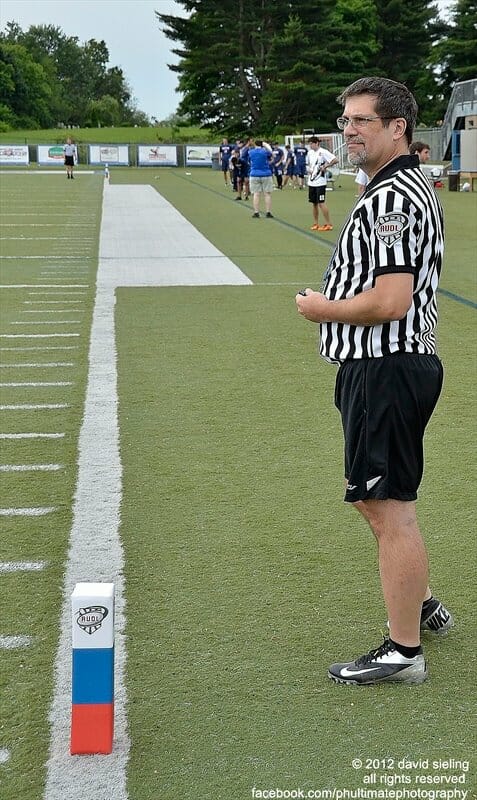
American Ultimate Disc League referee Mark Evangelisto working for the Rhode Island Rampage.In every sport, rules define how competition is to take place. They determine the playing field, number of players, methods of scoring, and acceptable contact. All sports rely on some form of officiation to ensure that the rules of gameplay are actually followed. Referees or, in the case of ultimate, players call fouls and infractions to punish and correct any rulebreaking.

Self-officiation, however, often fails to ensure that rules are actually followed. Less experienced players often do not call fouls in situations where they should. Additionally, when fouls are called and contested, violations go uncorrected.  Some believe that this is acceptable because self-officiation exists to foster debate and compromise, even at the cost of ensuring that the rules are always enforced.

However, it is fundamentally wrong to treat calling fouls as part of the sport and demand the cultivation of this sort of skill in a player when there is a readily available alternative in referees.

Self-officiation breaks down most often in ultimate when players cannot agree on a call. If this occurs, the foul is contested and there is a “do-over.” Though this compromise is the best answer self-officiation can provide to unresolvable disputes, it does not correct a violation of the rules. Imagine a situation where a receiver drops the disc and calls a foul on the defender. If the call was correct, the disc goes back to the thrower and puts the offense at a disadvantage. The defense has had time to regroup and the offense has lost their momentum. If the call was incorrect, the offense retains possession when it shouldn’t. Though someone is wrong, there is no way for players to determine who is right.

The problem is that players should be primarily concerned with playing, not with making the right call. Playing hard and getting tired clouds our judgement and perception. Because playing a sport is far more taxing than officiating, players are poorly equipped to make good calls. At many high-level North American tournaments, asking an observer to make a ruling provides a solution to this problem. The observer, better equipped than players to make the correct call, can make a ruling in a dispute between players. But observers are not a panacea.

Even observers don’t guarantee adherence to the rules, because they cannot intervene when players do not call fouls. A player might not call a foul for any number of reasons, including inexperience, fatigue, and incomplete knowledge of the rules. A much-discussed example of this is the “Stall Seven Incident” from the 2012 Mid-Atlantic Club Regionals Final between Washington, D.C.’s Truck Stop and Philadelphia’s Southpaw.

After a pick call, the thrower and his mark agreed that the stall would come in at seven, an explicit violation of the rules. This should always be corrected by a call. However, the young thrower failed to make that call, the rules were not followed, and the observers looked on powerlessly, unable to correct the violation. Whatever the reason for this error, it is simply a failure of ultimate’s officiation system.

Some proponents of self-officiation claim that the purpose of self-officiation is to preserve Spirit of the Game. Notably, Lou Burruss, the chair of USAU’s Spirit of the Game Committee, argues that removing self-officiation will erode Spirit of the Game and destroy what he calls “the culture of Ultimate.” He believes that ensuring that players respectfully discuss their differences or issues is of paramount importance. He emphasizes that self-officiation creates a culture in which respectful conversation with others is necessary. Without self-officiation, he writes, players would direct their complaints to the referee rather than the other team.

However, officiation does not exist to foster respectful conversation. It is merely to enforce the rules and ensure that players are unable to gain an advantage by breaking them. There is a reason that every other sport uses referees — they work. We should use them as well.

Fortunately, there are plenty of ways to preserve “the culture of ultimate” while delegating officiation to third party referees. Spirit Circles are an obvious way to do this. They were created with the explicit purpose of fostering Spirit and respectful conversation and, in my experience, do the job quite well. Expanding the practice of Spirit Circles in the United States (they are much more common overseas) is a simple way to promote Spirit and the unique culture of our sport.

Increasing awareness of ultimate’s storied history might be another way to promote spirited play. Because tradition helped shape Ultimate’s culture, increasing a sense of connection with that culture might help foster a sense of responsibility towards fellow athletes. USA Ultimate could create a youth league with the explicit intent of creating and reinforcing values in young Ultimate players, much in the way that programs like AYSO seek to build a spirit of sportsmanship in young soccer players.

There are plenty of ways to foster Spirit of the Game. However, it is imperative that we stop pursuing the ways that prevent officiation from serving its true purpose: to ensure that the rules are consistently followed.

Tagged , , , ,

About Alexander Palmer

Alexander Palmer is an Ultiworld opinion columnist. He is the captain of Columbia University's Open team, Uptown Local. He has played in the Club series with Flight NYC. He lives in New York City.

View all posts by Alexander Palmer →

Related Posts

  • Sam

    great article . there should be refs in all ultimate including the club scene

  • Liam Kelly

    you say “There is a reason that every other sport uses referees — they work. We should use them as well.”

    But we all know that this is incorrect…. referees make “mistakes” often.

    you also say “Whatever the reason for this error, it is simply a failure of ultimate’s officiation system.”

    Here is a video example of a failure of footballs officiaiton system – the biggest sport in the world, at the world cup, which is the biggest single sport sporting event in the world.

    http://www.youtube.com/watch?NR=1&v=WML0aP4jo_g

    some people seem so quick to abandon self-officiating when it hasn’t proved itself any less valuable than refereeing – in fact, it’s the single most unique selling point of our sport. Why are you so ready to abandon that?

    Of course we can’t expect new players to self-officiate. In the same way they can’t throw forehands – its a learning process to develop a new skill. But self-offication works at the highest levels of competition.

    Surly the money you would invest in a referee system (which will be unbelievably huge) – a fraction of that could educate players appropriately for their stake in the competition ladder.

    • Charlie

      The example you showed on youtube as a flaw in refereeing occurs every single game in self officiation though, and only once in a while with officials. Almost everything questionable in ultimate gets called back and is redone.

      It’s not that referees have a better perspective or knowledge of the rules than players. It’s the fact that they are an unbiased third party. Although I do think the question of whether or not referees are an affordable option is a good one. Maybe continue no referees at the lower levels and add refs at the higher levels? But then again this creates a new problem of essentially making ultimate two different games from one level to the next. There are lots of sides to this debate.

      • Boomer

        This fits right in the the case for observers. Many of those questionable calls are overruled and are not do-overs. Having obervers at the upper levels also makes for an easier transition in to “officiated” ultimate than refs would.

        WFDF is holding a strict self-officiated stance, the “pros” are using what is familiar from other sports and USAU, in my opinion has found the middle ground in their “hybrid” system of using observers.

        • ProUltimateTeamInsider

          The pro leagues are preserving parts of the self-officiation system by having “spirit rules” that allow them to override some calls as long as the override benefits their opponent.

          What i find interesting about this ongoing debate is that each side points to the infallibility of their particular system. Face it folks, there are humans involved here. Mistakes will be made. Players who are playing and in the best positions to make the calls, are also in the best position to make mistakes and cheat. Refs will miss calls and have different interpretations of incidental contact than the players. So be it. Each player has a different interpretation too. Basically, any criticism you can level at a ref, you can level at a player who is acting as a ref with the additional kicker that the player that the player has a vested interest in the outcome of the game.

          I, for one, think that ultimate should retain the SOTG system at most levels of play. At the highest levels of club play, if the observer system is working, so be it. In fact, preserving the SOTG system for lower levels of play will help foster the idea of playing with spirit, since most if not all players who end up playing in a pro league will have come up though a SOTG system.

          At the “pro” levels they’re trying to eliminate the partisan bickering (and other prolonged stoppages) that often occurs during heated play and keep the action going for the fans. This does NOT, in my opinion, lead to the erosion of spirit. If you cheat in club, you’ll try to cheat in the pros. If you are a paragon of spirited play, you’ll be enacting the spirit clause in the pros. Its all up to the individuals and their respective coaches and organizations.

          Anyone who thinks either system is a panacea for “fair play” is fooling themselves. Reffed ultimate with the override rule enabled is a hybrid just like the observer system, except the observers make all the calls, and the players can potentially override them. As with any of the systems being discussed, they’ll only be as “spirited” as the players and refs/observers playing within them. Simple as that.

          • Alexander Palmer

            I don’t think a perfect system of officiation is possible. As long as humans make calls, there will be human error. However, examples of human error cannot be trotted out to argue against referees or for self-officiation. Lampard’s disallowed goal was not an example of a system failing. Rather, it was an example of an organization not eliminating human error while the technology to do so exists. The incident resulted in demands from fans and players for use of Goal Line technology and instant replay, leading eventually to FIFA’s use of goal line technology in the 2012 Club World Cup. To be clear and explicit: I believe that the purpose of officiation is to enforce the rules. As such, I believe in referees, goal line technologies, instant replay, and anything else that removes human error from officiating sporting events. Of course, none of these things can be implemented until they are financially viable.

            Currently, it seems that the best practical system is a hybrid system with expanded observer powers, though I believe that the addition of referees would be a huge step towards an ideal system. I understand that the financial difficulties of incorporating referees are probably insurmountable at the moment. My argument for referees does not seek to offer proof that it is currently practicable. At the moment, the use of observers is preferable to pure self-officiation (as they solve the problem of the “do-over”). However, until it is recognized that the point of officiation is not to make us better people but to enforce the rules, there is not impetus for the USAU or WFDF to look into the practicability of a system with referees.

            I suspect that the financial difficulties might be less than we are being led to believe. Ultimate has an extremely proactive community of Club players, many of whom might be willing to volunteer as referees in order to lower the cost of high-school and college play. Of course, I do not know if this is the case. This will remain a conjecture until organizations with the infrastructure, income, and influence of USAU and WFDF begin thinking seriously about the purpose of officiation and economically about the practicality of referees.

  • MilesMB

    Disclaimer: I don’t have a lot experience playing ultimate with refs. My one experience was when Ironside scrimmaged the RI Rampage last summer. I do have a few years of experience playing club with observers.

    I found playing refereed ultimate to be a frustrating experience because of missed calls. Marking fouls in particular are difficult for observers to rule on and having referees solely responsible for calling them led to repeated illegal marking behaviors. (To be fair, I wasn’t all that clear on the AUDL rules. What I’m talking about is bumping on the mark and making contact with the disk while it is in the thrower’s hand.)

    When my team decided to embrace the silliness of double-teams and throwers being unable to call fouls, we built a comfortable lead. A few points later in the game we chose to stop double-teaming because it gave us what we felt was an unfair advantage.

    I prefer having observers available for games in club. I am willing to try referees out again in the MLU, but I do not expect they will improve my playing experience.

    The other factor to consider is cost. Many club teams have been complaining about the increased cost of additional travel for the Triple Crown. Switching to referees, especially if you want referees to replace self-officiating at every game above a certain level (I’m not sure if this is what you are suggesting), will add a significant cost to club ultimate. I am willing to spend money on flights to play the best competition, but spending money on referees does not appeal to me.

    • Richard

      I second this. I’m all for refereeing at higher levels, but adding the cost of 3 paid officials per game will unnecessarily drive up the cost (and logistical burden) of leagues and more casual tournaments if you want to see this at all levels. I have seen very few significant rules arguments or misapplications at these levels, and would hate to see leagues double in cost for little real benefit.

      • brent

        so then refs would not be a part of those games/leagues/tourneys. people have often made a connection to tennis on this one. most leagues at the low amateur level are all self-officiated. as you move up the ranks, you begin to see officials used.

  • Tom

    One of the premises of this article is that referees will always make the correct call. In some areas referees would bring consistency as they are able to make calls with better perspective and (non-biased) judgement than players but in others the players have far more information than someone with an outside perspective. Notwithstanding other pros and cons of referees vs self-refereeing (that could fill pages!), any change to the system should be aiming to increase the number/quality of correct calls/decisions.

    You make a number of arguments as to why referees will improve the quality of decision making, which essentially boil down to the following: rules are actually followed. As described referees will enforce the rules (assuming they know them!) but are often in a position where they are making a call with less information than the players involved. Take the example of a foul on the throw/hand block. This is difficult for an outsider to know whether the disc was released before the contact (hand block) or after the contact (foul), but the players will usually have a better idea (but as pointed out with potentially clouded judgement). In this case a referee will provide a decision but not necessarily the correct decision. If his/her decision is incorrect then the rules have equally failed to be followed. Many of the contentious decision making areas in Ultimate revolve around decisions in which the players could have more information on which to base their judgement. As an example of this going wrong in other sports, football (soccer) referees often make decisions which impact on the result of a game and their decisions are often the most talked about parts of a match. Essentially the trade-off is that referees make arbitrary but unbiased decisions whilst a self referee makes a decision with more information but with clouded judgement due to bias.

    There are many other arguments surrounding the pros and cons of referees but I would find it a backward step to move to a system in which potentially there was a greater amount of incorrect calls.

  • Boomer

    “…even at the cost of ensuring that the rules are always enforced.” – Refs see everything?

    “A player might not call a foul for any number of reasons, including inexperience [...] and incomplete knowledge of the rules” – This is not a product of not having officials, it is a problem with the general culture of ultimate players not researching the rules. In any other sport (or game) from Football to Poker, players actively try to learn the rules. It seems this is not the case in ultimate. Rules are learned by hearsay. That is one of the main problems that needs to be fixed, and it needs to be fixed at the team level. It may not be “cool” to sit and study the rules but it is important in any sport to know them, refereed or not.

    “The problem is that players should be primarily concerned with playing, not with making the right call.” – I hear this argument a lot and I have a huge problem with it. It seems like a very slippery slope to “I shouldn’t be concentrating on following the rules.”

    I (as on observer) believe that the current system works, there just need to be tweaks. Observers should have more authority, decisions should be sped up a bit and TMF/PMFs should be more than just a slap on the wrist.

    One of my main problems with the referee system is that they take the spotlight far too often. Whether it is calling a game too close or missing a bunch of calls, a lot of people are upset. Those that are pro-referee always say “it works in other sports,” but does it really? Is it the best system, or just the one we know? Their system is just as broken, if not moreso, than ours and it seems that some people find it cozy and safe and warm just because it is familiar and mainstream.

    Both referees and observers are fallible, there is no denying that. But with the observer system, the players, not the officials, get to set the tone for the game, whether it be gritty with a lot of contact, or no-nonsense and no contact.

    • ProUltimateTeamInsider

      The players get to set the tone? What if one team wants to play gritty with a lot of contact, but the other team wants to play no-nonsense? What you get is complete chaos, lots of arguments, and a completely unwatchable game, observers or no. These types of games are not rare by any means and you end up with a lot of bad blood between teams simply over rules interpretations.

      Maybe its just a matter of preference. Maybe some players need to have the power to correct injustices on their own in order to feel like they cant be cheated. Maybe some players need to have the power to cheat in order to feel like they’re infallible (i.e. “that guy” that always calls a foul when he doesnt catch the disc in a crowd). Perhaps some want to believe that ultimate and SOTG is the utopia of sports. Maybe some just want to play. There will always be mistakes in judgement, there will always be outright cheating, and there will always be amazingly spirited play. At the highest levels of play, i’d rather see the players play than debate and recreate. And the endless do-overs are just ridiculous. Have a ref make a call, accept it because its a 3rd party presumably and with reasonable assurance without prejudice, move on.

    • Alexander Palmer

      “The problem is that players should be primarily concerned with playing, not with making the right call.” – I hear this argument a lot and I have a huge problem with it. It seems like a very slippery slope to “I shouldn’t be concentrating on following the rules.”

      It just seems to me that my making the right or wrong call has nothing to do with whether or not I follow the rules. I’m not sure if that’s really a reply to your argument though. I don’t think I have a handle on what you’re trying to say. Do you think you could flesh it out a bit? This sounds a bit like the “referees will destroy Spirit” argument, but I’m not sure that you intend it to look that way.

  • Jeff

    One big argument here against refs is they can’t determine foul calls as accurately as players themselves since they aren’t directly involved, especially where physical contact is concerned. Which is true and a legitimate point. But can anyone articulate why other pro leagues don’t use this model if it’s seemingly so superior? Why can’t Kobe call his own fouls? Or lineman in the NFL call their own holding calls? Or catchers call strikes?

    • ND

      An umpire in baseball or cricket is more akin to an observer, making calls on the outcome of a play. These are simple sports.
      Basketball and football and hockey are complicated, with many moving parts and contact happening all the time. Multiple players might have a claim to a foul in a scrimmage. How would self officiation resolve that? Maybe it’s the result of 100 years or so of testing the limits of referees’ observations, but these sports couldn’t revert or become self officiated.
      Ultimate is a simple game. You catch, you throw, there was contact, it affected the play, or it didn’t.
      “But people don’t understand a game without referees”. No, people don’t understand ultimate. Good commentators will do more to popularise ultimate than referees will, which NexGen is progressing with. More visibility of ultimate will help, which is USAU’s primary goal.

      • Jeff

        I’ll give you baseball (don’t know much about cricket), but basketball and soccer to me are the closest in action to ultimate and I still don’t see why players couldn’t call their own fouls. The argument “Multiple players might have a claim to a foul” doesn’t hold much water since it’s clearly possible for the same to happen in ultimate. I do think you’re on to something with “Maybe it’s the result of 100 years or so of testing the limits of referees’ observations”. Is Ultimate going to wait 100 years to figure out what everyone else already has?

        • ND

          In basketball there is a lot more contact. In soccer possession is always contestable. In both the defence will do whatever they can get away with to get possession.
          I would suggest that the founders of ultimate already had more than 50 years of sport history to influence their decision to make a beautiful game with simple rules and self officiation. We’ll spend the next forever second guessing them whichever way this debate turns out.

          • ProUltimateTeamInsider

            Please stop deifying the founders of ultimate, particularly if you have no idea what their “bible” states.

            Someone above posted a link to the first edition rules. Go read them here: http://www.alanhoyle.com/ult-rules/1st%20Edition.pdf

            The founders put the “referee” system above the so-called “honor” system and also suggested solving disputes by “flipping a coin”. Referees are referred to in multiple spots in these rules. They also suggest that asphalt is an acceptable surface to play on and state that the field should have no lateral boundaries. Thoughts on those suggestions?

            Stop saying the founders intended the game to be played without refs. Its not true.

          • ND

            Referees ‘may’ be used, or the honor system. I don’t see any preference, and they are quite vague on a few things. I can’t find a copy of the first edition UPA rules online, but I’d suggest that by that time, you know, boundaries and what have you, they decided referees were unnecessary.

      • Charlie

        Agreed with Jeff. There have been lots of times when someone called a foul on me, and I turn around and can honestly say, “no, it was you that fouled me. I established position and you ran into me.” Then we go into a debate about who fouled who.

      • http://www.facebook.com/MountainRob Rob Barchard

        Also worth considering is that its how things have been done. We aren’t trying to change other sports towards self officiating, more so preserve it in ours. Baseball is interesting though, I imagine catchers could perform call strikes but I don’t know that they would be better suited than the umpire with any additional information. I think self-officiating is a really good fit with ultimate, but haven’t considered whether it would be a good fit with other sports. The rules and officiating of a sport largely impact the type of play and attitude of people on the field. They are part of the culture of the sport. Ref’s might work fine in “new ultimate” but I just don’t think it would be the same sport we, or I love.

        • Jeff

          I’m not arguing we should be trying to convert other sports, I’m trying to ascertain from someone in the anti-ref camp why so many other sports don’t use the self-officiating model that ultimate uses if it’s so superior. You say it fits ultimate well, but why not soccer, or basketball, or any other sport. Did those sports start as unofficiated and evolve to what they are today? Did ultimate ditch referees because it was largely started by a bunch of counter culture hippies that didn’t want to be like other sports? How is being different better? And if the only argument is “This is how it’s always done. And culture”, that’s not a solid argument.

      • brent

        are you saying ultimate is more akin to baseball than basketball/football/hockey?!?!
        welp, there goes your argument.

  • Guest

    A well written and laid out article. I think you have clearly communicated
    and explored faults with self-officiating and to some extent observing. But
    there is a major hole here.

    You assume, and lead the reader to assume, that referees will instantly resolve
    non-compliance with the rules. I don’t believe this to be true at all. In fact,
    I believe that more rules violations will occur and go uncalled under a
    refereed structure. How many times have you or someone you know commented on
    the refereeing of a NHL, NFL, or NBA
    game? Unfortunately the quality of refereeing is just as relevant as the
    quality of players self-officiating. Worse yet, is that at the end of a game,
    players can always be content with the outcome of the game because they have
    the structure to control the officiating currently, while winning or losing a
    game over questionable refereeing is a much more souring experience.

    Referees cannot, no matter their training, make calls as accurately as players
    in every circumstance. Admittedly, there are other times such as line calls
    that the use of another perspective is very valuable – observers handle this
    well. Knowing when a foul happened is about paying attention to how and where
    you were contacted, and the order of events in questions. All the fine details
    come into it and there are many times an outside perspective just doesn’t have
    the ability to know what happened as well as the players themselves, and in the
    event of disagreement – compromise- what a novel and excellent approach.

    More to the point, I agree whole-heatedly with Lou Burris. Adding referees will
    certainty erode the Spirit of the Game and community of Ultimate. It also adds
    to the infrastructure requirements of any event making the sport slightly less
    accessible. In, I believe the early 2000’s, the UPA (now USAU) received a
    letter from the head referee of FIFA regarding self officiating and refereeing.
    The sum of it was a suggestion to preserve self-officiating and avoid ever
    entering into refereeing. The main reason was very strait forward: in a
    refereed game, it the responsibility of the referee, not the players, to
    observe the rules of play. This is to say while playing in high level
    competition with a referee, players should begin to exist win-at-all-costs
    attitudes, so long as they can avoid penalties of getting caught.

    Many years ago I played university nationals for ultimate the weekend after
    play club nationals at a jr. level for waterpolo. Waterpolo is a very different
    sport, but it is entirely driven by the referee. The rules are such that it is
    in many circumstances it is advantageous to intentionally foul other players,
    even when the referee calls it. Most of the time it goes unnoticed and the
    advantage is amplified. As a result the sport is violent, and in my experience,
    the players did not have nearly the respect for each other as in Ultimate.
    Translating this to Ultimate, a situation could arise where a marker simply
    pushes the thrower over before they get a chance to make a huck- in a refereed
    situation having a foul called on you could easily be advantageous to the
    potential point your opponent is about to make. In a refereed game you could,
    or possibly should, push the mark when the balance is in your favor. In our
    game, that doesn’t happen.

    In soccer people dive, in waterpolo players strike ribs and faces when no one
    is watching, and in every other refereed sport players draw fouls to gain
    advantage by manipulating what and how the referees sees an event. This type of
    behavior is not respectable and has no place in Ultimate. Referring only opens
    the door for this. It doesn’t take long for this to happen either. Watching the
    first Alley Cats game of the AUDL I saw a player pivot in a way that involved
    contact – possibly drawing a foul– and began to walk the yards before the
    referee even called it.

    Observers are an excellent balanced solution, and with fine-tuning could
    even better meet the needs of pro-referee advocates. If timeliness is the
    issue- give players 10 seconds to resolves calls, at which point observers
    could step in like ref’s to make the call. And what about the times you get hit
    a little bit and just don’t want to call it? I’ve got a player striking long
    and its more preferable to complete the throw than to call non-incidental but
    accidental contact? Players should focus on playing the game well and by the
    rules, not appearing to do so for the referee. It should remain the player’s
    responsibility to play by the rules, and when players disagree on what happened
    it takes only a second to involve the observer to make the call.

    • Boomer

      Before anyone points out that the decision of a player to not call a foul is not “consistent adherance to the rules,” I would like to point out the similarity of that situation to a soccer ref “playing the advantage” and not calling a foul that would disadvantage the fouled team.

      • Ryan Nation

        I don’t think you can just dismiss this. A lot of arguments here against referees revolve around players calling the game better since they are the ones playing it. What if they don’t make the calls? Why is a player not making a call inherently better than a ref missing a call?

        Also, didn’t Lou have an entire series of articles regarding manipulating the rules as a player while still not running afoul of the letter of the law?

        • http://www.facebook.com/MountainRob Rob Barchard

          I think the whole point of defining fouls is to say you shouldn’t get an advantage because you contacted someone- that person can call you on that. If you say that the person HAS to call you on it ( or a ref does), now you might be advantaged by contacting them, kind of defeating the point.
          Unrelated, does anyone know how or why my previous comment is showing up as Liam writing it instead of me?

  • http://www.facebook.com/MountainRob Rob Barchard

    This is a well written and laid out article. I think you have clearly communicated

    and explored faults with self-officiating and to some extent observing. But
    there is a major hole here.

    You assume, and lead the reader to assume, that referees will instantly resolve
    non-compliance with the rules. I don’t believe this to be true at all. In fact,
    I believe that more rules violations will occur and go uncalled under a refereed structure. How many times have you or someone you know commented on the refereeing of a NHL, NFL, or NBA game? Unfortunately the quality of refereeing is just as relevant as the quality of players self-officiating. Worse yet, is that at the end of a game, players can always be content with the outcome of the game because they have the structure to control the officiating currently, while winning or losing a
    game over questionable refereeing is a much more souring experience.

    Referees cannot, no matter their training, make calls as accurately as players
    in every circumstance. Admittedly, there are other times such as line calls
    that the use of another perspective is very valuable – observers handle this
    well. Knowing when a foul happened is about paying attention to how and where
    you were contacted, and the order of events in questions. All the fine details
    come into it and there are many times an outside perspective just doesn’t have
    the ability to know what happened as well as the players themselves, and in the
    event of disagreement – compromise- what a novel and excellent approach.

    More to the point, I agree whole-heatedly with Lou Burris. Adding referees will
    certainty erode the Spirit of the Game and community of Ultimate. It also adds
    to the infrastructure requirements of any event making the sport slightly less
    accessible. In, I believe the early 2000’s, the UPA (now USAU) received a
    letter from the head referee of FIFA regarding self officiating and refereeing.
    The sum of it was a suggestion to preserve self-officiating and avoid ever
    entering into refereeing. The main reason was very strait forward: in a
    refereed game, it the responsibility of the referee, not the players, to
    observe the rules of play. This is to say while playing in high level
    competition with a referee, players should begin to exist win-at-all-costs
    attitudes, so long as they can avoid penalties of getting caught.

    Many years ago I played university nationals for ultimate the weekend after
    play club nationals at a jr. level for waterpolo. Waterpolo is a very different
    sport, but it is entirely driven by the referee. The rules are such that it is
    in many circumstances it is advantageous to intentionally foul other players,
    even when the referee calls it. Most of the time it goes unnoticed and the
    advantage is amplified. As a result the sport is violent, and in my experience,
    the players did not have nearly the respect for each other as in Ultimate.
    Translating this to Ultimate, a situation could arise where a marker simply
    pushes the thrower over before they get a chance to make a huck- in a refereed
    situation having a foul called on you could easily be advantageous to the
    potential point your opponent is about to make. In a refereed game you could,
    or possibly should, push the mark when the balance is in your favor. In our
    game, that doesn’t happen.

    In soccer people dive, in waterpolo players strike ribs and faces when no one
    is watching, and in every other refereed sport players draw fouls to gain
    advantage by manipulating what and how the referees sees an event. This type of
    behavior is not respectable and has no place in Ultimate. Referring only opens
    the door for this. It doesn’t take long for this to happen either. Watching the
    first Alley Cats game of the AUDL I saw a player pivot in a way that involved
    contact – possibly drawing a foul– and began to walk the yards before the
    referee even called it.

    Observers are an excellent balanced solution, and with fine-tuning could
    even better meet the needs of pro-referee advocates. If timeliness is the
    issue- give players 10 seconds to resolves calls, at which point observers
    could step in like ref’s to make the call. And what about the times you get hit
    a little bit and just don’t want to call it? I’ve got a player striking long
    and its more preferable to complete the throw than to call non-incidental but
    accidental contact? Players should focus on playing the game well and by the
    rules, not appearing to do so for the referee. It should remain the player’s
    responsibility to play by the rules, and when players disagree on what happened
    it takes only a second to involve the observer to make the call.

  • Joel

    Sorry, what are spirit circles?

    • Scott

      Common after WFDF games, where both teams form one big circle and discuss SOTG as it applied during the game. http://wfdf.org/sotg/about-sotg for more.

    • brent

      wobster’s dictionary defines spirit circles as: (n.) a terrible waste of time.

  • Boomer

    This debate is so old that if it were a person, it would be masters-eligible:

    http://www.usaultimate.org/multimedia/usa_ultimate_magazine/upa_newsletter_1980_apr.aspx

  • Jim Brose, Philly Ultimate

    I think this article is a bit naive. Neither of the two best arguments for having refs in ultimate are mentioned. First, having refs in ultimate speeds the flow of the game and makes it more spectator (and maybe player?) friendly. Having watched a couple AUDL games last year, there is no doubt the pace of the game was better.

    Second, having a 3rd party officiate a game removes the bias inherent in teams making calls against each other. I have played all over the world, and I have been screwed out of big games by teams and players intentionally taking advantage of their ability to make calls. I have been in huddles where my team thought it best to respond in kind. When you have invested so much time and effort into something like winning nationals or worlds and you feel like your opponent is cheating you out of it, it is natural to want to cheat back, or to call for a third party system. There is no doubt that refs make as many bad calls as players, but at least when they make mistakes it is not motivated by wanting to win. Having refs solves this problem.

    On the other hand, the best argument against using refs, is that the
    people who created this great sport made self-officiating a fundamental
    tenet of the game. By upholding this tradition, we respect the founders
    and the game itself. This fact is too often overlooked (as evidenced by its lack of inclusion in the article). Self-officiating is not just a way to uphold the spirit of the game, it IS the game. By all accounts, it was essential to the people who created the sport to have a game where people were “cool” with each other, and this included resolving disputes about calls amicably. This was the game within the game and it is what set ultimate apart from other sports (no “win at all cost” attitude). It is also a major factor in the sport’s amazing growth.

    In the times when I did not speak out in the huddle against reacting to cheating with cheating, I was small. This is what ultimate and self-officiating teaches. It calls on each of us to raise our character – to behave with integrity at the highest level of the game when faced with the greatest pressures. There is no other team sport like it, and I have found little else in life like it.

    Have refs in pro games so they are marketable to tv companies. Have observers at high-level club tournaments so teams don’t get totally screwed by cheaters. But let’s leave the rest of the games, the huge majority of the sport, as it was intended to be played, and let’s continue to demand more of ourselves through playing it.

    • Bob

      “On the other hand, the best argument against using refs, is that the people who created this great sport made self-officiating a fundamental
      tenet of the game. By upholding this tradition, we respect the founders
      and the game itself. ”

      If that is the best argument, then it is a poor argument indeed.

      Check the first edition rules: http://www.alanhoyle.com/ult-rules/1st%20Edition.pdf

      “A referee or referees may officiate, and if so their
      decision must be final. If no referee is available, teams play on an honor system.”

      Self-officiating a fundamental tenet? Sure, but only because no one wanted to referee while their friends had fun playing. It doesn’t even say “Hey use the honor system, that’s a cool unique idea for this sport!” It says “if you CAN’T get refs, then hey, play anyway like pick-up anysport.”

    • Alexander Palmer

      I didn’t make the flow argument because speeding the flow of the game is not the primary goal of officiation; it is, at best, a secondary goal.

      Furthermore, mentioning that referees make Ultimate more watchable would require that I address the question of whether or not Ultimate is a marketable spectator sport in its current form. At this point in time, I am not willing to defend the idea that we should change it to make it a more spectator-friendly sport. I think this should be treated as a more controversial issue than it is, as it implies much greater changes to the sport itself than a move to referees. For example, the time leading up to the pull is incredibly boring to watch, especially after points that are shorter than 70 seconds (USAU rules) or 20 seconds (AUDL rules). After a bunch of quick points, these 20 seconds seem to simply break up the flow of the game. However, I don’t think we should be jumping to make Ultimate more of a spectator sport by removing these.

      Finally, I don’t think this argument applies to USAU games because receive their income not from spectators, but from players.

      I didn’t mention the inherent bias argument because it is so commonly used. At this point, I suspect there is nothing to add.

  • Cameron Brock

    I’ve played in both club and the AUDL, and I have to say, I will take a referee who has no vested interest in the outcome over a player from another team any day. I don’t care if the call is wrong or right, as long as it’s from a neutral party. Referees are ONLY there to make calls. They aren’t jumping, diving AND trying to make calls. And they aren’t trying to help “their team” win. People are going to get it wrong no matter what the system is, so saying that’s a reason against reffing is really dumb. Trust me, if you got to play with refs and had to go back to self-officiating, your level of frustration with crap calls from people on the other team will only get higher. Anyone that played in the AUDL can probably attest to that. I don’t think they all necessarily like the way the AUDL did things 100% (definitely room for improvement), but I am willing to bet they will all agree that terrible calls in club ultimate are even more frustrating and annoying.

  • Pingback: Don't Speak Too Soon: The Unexpected Consequences Of Rules Changes | Ultiworld

Find us on Twitter
Find us on Facebook