The Open division saw some surprises but a juggernaut program taking home gold again
August 27, 2025 by Benjamin Rees in Recap
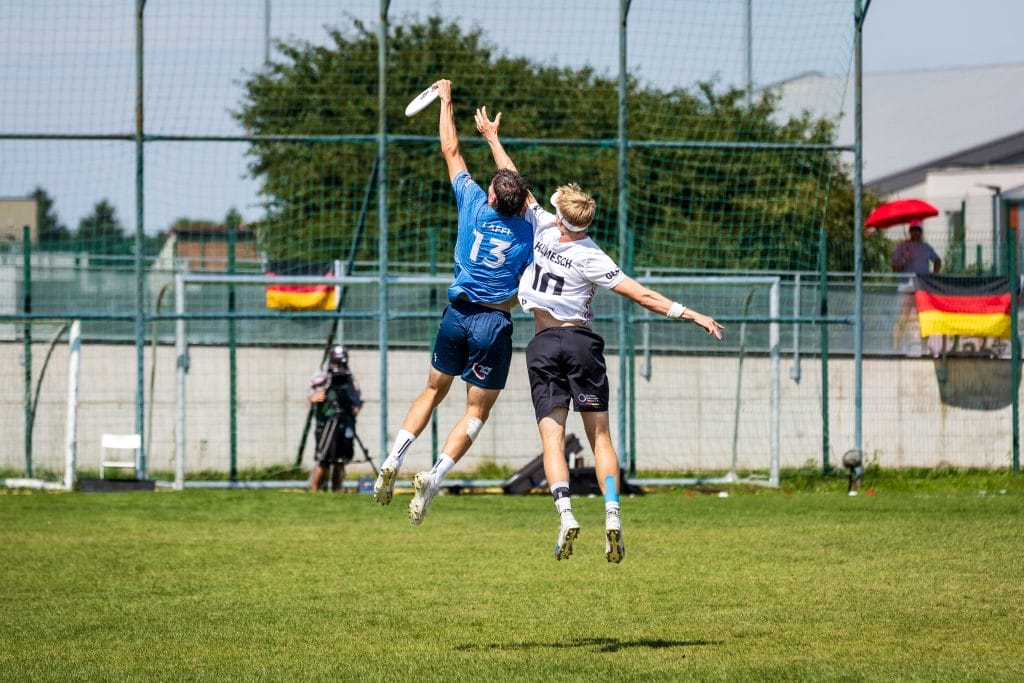
The latest edition of the European Youth Ultimate Championships took place in Trnava, Slovakia, earlier this month with 31 teams across the U20 Women’s, Mixed, and Open divisions duking it out to claim the continental crown. Which nations demonstrated the depth of their development, and which players established themselves as ones to watch for the future (and present)?
The Open division hosted fourteen teams in two pools of seven, with the first place finisher in each pool receiving a bye into the semi-finals, with the second and third place teams facing off in the quarter-finals. Teams finishing fourth or lower in each pool had to make do with consolation play, leaving little margin for error for any nation with medal hopes.
Pool A featured Austria, Belgium, Finland, Great Britain, Italy, Lithuania, and Sweden. The top three established themselves early on as Belgium, Great Britain, and Italy, with the order of their finish the only real question. It would take until Wednesday for them to match up, with Belgium snatching a universe point upset of the Italians, who responded strongly that afternoon by taking GB to task with a 15-9 scoreline. Belgium and the Brits matched up in the last game of the pool, where a Belgian win would give them the bye, while a British victory would allow Italy some extra rest at the top of the pool on a three-way tie. While the game went right down to the wire, Belgium claimed their second sudden death win of the week, 15-14, to give themselves the free pass to the semi-finals, with Italy ending up second and GB in third.
Pool B was much less clear-cut. While France proved the class of the field, going a perfect 6-for-6 (including two 15-0 victories), and Romania, Israel, and Ukraine rounded out the bottom of the pool,the other progression places were much more hotly contested. Switzerland’s 14-13 win over Czechia got them off to a hot start, with the Czechs going to universe point again in their next game, this time ending up on the right side of the scoreline with a 13-12 victory over Germany. Going into the last round of pool games, Switzerland and Czechia were due to advance, but with the final matches pitting France against Czechia and Germany against Switzerland, the Germans were given the opportunity to play spoiler. If France won, a Swiss win would see them second and Czechia third, a Germany win by two or more would see Germany second and Czechia third, while a universe point win for the Germans would create a three-way tie between the three nations, with any finish order possible depending on the France vs. Czechia scoreline – a Czech upset win coupled with a German victory would even see Czechia top the pool on a head-to-head against France. Wins for both Switzerland and Czechia would see Germany out and a three-way tie for first.1. Given the stakes, it felt like a de-facto bracket game for Germany, and they duly delivered with a 14-12 victory which, coupled with a 15-12 France win, saw France finish first, Germany second, and Czechia in third, with Switzerland left on the outside looking in.
The quarter-finals pitted Germany against Great Britain, with Italy matching up against the Czechs. Germany continued their momentum from the end of the pool phase en route to a commanding 15-10 victory, while Czechia pushed the Italians at points but fell away in the second half, with Italy winning 15-11.
The semi-finals saw Belgium take on Germany and Italy face off against France. The former saw the classic rest vs. rust debate manifest, with the Belgians, coming off the bye, against a red hot Germany side playing essentially its third elimination game in a row. Belgium by this point were carrying some niggling injuries and feeling the effects of a potential lack of depth, while Germany had continued to improve as the week progressed, and with the offense firing on all cylinders pulled off another upset, winning 15-12 to seal a berth in the final. On the other side of the bracket, Italy and France, the two pre-tournament favorites, faced off in a game many expected to be the final. The game delivered on that promise, an engrossing back-and-forth affair with neither side able to truly pull away, but Italy had their noses in front for the majority of the contest and held firm for a 14-12 win to make the gold medal match.
France and Belgium played out the bronze medal match hoping to salvage something after semi-final heartbreak, having both been undefeated in pool play. France raced into an early lead that they would never relinquish, and finished strong scoring five of the last six goals to claim the bronze 15-10.
While Belgium ran out of steam by the end, at their best they showed they could challenge the division’s best. Pierjan Deforce powered his team forward with expansive and creative throwing options, airing it out to speedsters like Stern Ongenaet and Han Pisano. Wolf Pannemans picked up a knock mid-tournament, and his hybrid ability was sorely missed, while Staf Decraene wowed with his athleticism, ruling the skies but happy to bomb it after the turn as well2. Sometimes the success of your predecessors can create huge pressure, and Belgium’s golden generation have almighty shoes to fill, but the fearless ultimate this group played showed they were not overawed by the occasion.
Bronze is certainly not the medal France were hoping for, but the roster is clearly packed with talent. Arthur Negre and Raphaël Chareix were titanic in the backfield, Olivier Gibert and Erwan Pare led from the front in all areas of the pitch, and Marin Perez, Ancelin Letailleur, and Tristan Wu were a trio of electric finishers. They might feel slightly hard done by, given that at times they seemed like the second-best team in attendance, but Belgium’s pool play upset of Italy worked against the French here. It’s still another stacked team from France, which in the long run matters more than the color of the medal.
Italy and Germany met in a slightly surprising final, but the Germans had earned their place by virtue of their electric performances when it mattered most, in the bracket. Unfortunately their Cinderella run finally ran aground against an almighty Italian outfit, who forced consistent pressure defensively and were unbroken themselves in the final, with the Azzurri showing their dominance in a 15-11 victory to claim the top prize.
Germany’s success was built on a rock solid offensive seven that gained confidence and rhythm as the week progressed to turn into a fearsome unit. Their visored triumvirate of Michael Schütz3, Moritz Klimesch, and Fabian Maierhofer had an almost telepathic understanding at times, but the whole unit looked so smooth and flowing at its best, leaning on dominator sets to methodically work their way downfield. Although there wasn’t much chance to see it in the final, Konrad Gramsch was devastating off the turn, with his enormous arm talent on clear display for a good, old-fashioned, big play D-line offense. The Germans deserve a huge amount of credit for getting better each game, and game planning effectively towards the tournament’s end, and a silver medal is a welcome return to form. To borrow a footballing4 phrase, you can never write off the Germans.
Italy seemed like the best team all week, and did well to put the setback against Belgium behind them and kick on to claim the eventual gold. Giacomo Vandelli firmly announced himself on the international stage, seemingly able to get open at will while finding creative passes, Niccolo Pivi directed traffic in the backfield with 23 assists, and Tommaso Totti, very fittingly in the number 10 jersey, finished with a statline of which his namesake Francesco would be proud – 1 assist and 15 goals, proving himself to be a lethal finisher. Alberto Laffi5 was perhaps the best player in attendance, showing his do-it-all ability – creating chunk plays downfield, forcing teams to roll coverage his way with his athleticism, but still finding ways to get open, carve teams up with his throws, and come up with huge blocks on defense. Alberto is going to be a problem for a long time going forward for any opponent – Europe is now officially on notice. You have been warned.
Got all that? No? Imagine how the teams involved felt! ↩
His play this week catapulted him up the Decraene rankings, or Decraenkings for short. ↩
Brother of Lisa, who recently represented Germany at The World Games! Some legacy. ↩
Or soccerballing, I guess. ↩
Who was one of the top players on Italy’s fourth-placed U24 team earlier this summer. ↩
