Recognizing the next set of top performers of the 2026 season.
June 12, 2026 by Calvin Ciorba and Josh Katz in Awards
Each year, Ultiworld presents our annual College Awards. Our staff evaluates the individual performances of players from throughout the season, talking to folks around college ultimate, watching film, and look at statistics, voting upon the awards to decide those to be honored. The regular season and the college Series are both considered, with extra emphasis for performances in the competitive and high-stakes environment at Nationals.
Our All-American teams recognize the top seven and next seven players who had the best seasons.
- All-American First Team
- Player of the Year
- All-American Second Team
- Offensive Player of the Year Award
- Defensive Player of the Year Award
- Rookie of the Year Award
- Breakout Player of the Year Award
- Coaches of the Year Award
- Full Awards Voting Breakdown
D-III Men’s All-American Second Team
Owen Suelflow (Macalester)
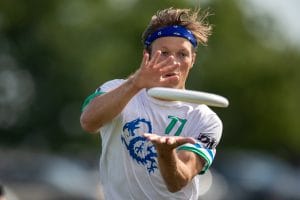
Macalester’s graduation date robbed us of the chance for an all-time heroic Nationals for Owen Suelflow. Even still, he earns his way onto an All-American team through his ridiculous stats in consolation (7G/17A/3D in three games) and through all the work, especially in the deep space, he put in to help Flat Earth get to Nationals in the first place.
Couper Kerns (Oklahoma Christian)
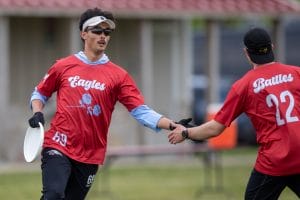
The best players find ways to make an impact every time they step foot on the field, and no one embodied that more than Couper Kerns in 2026. The former defensive superstar added “offensive dynamo” to his resume this year, mixing perfectly weighted throws with timely cutting to post a cool double-double and co-anchor the OC offense. But he still found ample ways to show off his defensive chops, and saved his best play for the biggest moment: a layout block on universe in OC’s quarterfinals victory.
Orlando Impas (Lewis & Clark)
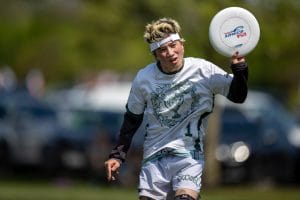
While Bacchus’ Nationals results left something to be desired, they were one of the best D-III teams all year— largely thanks to their star player Orlando Impas. Impas’ agility made his matchups pay for being flat-footed. Whether it was going every-other or throwing up pin placement hucks, Impas was a menace to have to defend. Look no further than his team-leading 12 goals and second-most 12 assists for proof of Impas’ importance to this Lewis & Clark squad.
Geir Hartl (Middlebury)
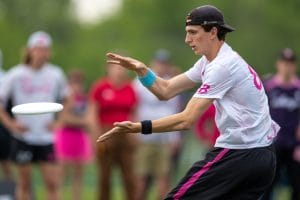
We cite the numbers a lot for All-American cases, but for Geir Hartl, it’s best to ignore them. The statline misses all the intangible qualities he brought to the field. It’s Hartl that dictated the tempo on offense, speeding things up when the defense was flustered and reining everyone in when the moment was especially chaotic. It’s Hartl that prevented his matchup from even getting a whiff of the disc when he crossed over. And it’s Hartl that kept the Middlebury machine moving along in pursuit of greatness.
Reed Burkert (Elon)
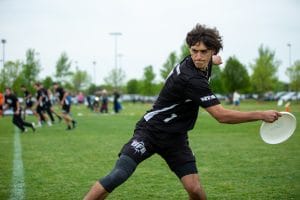
The players of the Atlantic Coast region have known how good Reed Burkert has been the last four years, but this was the first time the whole division got to see his talent. Tall and fast, Burkert is a two way player, seen catching skyballs or throwing dime hucks. With a Nationals stat line of 6G/15A/5D, Burkert was a matchup to be reckoned with and a major reason Elon reached their first-ever semifinals.
Wade Buchheit (Williams)
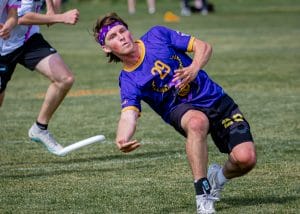
With Williams’s return to Nationals this year, it was a treat to be able to watch Wade Buchheit ball out again. The 2023 ROTY second runner-up became WUFO’s centerpiece in his senior year and did so with pizazz. Notching 12 goals and 18 assists, Buchheit looked like the most important player on the field at all times. Trusted for his strong break throws and steady poise, he was also up to taking the big shots when necessary. Buchheit’s dominant year brought WUFO all the way back to a nice quarterfinals appearance.
Theo Barton (Bowdoin)
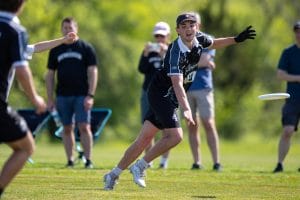
Barton’s workload alone justifies his selection for an All-American team: some of his teammates estimated he played 80% of Bowdoin’s points. And when he was on the field, he was heavily involved in the action. He was on one end of over half of Bowdoin’s goals at Nationals (6G/36A out of 73 total goals), rarely strayed too far from the disc, and posted eleven blocks on top of his offensive contributions.