Valparaiso’s Premier Club Sports model is unique in the college ultimate landscape.
February 26, 2026 by Alex Rubin in Analysis, News
Ultiworld’s 2026 college coverage is presented by Spin Ultimate; all opinions are those of the author(s). Find out how Spin can get you, and your team, looking your best this season.
For years, college ultimate teams operated as student clubs at their colleges and universities under the organizing umbrella of USA Ultimate. The national governing body requires that teams have some connection to the school, since the organization verifies team rosters with school registrars, but otherwise college ultimate teams can exist with a variety of different relationships to their schools ranging from the tacit recognition required to fill out paperwork to the full-throated endorsement of varsity programs.
As anyone who has ever captained or coached a college ultimate knows, though, it is usually advantageous to stay in the good graces of school administration. Schools sometimes provide funding to club programs, assist with practice field reservations (or for lucky teams, tournament field reservations), reserve rental cars, and offer a platform for recruiting new students. The model as it exists in most schools works for the majority of ultimate players, but it has remained more or less the same for the half-century of college ultimate’s existence.
That changed a bit in 2019 when Oklahoma Christian University began offering athletic scholarships for ultimate and developed even further ahead of the 2024 season, when Davenport joined the likes of scholarship programs and introduced a women’s division team. Some small colleges realized that they could use participation in club-level sports to drive enrollment, and they invested resources to offer incentives for players to choose their schools over others because of their ultimate programs.
Though bigger schools have yet to breach the idea of scholarships, and most ultimate players probably don’t want the NCAA oversight that would come with full varsity status across the country,1 the on-field success of the OC and Davenport teams is hard to ignore. OC won the 2021 and 2022 Men’s D-III titles, and neither Davenport team has missed Nationals since its inception despite both teams starting basically from scratch. Beyond the on-field accolades of varsity programs, the schools offering scholarships are lowering the barrier of entry into the sport and making both playing ultimate and attending university more accessible to more people. On its own, that is an admirable goal.
Still, full-fledged ultimate scholarship programs are likely to remain a rarity. But Valparaiso is debuting a new model — the Premier Club Sport model — that could become replicated more easily and would make a big impact to the majority of teams that are at the club level.
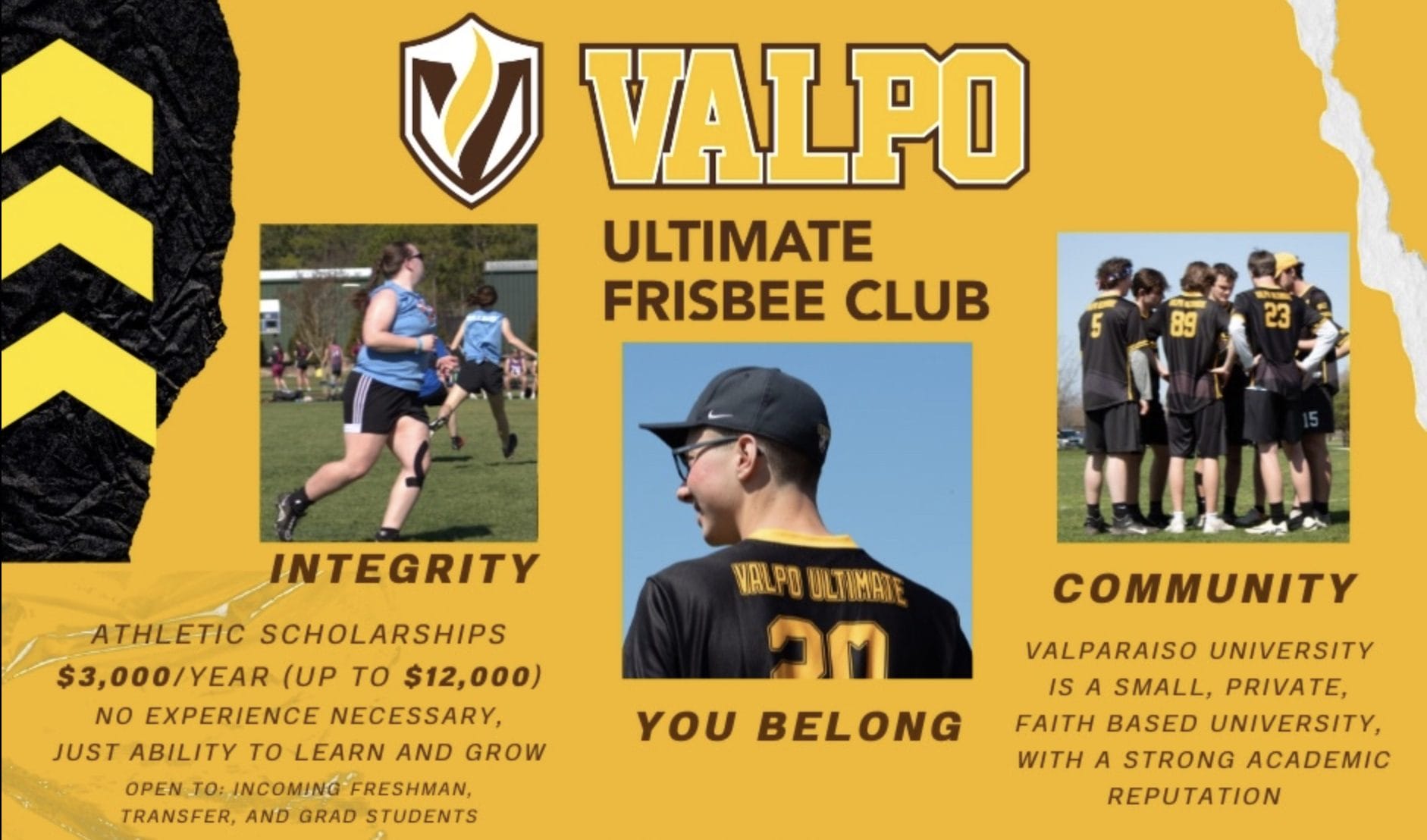
Next year at Valparaiso, the Men’s and Women’s ultimate teams will be designated as Premier Club Sports. Their coaches will be paid by the university (the posted salary range for the job is $40,000-$45,000). Newly recruited players (including transfer and graduate students) will be given $3,000 yearly participation scholarships. Each team will have a budget of $10,000 (plus the ability to fundraise more if they need) to defray travel costs or that coaches can use for recruitment. The teams will be granted scheduling priority ahead of regular club sports and intramurals for practice fields. As other programs are struggling to recruit volunteer coaches or find field space at reasonable times, this sounds like a dream come true for ultimate organizers.
There are some catches, namely that the coach will need to take a second role in University Enrollment or the Department of Athletics and Recreation to justify a full-time salary with benefits. By and large, though, this is an incredible investment from a university that offers tangible support that will benefit the team. It also keeps the team compatible with existing ultimate infrastructure.2
Valparaiso competes in the Great Lakes region in the D-III division. Last season, their men’s team finished winless at Regionals, but the team made Nationals as recently as 2019. Their women’s team appears to be on hiatus, with their most recent sanctioned game played in 2023. Before the COVID pandemic that lowered participation numbers in the women’s division, the school’s women’s team was successful, reaching Nationals in 2017.
“We’ve seen success in our region with adult leagues, and we’ve had student-led club programs on our campus,” Valparaiso Assistant Athletic Director for Campus Recreation & Well-Being Chris Smith said. “We saw a unique opportunity to continue with those and lift them to a higher level.”
Brandon Long, who played on the team from 2007-2011, was named the Valpo head ultimate frisbee club coach in January 2026. He is a licensed real estate broker in Valparaiso, Indiana, and was founding member of the local disc organization NWI (Northwest Indiana) Ultimate Frisbee in 2020. In the ensuing years, he has served as the coordinator of a recreational league, partnering with the local parks department. The university is still searching for its women’s division coach. Long is also recruiting for the women’s team while the search for a coach is ongoing.
Valparaiso’s push to this model is designed to boost enrollment for the university. While there are financial incentives in place, it clearly is also aimed at improving the student experience for athletes on the ultimate team (as well as the other Premier Club Sports: men’s rugby, women’s soccer, pep band, E-sports, and the spirit squad combination of cheerleading, dance team, and mascots). While the D-I varsity athletes at Valparaiso are solely focused on their sport full-time, athletes in the Premier Club Sport programs would be free to pursue other interests and be part of other student clubs alongside their chosen sport.
Ultimate was chosen to be part of this model in part because it is not in consideration to become an NCAA varsity sport. The school chose not to pursue potential Premier Club Sports such as Flag Football because they are emerging NCAA sports, which will require their participants to be uniquely focused on their sport.
Smith described the Premier Club Sport initiative as “student experience focused first, to enhance their time on campus while competing in the sport they love.” Succeeding competitively is not the university’s top goal by moving to this model. While that might be the coach’s goal, the school wants to provide a great student experience that entices more applicants to consider Valparaiso.
The upshot for the Valparaiso ultimate teams is that they’ll receive many of the benefits of a varsity program, like professional coaching and partial scholarships, while also retaining the freedom to be part of other student clubs and organizations. This model has the potential to revolutionize the sport if other universities see the same value that Valparaiso sees in investing in popular club sports to enhance their student experience. For a lower investment than a full varsity program would cost, schools can meaningfully differentiate themselves while also helping their ultimate teams succeed on the field.
this is an interesting topic but one that I won’t address in this piece ↩
Clearly, OC and Davenport have also been able to play within existing ultimate infrastructure, but it is quite different from standard NCAA and NAIA varsity sports. This status invites the question wondering how many varsity programs would be needed to move from a tournament model to one-off games, which could improve athlete health as well as the commercial viability of the sport. Those questions are beyond my scope in this article, but I hope to explore them soon. ↩