In some of the final action of the regular season, three champions are looking ripe for postseason success.
August 23, 2026 by Asa Lee, Aidan Thomas and Zack Davis in News, Recap
Women’s Division
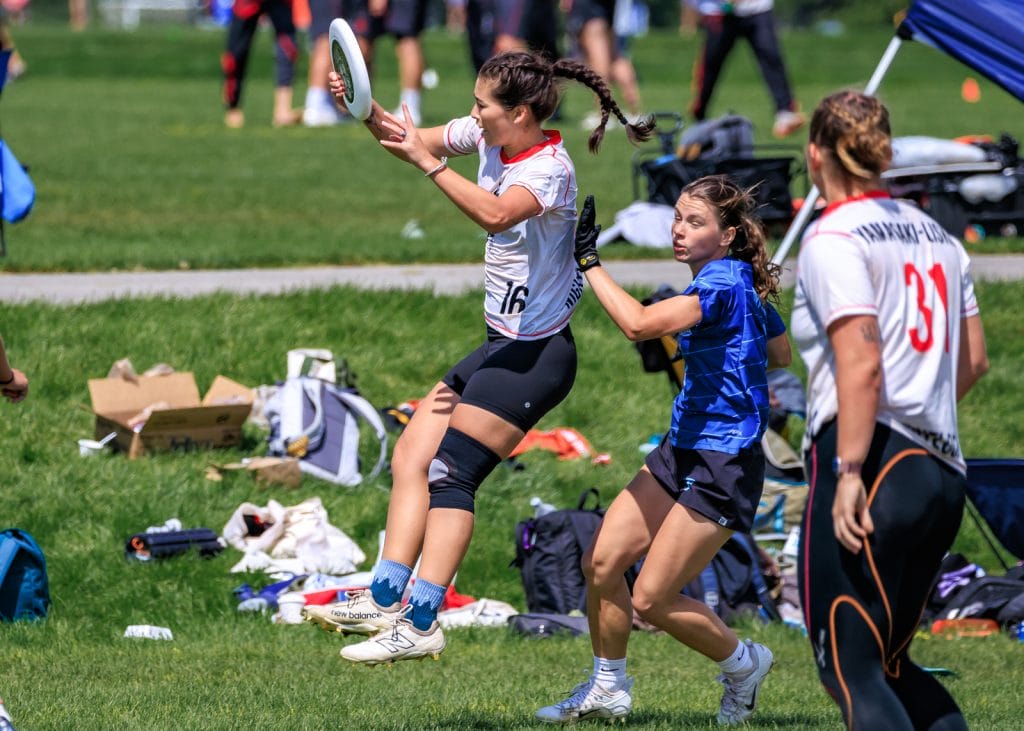
#5 San Francisco Nightlock leapt out to an early 5-0 start over #15 Minneapolis Pop and never looked back. Nightlock’s route to the win was simple: force errors and capitalize on Pop’s mistakes. After Pop got on the board to make it 5-1, the teams traded holds to half, making it 8-3. Out of half Pop held, and had a chance to break the following point, working the disc down to the goal line after some good redzone defense of their own, but were unable to convert, and one deep shot to a bidding Lauren Yamasaki-Liske later and Nightlock were back on the doorstep. Pop were creating chances for themselves, and making great individual plays, particularly from Jessica Hendrickson on defense and Haley Challgren on offense, but couldn’t quite string enough good throws together to find the end zone.
To Nightlock’s credit, their person to person defense was creating a lot of pressure. Stall counts were high, windows were tiny, and they were consistently covering the easier throws to force the lower percentage throws.
Offensively though, Nightlock were lights out. Mars Bau and Violet Yap are any handler’s dream receivers, with explosive acceleration combined with blazing speed and shifty feet. Pop tried a number of different looks to slow down Nightlock and couldn’t find a solution to their problems. Their wall was dismantled brick by brick by Nightlock’s handler set; Arenaria Cramer in particular had a knack for moving the disc to the second level, along with Connor Stuart-Paul and Angela Aie. Once Nightlock got past the wall and Pop tried to fire, Nightlock would immediately send someone deep – usually Bau or Yap, but really whoever was available – and abuse the transition. When Pop skipped the zone altogether, Nightlock found the breakside and would either carve out 10-20 yard chunks to the goal line and score on a slash cut or find a deep shot from power position and punch it in.
Nightlock finished things off with a string of scores for a 15-6 final score. An emphatic exclamation mark to cap off a tremendous regular season. Nightlock now look to regionals where they should be a shoo-in for a bid to Nationals.
Men’s Division
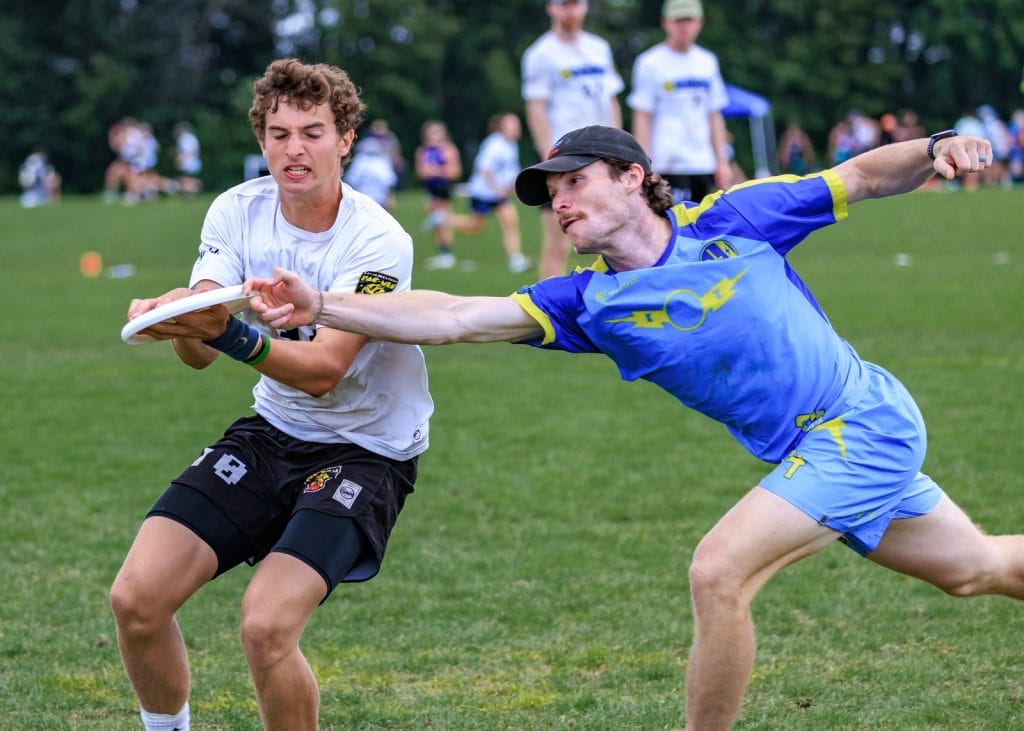
In a thrilling finale to the Elite-Select Challenge, #10 Philadelphia Pacmen completed their unbeaten weekend, riding three midgame breaks to a 14-13 win, punching in a gritty clean hold that featured a controversial call and multiple impressive grabs to save possession. Sam Grossberg was nothing short of a star for Pacmen in the final, notching seven assists, including the game-winner. His relentless cutting made him a consistent every-other option in the handler space, and his prodigious throwing remained a weapon that unlocked the Philly offense. Owen Erdman was seemingly always open, scoring five times, including the game-winner via a layout.
Double game point first featured some highlights, as Adam Grossberg toe-tapped to save a wayward inside flick reset, and then his brother laid out for a trailing edge grab on the ensuing swing to keep possession. However, the highlights and overall point were marred by a somewhat controversial (and observer-upheld) call. A reset to Erdman popped in the air and was caught by a defender, but Erdman called foul on Atlanta’s Tyler Randall. Randall didn’t contest, but upon checking with his teammates and sidelines, appealed that the throw was uncatchable. After a discussion and an observer ruling, the play stood as a foul, and a few throws later, Philadelphia punched in the game-winning hold, as Grossberg slotted a flick into a narrow window and Erdman laid out to collect the goal. Was it a catchable disc without the foul? You be the judge.
The game was a back-and-forth battle, as Atlanta jumped out to the early edge, largely due to the inability of Philadelphia’s D-line to punch in a break chance. It was all holds for seven points, as Philadelphia didn’t turn the disc on offense, and Chain Lightning turned it just once. Then Pacmen’s first turn on their fourth possession resulted in a quick Chain counter and break for the 5-3 Atlanta lead.
Atlanta coughed up five break chances in the first half before Philadelphia finally capitalized on the sixth. With a heavy dose of crossovers, including Sam Grossberg, Pacmen forced two turns on a point, including a stall-out that gave them a short field. They converted the break chance to tie things at 7-7. Nick Spiva hit Grady Richman for Atlanta on the ensuing point to ensure Atlanta held to go up 8-7 at the halftime break.
However, out of the half, it was all Philly. Erdman ripped a hammer assist to convert a hold, and then after Pacmen earned a break chance, they had a player go down with cramps, allowing Sam Grossberg to enter for the counter. The Georgia Tech star delivered the assist that put Pacmen up for good in the tournament final, and he then crossed over again and earned a block. This time, he ceded the offensive stat to his brother as Adam notched the assist, and Pacmen were up 10-8 in a blink.
From there, the offenses settled, and seven straight points went by with just one total turnover and zero breaks. Down 13-12, Chain Lightning still needed to get two breaks back, and they rolled out their best D-line and forced the first Pacmen turnover since the first point of the second half. Stefan McCall took advantage with a laser huck to Ethan Austin-Cruse, sending the game to universe point.
For Atlanta, McCall was a standout, notching two goals and an assist. Spiva had four assists, while Adam Miller and Hayden Austin-Knab filled up the box score in their own right, with a few big hucks from Austin-Knab producing key holds.
Mixed Division
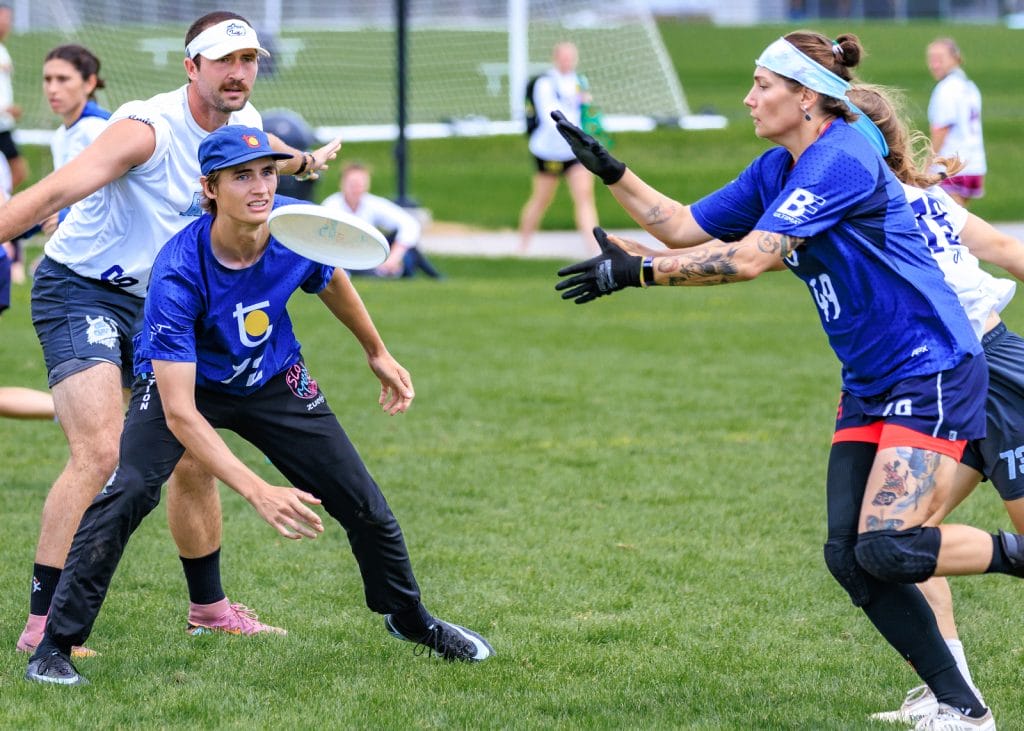
With Club Nationals on the horizon, being able to produce at late-season tournaments is often a key indicator of how a team will perform throughout the series. Out of all the teams attending Elite-Select Challenge, it was #17 Sacramento Tower that set the tone for the field, capping off an undefeated performance with a statement win over #4 Philadelphia AMP in the final. In a tense game where both teams suffered from unforced errors, Tower’s ability to quiet the noise and not get in their own heads helped them achieve a 15-11 victory to claim the tournament title.
The game started with a series of holds, though it became clear early that both teams were willing to crank up the intensity. Multiple layouts, tight coverage that flustered opposing offenses, and confusing defensive sets were common themes. The stars shone as well: Robyn Fennig was excellent for Tower as their center handler and main engine, and Lindsay McKenna dominated athletically for AMP, reeling in multiple hucks and elevating to help secure goals. James Pollard, moonlighting for AMP’s O-line, helped stretch the field and solidify the defense off a turn.
Tower managed to earn the first break after an AMP reset floated high above the intended receiver’s hands, working through the handlers before throwing a smooth forehand to Reilly Berberian to put them up 4-3. Tower earned another break later to go up 6-4, in a sequence that felt representative of their performance all game: an AMP turn saw Tower shoot deep for Berberian, who dropped the wide open pass, only for him to then earn a massive handblock on the goal line to set up an easy score. It was Tower’s resilience that kept them steady, even after AMP earned a break of their own shortly after. A few more holds brought the score to 8-7, with Tower still leading and with the chance to go up by another point out of half.
Up to this point, both teams had committed numerous turnovers. Maybe it was the wind, or the pressure of playing in the final, but it felt like every pass had a chance of hitting the ground or flying past a receiver. Yet coming out of half, Tower looked calmer and more focused, securing a few clean holds in a game where it wasn’t uncommon to have two or more turnovers in any given point. AMP, by comparison, looked scrambled, especially after Tower unveiled a tricky zone that clogged up the handler space. Lindsay McKenna, stuck on the sideline, tried to force an upline throw into a tight window, and Breana Marin swooped in to get a big run-through block from behind, just yards from the AMP end zone. That break put Tower up 11-8, and they didn’t look back for the rest of the game, piling a few more breaks for good measure before ending the game on a long, drawn out O-point that only seemed fitting for such a messy game.
Tower’s win against AMP and overall performance at ESC establishes them as instant contenders in a crowded Southwest region, and barring any shocking upsets, should see them qualify for Nationals with the potential to go on a run.