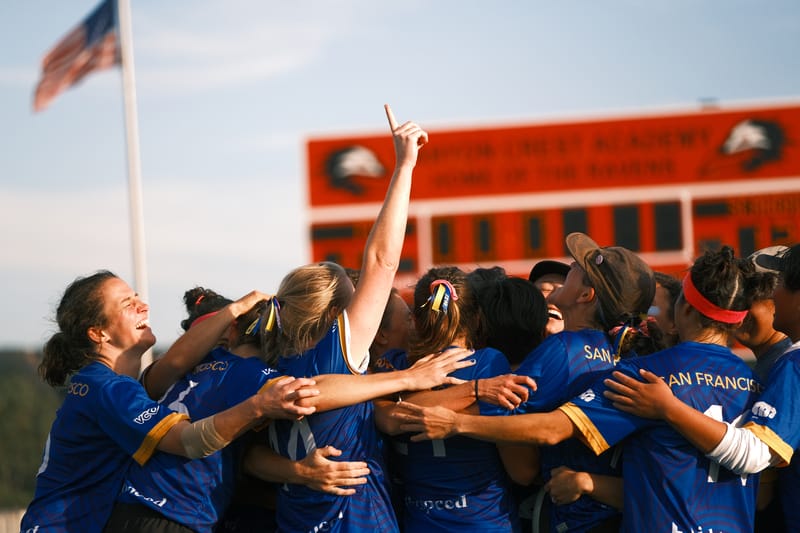
San Francisco Fury look far-and-away like title favorites. Do any teams have a shot at dethroning the reigning champs?
September 5, 2025 by Theresa Diffendal in Recap
Ultiworld’s coverage of the 2025 club ultimate season is presented by Spin Ultimate; all opinions are those of the author(s). Find out how Spin can get you, and your team, looking your best this season.
With eight of 2024’s top finishers in attendance, the last TCT event of the regular season is lauded as essentially a “mini Nationals.” If Pro Championships is at all predictive of Nationals, we might as well hand #1 San Francisco Fury the crown now.
Fury were dominant, pure and simple, never winning a game by fewer than three while playing every team in attendance, save Flipside, who they beat earlier in the season. San Francisco put up a +28 score differential across seven games; no other team’s differential reached double digits.
#2 Seattle Riot seemed the most likely to interrupt Fury’s persistent climb, meeting for the second time this year in a TCT final. Riot struck first and often Monday morning, breaking once upwind and then down, with Jamie Eriksson notching the first with a goal and the second with an assist to claim a 4-2 lead. Her length on Riot’s defensive line was an asset in the wind against popped and hanging throws as both teams adjusted to the conditions.
“It can be really hard mentally to go down early in a game and we’re not a stranger to that this season, unfortunately,” said Fury’s captain Maggie Ruden. “It doesn’t actually feel that stressful for us because we’re always building, always attacking the moment right in front of us. We rely hard on our defense and we always believe that we can come back from that.”
Just as when they were tied late in the second half of quarters with Molly Brown, San Francisco mounted a furious comeback. Fury scored the next three to claim a lead they’d never relinquish, and tacked on two more breaks for good measure to bring the first half to an 8-5 close.
Both teams progressed to the final in part due to superior handler play, able to reset the disc against the wind and stay patient to find the right angles to attack like few others. But on the same field, it was clear Fury were a step above. The commitment between a rotating cast of Carolyn Finney, Julianna Werffeli, Sarah VonDoepp, Kirstin Johnson, and Anna Thompson to swing the disc and attack from the high side of the field created easier throws to large cutting lanes and allowed Fury to attack well even upwind.
Thompson in particular is playing like the clear Player of the Year frontrunner, out-maneuvering even the best defenders and delivering pinpoint-accurate upwind hucks as gusts reached 20 mph in the coastal climate of Virginia Beach. She collected four assists against Riot, including a heat check of a scoober and a nice away shot for half to Johnson.
Johnson perhaps will rival Thomspon in the PotY race, also collecting four assists to go along with three goals in the final while looking at times like the most important piece in the Fury machine. She was as capable of collecting goals under pressure — like Thompson’s toss to take the all-important 5-4 that was fading out of bounds as defenders closed — as she was taking the shots, including a well-weighted downfield huck to Irene Scazzieri.
Though Riot’s handler corps of Ikran Elmi, Steph Phillips, and Kate Lanier were able to place discs on the break side of the field with an ease that made you forget there was wind, it’s notable only one of Riot’s four holds in the second half came on a pass over 10 yards out. The rest came as a result of grinding unders and handler looks on near full-field drives, a testament to Riot’s composure with the disc as much as it is Fury’s downfield defense.
That truly suffocating defense is the perfect counterpoint to Fury’s quick strike offense. If ultimate had salary caps, Fury would break them to add Kaitlynne Roling to a crew with Shayla Harris, Dena Elimelech, Ally Tsuji, and Sharon Lin. Roling and Elimelech went yard for yard on some of the deepest pulls in the division, often trapping teams in their own end zone with the aid of a tailwind and forcing handlers to swing into the wind.
Lin and Harris traded the Nora Luloff matchup, limiting Riot’s budding star cutter to just two goals and often shutting her out of the play. Both Lin and Tsuji notched blocks on hucks to Luloff in the first half through strong positioning.
Once again to end the tournament, Fury pulled away down the stretch. After six straight holds to open the second, Riot’s same-third huck on the low side was pushed out of bounds. Fury’s handlers coalesced to work through the cup and outrun it after dishes. The upwind drive capped with Finney crashing into the soft space between cup and mark and flipping a quick continue to Magon Liu past a bidding Luloff for the upwind break, 12-8.
With the pressure on Riot’s offense for an upwind hold pushing them into a dead end, Seattle flexed over their D-line. It looked like they’d notch an easy score despite pressure from Fury’s three person cup, as Eriksson found a hole that allowed Riot to flow to the high side, 10 yards out from a clean hold. But Lauren Goddu’s IO flick, which only needed to go a few yards, didn’t hold its edge in the right to left wind, and it sailed over the intended Riot receiver.
Wind foiled Riot’s next opportunity to hold, too, after a short-field Fury mistake, and Nicki Yang stymied further hopes with an away shot to a streaking Irene Scazzieri. With an open field and a full head of steam, Fury took five more passes to find Thompson on the goal line, who lofted a scoober to Roling streaking to the back cone. After back-to-back breaks, the game seemed well and truly put away.
It seemed any time Riot built momentum – first half breaks, clean holds to start the second, electrifying plays to maintain possession as the wind toyed with the disc like it had it on a string – Fury had a back-breaking answer.
When Dena Elimelech’s flick huck soared low enough for Lauren Page to get a tip, the wind kept it fluttering straight into Yang’s hands. After Carly Campana had one of the catches of the tournament, toeing the back line to bring the score to 14-10 and keep Riot’s energy up for a comeback, Fury responded with one final clean hold, no throws more than 10 yards or discs held longer than three seconds, to take the Pro Champs title.
“We have a lot of building still to do [before Nationals], as do the other teams, so we don’t take anything for granted,” said Ruden. “It’s awesome to win, but we don’t let that get in our heads…we’re never getting too confident, never getting too in our heads about things. We’re trying to stay in that happy middle and we’ll continue doing that for the rest of the season and just grind.”
Against their best-in-show offense and equally formidable defense does anyone else stand a chance? If Fury are to be foiled, who has the best shot of adding their team’s plaque to the trophy?
Bet on Brute
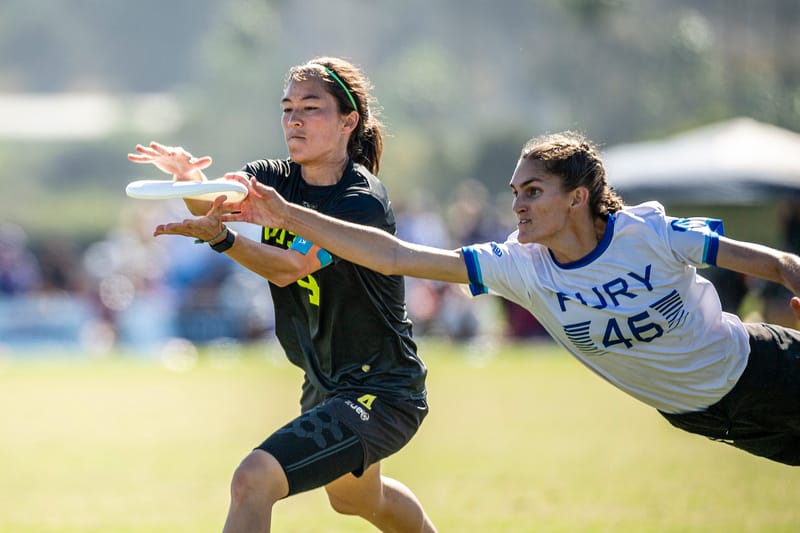
Let’s start with the most recent non-Fury champion: #3 Boston Brute Squad. They played Fury the closest at Pro Champs so far, and in fact the whole season, in a 15-12 last round game you could maybe put an asterisk on, what with every team making the bracket.
Transplants Liv Player and Grace Conerly have been a booster shot in the arm of Brute’s already capable throwing corps, with Conerly trading time between launching pulls on the D-line and hucking to a cadre of deep receivers when she’s taken stints on the O-line, while Player brought her shots from the mixed division and is thriving in women’s. Player in particular shone against Scandal in Brute’s quarterfinal loss, getting a nasty high arm block on a huck attempt and putting well-weighted discs deep.
Together with Lia Schwartz, Tulsa Douglas and Angela Zhu, Brute Squad are one of the more huck-happy teams in the division. While the shots weren’t dropping at the highest rate against DC, they found the greatest success targeting Becky Malinowski. Her hands saved a number of throws that popped in the wind or sailed too close to defenders for comfort.
In the midfield, Laura Ospina was a certified workhorse and with quick speed and release was able to grind out yards with Brute’s handlers or equally skilled glue pieces like BENT transfer Ximena Montaña. Dorothy DiMascio-Donohue used well-timed deep cuts to stretch the field and let the handlers work, and should be rewarded more in calmer conditions.
If teams are to beat Fury, after the holds they’ll need breaks. Brute’s tight person D continually pressured catches or led to easy blocks on the slightest miscalculations, and most of those already mentioned – Zhu, Player, Conerly, Freedman – earned their share of hand-on-disc blocks or forced turns through downfield denial, especially Zhu with smart switches. But Brute’s inability to punch in a break to take an 8-5 halftime lead over Scandal might not inspire confidence, nor does their seeming trend of letting leads slip away in the second half.
The other knock on Boston is, of course, their spotty record against other top teams, with a loss to Phoenix in addition to Scandal and Fury at Pro Champs. Their US Open record is probably most indicative of the team’s ceiling, missing as they were Levke Walczak, Caroline Tornquist, Caitlyn Lee, and more this weekend. The feather in Brute’s cap from Aurora is their halftime lead on Fury in crossover play, and the thorn is the six straight Fury scores to start the second half.
We know Brute love to peak in the postseason and have put together some masterclass bracket runs after ho-hum regular seasons. With two of the most impressive showings against Fury thus far, we could see Boston hoisting the cup for the second time in three years.
Scandal’s Search for Success

#5 Washington DC Scandal’s record against Fury dating back to 2014 stands at 5-12, with three of those wins coming in the 2023 regular season. Pro Champs added another notch in the loss column for Scandal, and it wasn’t particularly close for the back-to-back finalists, who were unable to notch a single break through the game.
Claire Trop is playing like she’ll end up on the PotYium once again, but even though she tries, she really can’t do it all for Scandal. Their crutch this weekend in particular was a zone defense. Though Kira Flores showed flair for switching the field well and often in Scandal’s quarters win over Brute, when Scandal can’t easily move the disc between handlers and cutters, Trop has to drop back.
Trop’s gravity causes her own team to have blinders to the rest of the field at times, resulting in a Riot callahan when Scandal’s handlers were stuck in their own end zone and unable to work through the cup, or an Angela Zhu run-through block when Trop was the obvious iso in the pull play.
While no callahans were thrown against Fury in semis, when faced with the wind – which admittedly plagued even Fury’s best at times – Scandal had difficulty swinging to the high side of the field, jamming short dishes up the sideline that were often blown out or pressured by the defense into turns.
When Scandal are able to get the disc downfield to their cutters, their run-and-gun style is fantastic. Verena Woloson looks like one of the best finishers in the division, and Kami Groom has the nickname “zoom zoom” for a reason.
But Scandal’s best points came when they brought Marie Périvier over from the D-line to work alongside Trop. They made use of her top-class backhands to pulls against the 20 mph gusting headwinds, but she also had a well-spaced flick dot to Maddie Boyle for a score. Having Périvier and Trop on the same line gave Scandal a dynamism that stopped teams from zeroing in on just one as the line’s primary receiver or thrower.
As was lamented several times this weekend, it will be fascinating to see how teams match up when the wind isn’t so disruptive. Yes, there were upwind scores, but more frequent were teamwide pileups under hanging jump balls thanks to just a single degree miscalculation in nose angle.
In calmer conditions, Scandal’s defense could wreak havoc. Amanda Murphy and Ashleigh Jentilet can both deter and have the closing speed to contest any shot downfield, and Allie Wallace is an imposing handler mark against even skilled throwers like Zhu and Douglas.
It’s those unsung grinders Scandal will need to step into the spotlight if they hope to challenge Fury’s depth, allowing Trop, Périvier, and Groom to thrive in the right moments rather than carry the whole load.
Phoenix Reborn
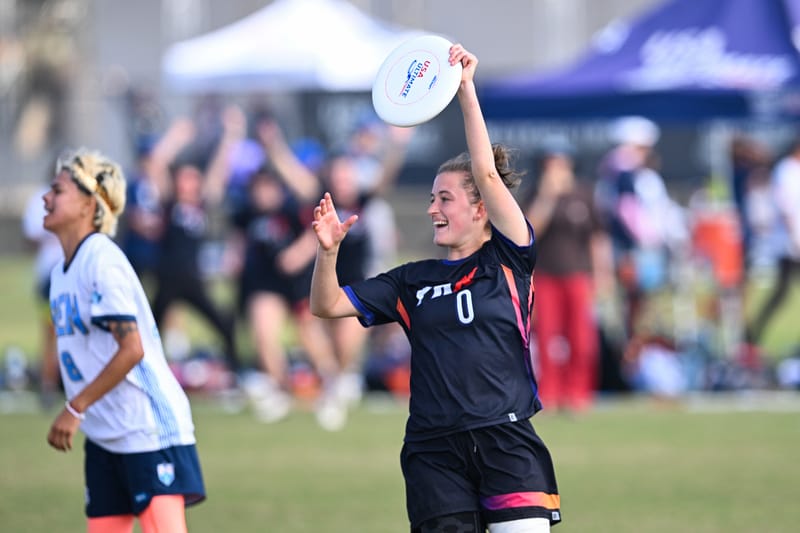
How ‘bout them birds? #12 Raleigh Phoenix came out hot at Pro Champs and played arguably the most scintillating game of the tournament in a universe point semifinal thriller – though loss – to Riot. Without video evidence, who’s to say what happened at PEC East, but Raleigh’s growth over the season is undeniable in their flipped result against Brute Squad to start pool play.
“Our number one game plan was to kick ass,” said Alex Barnett. “Especially being towards the bottom of the pool, we have stuff to prove.”
Phoenix’s strengths were in full view in their quarters win over Flipside, when they overcame an early 3-1 deficit to take half 8-5. Already one of the best cutters and feared defenders in the division, Dawn Culton has added a potent throwing arsenal to her game. Her game IQ allows her to beat defenders to the most dangerous space with legs and then launch roaring backhands and bladey flicks to the most dangerous space in the end zone.
She’s also wielding a crafty scoober that at one point she launched from one corner of the end zone to find Lindsay Soo all alone in the other.
Paired with the lethal throwing force that is Barnett alongside their pick of Theresa Yu or Alyssa Ehrhardt or Jenny Wei, Bridget Mizener is able to quarterback the defense for precision and agility off the turn most teams only dream of. In high-pressure moments like Phoenix’s offensive point to hold for half against Riot, Mizener can be pulled over to work alongside Barnett to weave, power loom-style, a tapestry of strike cuts and inside shots.
Phoenix looked more comfortable working through Riot’s zone than prior opponents, pairing over-the-top shots with insides through the cup to keep marks honest. Particularly when Barnett and Mizener were paired together, their swinging capabilities unlocked the field for shot takers like Culton or Wei to find deep receivers looking to catch defenders out of position as the angles of the field switched.
Another reason to get excited about Phoenix: they’re adding Sarah Meckstroth for the postseason, who’s back after a year away with Drag’n Thrust. Her two prior years with Raleigh should smooth some of the chemistry issues you worry about with a late addition, and add a needed level of experience to a relatively young team.
Don’t Discount Denver
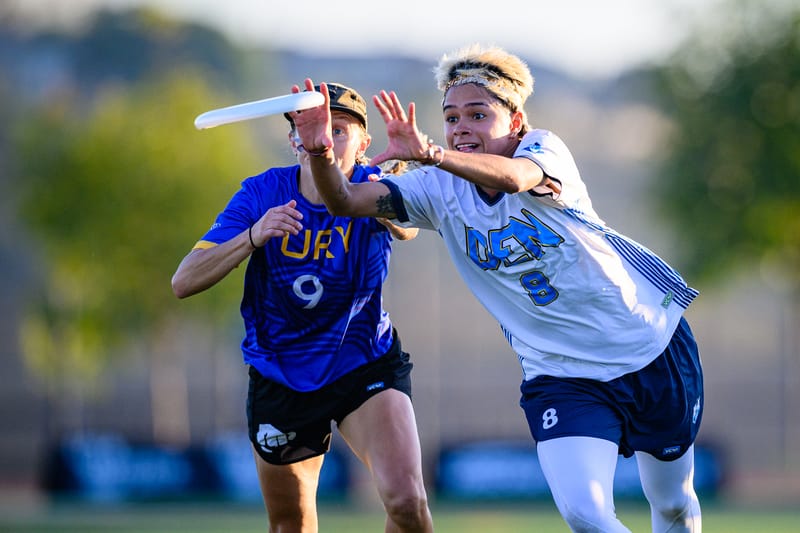
We at Ultiworld have given #4 Denver Molly Brown some hard knocks lately, but there’s an argument to be made that despite their winless record through two days of play, they had the most competitive game against Fury this tournament.
An 0-3 pool play matched Denver with San Francisco in the late quarterfinal round, and Molly quickly made a statement with the game’s opening break. Their O-line, however, struggled to respond in kind as Fury reclaimed the lead, then built it to 3-1 in a story that would come back to haunt Denver in the game’s final stretch. With the disc on the goal line to break for the 12-11 lead, Molly Brown instead surrendered an upwind hold to Fury, and never scored again.
Molly possess players with the claim to be the best in the world on either side of the disc in Valeria (throwing) and Manuela (defense) Cárdenas. Each showed their skill against Fury, Manu tipping a pass on the game’s first point and going step for step with Thompson in the reset space, while Vale’s spin and angle control sliced and rode the wind as needed, including a pretty first-throw shot to a bidding Saioa Lostra for a score.
Claire Chastain and Jesse Shofner had their own moments of brilliance, Shofner powering two backhands upwind on the money while Chastain hit budding goal-scoring phenom Alexandra Guy with a frame-perfect shot. Sara Taggart and Clil Phillips’ throwing load is less lauded but just as essential; Taggart’s inside flicks kept Molly on the high side and notched multiple goals that marks did not adjust to, and Phillips’ signature around backhand breaks marks at the club level just as well as it did in college.
Amongst their stars, Molly have the depth of disc skills few other teams can claim, even at this level. Their defensive pop gives that extra oomph that feels needed to swing the tide against the machine that is Fury’s offensive system. But down the stretch is where Fury pull away in all aspects, and it’s that late game consistency Molly Brown will need to find to outrun Fury to 15.
Ready, Set, Riot
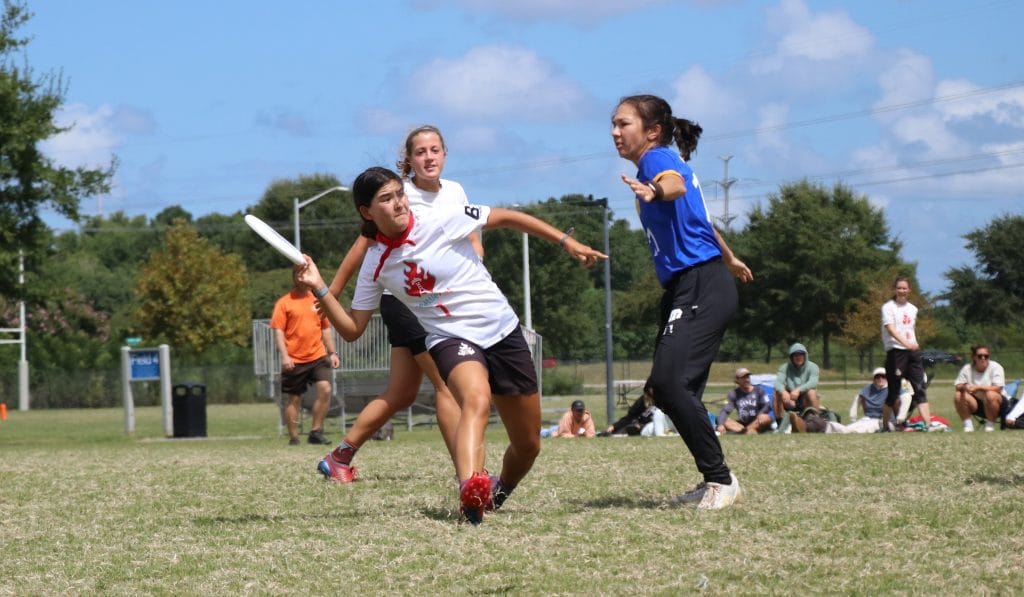
Then there’s Fury’s opponent in the final: #2 Seattle Riot. Their only non-Fury loss of the season was to #10 Vancouver Traffic all the way back at PEC West, and since then have beaten every other 2024 quarterfinalist. Skeptics were wondering if their US Open success would hold up against the strong Pro Champs field, and while none of their wins came by more than three points, Riot proved they’re one of the most promising – and exciting – teams in the division right now.
Seattle’s universe point win over Scandal to take Pool B showed their poise as they recovered from Scandal’s breaks to take half and force double-game point. Needing the upwind hold, Riot crossed over much of their D-line.
Universe point seemed set to be a battle when Steph Phillips’ swing for Chloe Hakimi sailed high, but Hakimi stayed with the play, tracking down the overthrow with a layout, popping back up, and calmly sending the game-winning throw to the end zone.
“When I saw it was hanging a little bit and there was time, I yelled, ‘Chloe please,” said Phillips. “If there’s any gas left in the tank, please use it now!
“We’re always trying to be so present in the moment, where anything you have left in the tank, use it now, even early on,” Phillips continued. “Especially as it gets later and fatigue causes more errors or we’re not getting into position fast enough, we always remind ourselves, ‘win with your legs.”’
Their universe point win over Phoenix to make the final showed their grit, placing trust in youngsters Chloe Hakimi and Nora Luloff to go out and get the game-winning break. And Hakimi delivered, breaking up an upline pass intended for Alex Barnett and showing why she’s already one of the D-line leaders.
Riot used Hakimi’s powerful backhand as a weapon all weekend, tasking her with picking up after the turn and sending looping OI hucks to streaking receivers like Jamie Eriksson for fast breaks. It didn’t always work in the wind, but the trust and confidence to keep taking shots will only pay off come Nationals.
The key to Riot’s success though, particularly in the weekend’s windy conditions, is undoubtedly their strength and depth of handlers. The hours spent likely practicing against their defense’s zone made for one of the most mobile and flexible corps at the tournament. Ikran Elmi’s, Kate Lanier’s, and Steph Phillips’s ability to manipulate marks with pivots and throw on the run single-handedly moved Seattle to the end zone multiple times. It’s beautiful to watch.
Shira Stern, Abbie Abramovich, and Carly Campana all flexed ably in the fifteen to twenty yards downfield of the handler set, leaving large windows for insides and cutting well to provide continues off the edges of handler flow. That left room for Luloff to roam deep and she took advantage, fearlessly outracing the division’s tenured vets to the house, and throwing in some bids and skies to show she’s more than just straight-line speed.
“We’ve just been honing in our hungry rat D,” said Luloff. “Hungry rat D is a mindset, it’s a little bit of a lifestyle. It really just means playing gritty, playing at 100%, and then the next level after that.”
Are Riot then the best shot of a non-Fury champion in 2025? Their record so far presents the answer as “yes,” but enough of their games at Pro Champs are within the error range that just making it to the national final will be its own battle.
A Note on 6ixers and Flipside
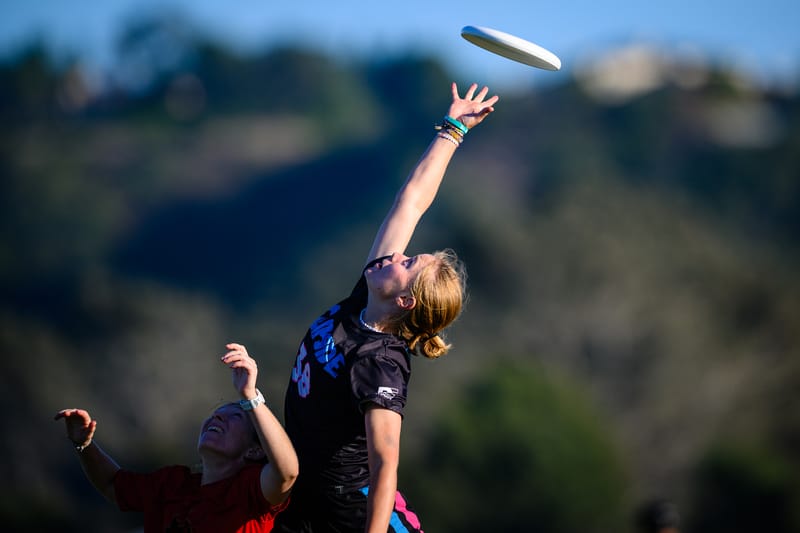
#8 Toronto 6ixers were the only team at the tournament to go winless, falling in the last place game to Molly Brown 15-13. Like Brute, 6ixers were missing a critical contingent of players in Molly Wedge and Sarah Jacobsohn, whose return should significantly boost their ceiling and less the load on Alyssa Mason in particular, who was relied upon to be 6ixers’ top cutter and defender.
Lauren Kimura almost singlehandedly kept their offense competitive, initiating pull plays with her throws or legs and guiding the team upfield with some of the better upwind throws.
But 6ixers’ ceiling is ultimately capped by the absence of Brittney Dos Santos, who is out – likely for the season – with an injury sustained at the World Games. There’s a chance the added firepower of Jacobsohn and Wedge gives their quarters opponent a scare, but semis and beyond is a stretch for a team whose best win on the season came in June over #11 Quebec Iris.
Kaela Helton’s return to #14 San Diego Flipside, even while not quite at 100% after a hard landing at the PUL vs WUL All Star Game, marked a clear turning point after a US Open that saw losses to Colorado Kelp and Washington DC Grit. San Diego notched their first win of the season over a top five team, taking down Molly Brown at the end of pool play.
With Helton still returning to form, Kristen Pojunis took on the role of Flipside’s most crucial piece, helping direct two of Flipside’s three breaks that spanned halftime to bust the game open. Present for all three breaks was Laura Blume, whose defense on reset handlers denied late-stall fills and forced punts.
Flipside appeared to still be experimenting with lines, pulling the throwing ability of Kaitlyn Weaver and sure hands of Jasmine Childress over to D-line to punish windy turnovers and letting Kelli Iwamoto and Abbi Shilts cook together in the backfield on offense. A swing from Shilts to Iwamoto could instantly change the space they’re looking to attack with deep away shots to field-switching breaks as they frequently looked to find Megan Maxfield in the end zone.
Flipside may not have the resume of world beaters this year, but they will likely have the first shot at Fury. The two teams have met in the Southwest Regional final every year since 2022, with Flipside narrowing the margin of defeat each year. With neither team on home turf in Scottsdale, AZ, a healthy Helton alongside a playmaking Pojunis will be looking to wrest the regional title from Fury, one they’ve held since the regional redraw in 2012.
As Fury have completed their first undefeated regular season since 2012, they are once again the yard stick by which all other teams are measured. It’s a heavy target, the fist emblazoned on their jerseys. Will any among the Pro Champs field be able to dull San Francisco’s punch in Del Mar? As frontrunners for the other three semifinalist spots, they’ve got about eight weeks to figure it out.
All Tournament Line
- Claire Trop (Scandal)
- Anna Thompson (Fury)
- Marie Perivier (Scandal)
- Kirstin Johnson (Fury)
- Ikran Elmi (Riot)
- Dawn Culton (Phoenix)
- Alex Barnett (Phoenix)
All Tournament Second Team
- Kaitlynne Roling (Fury)
- Liv Player (Brute Squad)
- Steph Phillips (Riot)
- Bridget Mizener (Phoenix)
- Lauren Kimura (6ixers)
- Chloe Hakimi (Riot)
- Claire Chastain (Molly Brown)
Pro Championships 2025: If Not Fury, Who? (Women’s Div. Mega Recap) is only available to Ultiworld Subscribers
Already have a subscription? Log in
Whether you visit Ultiworld for our reporting, our podcasts, or our video coverage, you can help us continue to provide high quality content with a subscription. By becoming a subscriber, not only do you receive benefits like exclusive articles and full article RSS feeds, you also help fund all of Ultiworld's coverage in general. We appreciate your support!