Unmatched byes after prequarters are having a big influence on teams' Nationals ceilings.
September 17, 2025 by Tim Schoch in Analysis, Opinion
Club Nationals serves as the pinnacle of the ultimate calendar every season. It boasts the highest concentration of the best teams in the world, (mostly) quality fields, and a highly standardized format. It’s a format that has one clear goal: to crown a national champion in each of the three divisions in a fair and decisive manner. Originally instituted in 2016, following a few chaotic (but very entertaining) years of seeding all 16 teams into the bracket, the “16-team, 4-pools-of-4, pool-winners-get-a bye-into quarterfinals” structure is the quintessential tournament format.
But Club Nationals has a fatal structural flaw. It’s a glitch, hiding in plain sight, that does almost as much to determine the final four as the teams themselves. Digging into nearly a decade of data from the Nationals format, I’ve discovered that the tournament’s seeding is preordaining some teams for greatness and others for the consolation bracket.
Everything is balanced for all teams in the schedule – except for the scheduling of quarterfinals. Teams who win their prequarters and are scheduled to play again one hour later have a huge disadvantage compared with the teams who win their prequarters and are given a 3.25 hour bye. The quick turnaround isn’t just another challenge to overcome on the path to an underdog semis birth, it is a veritable tournament death sentence.
Three Hours of Rest is a World of Difference
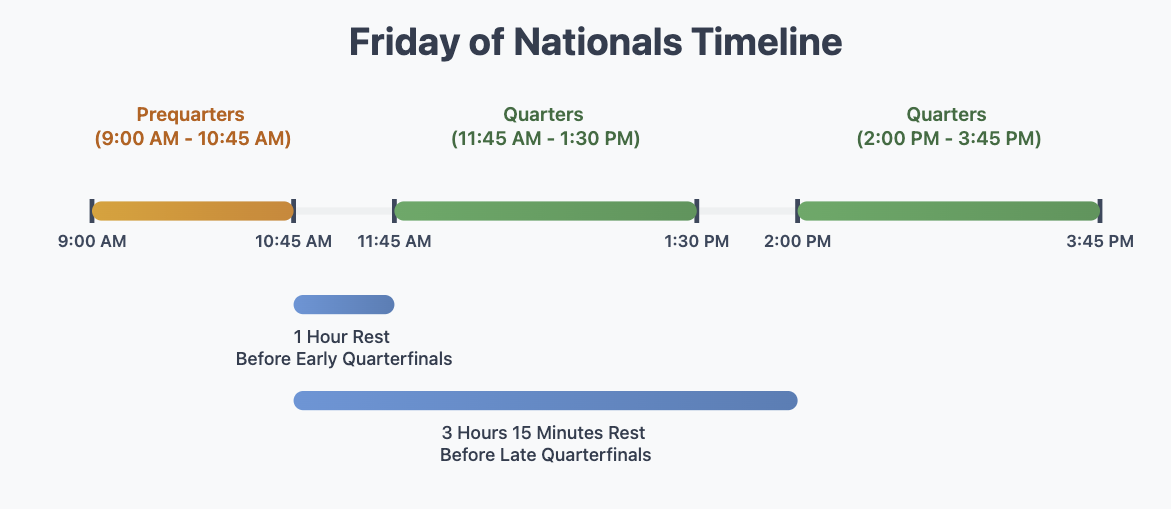
Since 2016, there have been eight club championships, and with four quarterfinals in each of the three divisions, we have a robust 96 games to look at. 48 of those were played by teams without the bye (“no-bye teams” from here on out) after their prequarterfinal and the other 48 by teams with the bye. No-bye teams have an unremarkable 6-42 record (12.5% win rate) while the bye teams are an impressive 16-32 (33.3% win rate). It’s a clear difference.
The advantage of the bye comes into even starker relief when you drill down a bit deeper. As you might expect, the rested squads not only win at a higher rate, but they also lose by smaller margins than the no bye teams. The rested teams lose by only 2.1 goals on average while the unrested teams lose by 4.4 points on average, 2.3 points per game worse.
The effect the bye has is not uniform across divisions, however. It is, by far, the most pronounced in the men’s division, noticeable but not considerable in mixed, and almost nonexistent in women’s. This could be due to the levels of parity we see in each. In the women’s division, the best teams have long been a clear cut above the rest of the pack. The top six seeds in women’s are consistently among the division’s final four, claiming 29 of the 32 semifinal spots under this format.1 That clear demarcation makes it so having the bye or not having the bye does little for second tier contenders’ ability to break into the top four. On the men’s side, the parity year to year2, particularly the overlapping ceilings and floors of the tiers of teams at Nationals, highlights the advantage that the bye provides. Mixed, well, I’ve always seen the mixed division as chaos, and this does little to fight those accusations. The last time more than two of the top seeds won their pools was 2017 and with so many high-seeded teams scattered across the bracket, it’s no wonder the bye/no-bye dichotomy is muddled.
Prequarterfinalists’ Quarterfinal Performances Across All Divisions (2016-2024)
| QF Record | Avg Point Diff. | No Bye Record | NB Avg Point Diff. | Bye Record | Bye Avg Point Diff. | Change in Avg. Point Diff. with Bye | |
|---|---|---|---|---|---|---|---|
| Overall | 22-74 (23%) | -3.3 | 6-42 (12.5%) | -4.4 | 16-32 (33%) | -2.1 | +2.3 |
| Men’s Div. | 9-23 (28%) | -2.3 | 1-15 (6%) | -4.5 | 8-8 (50%) | -0.1 | +4.4 |
| Mixed Div. | 7-25 (22%) | -2.8 | 2-14 (13%) | -3.8 | 5-11 (31%) | -2.2 | +1.6 |
| Women’s Div. | 6-26 (19%) | -4.8 | 3-13 (19%) | -5.4 | 3-13 (19%) | -4.1 | +1.3 |
Zooming into the men’s division for a moment: the stats I presented earlier, which were already concerning from a fairness point of view, become downright alarming. No-bye teams, in 16 quarterfinals games, have only a single win3. Contrast that with the almost unbelievable 8-8 record that teams with the bye have! The difference between having the rest and not having the rest is the difference between (almost) certain elimination and a coin flip chance at the semifinals. Since COVID, those numbers are 0-8 and 5-3. You were more likely to win the later quarterfinal if you didn’t win your pool! The bye has bought teams a whopping extra 62.5% chance at continuing your season over the past four years. It is just wild.
The point differential numbers in men’s are equally as bonkers as the pure W/L record. Teams without the bye lose by an average of 4.5 points while teams with the bye have an even point differential (an average deficit of 0.1 goals). History has borne out that having two extra hours to rest is worth 4.4 goals. These numbers are so blatant I don’t know how to editorialize them except to just state them.
To be clear, these games are (usually) upsets, both by the eye test and according to the seeding. The quarterfinalists’ average seeding is almost the same between the early and late quarterfinals. In the men’s division, the pool winners have had a near identical average seed, with the early quarterfinals pool winners at 4.3 and the late ones at 4.5. The no-bye teams have had an average seeding of 7.0 while the teams with the bye have had an average seeding of 8.1. Strictly based on seeding, you would expect more upsets on the no-bye half of the bracket, but in fact there are far fewer. Accounting for upsets in pool play, there have been an equal number of times across both sides of the bracket where the pool winner had a lower seed than the prequarterfinal winner. A quick analysis of the seeding between these teams points even more toward the systemic explanation for the high rate of upsets in the bottom of the bracket (as seen on score reporter).
First Hand Experience
During my club career, I’ve played in the quarterfinal round six times. Two of those times I played in a prequarter earlier that day, once with the bye and once without the bye. It’s purely anecdotal, but with Machine in 2021, after playing to universe point against Revolver, we had about 30 minutes until we needed to warm up again. Our team was tired and barely had enough time to come down from the thrill of breaking to win to extend our season, let alone reset for the next game. An (admittedly much stronger) PoNY squad took half on us 8-4 and never looked back. And when I think of this round of quarterfinals, that’s the game script that comes up again and again. Like last year when PoNY took half on Ring of Fire 8-2. Or in 2022, when Truck Stop comfortably won after taking half 8-4 on Ring. Or even back in 2017 when Revolver took the game 15-4 against PoNY. These are the prototypical early quarterfinals: no time to recover, no time to reset. Blowouts.
But give the prequarter winner a moment to catch their breath and it’s anyone’s game. Last season, after taking down Shrimp, we had the bye. It was enough time to leave the fields, get food, water, electrolytes, A/C, and, for some of us, even some shuteye. The time spent in the Whole Foods across Via De La Valle was not only physically refreshing but gave us time to mentally recharge for another elimination game. Having experienced both, the benefits are undeniable. We were refueled and demonstrably more focused than the 2021 Machine team, and we were able to claw out a victory over a polished DiG team.
Every single memorable quarterfinal upset in the men’s division4 has come in the second round of quarterfinals. The infamous “Strip” game was the later round of quarterfinals, and Truck likely wouldn’t have beaten DiG and won Nationals if they had had no turnaround time after a close game against Chain Lightning. Ring upsetting PoNY the same year happened one field away at the same time. Truck over defending national champions Ironside in 2017, the first and only time that Ironside missed the semifinals. Rhino downing Truck in 2021. I could go on!
And I will! I’ve been on the losing side of this game myself. I think Johnny Bravo’s 2022 bracket run is one of the most impressive performances we’ve seen at Nationals in a long time, but judging by the data, Bravo almost certainly don’t win if they are scheduled to play Machine immediately after their rock fight of a prequarter against Sockeye. The infamous Doublewide v. Florida United game was a late quarterfinal. It was a long time ago, but 13th seeded Ring upsetting Truck in 2016 was shocking. A loaded Truck Stop team that had made it to the finals of three regular season tournaments, boasted a 12-4 record against Nationals teams (all four losses coming at the hands of eventual semifinalists), and who had beaten Ring decisively twice that season lost to that very same Ring team whose sole pool play win over Prairie Fire kept them from elimination. That late quarterfinal game was Ring’s only impressive win all year!5
Even the most memorable near-upsets have happened in the 2:00 PM round! Machine taking half on eventual national champions PoNY in 2018 before losing the lead in the fourth quarter. Rhino Slam! were one drop away from stunning the world in 2019 when they had an offensive possession to knock off an even more stacked PoNY roster. Truck Stop had the lead at half last season against Rhino in the late quarterfinals before Rhino pulled away and would go on to steamroll the rest of their bracket. None of this is to take anything away from the teams that completed the upset after the bye (two of these teams went on to win national championships!), it’s to show how common upsets can be in this round if teams are given the chance. And, without the bye, these teams, at least in the men’s division, have basically no chance.
Semifinalists by Predestination
So what, you might say. Some of the greatness of winning a championship is the adversity you face along the way. To win you need to get a little bit lucky and if “a quirk of the format” is just another bullet you need to dodge like the injury bug, why is that a big deal? Well, putting aside the fact that the structure of the format is entirely within USAU’s control, the problem lies in how pool play feeds into this unfair bracket arrangement.
A downstream effect of all of these upsets on one side of the bracket6 is that the semifinalist representation skews toward two of the pools, A and D. Since the change in the format, 15 of the 32 men’s semifinalists have all come from pool A. That is, just under 50% of all of the semifinalists in an 8-year span all came out of one pool! Eight semifinalists have come from pool D, a quarter of all of them, just as you may expect. That leaves the victims of this format, the teams in pools B and C. A paltry 12.5% and 15.6% of the quarterfinalists are coming out of these pools, respectively. An echo of this is visible in the mixed division where about 60% of semifinalists originated in pools A or D while only 40% are from pools B and C. In women’s, it is uniform with about 25% of semis competitors coming from each pool.
Men’s Division Semifinalists by Pool (2016 – 2024)
| Pool A | Pool B | Pool C | Pool D | |
|---|---|---|---|---|
| Total Semifinalists | 15 | 4 | 5 | 8 |
| Avg. Semifinalists Per Year | 1.9 | 0.5 | 0.6 | 1.0 |
| % of Semifinalists | 46.9% | 12.5% | 15.6% | 25.0% |
| Pool Winners in Semis | 8 | 4 | 4 | 7 |
| Pool 2nd Place in Semis | 4 | 0 | 1 | 1 |
| Pool 3rd Place in Semis | 3 | 0 | 0 | 0 |
| Pool 4th Place in Semis | 0 | 0 | 0 | 0 |
Since 2016, the second-place finisher in pool A has been just as likely to make semifinals as the winners of pool B and pool C. In that same time span, three third-place finishers from pool A have made semifinals. That means that the third place finisher from Pool A has made the semis at nearly the same rate as each of the Pool B and the pool C winners. Buoyed by the format, a team that likely went 1-2 on day one has been nearly as likely as a pool winner to make it to the top four!
Either USA Ultimate is systematically overseeding the 2, 3, 6, and 7 seeds and underseeding the 8, 12, and 13 seeds – or the format is partially dictating the outcome of the tournament. The key insight is understanding that the advantage of being in pools A and D comes on both sides of the quarterfinal timing disparity. If you win pool A or D, congratulations, you have earned your team a bye into the quarterfinal round where you will be playing at 11:45 AM and your opponent will not have time to rest: 15 out of the 16 teams to win Pools A and D since 20167 have advanced to the semifinals. If you don’t win the pool and finish either second or third, you’ll need to play a prequarter, yes, but if you’re able to win that game, you’ll have time to rest afterward, and then a coin flip’s shot at semis. Pools A and D really get to have their cake and eat it too!
That means the inverse is true of being seeded into pools B and C. If you win your pool, you have only a 50/50 shot in quarters, and if you don’t win your pool, you’ll need to both win your prequarter – hardly a given – and then do something only one team has done since 2016: win their quarter.
With the institution of the World Cup style draw in 2023, the randomness of the draw now meets the slanted advantage of the format itself. Being seeded into Pool A or Pool D is a huge advantage over ending up in B or C. While it certainly doesn’t extinguish your title chances, it makes the path to the top of the mountain a much steeper one.
Conclusion and Recommendation
Something that I have refrained from doing over the course of my research for this piece and analysis of the difference in outcomes for the pools at Nationals is try to determine how many of these “upsets” were legitimately upsets. The seeding breakdown points further toward the bye being a huge advantage but I did not investigate how accurate the seedings are. I haven’t gone through Ultiworld’s own power rankings archives or checked the RRI scores to compare each matchup and seed. It could be the case, however unlikely, that the teams that have prevailed in the later quarterfinals round were just the better yet underseeded squads, and those that got blown out in the earlier rounds were deserving of their legacy being a particularly lopsided score reporter entry. My assumption here is that underseeded and overseeded teams come out in the wash.
If you can live with that assumption, I think the only reasonable conclusion is that there is a significant advantage to having the extra rest after playing your prequarterfinal. Thus, because of the way the bracket is populated, the format is biased toward teams seeded in pool A and D and should be fixed to alleviate that bias. While the stark dichotomy is clearest in the men’s division, the pattern is present, albeit muted, in both mixed and women’s as well. The obvious solution is to play all the quarterfinals within a division at the same time. With the current Nationals round times, this should be doable. You could even offset them across divisions so that you could still broadcast as many of the games as usual.
I would personally recommend that the games are spaced out so that all prequarter winners have the bye instead of none of the prequarters winners getting a bye. The easy solution – not accounting for consolation scheduling – is to hold two rounds of prequarters and two rounds of quarters on Friday. If you play the early prequarter, you play the first quarter round; the late prequarters teams play the late quarter.
A national championship where winning is hard and there are no free games, especially in the bracket, is how I picture the pinnacle of ultimate. For that to be the case, every team needs to have a fair chance and an equal footing in each bracket play game.
We are counting 2023 Brute Squad among the 29. They are listed as the 8-seed on the score reporter page, but that is because USAU randomly drew them into Pool A as the representative for that group of pool second-seeds. They were actually in the top six in the rankings. ↩
The men’s division’s eight-season streak of unique champions is quickly running out of possible heirs ↩
Raleigh Ring of Fire over Boston Dig in 2017, heartbreaking stuff for some of us ↩
Ozone over Riot in 2017 is the only shocking women’s division early quarterfinals upset ↩
This piece mostly highlights the drastic differences seen in the men’s division, but one of the best quarterfinals rounds ever was the 2019 women’s division’s late quarterfinals where both top seeds went down. Hearing that two perennial semifinalists, Seattle Riot and Denver Molly Brown, had fallen in the same round was shocking, but maybe it shouldn’t have been. ↩
Except for in 2023 in the Mixed Division when USAU switched which side of the bracket played first, the one and only time they did this ↩
It still stings. ↩