With the San Diego Super Bloom entering a new era and the Bay Area Falcons reloading with generational talent, the WUL landscape has never been more volatile. We break down every roster and opening-weekend matchup ahead of the opening pull of 2026.
March 12, 2026 by Keith Raynor and Emilia Scheemaker in Preview
The Western Ultimate League’s fifth season begins Saturday, March 14, and the league looks bigger and better than ever. Big-name talent has signed on for this season’s title chase as the field looks to knock off the San Diego Super Bloom, a squad that finally summited the mountain in 2025.
There are plenty of questions to start the year. The Bay Area Falcons have an influx of major talent that makes the team an immediate title favorite. San Diego’s title defense also marks the beginning of the post-Dena Elimelech era. Los Angeles Astra are reintegrating into the Southwest, while the Utah Wild and Oregon Soar have a wave of new faces gracing their rosters. The Arizona Sidewinders are looking to get back in the win column with a return-heavy group, while the Seattle Tempest want to prove they belong firmly in the league’s elite tier even without star Sadie Jezierski. Colorado Alpenglow are back and still dangerous, with one of the league’s best duos in Ari Nelson and Abby Thorpe returning after another season of earning accolades.
Season Schedule
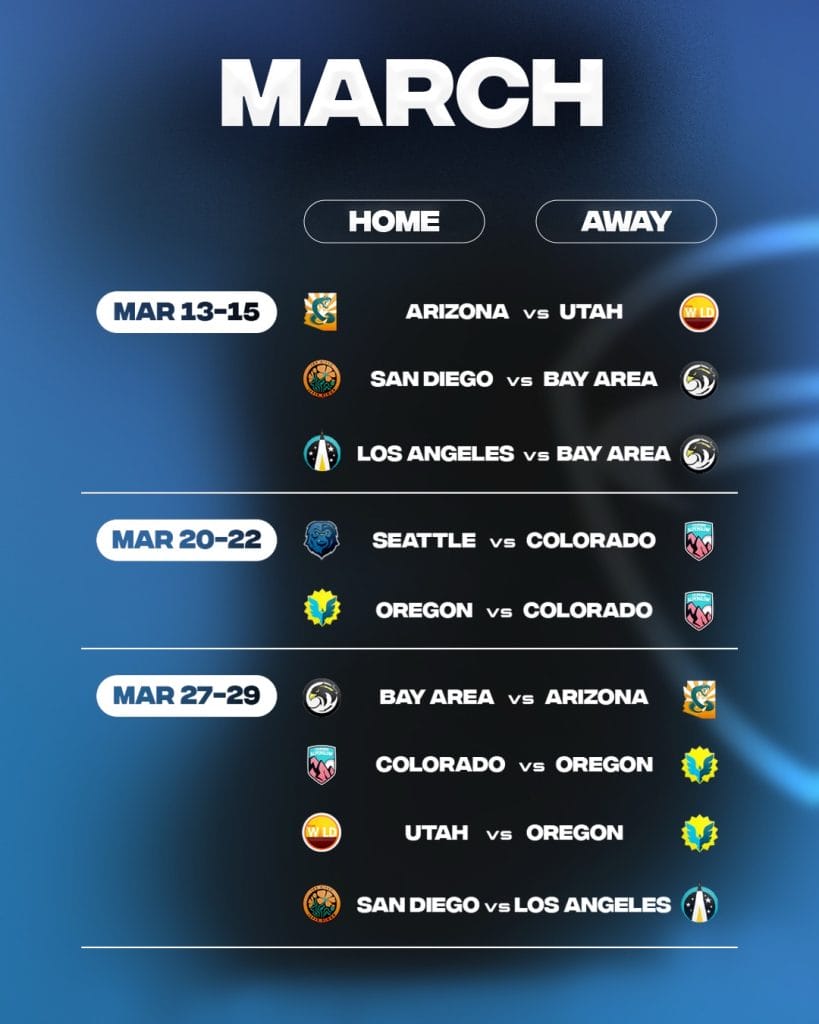
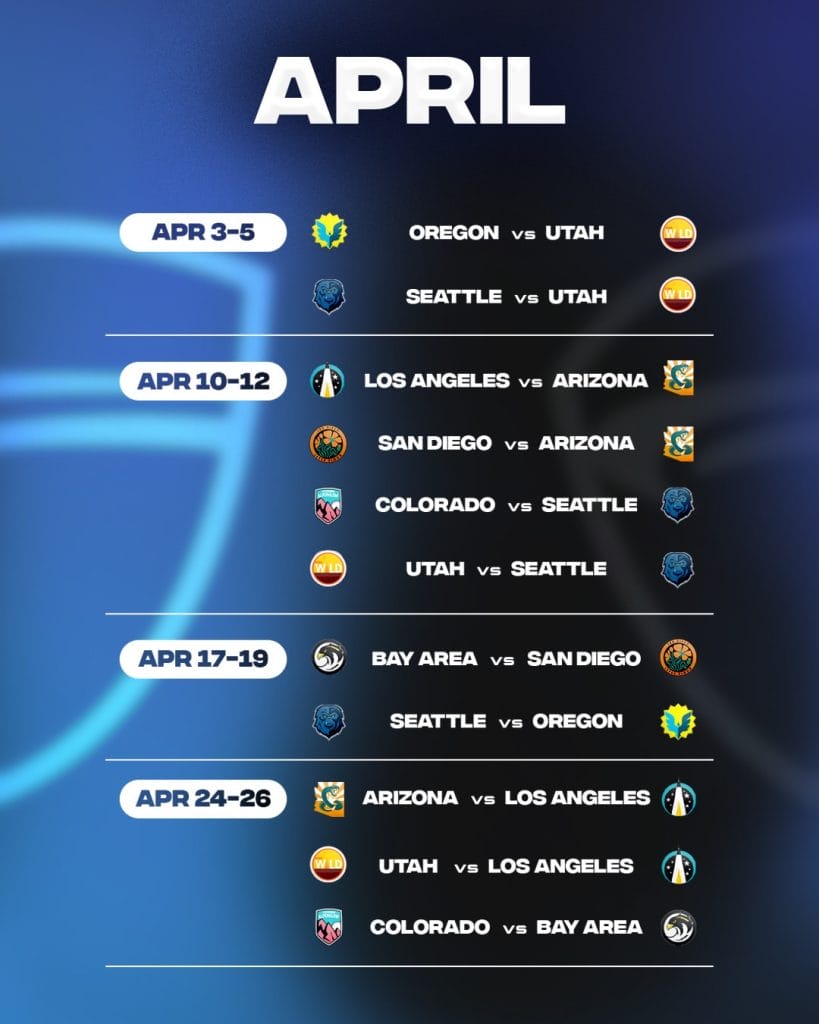
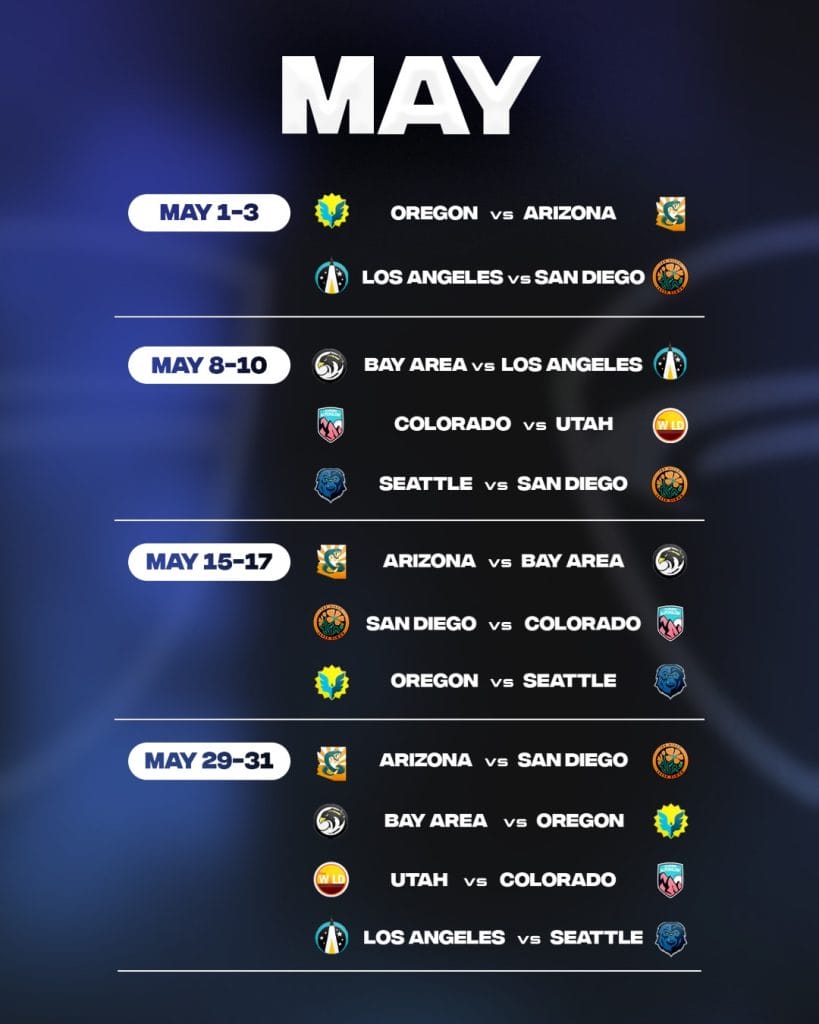
With the return to eight teams, the schedule is both larger and more balanced than last year. Teams will now play eight games, up from last year’s six, with two matchups against each conference opponent. The sprint won’t quite be as mad a dash this time out as teams race to Championship Weekend in Portland, OR.
The season opens with the title bout rematch between the Bay Area Falcons and San Diego Super Bloom. Rife with storylines from two of the team’s foremost title contenders, it’s a cracker of a kickoff.
2024’s champions, Colorado Alpenglow, will be battle tested, having to face both the Bay Area and San Diego in their non-conference competition. That means half of their schedule will come against last season’s championship weekend field. While they are the favorites to win their conference, their schedule could either open up the opportunity for the rest of the Southwest to catch them, or simply sharpen their game for Championship Weekend.
Team Previews
 Utah Wild
 Utah Wild
2025 Record: 1-5, missed the playoffs
Key Additions: Jaycee Jones, a massive unknown rookie class
Key Returners: Cass Williams, Abbie Davis, Lily Terpstra, Eva Bell, Anna McClurkan, Kari Shelkey
Key Departures: Kyra Khoroujnikova, Kat Songer, Paige Kercher, Kenzie Finigan, Morgan Williams, Amy Norris, Carolyn Lober, Brittany McCready, Justine Cherwink
Utah was hit hard with departures this year, losing several influential names behind and in front of the disc. Justine Cherwink, Kat Songer, and Paige Kercher have all left the roster, leaving behind considerable holes in leadership. Kyra Khoroujnikova moved to the San Diego Super Bloom roster, creating another gap, this time on defense, for the Wild. Utah’s success hinges on how well newer or returning role players step up and how consistently they execute late in tight games.
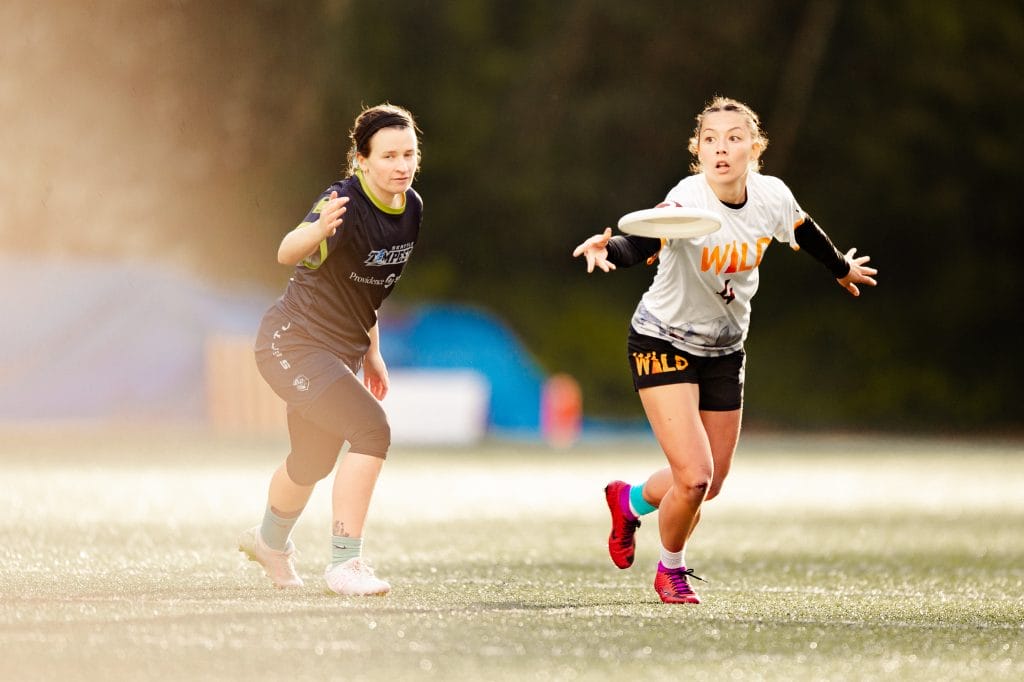
Returning for her fourth season with the Wild, Utah native Lily Terpstra is one of the most experienced cutters on the roster and likely a focal point on offense with her downfield threat and field awareness. She’s still a young player and returning from an extensive injury layoff, so Terpstra’s role will be a key element to watch for.
Jaycee Jones brings athleticism and fresh dynamic energy to Utah’s offensive and defensive rotations, making her a candidate to have a major on-field impact in 2026. Saya Noya’s international background and multi-role potential provide Utah with creativity and depth that could significantly influence both offense and defense.
This team has seen the highest turnover of any roster in the 2026 season. They’ll need strong performances from their leaders and improvement in clutch situations to truly challenge for a Championship Weekend berth this year.
 Seattle Tempest
 Seattle Tempest
2025 Record: 5-1, semifinalist
Key Additions: Nina Finley, Kaitlynne Roling (Returning), Jess Spaulding (Returning)
Key Returners: Cheryl Hsu, Lauren Page
Key Departures: Sadie Jezierski, Julia Hasbrook, Ikran Elmi, Lani Nguyen, Emily Decker, Hana Kawai, Lexi Garrity, Jamie Eriksson
In 2025, Seattle’s roster was anchored by Sadie Jezierski, but with Jezierski moving to the New York Gridlock in the PUL for the year, and two of their three All-Stars gone (Elmi and Jezierski), this team will have sizable shoes to fill. Returners like Cheryl Hsu and Alexa Kirkland will contribute stability to the handler and cutter roles. Seattle’s depth across multiple lines should allow them to stay competitive in possessions and convert defensive stops into scoring opportunities—an identity that helped them finish third at the 2025 Championship Weekend and return to postseason contention. However, they’ll need to sharpen their execution and reduce turnovers to consistently challenge top offenses like San Diego and Colorado, as Seattle’s near-miss in close games last season showed how fine the margins can be.
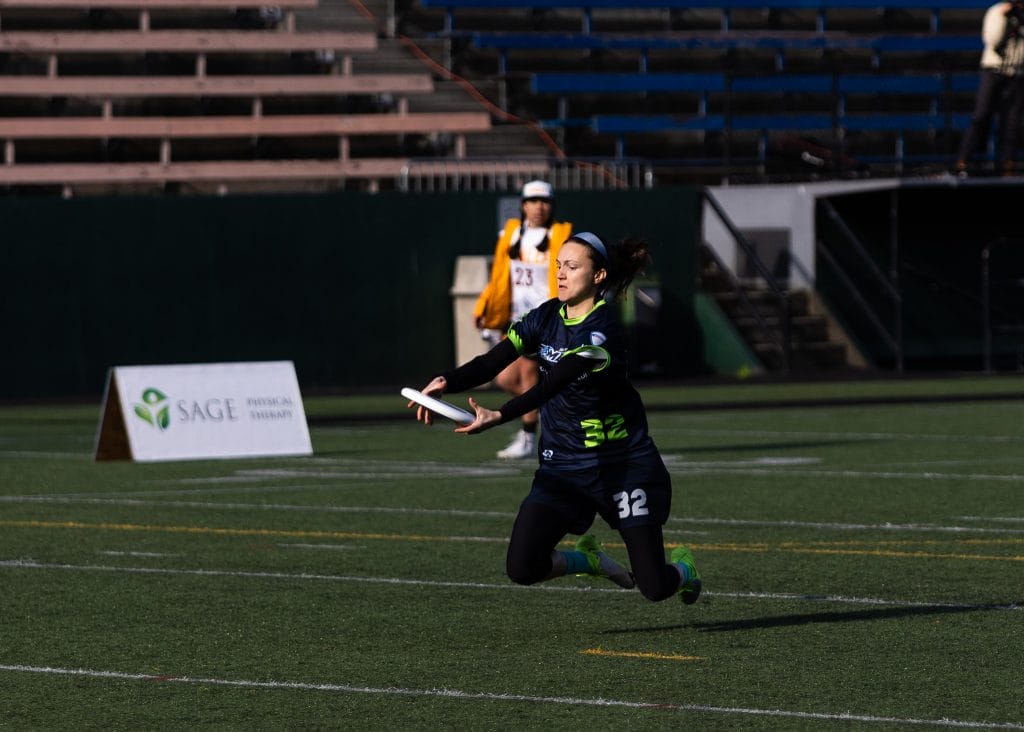
Jess Spaulding and Lauren Page bring steady cutting and reliable offensive threats in the end zone. Spaulding’s experience and field awareness help balance Seattle’s attack from the backfield, while Page has the offensive instincts to swing tight possessions and can elevate Seattle’s offensive efficiency with her incisive cutting.
Seattle returns several experienced returners and playmakers, providing a solid foundation for consistent performance in the WUL’s Northwest Conference. They very nearly put together an undefeated regular season in 2025, falling short in OT against San Diego in their only loss. However, the loss of Jezierski puts pressure on the Tempest to develop new defensive leaders and maintain their conversion rates to remain competitive with the league’s elite contenders.
San Diego Super Bloom
 San Diego Super Bloom
2025 Record: 5-1, league champion
Key Additions: Laura Blume, Naomi Guzman, Kyra Khoroujnikova, Megan Maxfield, Amita Stowitts, Charlize Tan
Key Returners: Kaela Helton, Kristen Pojunis, Kaitlyn Weaver, Abbi Shilts, Avery Jones, Tori Gray
Key Departures: Dena Elimelech, Yu Ishii (Practice Player), Amanda Rutland, Jessica Wan
The reigning WUL champions are reloading for a run rather than resting on their laurels. The San Diego Super Bloom bolstered an already elite defense by adding Kyra Khoroujnikova, a long-time standout for the Utah Wild, and Megan Maxfield, a versatile defender with previous stops at Arizona and Colorado. This influx of veteran defensive talent deepens an already championship-caliber core. Perhaps the most anticipated addition, however, is Laura Blume. As the 2025 Callahan Award winner, Blume brings a high-octane college pedigree that should slot seamlessly into San Diego’s creative offensive systems.
Despite the incoming talent, the Super Bloom must navigate the departure of Dena Elimelech. One of the most storied players in league history—and the WUL’s all-time leader in blocks and receiving yards—Elimelech has moved to the Atlanta Soul in the PUL. Her exit leaves a massive tactical void, as she was a rare “anywhere, anytime” playmaker who could anchor a line on either side of the disc. This shift creates a significant leadership and statistical gap that will likely be filled by a committee of rising stars and the team’s remaining stalwarts.
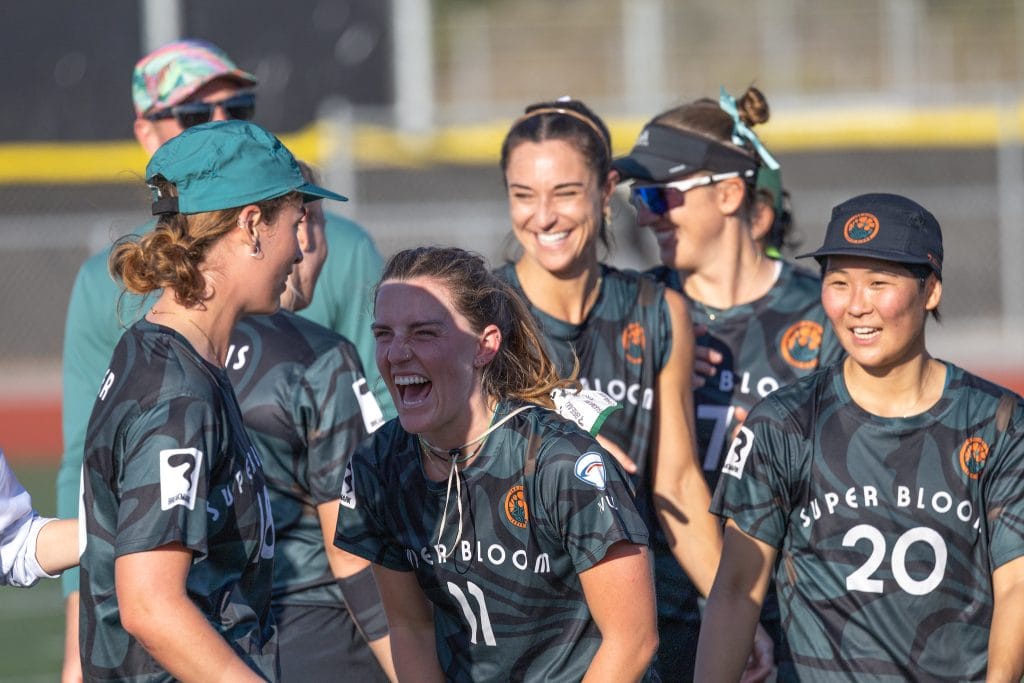
Foremost among those returners is Kaela Helton, who remains the undisputed cornerstone of the San Diego attack. The reigning 2025 WUL MVP was one of just six players with over 1,100 receiving yards last season and the only one without a single receiving error—a staggering statistic that underscores her reliability. Helton’s ability to oscillate between the backfield and the cutting stack makes her a nightmare to game-plan against and a perennial MVP frontrunner.
Supporting her is Kaitlin Weaver, a 2025 All-WUL Second Team selection who emerged as a top-tier multi-role threat. Weaver’s ability to generate blocks and immediately transition into a primary scoring option makes her one of the most influential “two-way” players returning to the roster this season.
While San Diego’s floor remains higher than most of the league’s ceiling, their success in 2026 depends largely on how they distribute the massive workload left behind by Elimelech. If the new defensive acquisitions can maintain the team’s break-rate, the Super Bloom are well-positioned for another deep postseason run.
Oregon Soar

2025 Record: 0-6
Key Additions: Emily Pozzy, Caitlin Fitzgerald, a bevy of new recruits
Key Returners: Noelle Takahashi, Zoe Luke, Jackie Matonis, Rachel Egan
Key Departures: Wren Vogel, Jackie Riley, Raina Kamrat, Kimber Coles, Emma Bartlett, Shannon Dennehy, Clea Poklemba, Eliana Norton, Julia Butterfield, Sidra Pierson, Natalie Hancock, Helen Burruss
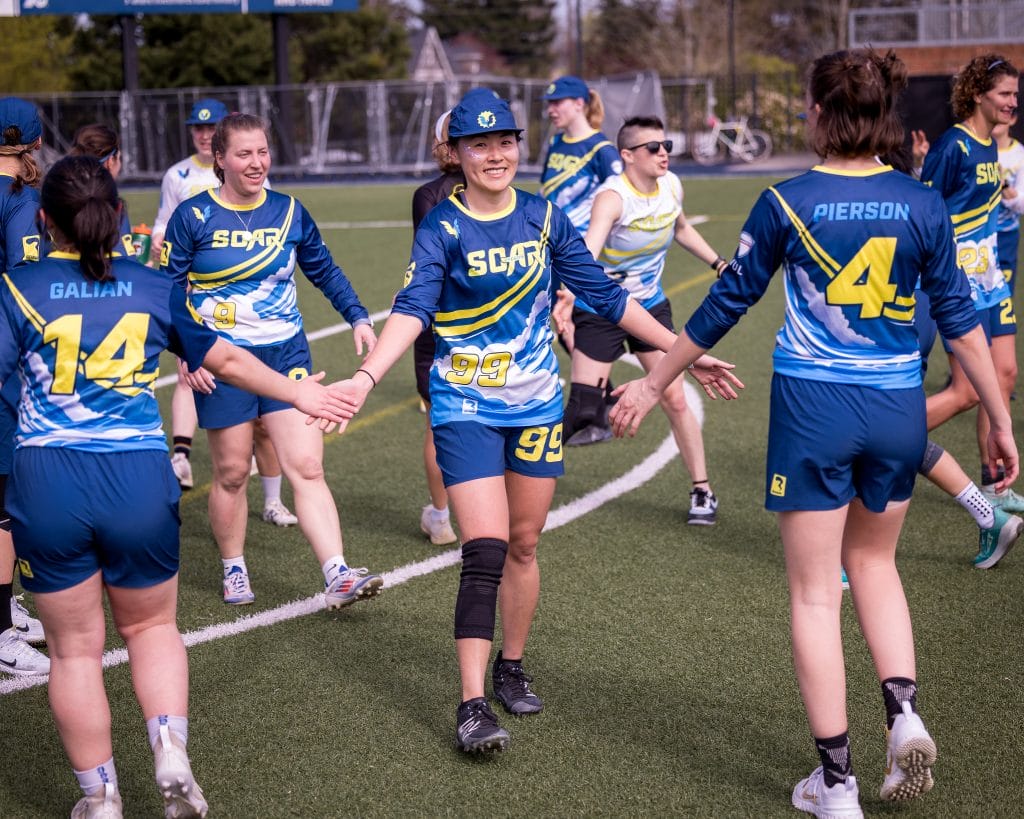
After bringing Portland ultimate back to the WUL in 2025 as the newly minted Soar, Oregon is embracing the new year and blank slate. After a winless 0-6 inaugural season, Oregon Soar enter 2026 in the midst of a massive personnel shift. The 2025 campaign was a trial by fire where All-WUL Second Team selection Jackie Riley provided many of the lone bright spots; however, Riley’s departure—alongside the team’s other top three players in points played (Wren Vogel, Raina Kamrat, and Kimber Coles)—leaves the Soar effectively starting from scratch. With rotation mainstay Clea Poklemba also off the roster, Oregon is a fundamentally different team than the one that struggled to find its footing last year.
Despite the statistical reset, the squad is far from inexperienced. This 2026 iteration draws heavily from the deep well of Oregon’s regional talent, with several players—including returning veterans Aly Steinfeld and Murl Hammond—having played together for years in the club circuit or during the team’s previous tenure as the Oregon Onyx. This existing chemistry will be the lifeline for Soar as they navigate the most significant roster turnover in the Northwest Conference.
For 2026, Soar need their new core to transition from raw potential to reliable production. The team showed flashes of big-play offense during their winless run, and the infusion of new talent like rookie Emily Pozzy suggests they intend to maintain an aggressive, high-risk profile. While they’ll still face an uphill climb in a Northwest Conference loaded with established contenders, Soar’s blend of athleticism, veteran club experience, and emerging cohesion positions them to be the league’s most unpredictable outfit.
Rachel Egan brings a versatile two-way presence that impacts both sides of the disc. Her catching ability makes her a reliable target in tight windows, while her willingness to mix it up in deep defense creates game-changing turnovers. As Oregon looks to tighten defensive consistency amidst a personnel sea change, Egan’s physicality and instincts will be central.
Pozzy’s combination of field vision, throwing range, and athleticism will make her one of Oregon’s primary offensive engines in 2026. Her ability to generate yards and keep possessions alive—both through handler distribution and deep targets—sets the tone for Soar’s offense early and often.
Noelle Takahashi delivered consistent production last season and provided an athletic presence that Soar relied on in competitive moments. With the departure of the team’s top yardage earners, last year’s assist leader must continue to improve if Oregon hopes to find the win column.
Soar will need to mesh early if they want to rise out of the middle of the pack. With a season opener against the Colorado Alpenglow, they have no time to waste. Finishing points and converting on break opportunities will be the keys to the team’s development and competitiveness in 2026.

Los Angeles Astra
2025 Record (in PUL): 1-5, missed playoffs
Key Additions: Sabrina Belkin, Casey Wong, Ally Latham, Parissa Teli, Emma Liu
Key Returners: Stephanie Pritchard, Amy Lee, Delilah Masket, Chip Yen
Key Departures: Maggie O’Connor, Samantha Wool, Naomi Guzman
After spending the 2025 season in the Premier Ultimate League, the Los Angeles Astra is back in the WUL for 2026. This move reunites them with West Coast rivals and restores the league’s traditional Southwest Conference slate—including Arizona, the Bay Area, and the San Diego Super Bloom—for the first time since 2023.
The 2025 PUL campaign was a difficult journey that resulted in a 1-5 record and a league-worst offense that generated just 63 goals in six games. That was the second-fewest in the league, while the Astra recorded the second-most turnovers during the regular season. Their defense was stout, providing a reliable source of blocks and pressure that burdened opposing lines and provided a necessary safety valve for the struggling offensive unit.
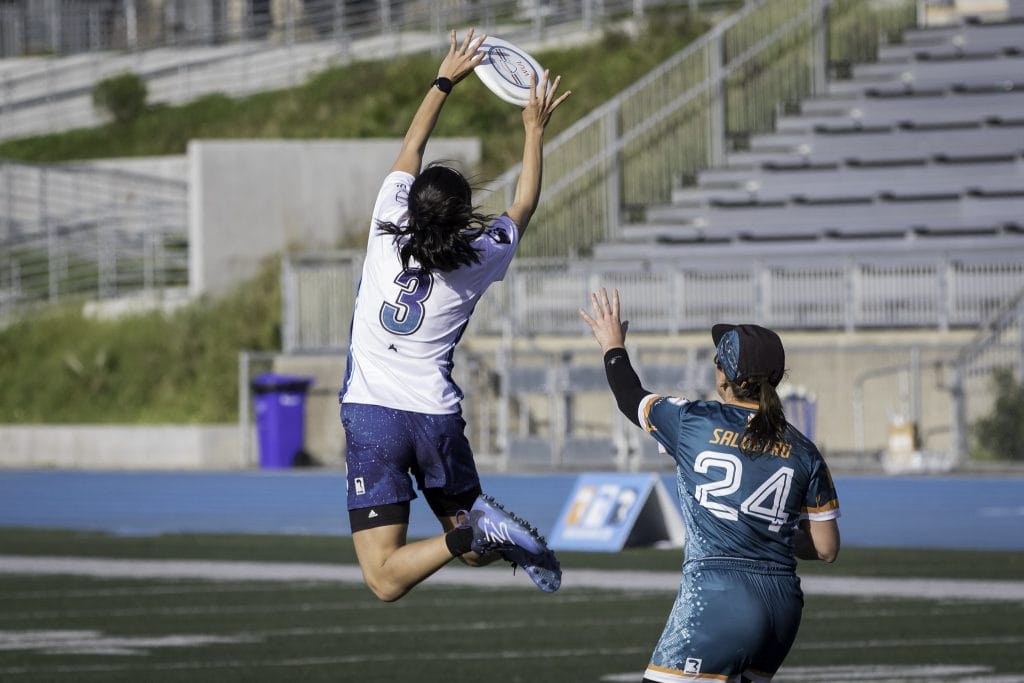
The core of the 2026 squad remains rooted in the talent that carried them through recent campaigns—a mix of experienced handlers and athletic downfield players drawn mainly from the 2025 roster. The Astra aim to blend experience with continuity, but they will need to find new backfield production after losing their top three leaders in touches: Maggie O’Connor, Samantha Wool, and Naomi Guzman. Newcomer Sabrina Belkin is a prime candidate to step into a high-usage role immediately, while Maddee Shade and Karli Steiner are going to be asked to shoulder a larger load this season.
Stephanie Pritchard’s cutting instincts, reliable catching, and ability to make plays in tight spaces give her a high-impact ceiling as the team settles in. Amy Lee’s command of the disc and ability to punctuate the offense with clean resets and incisive throws should make her a foundational handler for Astra’s offensive structure. Delilah Masket brings the savvy and poise needed to steady the attack; her decision-making and ability to connect critical possessions—especially in high-leverage moments—will be crucial as the Astra adjusts back to WUL competition.
Ultimately, Los Angeles needs to finish possessions cleanly and improve defensive disruption. These aren’t trivial hurdles, but a stable core and renewed conference rivalries give them a clear path to reclaiming their status as a Southwest contender.
Colorado Alpenglow
 Colorado Alpenglow
2025 Record: 6-0, semifinalist
Key Additions: Maggie O’Connor, Alexandra Guy, Emma Williamson
Key Returners: Abby Thorpe, Ari Nelson, Jade McLaughlin, Allysha Dixon, Rena Kawabata, Blaise Sevier
Key Departures: Rory Veldman, Robin Fassett-Carman, Megan Maxfield, Shayna Brock, Sarah Pesch
The Colorado Alpenglow enter 2026 with the clinical poise of a program that has fully realized its identity. Following a 6-0 regular season and a deep playoff push in 2025, Colorado returns with a system built around tempo control, spacing, and disciplined defense.
Ari Nelson (WUL Offensive Player of the Year in 2025) remains the engine—a high-volume, high-efficiency handler who can dictate pace and break games open with their range—while former MVP Abby Thorpe provides two-way impact that keeps lines flexible and dangerous.
Around that, a deep supporting cast gives the Glow matchup versatility and the ability to roll out balanced units without sacrificing production. Allysha Dixon’s presence on both sides of the disc and her recognition as a WUL All-Star captain speak to her value on this roster. She sets the tone with leadership, versatility, and consistent execution that elevates Colorado’s performance in key moments.
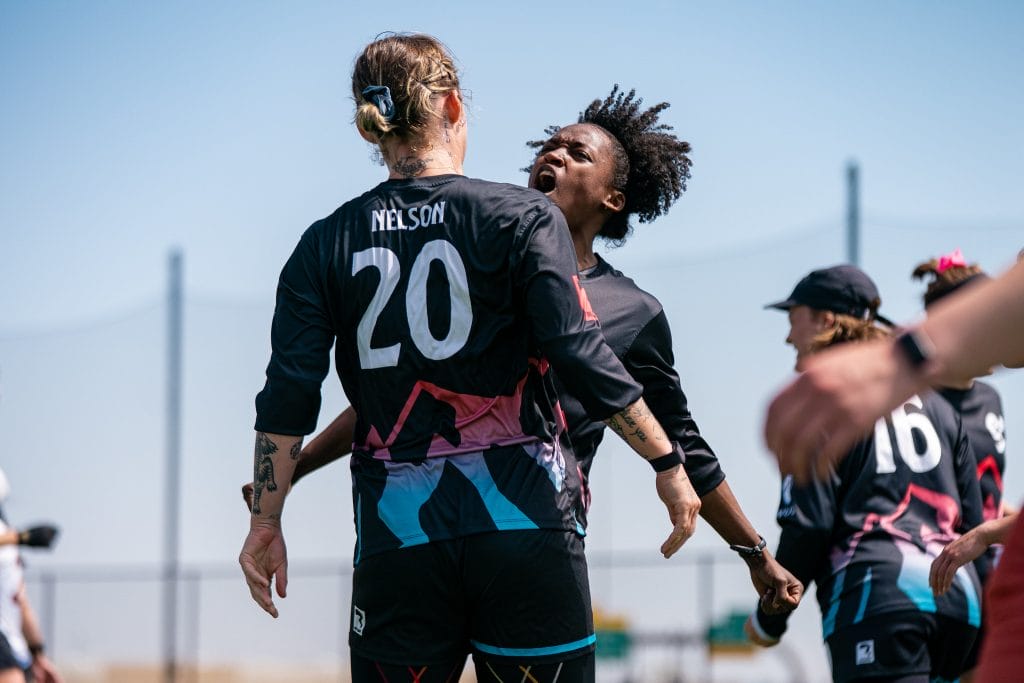
The biggest offseason question is how Colorado absorbs the loss of key defensive depth from last year’s rotation. Notably, Megan Maxfield and Rory Veldman are absent from this year’s roster. Maxfield is throwing her blend of offensive and defensive utility behind the San Diego Super Bloom this year, while Veldman was an All-League producer in 2025. Replacing that individual disruption will require Colorado to lean even harder into their team-defense schemes.
Even so, their DNA remains intact: patient offensive progressions, punishing transition play, and a willingness to grind opponents down over four quarters. If the returning core maintains its efficiency and a new piece or two steps into expanded roles, the Alpenglow should once again be the favorite to represent the Northwest at Championship Weekend.

Bay Area Falcons
2025 Record: 4-2, league runner-up
Key Additions: Sarah Combs, Reeve Grobecker, Karen Ehrhardt, Kendra Miller, Dawn Culton, Alex Barnett
Key Returners: Robyn Fennig, Georgia Cardosa, Margo Donahue
Key Departures: Han Chen, Meeri Chang, Amanda Meroux, McKinley McQuaide, Morgan Greenwood
The Bay Area Falcons have locked in their core from 2025, providing a formidable foundation for a legitimate championship push in 2026. This stability is spearheaded by Robyn Fennig, who finished last season with the second-most throwing yards in the league as a First Team All-WUL selection. Fennig remains the undisputed engine of the Falcons’ offense; her vision and timing give the Bay Area a consistent go-to handler to control pace and break the mark.
The defensive side of the disc is equally stabilized by the return of Georgia Cardosa (Defensive Player of the Year finalist) and Margo Donahue (Breakout Player of the Year finalist). Cardosa’s impact on the turnover battle remains invaluable, as her ability to lock down opposing throwers and turn defense into offense gives the Falcons an edge in D-line transitions. Donahue rounds out this veteran core with high-level contributions on both sides of the disc, providing the versatility and consistency needed to thrive in high-leverage moments.
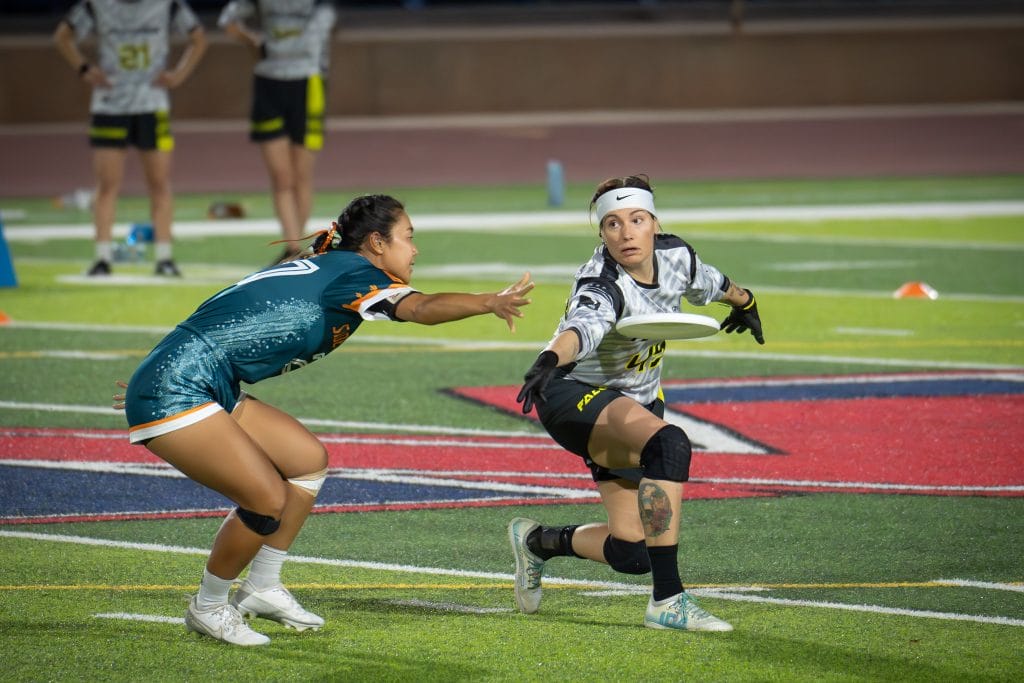
While the veteran core provides the floor, a historically talented rookie class raises the Falcons’ ceiling to the stratosphere. The most notable addition is Dawn Culton, widely considered one of the best players on the planet. Culton is a defensive eraser capable of neutralizing an opponent’s primary option, and her arrival alongside Cardosa gives the Bay Area arguably the most feared defensive duo in the WUL.
The roster is further bolstered by Alex Barnett, one of the premier up-and-coming throwers in the division, whose range will help offset the loss of veteran handler Han Chen. While Chen’s departure marks a shift in the backfield, the influx of talent like Kendra Miller and Karen Ehrhardt ensures the system remains robust. Ehrhardt, in particular, projects as a midfield dynamo, acting much like a central midfield in soccer. She excels at timing under cuts and immediately launching continuation throws to keep the offense in a constant state of flow.
With a blend of elite returning finalists and eye-popping additions, the Falcons look poised to convert their recent runner-up finish into a 2026 title.

Arizona Sidewinders
2025 Record: 0-6, missed playoffs
Key Additions: Kristen Reed, Kez Gessell (Returning)
Key Returners: LP Aragon, Paige Applegate, Chip Chang, Brittany Stettmeier, Melissa Dunn
Key Departures: Erin Donahue, Emma Erickson
A winless 2025 campaign sets the table for the Arizona Sidewinders to pursue a bounceback campaign. While the rotation from last year is almost completely intact, the narrative in the desert is about finding forward motion after a stagnant season.
The Sidewinders’ offseason is headlined by the return of Kez Gessell and the addition of Kristen Reed. The club brought back Gesell (2023 Breakout Player of the Year) and signed Reed, a proven high-volume scorer whose elite instincts were on display with the Colorado Alpenglow and top club programs like Molly Brown. Reed’s club experience—including deep postseason runs and national-level competition—makes her one of the most notable two-way additions in the league going into 2026.
Arizona has historically struggled to consistently score; the return of Gesell and addition of Reed—who finished third in the league in goals during her lone WUL season with Colorado, including a standout seven-goal performance—are key steps toward addressing that, but may still require further roster depth improvements.
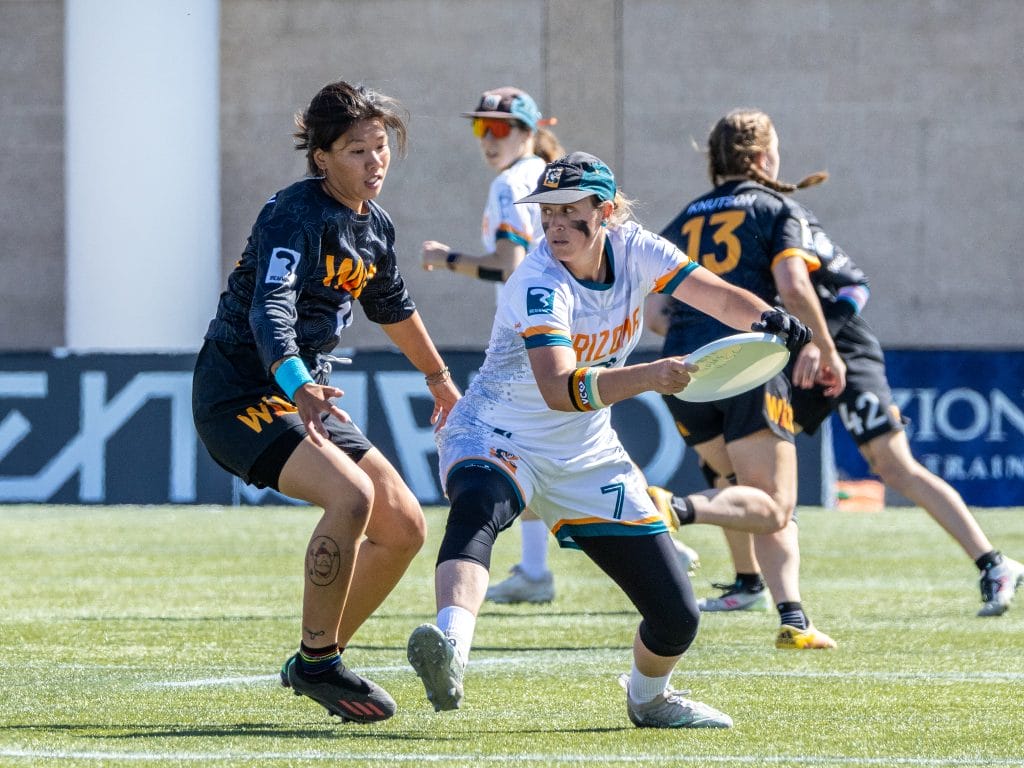
Returning to the Sidewinders is LP Aragon, a seasoned handler and field general. Aragon led the league in throwing yards during her last full season and has consistently been the backbone of the Sidewinders’ offense. Her experience and ability to distribute the disc while creating looks for cutters like Reed are crucial for the team’s success.
Aragon isn’t holding down the backfield alone; Paige Applegate’s combination of handler throws, composure, and offensive efficiency made her one of the Sidewinders’ most trustworthy playmakers. A finalist for 2025 Offensive Player of the Year, she creates space and opportunity as a go-to piece wherever Arizona needs production.
The Sidewinders have stacked a roster around improved scoring and leadership, betting that their established chemistry—supplemented by Reed’s elite production—will be enough to finally climb out of the South cellar and into the WUL win column.
Week 1 Game Preview
Utah Wild, Arizona Sidewinders Dust Up
Opening weekend in the 2026 Western Ultimate League season kicks off with a quietly pivotal Southwest showdown as the Utah Wild take on the Arizona Sidewinders. It may be Week One, but for two teams looking to climb into the contender tier, this already feels like a tone-setter. If the Sidewinders want to set themselves up in the middle of the pack, this game is a must win, while a Utah win would set the tone for a Wild team looking for a Championship Weekend bid.
Utah enters the year balancing continuity with recalibration. The Wild have traditionally leaned on gritty defensive energy and quick-strike transition offense, but roster shifts, and the loss of key players like Kyra Khoroujnikova and Justine Cherwink, mean new players will be asked to shoulder initiation and late-stall responsibilities. Expect Utah to emphasize defensive intensity early with active marks, help in the lanes, and a willingness to generate chaos off pulls.
Offensively, they’ll likely look to simplify: establish reset comfort first, then attack deep once rhythm builds. They’ll need strong leadership from returners like Lily Terpstra to keep this on track and that may mean switching from offense to defense to keep things tight. The biggest question in their opener is chemistry — can new combinations click quickly enough to avoid early-season offensive stagnation?
Arizona, meanwhile, may have the higher offensive ceiling on paper. The Sidewinders’ identity in recent seasons has revolved around play-making cutters who can win isolated matchups and handlers like LP Aragon and Chip Chang willing to break the mark aggressively. Kes Gesell and Kristen Reed are two notable additions to the roster this year that will be pivotal to the Sidewinder’s ability to create downfield threats.
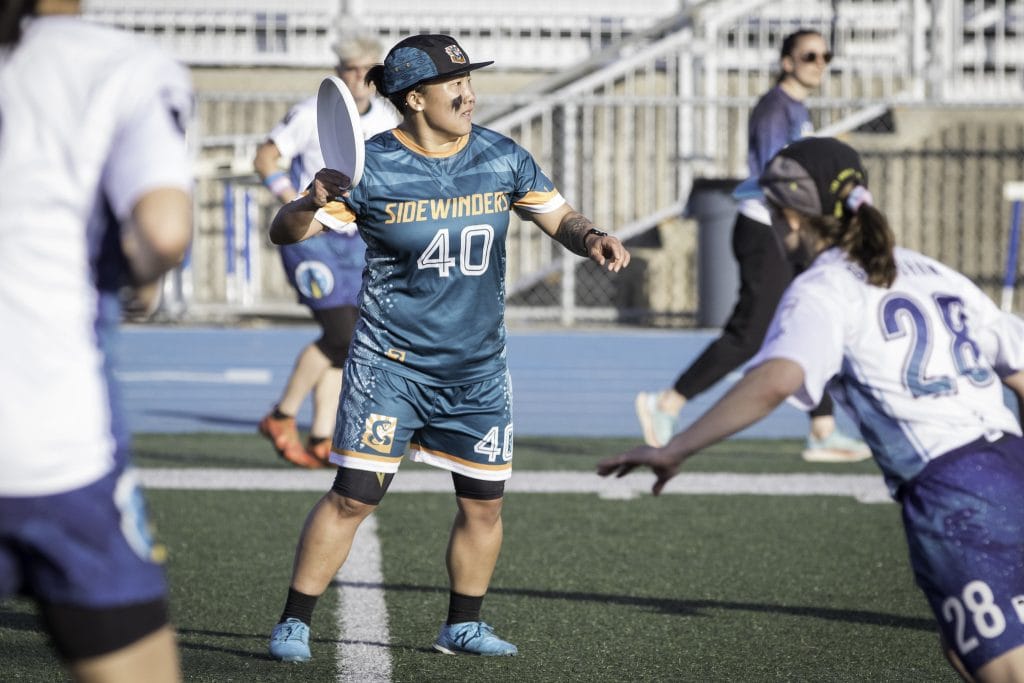
When Arizona is flowing, they’re comfortable stretching the field horizontally before taking vertical shots into space. Expect them to test Utah’s downfield communication early with timing-based deep cuts and quick continuation looks. Paige Applegate will need to flex exactly that kind of quick decision making and composure to define this team. Defensively, the Sidewinders will likely pressure resets and dare Utah’s newer handlers to beat tight windows.
This matchup could hinge on conversion rate. Both teams are capable of generating turns; the question is who turns short fields into breaks. If the game stays scrappy, Utah’s defensive grind could tilt it. If it opens up into a rhythm game, Arizona’s top-end athleticism might create separation.
Hot take: Arizona flashes the sharper offense, but Utah’s defensive pressure defines the opener — Wild pull out a narrow, low-scoring win by converting just one more break in the fourth.
San Diego Super Bloom Host The Bay Area Falcons
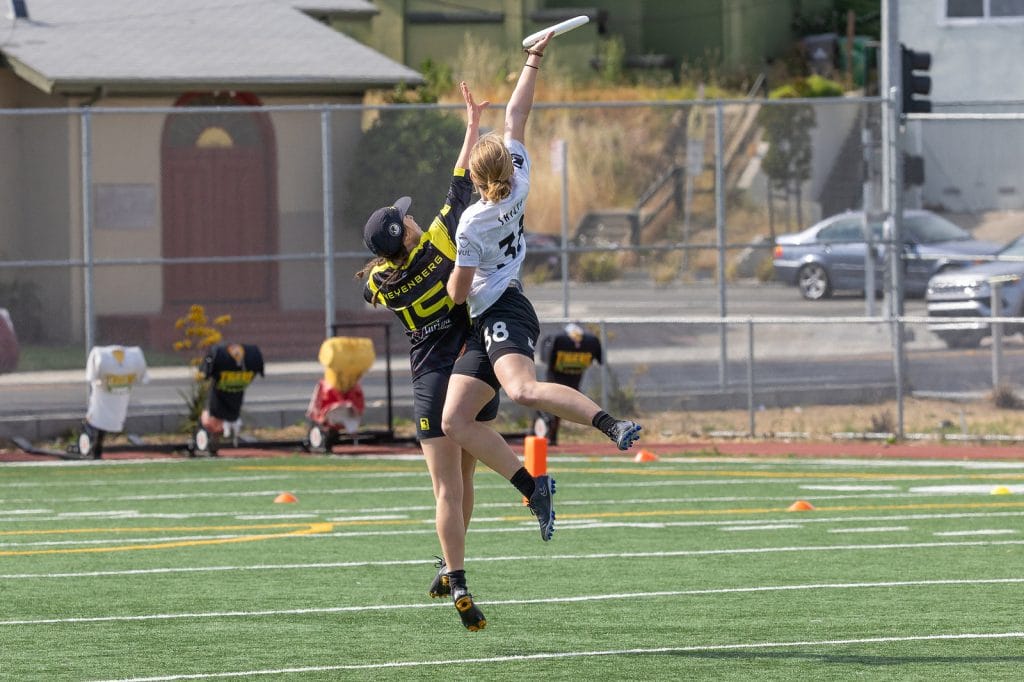
The Bay Area Falcons will take to the road this weekend, completing a double header against the San Diego Super Bloom and then the Los Angeles Astra. This Southwest clash ramps up with a marquee rematch of last year’s title game against reigning champs San Diego Super Bloom on March 14. Even in Week One, this feels like a statement game: Bay Area wants to prove they can sustain a top-tier run, while San Diego is looking to show they’ve maintained the dominance that earned them the title last season.
The Falcons bring a blend of experienced handlers, led by Robyn Fennig, and athletic downfield options, favoring possession-based offense and patience in the red zone. Expect them to probe San Diego’s marks with lateral resets and midline cuts before attempting deep throws, looking to force errors rather than creating hero plays.
The stats may not always reflect great defense, but keep an eye on Olivia Goss for suffocating defense that turns chances into points. Another point of interest, Megan Maxfield has crossed enemy lines to play with Super Bloom this season, a boost to an already flourishing lineup.
Defensively, Bay Area will emphasize positioning over risk, trying to contain San Diego’s explosive cutters while relying on team cohesion to generate turnovers. They have two lock-down defenders in Georgia Cardosa and Margo Donahue that could be an obstacle for the Super Bloom offense.
San Diego, as always, will dictate tempo. Their defensive rotations and downfield athleticism allow them to pressure both handlers and cutters simultaneously. Kaitlyn Weaver quickly made her mark last year as a top all around player and will be a key part of that roster rotation.
Offensively, Super Bloom will test the Falcons’ discipline with quick breaks, sharp isolation cuts, and an ability to punish even minor lapses in spacing. Look to 2025 WUL MVP Kaela Helton to set the pace for this Super Bloom offense playing both behind the disc and downfield when needed. The early-season matchup also offers a chance to see new rookies and returning stars integrate under game pressure — if their chemistry clicks, San Diego could seize control quickly.
The game will likely pivot on the first few breaks. If the Bay Area can hold early and force San Diego into extended possessions, they may keep it close. If Super Bloom establish rhythm and exploit matchups, the Falcons may find themselves chasing the disc for the weekend.
Hot take: The Super Bloom’s championship pedigree shows early — San Diego survives a scrappy first half, then pulls away with a late break or two to take the opener on the road, signaling they aren’t easing into 2026.
Los Angeles Astra Return Home with Bay Area Falcons in Pursuit
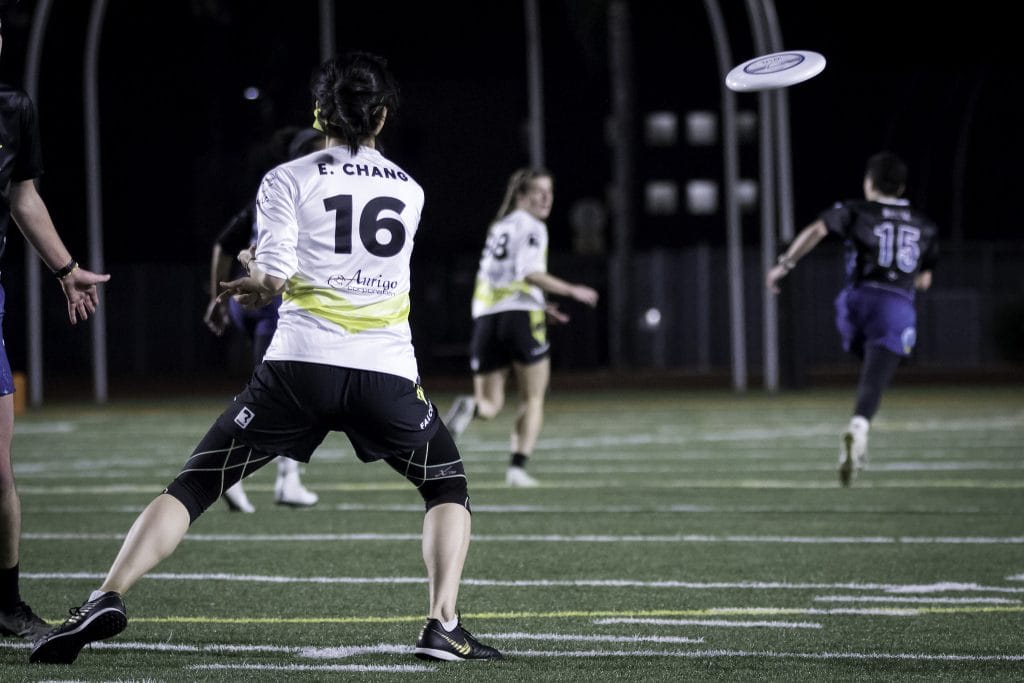
After taking on the defending champions in San Diego, the Bay Area Falcons face their second challenge of the weekend when they travel to take on the Los Angeles Astra. This matchup carries extra intrigue: it’s LA Astra’s first game back in the Western Ultimate League after a 2025 season in the PUL, where travel demands may have limited who could commit to the roster. With the return to a West Coast–focused league, the Astra’s lineup could look noticeably different, and this first game offers a chance to see which players decided to step up under a new season structure. For the Falcons, back-to-back road games make this an early test of endurance, depth, and adaptability.
Bay Area arrives with a clear identity: methodical, possession-oriented offense that seeks to minimize mistakes while taking advantage of defensive gaps. After their opener against San Diego, expect them to be sharper in resets and more willing to launch deep when matchups allow. Key players who took heavy minutes the day before will need to recover quickly, and the Falcons’ rookies may be asked to shoulder more responsibility in both initiating and downfield movement.
Defensively, Bay Area will rely on structured poaching schemes and smart rotations rather than pure athleticism, hoping to slow LA Astra’s pace. Alexi Zalk has the experience and positioning to capitalize on a defensive poach. If we’re lucky, we’ll see her at the top of the stat charts.
The returning Astra bring the energy and experience of a full PUL season, but the question is which players have chosen to commit to this WUL return. Will the core from 2025 reassemble, or will the team lean more heavily on those who didn’t travel last year? They thrive on vertical spacing, quick cuts, and aggressive handler sets, designed to generate break opportunities and rapid transitions. Amy Lee anchors the handler space delivering the disc with a crisp concision that few can rival.
Rookies Sabrina Belkin and Parissa Teli come in with college experience that should allow them to work in behind the disc to keep things moving. LA can turn short-field turnovers into scoring bursts, and if Bay Area’s marks aren’t crisp early, the Astra could seize momentum immediately. Stephanie Pritchard is likely to be the first score on the Astra side, bringing a zeal to plays in tight spaces and high-impact cutting. Defensively, LA relies on pressure marks and downfield communication, daring opponents to force risky continuation throws.
The story of this game will be energy management, adaptability, and chemistry. Bay Area’s ability to recover from a grueling opener, make adjustments, and exploit any early miscommunications may dictate whether this remains a tight matchup or tilts into a home-team advantage.
Hot take: LA Astra’s roster adjustments could make them faster and more versatile than last year. At home, they leverage depth and energy to convert early breaks, ultimately outpacing a fatigued Falcons squad in their first WUL contest back.