We know a good pull when we see it—the pull that hangs forever and finally lands deep in the end zone with the handler defenders closing in close behind—but we’ve lacked the tools to identify the inputs that create that result. Until now.
March 19, 2026 by Guest Author in Analysis
 This article was contributed by Luke Perkins and Devin Benson, the founders of Disc Sense. Luke Perkins began his competitive career in 2002 with the Cornell Buds and has played continuously in the Northeast and Colorado, currently competing with Johnny Walker in the Grandmasters division. Devin Benson started at Harding University and has over a decade of experience in the sport. Both engineers, they founded Disc Sense after taping an IMU sensor to a disc and seeing the rich data hidden inside every throw.
In the world of Major League Baseball, we’ve entered the “Statcast” era. Fans and coaches no longer just talk about a “long home run”; they talk about a 108-mph exit velocity and a 28-degree launch angle. Soccer has followed suit, moving from simple box scores to complex telemetry tracking “Expected Goals” (xG) and player work rates.
For decades, ultimate has relied on the eye test. We know a good pull when we see it—the pull that hangs forever and finally lands deep in the end zone with the handler defenders closing in close behind—but we’ve lacked the tools to identify the inputs that create that result. Until now.
At Disc Sense, we’ve spent the last several months using IMU (Inertial Measurement Unit) sensors to peel back the curtain on disc kinematics. By tracking the exact RPMs and launch velocities of some of the game’s best throwers, we’ve discovered a truth that challenges the conventional “throw it harder” wisdom: when it comes to the downwind pull, spin is the undisputed king.
The Experiment: The Flight Test Crew
To ensure our data wasn’t just a fluke of a single throwing style, we assembled a diverse roster of test pilots in Colorado:
- The Legacy: Founders Luke Perkins (Johnny Walker, Grand Masters) and Devin Benson brought 30+ years of combined ultimate experience.
- The Modern Pros: Quinn Finer (Colorado Apex / Johnny Bravo) and Rachel Stockdale (Colorado Alpenglow) provided the high-octane benchmarks of the semi-pro and elite club circuits.
- The Coaches & Architects: Will Sweeny (Club Coach) and Mike Stowe (App Developer/Masters player) helped translate the raw sensor voltages into actionable metrics.
The Data: Spin vs. Power
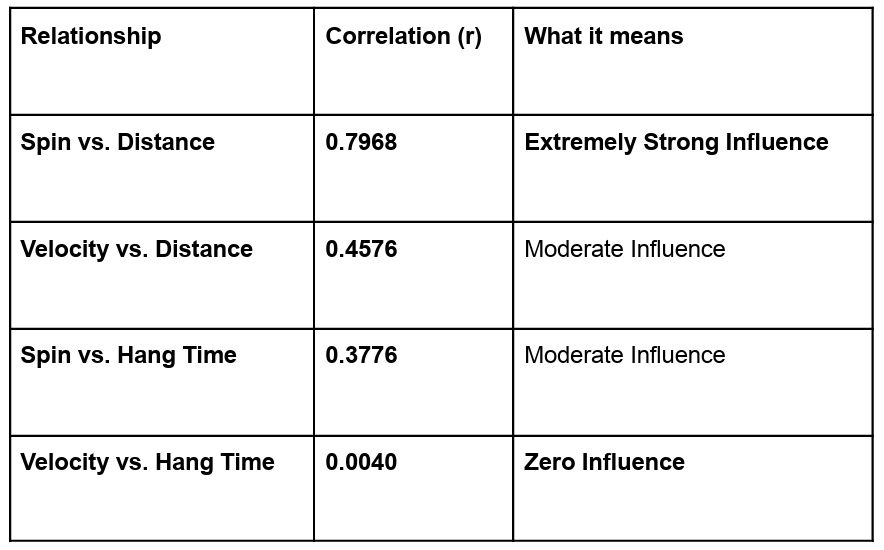
On a picturesque Colorado afternoon in early January we tracked two primary inputs (spin and velocity) and measured their impact on two outputs (distance and hang time) during light downwind conditions. The results were stark.
The Death of the Laser
The most shocking statistic is the 0.0040 correlation between velocity and hang time. In a tailwind, throwing the disc harder has essentially zero impact on how long it stays in the air. It’s important to note that everyone participating in the study is an experienced thrower, so even the slowest pull we measured was faster than 15 meters/second. Stating the obvious, a pull with zero velocity won’t have much hang time, but the results are clear that velocity isn’t the primary driver. If you are a puller trying to give your D-line time to set the mark, your arm isn’t the tool for the job—your wrist is. In a downwind environment, high velocity without high spin often results in a laser that loses relative airspeed and drops prematurely.
Why Spin Wins the Distance Race
The 0.7968 correlation between spin and distance is nearly double that of velocity. High RPMs provide gyroscopic stability, allowing the disc to ride the tailwind rather than being pushed down by it. High spin keeps the disc flat, maximizing the lift-to-drag ratio over the duration of the flight.
Mike’s Pull
Will’s Pull
Which of these pulls do you think had greater velocity? Which do you think achieved more hang time? You might look at how far the pullers brought the disc back, the length of their throwing motion, or the angle and height of their release. But you won’t really know, perhaps not even if you were standing on the sideline, watching each throw’s full flight.
But with measurement, we can know not only the characteristics and comparisons, but also tease out the why. Mike’s pull flew for longer and went further than Will’s, but Will’s pull had greater velocity.
Training for RPMs: Three Tips for More Snap
If the data says spin is the primary driver of success, how do we get more of it? Unlike velocity, which relies on large muscle groups, spin is a product of distal speed—how fast you can move the edge of the disc in the final millisecond of release.
- Shorten the Lever: Many pullers use a massive, straight-arm windup. While this adds MPH, it can muffle the wrist snap. By keeping a slight bend in the elbow (creating a power pocket), you allow the arm to act like a whip, accelerating the wrist through the release.
- The Pivot Point Grip: Ensure your grip allows the disc to pivot around your index finger or thumb pad at the last second. If you grip too deeply in the palm, you may be unintentionally dragging on the disc and eating your own spin.
- The “Audible Snap” Drill: Practice throwing into a net focusing purely on the snap sound of the release. If the disc wobbles (off-axis torque), you are losing energy. A clean, silent flight is the hallmark of high-efficiency RPMs.
The Future of Flight Data
This data is just the beginning. By quantifying the mechanics of players like Rachel Stockdale and Quinn Finer, we are building a roadmap for how the next generation of players can train smarter, not harder.
Disc Sense is currently ramping up for a Kickstarter campaign in the coming months to bring this sensor technology to every ultimate and disc golf athlete. When we launch, Disc Sense will measure spin, velocity, release angles, touch, and more.
If you want to be the first to get your hands on the “Statcast of Disc Sports”, you can join our pre-campaign at get.discsense.net and stay updated by following us on Facebook and Instagram. The “eye test” had a good run, but the era of the Disc Sense has arrived.
