Defending champs San Diego Super Bloom came out swinging to start the 2026 season, putting away a buzzy Bay Area team who had some splashy offseason signings
March 20, 2026 by Keith Raynor and Emilia Scheemaker in Preview, Recap
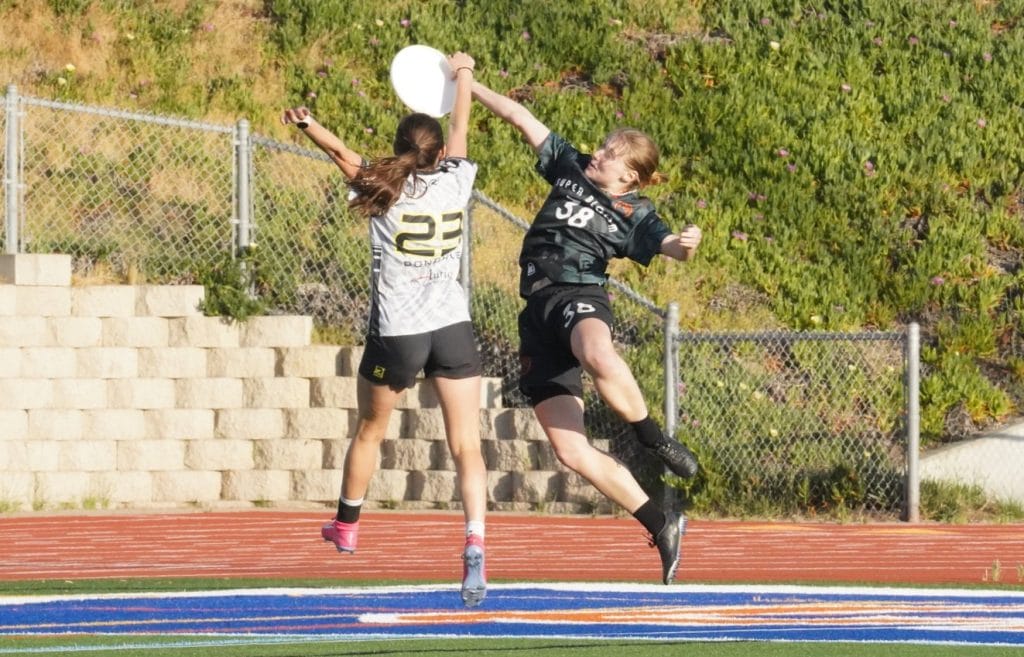
Week one is all wrapped up in the Western Ultimate League, and the reigning champs didn’t ease into 2026. Instead, they made a statement.
In a rematch of the 2025 title game, the San Diego Super Bloom overwhelmed the Bay Area Falcons 22–14, turning a competitive early stretch into a second-half rout.
San Diego’s identity looked familiar: suffocating defense, quick-strike offense, and a system that turns small mistakes into multi-goal runs. Bay Area had moments—especially when their handler core found rhythm—but they couldn’t sustain pressure against a team that punishes every lapse.
Read on for seven plays that tell the story. Plus, week 2 game previews and updated power rankings!
First Quarter: 7 Plays That Defined San Diego’s Statement Win Over Bay Area
1. Helton Sets the Tone Early
If there were any questions about how San Diego would look offensively this season, Kaela Helton answered them on the opening points.
Operating interchangeably between the backfield and cutting space, Helton initiated cleanly and then immediately attacked upfield for return passes. With relentless pace, San Diego showed they preferred to attack rather than grind. This showed in the final stats, as the Falcons attempted over 60 more throws than Super Bloom.
One early possession encapsulated it: at 7-5, San Diego threaded together a centering touch and a give-go burst through the lane, allowing Helton to perfectly time a continuation huck that flipped the field in seconds and found Lexa Stambaugh in the end zone.
2. Falcons Find Rhythm Through Fennig
Bay Area’s best stretches came when Robyn Fennig controlled the tempo, as she led the game to the tune of 593 throwing yards and four assists. Midway through the first quarter, Fennig orchestrated a patient hold, breaking marks and hitting inside lanes to keep the disc moving laterally before striking upfield. It was classic Falcons offense—composed, possession-oriented, and efficient. With Super Bloom up 9-6, Jules Madigan streaked deep. Even with Cameron Helm and Kelli Iwamoto in the area to tip the pass, Madigan was able to drag down the disc.
For a moment, the game looked balanced.
3. Falcons Miss Their Window
Early in the second half, Bay Area had a chance to shift momentum.
A turnover near midfield gave them a short field, and with Fennig and Alex Barnett working together, they advanced into the red zone. A well timed cut from Alexi Zalk and a throw that threaded the needle from Fennig brought wind back to their sails.
4. Maxfield Sparks the Energy
The game’s first real shift came late in the 3rd quarter off a long defensive point where Megan Maxfield made her presence felt. This is Maxfield’s first year with Super Bloom, but not her first year earning accolades.
With tight coverage and a narrow window, Maxfield attacked the lane for a huge bid and immediately turned upfield. Within three throws, San Diego converted to Merideth Byl in the end zone. That sequence became a pattern. Defense → instant offense → break.
5. Bay Area’s Deep Game Keeps It Close
To their credit, the Falcons didn’t fold early. A well-timed deep shot to Kendra Miller cut into San Diego’s growing momentum and cut the lead to two. It was one of Bay Area’s most effective drives: quick-strike offense before San Diego’s help defense could set.
At this point, the margin was still manageable, and Bay Area had a path.
6. Defensive Pressure Snowballs
Then the game tilted, and fast.
San Diego’s defensive unit, bolstered by additions like Kyra Khoroujnikova, began to compress space across the field. Handler resets tightened. Downfield windows closed faster. One sequence halfway through the third quarter said everything: a disc floated into traffic, leading to a heads-up block and another conversion. Khoroujnikova batted the disc down, allowing the play to develop where Tori Gray and Abbi Shilts showcased what connection looks like. This kicked off a five-goal run that allowed Super Bloom to effectively put the game away.
If there’s one stat that sums up the game, it’s each team’s break efficiency: while Super Bloom converted 50% of their 22 break opportunities, the Falcons punched in just one of nine.
7. Shilts Closes the Door
By the time Abbi Shilts took to the air against the pressure of Margo Donahue to pull down a late goal, the outcome was no longer in doubt. More than a highlight, the play was emblematic of San Diego’s ability to win in space, attack confidently, and finish plays cleanly. Bay Area had been pushed out of their system, while San Diego never left theirs.
The Bigger Picture
San Diego’s 22-goal output reflects not just offensive efficiency, but total control. They dictated pace, forced Bay Area into uncomfortable possessions, and converted breaks at a rate that turned a competitive game into a runaway. For Bay Area, the underlying structure is still strong. When players like Fennig and Barnett were able to settle into possession, the offense worked. But against a defense this deep and this coordinated, their margin for error was razor thin. And too often, they crossed it.
Beyond a win, this game was a reminder that the San Diego Super Bloom still set the standard in the WUL. If this game is any indication, in their title defense San Diego are aiming to reinforce a blueprint that few teams, even ones as talented as the Bay Area Falcons, have shown they can consistently break.
Second Quarter: Around the League
Opening night hosted another game in addition to the Falcons and Super Bloom: the Utah Wild on the road against the Arizona Sidewinders. And it took only one game for the Sidewinders to earn the win that has evaded them for their last 10 games, outscoring Utah 23-14. The game was fast paced, with both teams nailing hucks effectively and coming up with good blocks. The Wild offense showed the signs of inexperience, a problem not plaguing Arizona. Kristen Reed’s Arizona debut produced three goals and 231 receiving yards.
On Sunday, the Falcons welcomed the LA Astra back to the Western Ultimate League with a 15-12 win. It was breezy outing with both teams struggling to maintain rhythm as the wind picked up. After 11 combined goals in the first quarter, the teams put up just 16 more in the rest of the game. Raleigh imports Alex Barnett and Dawn Culton both made their mark for the Falcons: Barnett tossed 259 yards and three assists with only a single turnover, while Dawn Culton tallied three blocks in the win. Nadine Meister led the way for the Astra with 351 total yards, over 100 both receiving and throwing, to go with two goals and an assist to only one giveaway.
Third Quarter: Week 2 Preview
Oregon Soar Host Colorado Alpenglow
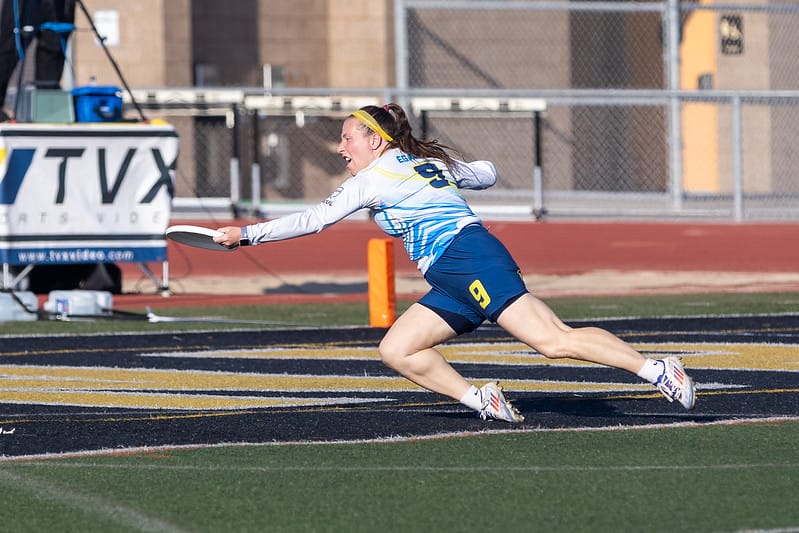
The 2026 Western Ultimate League season continues to build momentum with Colorado Alpenglow suiting up for their roadtrip. They’ll begin with a marquee matchup in the Pacific Northwest, taking on Oregon Soar and then Seattle Tempest. For both teams, this is Week One — a chance to set the tone for a season that promises depth, speed, and plenty of storylines.
Colorado arrives with a reputation for explosive athleticism and aggressive downfield play. The Alpenglow offense relies on vertical spacing, quick isolation cuts, and the ability to turn short-field turnovers into scoring runs. Ari Nelson is one of Alpenglow’s keys to quick transitions and threats downfield, no matter how far the throw has to travel. Defensively, they pressure handlers and cutters alike, aiming to generate chaos and force high-risk throws. Expect Kennedy McCarthy and Abby Thorpe to be consistent targets, as Thorpe brings a grit for tight-window plays and McCarthy has a unique ability to create space and make plays above and beyond her wingspan. With a new season and roster tweaks in 2026, the Alpenglow will be looking to see which combinations click early and how well rookies can integrate into high-intensity game flow.
Oregon, meanwhile, will lean on discipline and structured offensive sets. Soar favor patient possession, testing defenses with lateral movement before hitting high-percentage deep throws. Their athletic downfield corps can create separation, but chemistry and timing may take a few points to click in their first game. This roster feels like Onyx and Soar colliding, with players on both sides who will need to anchor team culture. Rachel Egan and Geli Boyden were standouts last year, now joined by Murl Hammond and Aly Steinfeld who boast Onyx roots.
On defense, Oregon will mix poaching and help coverage to absorb Colorado’s explosive early cuts, testing how well the visitors maintain composure. Expect Emily Pozzy to deliver behind the disc, using a blend of soaring passes to attack downfield and disciplined body positioning to defend the backfield.
The matchup sets up a classic contrast: Colorado’s game-speed aggression versus Oregon’s disciplined, possession-first approach. Turnovers and conversion efficiency will likely decide which team controls momentum. If the Alpenglow can weather early defensive disruptions and spread the field effectively, they can leverage their speed to pull away. But if Oregon’s sets click early, they can disrupt Colorado’s rhythm and force a more methodical, grind-it-out contest.
Hot take: Colorado’s road-tested explosiveness gives them an early edge, but Oregon’s freshness and disciplined execution keep it close — look for the Alpenglow to scrape out a one- or two-break win in a physically intense opener for both sides.
Colorado Goes Back-to-Back Against Seattle
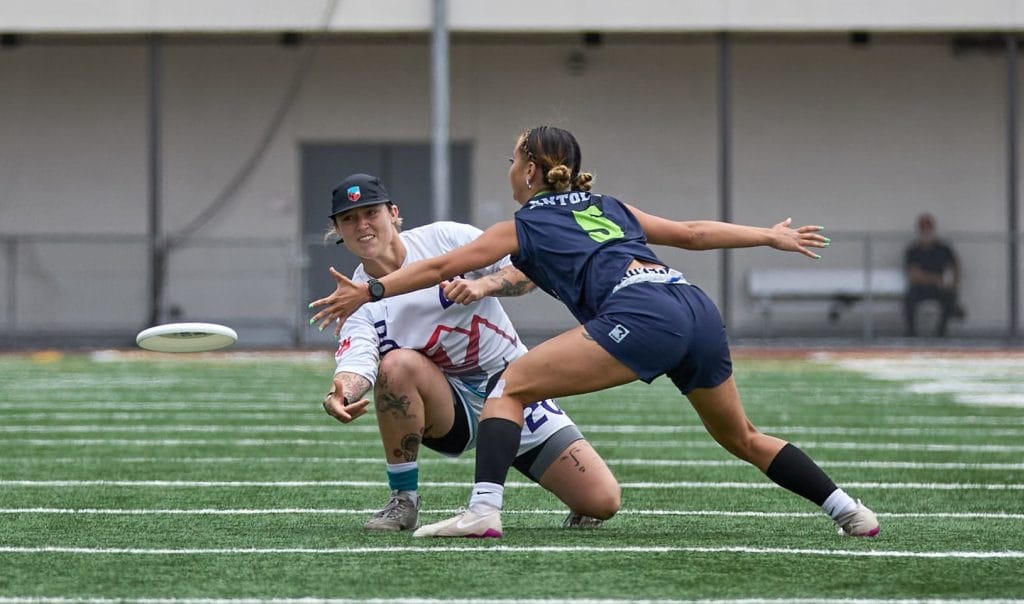
After opening their season against the Oregon Soar, Colorado stays on the road for the second leg of the early-season trip, taking on the Seattle Tempest. While this is Alpenglow’s second game of the weekend, it’s the season opener for Tempest, which adds an intriguing wrinkle: the visitors already have one full game of rhythm and fatigue on their legs, while the home team brings fresh legs but may be rusty in timing and spacing.
Roster continuity and high-level athleticism should allow Alpenglow to recover from the previous day’s exertions, though depth rotation will be crucial to maintain pace against a fresh opponent. Defensively, Colorado will look to pressure Oregon’s handlers early and punish any hesitation downfield.
With this being Seattle’s first game, chemistry and timing will be key, particularly in handling Colorado’s upfield aggression and transition speed. The Tempest defensive approach will emphasize smart rotations, poaching lanes, and forcing opponents into low-percentage continuation options, though some of that poaching strategy may go by the wayside with the loss of Sadie Jezierski to PUL’s New York Gridlock. Tempest will have sturdy anchors in Cheryl Hsu and Alexa Kirkland behind the disc, but they’ll need new players to step into defensive leadership.
The early narrative of this matchup is likely to be a contrast in style, pitting Colorado’s vertical, high-variance approach against Seattle’s patient, methodical execution. Turnovers will loom large — if Seattle can weather Colorado’s early bursts, they have the tools to grind out holds and keep breaks to a minimum. Conversely, if Colorado’s athleticism opens space quickly, Seattle may find themselves playing catch-up for much of the game.
Hot take: Colorado’s high-powered offense flashes first, but Seattle’s structured patience and defensive discipline allow them to absorb the early pressure and steal a tight opener, proving that in the WUL, efficiency can beat explosiveness when margins are thin.
Fourth Quarter: PUL Debuts New Stats Hub
Ahead of first pull of the 2026 PUL season, the league launched a new stats website. New Commish Emma Soiles actually shared this in our Discord, which all of our subscribers get access to.
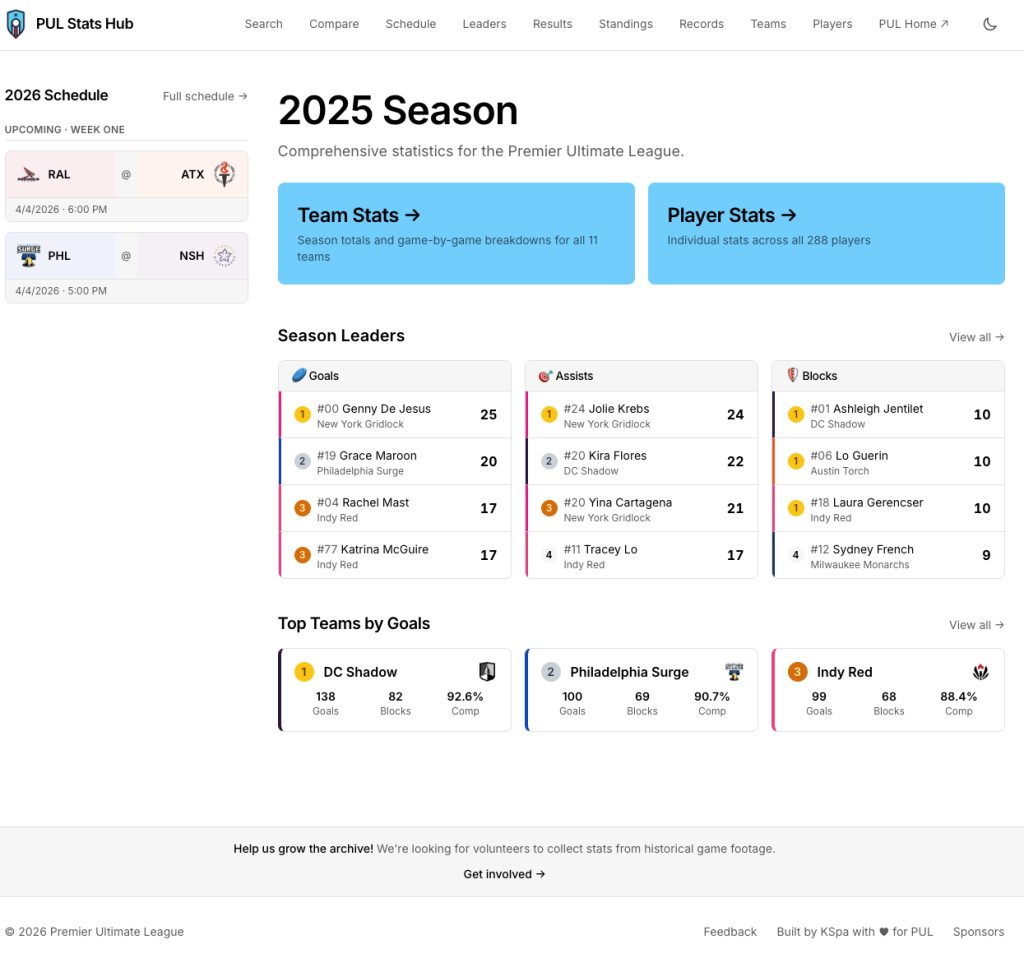
The new hub has a strong, easy to read aesthetic, and is quite response at the time of publication. While the content is mostly from 2025 at the moment, there is a Records page, indicating there is more to come to gather the history of the league. In fact, they are seeking volunteer help backfilling the data. The WUL Stats Page certainly seems to have raised the standard, and with another league’s worth of data, we could see further exploration of advanced statistics.
Currently, there is no yardage data due to historical discrepancies, but if resources allow, there is space that looks intended to host such valuable information going forward.
WUL Power Rankings
| Rank | Team | Change | Prior |
|---|---|---|---|
| 1 | San Diego Super Bloom | +1 | 2 |
| 2 | Bay Area Falcons | -1 | 1 |
| 3 | Colorado Alpenglow | - | 3 |
| 4 | Seattle Tempest | - | 4 |
| 5 | Arizona Sidewinders | - | 5 |
| 6 | Los Angeles Astra | - | 6 |
| 7 | Oregon Soar | - | 7 |
| 8 | Utah Wild | - | 8 |