Catching is an undervalued and undertaught skill by many teams of all levels and divisions.
March 25, 2026 by Tiina Booth in Opinion
This article is presented by the National Ultimate Training Camp. NUTC is celebrating its 26th Anniversary.
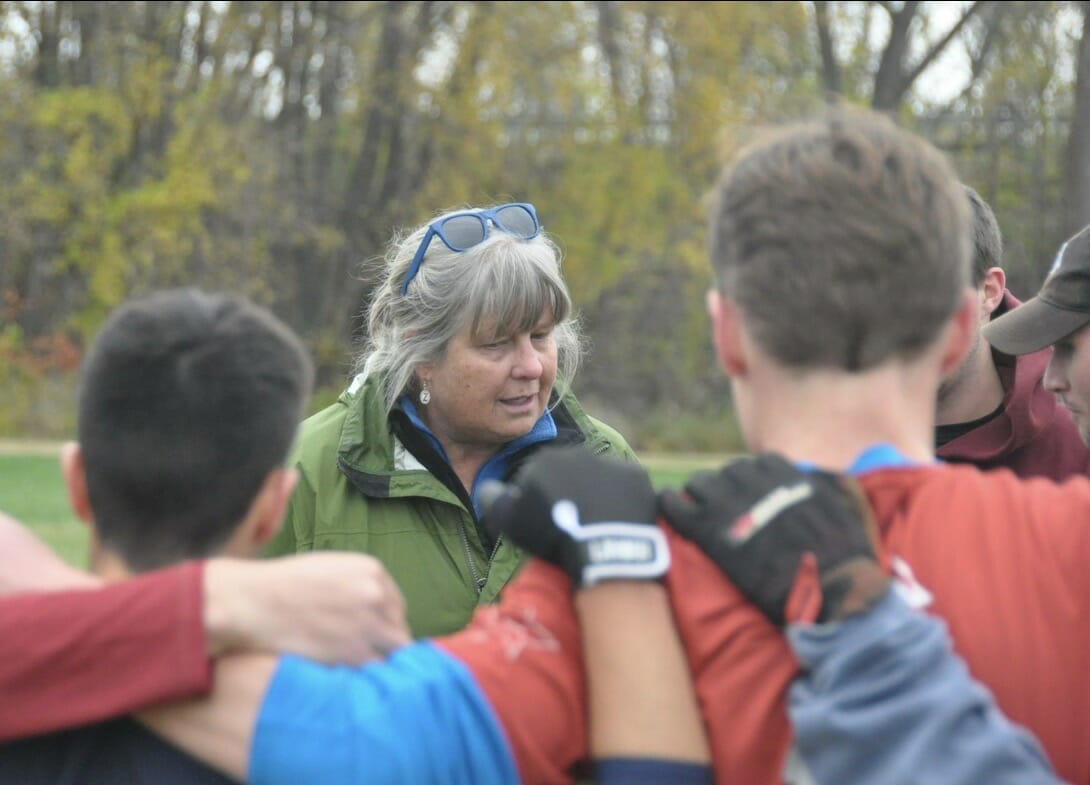
One of my favorite compliments from my years of coaching Amherst HS boys was from a Zoodisc alum, Brent Anderson. He said that he hated playing my team because the players “always caught everything.” Even when the disc was being bobbled and their arms were flailing, they still managed to secure the disc.
This was not random. We trained catching every day.
I knew if we wanted to beat teams that were older and faster than us, we had to develop skills that other teams did not.
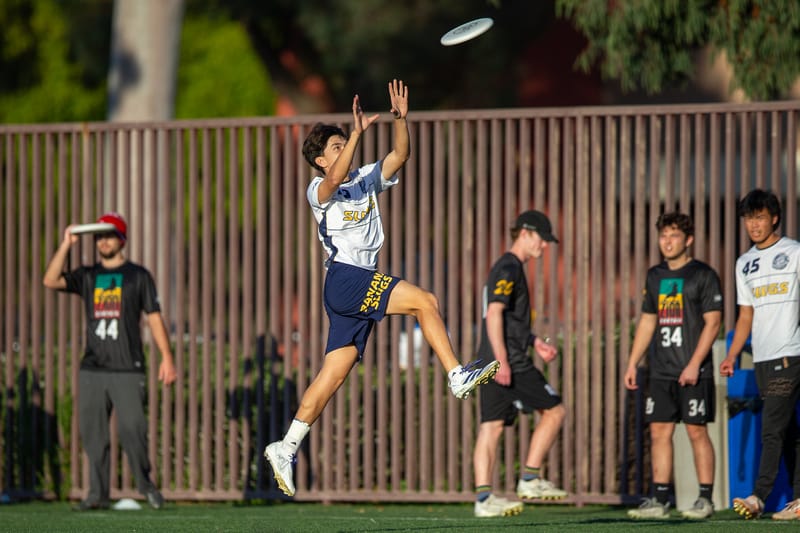
Catching is an undervalued and undertaught skill by many teams of all levels and divisions. When I think back on the games I have watched in the last year, it appears that teams are less concerned with drops these days. I am not calling out individual players or teams, as the issue seems to be everywhere. Will the same problems with drops show up this spring? When will overall catching improve, and how do we make it happen?
Teams put more effort into overlooking drops than eliminating them. Reasons such as wind, rain and even a different disc are some of the tired excuses. Every team should prioritize developing and maintaining catching skills. I know of no strategy whose foundation is built on the dropping of the disc.
When I mentioned this article to some friends, they laughed at first and then proceeded to tell me about catching techniques: two hands, attacking the disc, body positioning etc. That is not what this article is about. Sure technique is important, but developing strong analysis, practice and desire will bring your team to a new level of consistency, and success will follow.
Analyzing Your Catching
How do you know your team needs to work on catching? Aside from the obvious, a team that drops a lot starts this journey at practice. Here are some telltale signs:
Casual warm-ups with low effort. I have had to restrain myself when I see a player who kicks a low disc rather than bending over to catch it. Or fails to jump and reach just a little bit over their head. Or – I guess I just hate casual warm-ups.
Throwing drills that focus only on throwing. For example, if you are doing a swing and continue drill designed to get the disc off the sideline, make sure the continue is instructed to catch and fake down the far sideline. This player has to secure the disc, find the correct grip, pivot into the correct position and deliver a believable fake. Often players get ahead of themselves and look for the next target before they have completed the catch. This is a very common reason for dropping the disc (or football) and is a classic example of not being in the moment, the Achilles’ heel of competing.1
Looking off a player who drops. No one gets better at catching by not being thrown to. (I am looking at you, MMPs playing mixed). The handlers who execute a no-pivot half-flail to a player they have no intention of throwing to are the actual problem. Once you replicate this careless habit in an actual game, bad things will happen. Throwers should be delivering a well-timed easy catch to whomever is open.
And if you are that experienced handler who rolls their eyes when one of your “perfect” throws is dropped, let that go. It’s time to play defense.
How Drops Affect Competition
Drops are more than just turnovers. A dropped disc can do unchecked damage to other aspects of actual competition.
Players get rattled by their mistakes. Dropping a disc when the pressure ratchets up is almost to be expected. When a player is affected negatively by nervousness, the blood leaves their extremities and floods to their brain, heart and lungs. They are not able to breathe, run, or catch well. They are thinking too much (“What did I do?”, “How did I drop that goal?”) and have lost the quickness of just reacting. Unless players specifically trains their brain for these moments, this trap is always waiting for them. For additional proof, look no further than March Madness. The player who misses the bunny lay-up or airs a crucial free throw is also responding to a nervous inner monologue.
Fighting an internal team narrative (“we are a team that drops a lot” or “we aren’t fazed by drops because they just happen”) wastes a lot of energy and focus throughout the season. If your players respond internally with “Here we go again!” after a drop, they are setting the lowest of expectations. A coach is responsible for interrupting and instituting a new narrative as soon as possible: ”We are a team that catches everything.”
An opposing team that drops the disc a lot is a liability, not a gift to your team. After an easy win, your team often expects that the next team will also cough up easy turns. Your players wait around for the next drop rather than playing clean offense and aggressive defense. They are still hoping for unforced errors and it takes an intentional effort to elevate their play, which is exhausting for a coaching staff, especially if you have to do it multiple times during a weekend.
Drops beget shame, maybe more than any other mistake on the field. This is most true if it is a dropped pull. Commentators refer to it as a “nightmare” and reporters make sure to mention it in their recaps. Regular old drops in the end zone are also painful. If you are on a team with a competitive2 team culture, you will be able to withstand these mistakes. Unfortunately some players abandon the “droppers” or hold it against them, as if dropping is somehow contagious. If it does feel contagious, then your team needs to return to your mental resilience program.
Practice
The best news about improving a team’s catching efficiency is that it does not take a big chunk of time. It could take as little as 10-15 minutes per practice, and some of this can be woven into the drills and scrimmages that you already do. What needs to change is the mindset of every member of the team, from rookies to leadership, from tryouts to the last game of the season.
Raising the Stakes at Practice
The mental shift to get better reps outside of a game environment is not easy, but is achievable.
Assessing tryout players through the lens of catching vs. throwing skills. If you want a new player to succeed quickly in scrimmages, you want someone who will catch the disc no matter what, even if it looks frantic. This shows an ability to focus quickly and builds trust in the early days of forming a team. For the individual player, this could also be an easy way to increase playing time.
Ramping up pressure during drills. If one of your team narratives is “we play well at practice, but we fall apart during games,” then your practices are fundamentally a waste of time. Drills and scrims should test everyone’s ability to focus and execute, and should increase in difficulty. If they can’t do a catching drill, make it more demanding. I remember warming up at the Amherst Invitational years ago in thick sleet. I wanted them to get 15 throws in a row before we moved onto something else. Impossible. So I asked them to do the same thing but only use one hand. It was ugly but they did it and then easily caught more than 15 when they returned to two hands. Focus changes everything and being able to focus on the right thing is an essential part of practice.
A coach’s job is not to give their team a false sense of success. Fight the urge to make it easier. That’s not how you build competence.
Understanding the connection between throwing and catching. Maybe the reason I have noticed so many more drops recently is because throwers have become more skillful and catching skills have not kept pace. Or because the speed of offense has increased dramatically. Or because throwing is way more fun to refine than catching. However, as throws improve, catching needs to improve at the same rate. Dare I say, they literally go hand-in-hand. An easy example again is that swing pass off the sideline. As a thrower learns to put touch on the disc, and the disc hovers more, the receiver will have a much easier target to secure. Different release points and flight paths necessitate better and different training for catching.
Drills Worth Doing
Embrace the weather. Wind is your friend, and your enemy at times. But wind holds up a mirror so you immediately can see what you need to work on. It’s a gift, along with its counterpart, cold rain. When you can safely practice in these environments, embrace the opportunity rather than complain and hide.
“Reading the disc” drills are fun and not a waste of time. It’s the perfect opportunity to explain positioning, time jumping and increase overall team energy. Make a game out of it. Do it often.
For example, “It’s Up!” is a drill for many levels of players. Players pair up according to height or jumping ability and then line up next to an experienced thrower, facing into the wind. Thrower yells “go” and the first pair runs straight down the field. When the disc is thrown, the other players in the line yell, “It’s Up!” At this point, the two receivers look for the disc and track it down accordingly. Not only do these players have the opportunity to improve their reading and positioning, but the other participants can see these challenges in real time and hopefully learn from them.
Create drills in which inaccurate throws and other limitations are the norm: throw the disc deliberately behind the receiver, somersault and pop up as the disc approaches, spin once before catching the disc, lie on the ground and play catch, etc.
For example, set up players in pairs in a throwing line, facing each other. Make sure they are at least 10 feet away from the other players who are next to them. Start with basic commands, such as “flat backhands” or “io flicks.” Increase difficulty with “10 consecutive backhands and sit down when you are done.” I guarantee the catches will improve the second you introduce some kind of competition. Continue to build on this drill by adding some fun challenges. Watching a player figure out how to execute a coordinated spin before a disc hits them has always been one of the highlights of my coaching career.
Break up the perfect flow. Anything that interrupts the optimum flow can be useful because no team can maintain optimum flow forever.
Desire
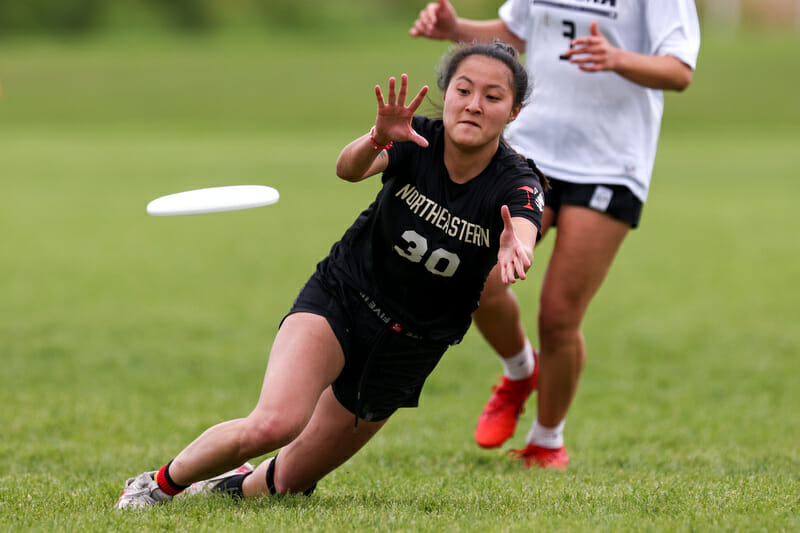
Getting a team to care about executing well is a monumental task. The story goes that if everyone cared more, they would try more and we would win more. Let’s lay that myth to rest. Instead, I suggest fanning a player’s desire to improve by hiding it behind small successes.
Rein in difficult throws that are challenging to catch, at least for the first part of the season. My forever pet peeve are those away throws in the end zone that are misread or flutter to the ground or both. Set your receivers up for success as often as possible and remind everyone that throws have to improve in order for catching to improve.
Replace shame with analysis when looking at drops. Try to find out exactly what is happening. In my early years of coaching, I had a player who dropped almost every single clap catch. I was definitely annoyed because I thought they were simply not trying. It turns out that when they went to catch the disc, they didn’t spread out their fingers and therefore their hands didn’t meet and they fumbled it into a drop. This happened over 20 years ago and I still remember my anxiety over not catching this easy error to fix and taking so long to help this player.
Offer genuine praise when good things happen. If your endzone conversion rate improves, let them know. If someone hustles to save an inaccurate or tipped disc, let them know. Also, ohmygoodness how much do I love the second-effort catch, either from the intended receiver or someone else who is paying attention? Hustle needs to be celebrated always, and leaders and captains need to hustle the most. Hustle is desire epitomized.
Dropping discs is a team problem and not an individual weakness. It therefore takes an entire team to improve catching efficiency, and no one is above doing what it takes to make this happen. This includes building a supportive structure, understanding drops as something to be fixed, and, most importantly, relishing every moment you spend throwing and catching in the coldest, windiest, wettest conditions you can find.
“Staying in the moment” is the basis of developing a strong mental game and, like anything worth learning, is easier said than done. ↩
Competitive does not mean win at all costs. Competitive means developing the team-wide skill of being able to rebound almost instantly, where everyone knows how and when to return to the moment. ↩