Ultimate's athletes deserve better concussion preparedness.
July 16, 2026 by Guest Author in Opinion
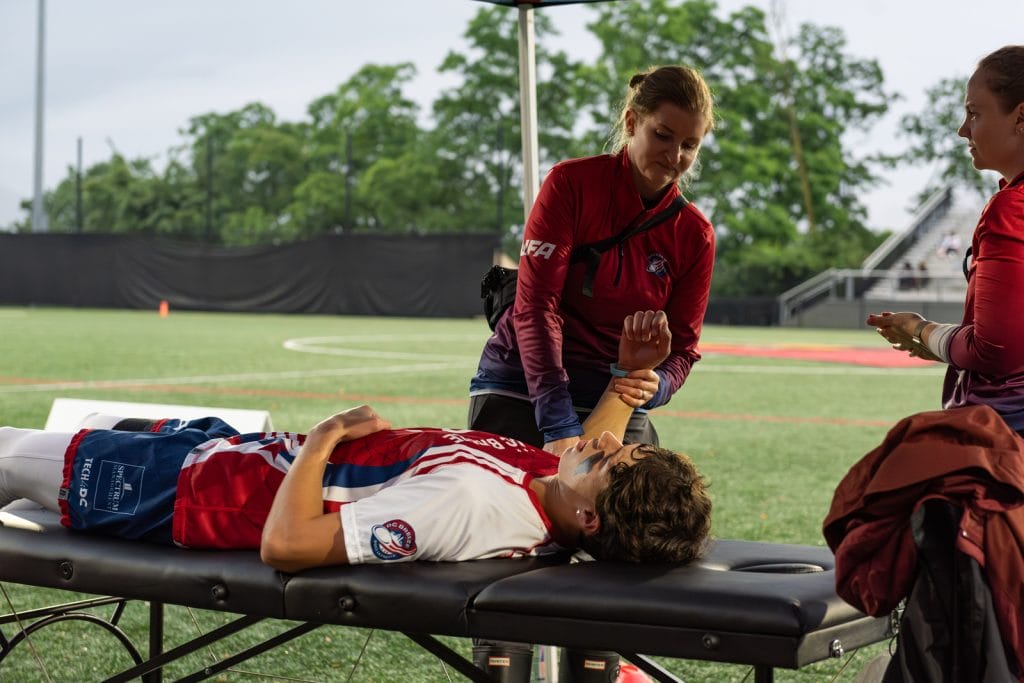
This article was guest authored by Adrianne Soo, an Emergency Medicine physician practicing in Seattle, WA. She is a former club ultimate player and D1 collegiate distance runner and volunteers as a team physician for the Seattle Cascades & Tempest Ultimate and Seattle Seawolves Rugby teams.
This article should not be used as a substitute for in person professional medical evaluation and recommendations.
Despite being considered a non-contact sport, concussions are still a common occurrence in ultimate. If we have not had one ourselves, it’s likely we can all name a friend who has sustained a concussion while playing. Prior research has suggested that a quarter of competitive ultimate players have been concussed during play.1 Concussions can have significant short- and long-term consequences for athletic, academic and professional careers. Prompt recognition of concussions and removal from play is critical for player safety in order to avoid Second Impact Syndrome, where a second head injury occurs before the initial head injury has healed. This can lead to rapid brain swelling and can, in some rare cases, be deadly. Even if a player does not experience a second head injury, immediate return to play has been shown to slow concussion recovery.2
Alarmingly, a prior study showed that approximately 40% of ultimate players still return to play the same day as a concussion, likely unaware of just how serious the consequences could be.3
After seeing this concerning behavior of immediate return to play both on the field and in the research literature, I was inspired to further investigate concussion protocols in the UFA, PUL, and WUL. As an Emergency Medicine physician and a former ultimate player, I believe the professional leagues have a responsibility to provide the education and resources needed to ensure player safety and have the potential to serve as examples for player care at the club and collegiate levels as well. If we look at other professional, semi professional, or NCAA collegiate leagues, we can find many examples for how to model concussion protocols. As a medical volunteer for the Major Rugby League, I’ve been highly impressed at how this league approaches concussion care with the utmost seriousness. The league requires preseason concussion education for players and staff, preseason baseline concussion testing, mandatory standardized sideline assessments after any suspected head injury, staged return to play criteria with a seven day minimum return time, and availability of medical staff including a team physician and athletic trainers. While rugby poses a much higher overall concussion risk than ultimate, we can still learn a lot from their management.
A Lack of Protocol
In surveying the professional ultimate leagues, I found that there were significant disparities in concussion management between teams. There did not seem to be any league wide standards for concussion care. The survey results showed that half of teams had no standardized post-concussion assessment or return to play protocols, or access to medical staff. Even fewer teams offered concussion education or performed pre-season baseline testing. The survey also found that the majority of players were interested in implementing concussion protocols if not already available on their team.4
These results showed that there is significant opportunity for and interest in improving concussion care in the pro ultimate leagues, and likely for the sport as a whole as well. Most professional, semi-professional and NCAA collegiate field sport leagues have standardized, league wide concussion policies in place to protect players. As the ultimate professional leagues continue to grow in visibility, developing their medical protocols to be more in line with other professional leagues will help further their legitimacy on the national stage.
Recommendations to Protect Athletes
So what are some ways that leagues or teams – whether pro, club, or college- can improve their concussion care? The most important components of concussion care are early recognition and immediate removal from play. Any suspected concussion needs evaluation by an objective assessor. A concussed player cannot be relied upon to make their own assessment. Not only can the confusion associated with a concussion impair a player’s ability to determine the degree of their injury, but players also have the strong conflicting motivation to return to the play, which can compromise their objectivity. While ideally concussion assessments should be made by trained professionals such as team physicians or athletic trainers, teammates or coaches can also make sideline assessments when medical personnel are not immediately available. Some basic rules of thumb for concussion assessments are as follows:
Definitive indications for immediate removal from play:5
- Confirmed or suspected Loss of consciousness
- Any convulsive movements or seizure-like posturing
- Loss of balance
- Clearly dazed or confused
- Disoriented to person, place or time
- Notable behavior change
- Significant headache
Any of these findings would be a clear indication of concussion and should prompt immediate removal from play. However, concussions can present much more subtly, and assessors should have a low threshold to remove a player from play if there is any uncertainty. Ask the player about symptoms such as headache, head pressure, nausea, and feeling “off”. Ask orientation questions such as what venue you are at, what half or period of the game it is, which team scored the last point, what team you played last week.6 Teams or leagues can consider making a checklist of assessment questions at the beginning of the season. Checklists can help reduce stress in the heat of the moment and offer objectivity when conflicting interests from an important game might be present. Standardized concussion assessments such as the SCAT 6 are also available for people trained in how to conduct it. In some cases concussion symptoms can be delayed, so even if the player is initially asymptomatic after head impact, they should continue to be monitored throughout the game. If a head injury is suspected, someone should stay with the player for at least three hours after the injury. Players with suspected concussions should try to be seen by their doctor within a couple days of injury.
Some head injuries require more immediate evaluation. While rare, sport-related head injury can cause serious brain injury, such as brain bleeding or skull fracture. Indications for immediate Emergency Room evaluation include, but are not limited to:7
- Vomiting
- Bruising around the eyes, ears, or scalp
- Altered level of consciousness or difficulty to arouse
- Abnormal behavior (e.g. excessive agitation, inconsolability, refusal to cooperate, lack of response to questions or events, violent activity)
- Seizure-like activity or convulsions
- Blood thinner use
- Age > 65
- Amnesia for > 30 minutes before the event
It is always better to be safe than sorry if there is any uncertainty.
Returning to Competition
Once a concussion is diagnosed or suspected, a graduated return to play is the next critical step in management. While the nuances of the best return to play protocol are debated, a stepwise return is generally recommended. Players should wait at least 24-48 hours before advancing to the next step, and should return to the prior step if symptoms are worsened by advancing activity.
Here is an example return to play protocol from the CDC:
- Return to activities of daily living- limit screen time and physical activity
- Light aerobic activity – 5 to 10 minutes on an exercise bike, walking, or light jogging
- Moderate activity – moderate jogging, brief running, moderate-intensity stationary biking, moderate-intensity weightlifting
- Heavy, non-contact activity
- Practice and full contact
- Competition
Proactive Steps for Teams and Organizations
In addition to post-concussion assessments and return-to-play protocols, providing preseason concussion education to players and coaches is a simple intervention that can help raise awareness and possibly improve outcomes. An example resource can be found from the Parachute injury prevention organization or other online resource, or could be as simple as reading this article.
Making a plan ahead of time for how to manage injuries is the best way to ensure quality care and safety. This is especially important for concussions, where the injured player may not be the person best suited to make their own decisions. I hope this information is helpful in guiding teams on how to prepare for and manage sport-related concussions.
Lazar, D. Concussion Prevalence in Competitive Ultimate Frisbee Players. Orthop J Sports Med. 2018 Mar; 6(3): 2325967118759051. ↩
R.J. Elbin, Alicia Sufrinko, Philip Schatz, Jon French, Luke Henry, Scott Burkhart, Michael W. Collins, Anthony P. Kontos; Removal From Play After Concussion and Recovery Time. Pediatrics September 2016; 138 (3): e20160910. 10.1542/peds.2016-0910 ↩
Lazar, D. Concussion Prevalence in Competitive Ultimate Frisbee Players. Orthop J Sports Med. 2018 Mar; 6(3): 2325967118759051. ↩
Soo, A. (2026, April 27). Concussion Protocols in Professional Ultimate Frisbee Leagues (Poster Abstract). 2026 American Medical Society for Sports Medicine Annual Conference, Seattle, WA, United States. ↩
Based on the MLR Head Injury Assessment (HIA) Criteria 1 criteria. Partially modified to target non medical readers. ↩
Based on Maddock’s Sports Concussion screening questions ↩
Based on the NEXUS head CT criteria, partially modified to target non medical readers ↩
