A case for a different landscape of professional ultimate
March 19, 2025 by Guest Author in Opinion

This article was written by Sophie Havranek, who is based in Los Angeles and plays for LA Astra. She has coached and played for LA Lotus and played college ultimate at Occidental (D-III) and UCSB (D-I).
The preseasons for the UFA, PUL, and WUL are underway and as teams gear up for opening day, team managers are faced with a perennial question: How can we promote ultimate in a way that expands viewership beyond the existing community?
Most UFA teams run in the red and financial concerns has caused team instability across the PUL and WUL. These leagues have implemented strategies to keep themselves operational such as charging for streamed games, selling limited-run jerseys, and holding fundraisers. But while these strategies are the best options the leagues have today, they result in an excessively uphill battle toward a holistically profitable sport.
There is a better way.
Instead of each league fighting on their own, the ultimate community and the sport itself would be best served with a single, mixed gender professional league the entire community could support and feel represented by.
This is not the first time the idea of a mixed league has been brought up, but an adherence to the existing framework for professional sports limited the risks people were willing to take. Today, the establishment of women’s leagues and the support the PUL and WUL have received make it clear that there is a market for ultimate beyond the men’s game.
RELATED: Is Mixed the Key to Pro Ultimate Success?
I believe that ultimate is ready to forge its own path. Leaning into what makes this sport unique, a mixed league would be the best way to attract and expand viewership. Here’s why.
World Games Alignment
Objectively speaking, the World Games is the biggest stage for ultimate. This summer, the 14 best athletes from eight countries will compete, with the US looking to bring home another gold. The World Games reaches a broader audience than the US leagues, with 268 million viewers in 2022 thanks to more mainstream broadcasting. This includes 558,000 views directly on the Olympic Channel as well as a large social media reach of 335 million engagements in 2022 across Instagram, then-Twitter, Facebook, and YouTube.
Why am I emphasizing the platform the World Games provides? Because that platform is the likeliest way to reach viewers who are not already part of the community. If someone new to the sport gets fired up watching Team USA play on the biggest stage, they may want to continue watching the sport or follow the players involved. The highest level of the sport1 beyond the World Games is the semi-professional game. By matching the semi-professional leagues to the product being promoted at the highest level, entry into following the sport becomes easier.
Beyond the World Games, the versions of ultimate that have been proposed to the IOC are grass mixed and beach mixed. We, as a community, are continuing to pitch mixed ultimate as the version we want to showcase on the biggest stages. Why, then, are we not doing the same here in the US semi-pro leagues?
Product Quality
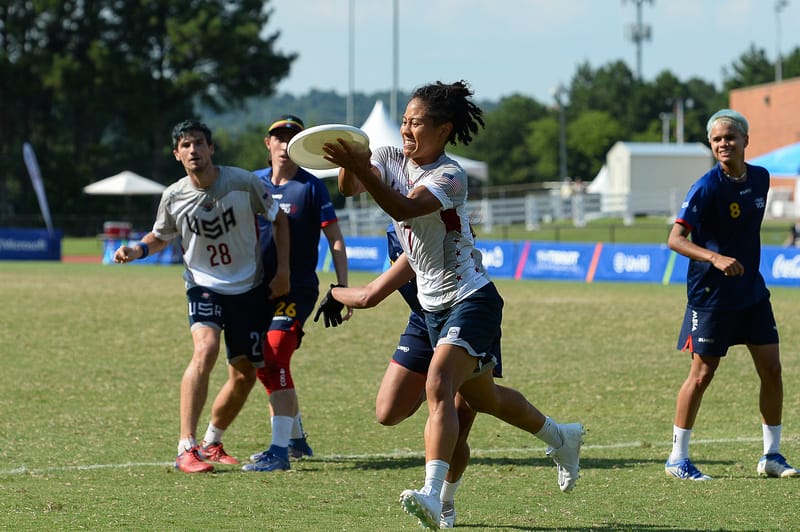
Think about the most exciting plays you’ve ever seen in ultimate. What moments live rent-free in your mind? Is it an incredibly athletic layout D? An IO huck with perfect touch? A cut so sharp it breaks the defender’s ankles? Whatever that is for you, I can only imagine you want to see more of it at the semi-professional level. Those exciting plays that make you want to watch replays again and again are what make a good product, which is necessary to promote and grow professional ultimate.
Here’s where this may become a hot take: I believe mixed frisbee would generate a higher quality product. The harsh reality is that in any team, there is a bottom of the roster, and the drop off in some pro teams is steeper than others as a result of communities that may not have depth or prioritize semi-pro. By focusing the semi-professional leagues on the mixed game, the teams would consist of the top half of both the men’s and women’s division players, raising the floor and creating a tighter roster where there is very little, if any, drop off between the top and bottom of the roster.
Yes, I am saying fewer people would be able to play professionally – but the remaining players would create a better product. Before anyone comes for me, I’ll be the first to say I wouldn’t make the cut. But to me, the improved product quality is worth not playing; it would only raise the bar of what to strive for.
Showcasing the best players at the semi professional level in a format that matches other high-level platforms makes the most sense. Imagine a combined Utah team with Jordan Kerr, Grant Lindsley, and Elijah Jaime teamed up with Paige Kercher, Abbie Davis, and Kyra Khoroujnikova. Or DC with Boxley & Merriman alongside Groom & Trop. These would be star-studded teams that could and would play highly competitive games across the board.
For areas like Arizona or Chicago, a mixed team would open up professional ultimate to the whole community instead of being gender-restrictive. For areas like the Bay, Boston, Colorado, DC, or Seattle, there could easily be two teams. Having two teams in a single city or state isn’t a bad thing – just look at soccer and football in LA, baseball in New York, or the English Premier League with promotion of city rivalries.
Within our sport, the Seattle BFG/Mixtape rivalry gives us a glimpse of what could be possible at the semi-professional level, while the AUDL and WUL partnered in 2022 to put on an 8v8 mixed showcase game. Making the teams more competitive and fostering rivalry raises the level of excitement and fan investment in the sport.
Resource Management
The financial state of professional ultimate remains precarious. The exit – and sometimes re-entry – of teams like Onyx (now Soar), Astra, Pride, and now Rising proves breaking even isn’t guaranteed. Meanwhile in the UFA, many teams run at a deficit and require bailouts from donors, which limits the amount players can get paid (if they are able to be paid at all).
The ultimate community is also asked to bear some of this cost through crowdfunding initiatives such as the Megafan and Player Sponsorship jerseys. Season tickets are priced with the intent for some of the cost to be a donation to the team. The UFA’s streaming service is relatively costly at $12/month or about $60/season, comparable to mainstream streaming platforms that offer far more entertainment options than just a single sport played only on the weekends. Asking the community to shell out enough money to fully support three different leagues is not sustainable.
The mixed format would lower the cumulative ask from the ultimate community, requesting support for just one team or league rather than forcing people to choose. Leagues could then spend more money on promoting the league outside of the ultimate community. If the target is growing the sport, we need more advertising to outsiders. Promoting highlight recaps of games across social media or placing ads for jersey sales directed at new consumers would be a better use of resources than spreading the existing community thin trying to support two leagues in their city.
A Unique Viewer Experience
Perhaps the simplest argument for the mixed game is this: Mixed is a format that almost no other sport offers. Tennis, ping-pong, badminton, and pickleball all include mixed doubles as a competition format, but single-gender individual competition is still the marquee event. Promoting mixed frisbee would be the first time a sport has prioritized a space where anyone can compete in a shared professional environment.
From a spectator perspective, this would be a novel experience and draw attention. It would also allow ultimate as a sport to grow in its own way, rather than trying to directly break into pre-existing sports systems in which markets are more saturated. New viewers as well as old fans would be able to support their favorite athletes, regardless of gender, in one place.
After the pro season, players would filter into both mixed and single gender club divisions. Any posts from club teams featuring pro stars would make their way back to new viewers following league accounts, exposing them to men’s, women’s, and mixed content. This exposure is unique to the mixed format and allows people to have a window into the full world of ultimate, all in support of a single team where the best of the best play.
A mixed semi-professional league would allow us to say that this sport is for everyone because we are providing a space and a framework for what high level mixed athletics could be. Instead of being a niche sport trying to break in, ultimate could be a trailblazer in a new space within the world of sports.
The Vision
So what would a mixed league look like? The mixed league would replace the current single-gender leagues, combining the UFA, PUL, and WUL. With the experience gained from the past decade of semi-pro ultimate, the new version of the league could keep similar rules such as the inclusion of refs, a larger field, and timed quarters.
Financially, leagues would continue doing as they’ve always done, earning money from ticket sales, jersey sales, and sponsorships. The difference is now the full community would have investment in a single team, increasing the total audience per team. Logistically, the new league could keep the UFA label league-wide, with the Premier and Western Ultimate League being absorbed as division titles similar to baseball or football. The season could run on the PUL’s timeline from April to June, minimizing club overlap while accommodating colder climates.
As a mixed league, equity would need to be at the forefront of core values, building on the mission statements of the PUL and WUL to be inclusive of all athletes and thereby sending the message that ultimate is a sport where all everyone should be represented and showcased at the highest level.
There are many more details that would need to be worked out and I don’t have all the answers. I’m just here to start a conversation for those willing to imagine a new system for professional ultimate.
Thanks for sticking with me. I know this isn’t the first time someone has imagined a mixed league. In fact, there have been many players before me who have spoken on the issue. Progress has, however, been limited by a combination of poor timing with community action relative to the pandemic, the formation of the women’s leagues providing a space for women to play professionally, and the fact that many community members simply aren’t thinking about a mixed professional league because no other sport has marketed one. These are not the only factors though, and there are many other reasons this idea has stalled in the past.
Nonetheless, I believe that consolidating the existing leagues into one mixed league is the best way to grow ultimate. Growing a sport is a challenge and I respect the work that has been done by the UFA, PUL, and WUL to get ultimate this far. But as much as I’m sincerely excited for the upcoming pro season, I’m more excited by the idea of what could be.
Similar from Ultiworld:
- Here is the List of Players that Signed the AUDL Boycott
- Going Beyond a Boycott
- Where Does the AUDL Go From Here?
- A State Of Disunion: The Future Of Women’s Professional Ultimate
From a new-viewers perspective, I’m not here to debate club vs. pro ↩
