Our newest series on coaching explores coaching concepts from multiple angles. Our second edition discusses using warmup time both for bodies and long-term learning.
August 8, 2025 by Ben Wiggins in Opinion
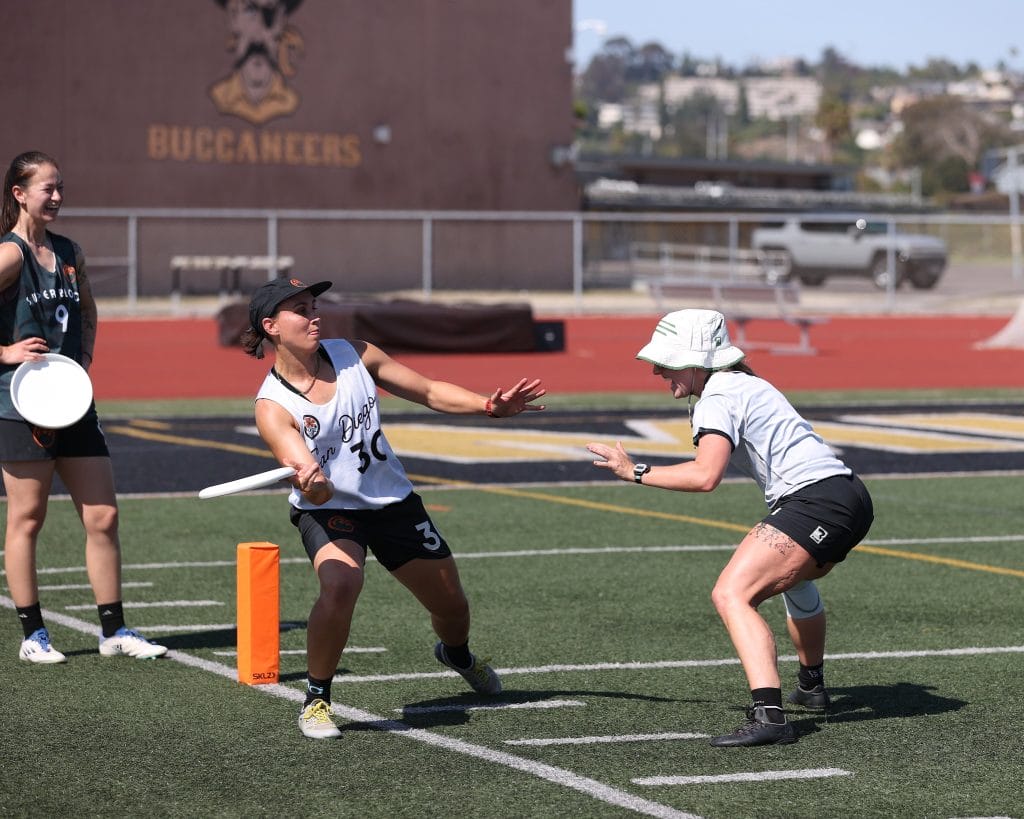
Welcome to Coach Considerations, a new series at Ultiworld where we share coaching concepts and ideas from the perspective of multiple expert coaches. There are so many different viewpoints on how to teach and strategize in ultimate, and while that lack of centralized consensus can create challenges in finding the best practices, it does create a space where various opinions can be formed, refined, and tested. We’ve invited Ben Wiggins to be the primary coach for our first series of articles, so each issue will center around his thoughts and then we’ll share responses to his viewpoints from several excellent, extremely experienced coaches.
The Time Problem
You’re coaching ultimate, huh? Then you have a time problem. Ultimate is an intrinsically time-consuming sport to learn, because:
- Players are asked to learn all of the skills and tactics. There are no shortstops here who don’t need to practice throwing a curveball.
- A single opposing player can provide a problem (a huge deep threat? A lane poacher? A strong around backhand?) that requires a full-team solution.
- The time-limited nature of play means your team needs to react instinctively, not just memorize-and-recall solutions like what kind of spin to use in a 7-10 split.
- Team strategies and tactics aren’t rigid; the location of a player in a zone cup might be massively different based on wind, opponents, stall count…and those are all within the same position and same strategy!
To drive the point about time limitation home, here is the combined practice time for an example season from a college team.
- Eight months in the academic year, minus holiday breaks, so let’s say seven months of time as a team. If we assume good weather throughout and no separate tryout process, then
- ~28 weeks in which practices can be held, and we’ll use 2 x 2 hours for weekday practices and 1 x 3 hours for weekend practices. Your situation is likely to vary, but that is at least a reasonable starting point. That’s a maximum of… less than 200 total team hours.
- You’ll lose some effective practice time for tournaments, and other events, even if you aren’t all living in the same dormitory.
If we generously assume 150 hours of total time, then a large part of those practices is not actively learning the game. Scrimmaging, warming up, team meetings, individual skill repetitions; when I look through my records in club ultimate (in which practice time is naturally more limited compared to college), we had something like 100 effective hours of practice per year on teams that had the privilege of being geolocated closely enough to practice frequently. If your team practices only on weekends, or for a shorter season than a school year, or only when people are together in town, then you have even less time.
How much time can you use to teach? In each of those practices (again, from my notes and practice plans over many years) roughly 40% of time could be put to focused learning of team tactics and strategies. If you consistently do teaching-focused practices for much more than that, then you’re likely to hear some groaning from players who want to scrimmage and are feeling overloaded with new information. I’ve seen that ratio change somewhat (3rd graders can deal with 10-20% as long as the practices are short, and international top teams can go up to 60-75% for a clinic or team camp), but it is generally descriptive of the total time limits you have for improving skills as a group.
For most teams, that time is split that time between offense, defense, plays, endzone situations, zone, etc. When you start to include more and of more of these considerations, the infinite expanse of a season starts to boil down into real, effective team development time that matches a single full-time work week. The struggle for coaches to fit everything in, and to coach it all deeply enough to provide dynamic instinctive learning, is real!
Making More of Your Warmup Time
Within these limitations, I want to call out a common feature of many teams: our warmup drills are consistent and relatively unchanging. The same “layup lines” in Practice #2 are being completed before the big game at the end of the season. It makes sense: players enjoy routine and consistency, and it feels good to turn your brain down and enjoy the boombox music. Copying and pasting a warmup scheme is quick, easy, and gives some mentally easy time in each session.
But the question remains: is throwing an unguarded 20-yard in-cut so valuable that you are running that same drill every time your team is together?
Here is my pitch for frequently changing your warmup drills throughout the season and using warmup time both for preparing bodies and long-term learning:
- The amount of time you spend on warmups is likely to be more total time than you spend on defensive strategy and tactics. If you don’t believe me, then just multiply your number of practices by ~20 minutes over the entire season. It’s a lot of time.
- Changing your routine allows you to incrementally add difficulty and new skills. Instead of ceaselessly learning to throw to a 20-yard in-cut on the sideline, your players can get experience at practice #2 in throwing a 20-yard swing, in practice #5 at throwing to a 40-yard swing, in practice #8 at throwing to a gainer in the middle of the field while watching for a side poach, and in practice #12 deciding which of two throws to complete (also giving one of two cutters a chance to break off and create a second cut).
- This incremental increase in game-relevance is a key feature of a learning theory called ‘deliberate practice’. People need time on task, they need feedback, and they need emotional encouragement to learn. But those aren’t enough if the challenges they are presented with are unchanged.
- Altering warmups as a feature of all team meetings means that parts of your tournament days can instill learning as well. Learning becomes the routine, not the weird part. That’s a growth mindset being added to many more times your team has their cleats on.
- Players who feel compelled to validate their skills can, eventually, become more comfortable stepping into the game and letting it rip. Ultimate is littered with players who feel that they need 20 forehands, 20 backhands, and 10 hammers before they are ready to throw in a game. Want that player to be confident even late in a game where they haven’t played much? Give them 20-30 opportunities during the season to play with different warmups. Those pet moves and sacrosanct warmups are, if left to their own devices, turning from useful helpers to mental crutches!
- This is a great place to mention the San Antonio Spurs shooting game: a bunch of NBA bench players under legendary head coach Greg Popovich had a competition where they had to make a layup, a floater, a free throw, a 3-pointer and a logo shot in a row. Each was only allowed a single attempt at the streak, and — the kicker — it had to be their first five shots of the entire calendar day. What a great way to playfully reinforce the idea that a shooter can shoot without being married to some extensive, constraining warmup!
- Much of learning dynamic skills come from repetition. You learn how to break a mark well by hearing about it, trying, failing with feedback, trying in higher pressure situations, etc. But you also profit from having touchpoints on that skill where it isn’t the sole focus. Imagine the advantage your mark-breakers will have if they see low-key drills (where the focus is on physical warmups) several dozen times per season, and each drill is a tiny bit different. The on-field mental model can change in that scenario from “my I/O flick is great; I just need a clear alley” to “this is a tool I have that I can use comfortably in just about any scenario.”
I’m not saying it will be easy; the habitual cognitive laziness in all of us means keeping a simple warmup routine is the path of least resistance. When you instill this culture of dynamism, you need to do it thoughtfully and get buy-in. But I think the benefits are clear and the negatives are mostly based in habit and community norms, not in how people actually learn. Think how much more your players can learn with those extra hours of real practice.
Coach Responses
We reached out to a network of great ultimate minds and leaders to get their thoughts on providing quality feedback to athletes. Adrian “Bruce” King has coached (and played) with a variety of elite men’s club teams, including Revolver and Rhino. Hall of Famer Gwen Ambler is a decorated national and world champion player and coach, coaching Seattle teams and US National Teams. Alex Crew helped coach with Washington DC Truck Stop during their title run.
Adrian King
I recognize that the spirit of my response should be disagreeable to spur debate and sharpen the arguments. Unfortunately, I agree completely. I’ll add a few thoughts on implementation instead:
- Don’t overlook the power of drill preparation between practices. One gift of the pandemic is a suite of tools for online collaboration and communication. Recording a 2-minute video with a simple whiteboard drawing of a new drill reduces the amount of valuable field time allocated to explaining the drill. If a player can visualize the drill a day in advance, they can digest the mechanics of rotation and timing, which reduces friction.
- Prototype unusual drills in a low-stakes environment or with players who have a higher tolerance for experimentation. This could be a weeknight pod practice or clinic. High school and college teams will have a higher degree of openness, whereas club players are calcified in their preferences and routines.
- Individual improvement might not be a goal in every practice scenario. In rare instances, the benefit of drills is to instill confidence or familiarity among players. Individuals on Team USA don’t improve meaningfully over a few months, so their practices should be a little boring. For club and college teams, the last practice before Nationals won’t be revolutionary.
- Consider a “discount rate” on novelty over time. Early season practices are highly variable with a small taper into familiarity toward the end of the season. This provides two key ingredients for compounding improvement: time and repetitions. In the experimental phase, successful drills can be retained and iterated upon while unhelpful ones are quickly discarded.
Gwen Ambler
Something that isn’t addressed in Ben’s suggestions is that the purpose of warm-up drills may differ greatly from a practice setting and a tournament pre-game setting and during the course of a season. What your team needs to get out of warm-up drills in a particular setting will help determine how much variety actually makes sense for the group you are coaching.
In general, warm-up drills can accomplish a number of things: getting touches on the disc, testing out the conditions (e.g, wind), allowing players to hit their top-speed attack gear, connecting players vocally and physically with their teammates, getting reps to build a specific skill or tactic, practicing certain high-value patterns, facilitating players access to their self-confidence—the list goes on! How much weight any of those goals for warm-up drills has may depend on whether you’re planning a practice or prepping your team for a big game. It may also depend on the skill and competitive level of your team.
Ben challenges coaches to think of flexibility and adaptation as a skill that players can build during warm-up drills. Which is great! 100% agree! Your team may find that practices are an ideal place to switch up what type of warm-up drills you run where you have a low-stakes setting to build the field sense and pattern recognition that go into succeeding in different scenarios intuitively.
However, right before a big game is not the time I would recommend introducing a brand-new warm-up drill to your team. My personal preference is having a menu of warm-up drills that your players are familiar with from practices to then choose which are best suited for what you’re facing at a tournament. If you want a large stable of options for tournaments, you will need to have rotated through a large variety of drills at practices multiple times.
You may also find that you can increase your players’ ability to adapt on the fly if more of the warm-up drills you run have built-in decision making components. For instance, the classic 4-lines drill often has players all get reps in sequence of open-side under cuts, then deep cuts, then some version of a break cut. What if instead each rep was “thrower’s-choice,” with the cutter needing to read off of the thrower’s pump fakes and/or the force chosen by the mark? Adding more flexibility into the warm-up drills your team uses at tournaments allows for a best-of-both-worlds opportunity with an element of familiarity with the structure of the drill itself while also pushing players to embrace the dynamism of real-time reads.
Alex Crew
From my perspective, I had the goal that the warmup drills should be related to whatever I thought our core skills should be (i.e. for Truck it was about maximizing the areas where I thought we could be best in the division; for lower level teams, the same holds but with a bit more view on raising the overall talent level).
To that end, my ideal versions have incorporated two sets of progression. One is progressing from moving a teaching drill into warmups and then slowly shortening it, such that it might start at 12 minutes when teaching what/how, to 8 minutes of getting reps (initially), and then down to 6, and then finally 4 or 5 minutes when it’s something everyone knows where we’re just trying to get a few deliberate reps before moving onto the next thing (and I can spend those moments reinforcing a few specific players).
The second kind of progression is looking to slowly have more focus areas in the drill. For instance, our typical breakmark drill, while ostensibly about a thrower and a mark, has opportunities to also focus on the cutting shape, continuation cut timing (+ throw), stack communication on continuation, and sideline communication to a mark. So across the breadth of the season, we can bring a different focus to the same drill and work on multiple things simultaneously (especially as players become more comfortable with it).