A cheat sheet on the new rules.
January 8, 2026 by Charlie Eisenhood in Analysis, News
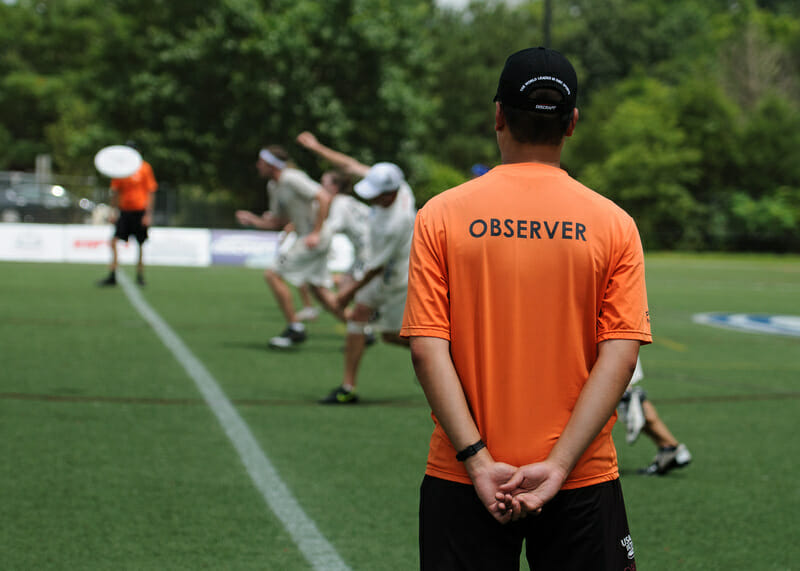
After a major rules update to begin the decade, USA Ultimate has been making smaller tweaks on a biennial basis. The latest rule set — the 2026-2027 Rules of Ultimate — is now in effect.
The large majority of changes to this ruleset are clerical or organizational in nature: there aren’t the kinds of big impacts from the 2020-2021 rule set that changed soft caps, offsides rules, and travel rules. Still, there are some new rules to be aware of along with some important clarifications, especially around dangerous plays.
Here are the biggest rule changes in the 2026-2027 Rules of Ultimate, ranked loosely in order of their relevance to everyday players:
1. In general, a dangerous play call may only be made if at least some amount of contact between the involved players occurred. (20.B.1.a)
The dangerous play rules instituted in 2020 acknowledged that they can sometimes be called in cases where no contact took place. While that is still true, the new rules are emphasizing that the no-contact dangerous play is extremely rare and signaling that observers are unlikely to uphold such calls. See the change in wording here:
2024-2025 Rules: “Contact is not required for a player to invoke this rule where there is reasonable certainty that contact would have occurred had the player not taken steps to avoid contact.”
2026-2027 Rules: “Contact is not required for a player to invoke this rule where there is near certainty that significant contact would have occurred had the player not taken last moment steps to avoid contact.”
While this may seem subtle, it’s an indication that non-contact dangerous plays (like a player claiming they had to avoid entering a space due to an imminent collision with an opposing player) are to be called very rarely. A new rule annotation explicitly notes that “if a player is vying for unoccupied space, but decides not to enter the space for fear of possible or likely contact with an opponent also moving into that space, the player may not call a dangerous play if no contact actually occurred.”
2. TMFs are now Blue Cards and PMFs are now Yellow Cards. Red Cards (suspensions, formerly called ejections) now assign two Blue Cards to a team instead of one. (Appendix C)
This is a language change more than a rule change. The confusing Team Misconduct Foul / Personal Misconduct Foul terminology is now codified into just cards and their associated colors. Appendix C also has a great deal more clarity around what cards are assigned to different types of infractions. Some non-exhaustive examples below:
- Blue cards: repeated infractions, invalid calls, mild taunting
- Yellow cards: dangerous plays, intentional fouls, aggressive taunting
- Red cards: very dangerous plays, punching/kicking/spitting/spiking a disc on an opponent
There is a rule change as well: red cards now assign two blue cards to a team towards Team Misconduct Penalties (yardage penalties), which kick in upon a team receiving its third blue card. Yellow cards still come with one blue card towards TMPs.
3. All pull violations (offsides, false start, gender match pull rule in mixed) accumulate together instead of in separate categories. (9.D.4)
The main difference here is that now a false start (O-line pull violation) means that a subsequent offsides (D-line pull violation) will allow the opposing team to take the disc at midfield. Essentially, it puts all pull violations into one bucket. In practice, false starts are quite rare, so this is really more of a clarifying rule change, but it could impact games occasionally.
4. For injuries not caused by contact with another player, either the player must sub out of the game or their team has to use a timeout. (7.C.4)
This is a subtle change, but it now allows for contact with any player, rather than just an opponent, to qualify an injured player to remain in the game without the use of a timeout.
5. It is not a travel if a player catches the disc while running or jumping, does not speed up or change direction while in possession of the disc, and releases a pass before three additional points of ground contact occur (provided that all points of ground contact are completely in-bounds, excluding their attacking end zone). In this instance, a player is not required to establish a pivot or stop as quickly as possible. (18.E.2)
This is not a rule change, but it really clarifies the rule around “three steps.” As long as a player doesn’t speed up or change direction, they can legally take two steps — even at full speed — and throw the disc. Bad travel calls from zone defenses hate this one weird rule!
6. There is no Continuation Rule applied if a call is made when no thrower is in possession of the disc and the disc is not in the air (e.g. the disc is on the ground). (17.C)
This is logical: you can’t have a call happen with a dead disc, then have the thrower pick it up and throw it and claim continuation applies. Instead, play is considered stopped when the call was made, regardless of when the call is acknowledged by the thrower.
7. If multiple calls occur on the same play or before play stops, the outcomes should be resolved in reverse sequence (latest call first, earliest call last). (17.I)
Previously, the language of this rule said “multiple infractions” instead of “multiple calls.” This change allows for things like stall calls (or other non-infractions) to be included in the order of operations.
8. For U-12 and U-15 youth competition, the rules for time between points and in-point substitutions are flexible. For U-17 and U-20 play, add 20 seconds to all prescribed time between points. (Appendix E)
These youth rules adaptations allow for coaches/organizers to agree on time between points and whether or not to allow mid-point substitutions with player safety in mind. Additionally, more time is explicitly added between points even for competitive high school and youth club play.
For a more complete list of substantive changes, see this document from USA Ultimate. The full ruleset is available here.