"...there are real, demonstrable advantages to starting the game on defense and that those advantages outweigh the advantages of starting a game on offense."
January 28, 2026 by Guest Author in Analysis
The article is contributed by Jacob Blackman. Jacob lives and plays in Columbia, South Carolina. He spent three seasons with the Atlanta Hustle (2022-2024) but has played his entire club career with a regionals level team called Lost Boys. He’s also in his second season coaching at the University of South Carolina.
On October 24, 2021, Ring of Fire defeated PoNY for their first ever club championship in team history. The championship game featured just a single break from each defense in the first half and none in the second as Ring won the capped game 13-12. PoNY won the coin toss to start that game and elected to start on defense, a decision much derided in hindsight. Charlie Eisenhood spoke of the coaching staff’s choice to start on defense in the recap episode of Ultiworld’s Deep Look podcast saying, “It is just actively the worst choice because you put yourself in a position to lose the game on equal breaks instead of being able to win the game on equal breaks. Why would you choose that? You should never choose that.” And as far as the decision to start on offense or defense goes, that was basically that. Pretty much everyone agreed. If PoNY had started that game on offense then they would have won and their decision to pull first ultimately cost them the game.
In the years since that game, I captained and coached teams under that same belief: that it’s always better to start games as the pull receivers rather than the pullers.1 But does the logic really check out? What does the data say about this? In this article I’ll address each of those questions, as well as offer some conclusions to draw given the answers. If you’re like me then you will be surprised by the data from a nearly 240-game sample, which tells a different story..
Does The Logic Check Out?
The idea is pretty simple. As a 2021 ultimate frisbee podcaster might put it: There is an inherent, categorical advantage to starting a game on offense because in a game with equal breaks the team that starts on offense wins. However, this isn’t exactly true. Only in a game with equal breaks in the first half and equal breaks in the second half is it the case that the offense wins. Although it’s a subtle difference, it’s an important one. Imagine a game where Team O receives the first pull from Team D and gets broken on the very first point before trading holds the rest of the half. That means Team D will take half with an 8-7 lead and receive the next pull. Imagine further that Team D also gets broken on the first point of the second half, tying the score at 8-8. Team D still receives the following pull and the two trade holds for the rest of the game. Team D wins by a final of 15-14. Now we have a game of equal breaks (just one each) that the team that started on defense won.
This is the idea of the “halftime break.” The crux of the matter when electing to start a game on either offense or defense lies in the first-half break count. And the winner of that halftime break reaps their reward in the second half. This means that if Team O finishes the first half with equal or more breaks than Team D, then Team D will need to finish the game with one break more than Team O in order to win the game. And inversely, if Team D finishes the first half with one more break than Team O, now Team O will need to finish the game with one break more than Team D in order to secure the win. It is indeed the case that, when the game is 0-0, Team O currently holds the advantage. But this advantage is like the hot potato being passed around. It doesn’t matter who pulls the thing out of the oven, but rather who’s holding it in the end.
Another way to think of it is to liken the halftime break to Schrodinger’s Cat. The advantage of starting on offense exists, but only in a potential form. It’s not really an extra point on the board to start the game; it’s a potential advantage that has not yet been actualized. If Team O fails to finish the first half of the game with an equal number of breaks as Team D, then it will be Team D who actualizes Schrodinger’s Halftime Break. In the scenario, Team O will need to finish the game with +1 break to win. Only when the first half has come to a completion will Team O know for certain whether starting the game on offense put them at an advantage or a disadvantage.
Now, dissenters might say, “Well given that holds are more likely than breaks, isn’t it the case that a breakless half is likely to occur? And if so, isn’t it better to start the match holding the Schrodinger’s Halftime Break?” And the answer is two-pronged. First, no, it is not likely at all for two teams to go unbroken in the first half. In fact, according to my sample that we’ll delve into below there is a 0.84% chance that this occurs. But also, yes. There is still a logical, a priori, advantage to starting on offense. It’s just not as vast an advantage as “winning a game with equal breaks.” I would put it this way: There is an advantage to starting games on offense because teams that start on offense have possession of Schrodinger’s Halftime Break and each subsequent change of possession will be increasingly difficult to come by as either the margin in score grows or the margin until halftime shrinks.
Digging Into the Data
So now that I had determined just exactly what the logical advantage to starting a game on offense was, I wanted to look at a sample of games to see whether teams that start games on offense indeed tend to earn the halftime break more often than their opponents, and if they actually win games more often too. At first, I started with a sample of elite club men’s games from Nationals, US Open, and other tournaments across 2023-2025. The games had to be filmed so that I could know who pulled and who received to start. The sample grew into the other divisions and in the end, I collected data from 237 filmed club games across men’s, women’s, and mixed divisions in that same time period. For each game I recorded, among other things:
- Which team started O or D
- Which team earned the halftime break
- Which team won the game
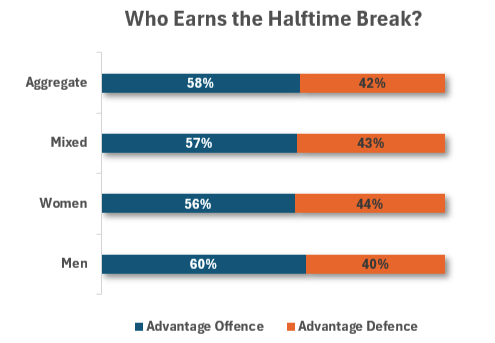
The first matter at hand was the team that earned the halftime break. I mean, that’s what this whole thing is about: figuring out if there really was an inherent advantage to starting games on offense. What I learned was, yes, there is a tangible—not just logical—advantage to starting on offense. In fact, in those 237 games, teams that started on offense earned the halftime break 58% of the time compared to the teams that started on defense who earned it just 42% of the time. And this holds true across each division, too. Men’s division teams that started on O earn the halftime break 60% of the time while the women’s division and mixed division teams that started on O earned it 56% and 57% of the time respectively.
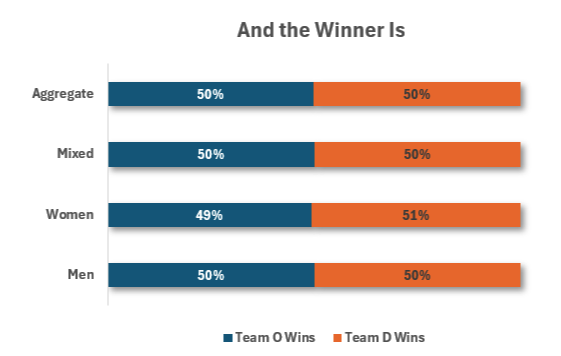
But don’t stop reading just yet! Interestingly, despite the fact that teams that started the game on offense are more likely to earn the halftime break, the data show that the chances of a given team winning a game are still exactly 50/50. And I mean exactly! In the 94-game sample of men’s games, 47 were won by teams that started on offense. In the 72-game sample of mixed games, it’s split 36 to 36. And in the 71-game sample of the women’s division, 35 were won by teams that started on offense.2
But not all games are created equal and not all games play out the same way. You see, no one fixates on the decision to start on offense or defense when the final score turns out to be 15-6. When my team gets eliminated at Regionals every year by a score of 15-10 no one asks me, “Did you make sure to start your game on offense?!!” No frisbee podcaster has ever looked at a final line of 15-8 and said, “Tsk. Tsk. They shouldn’t have pulled first.” This only matters in close games! So I took efforts to look for that as well.
In my brain, a game is “close” if you reverse the outcome of the final point and are left with a 1-point margin. So a 15-12 game is close because had the loser scored the final point instead of the winner, the score would have been 14-13 and 14-13 is obviously close. In other words, when the margin of a game is three or less, it is a close game.
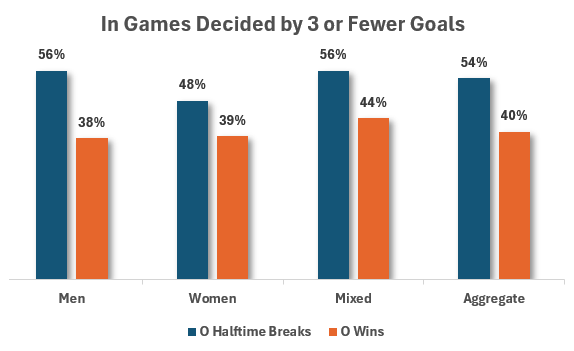
I wanted to know, when every advantage matters and every detail counts, is it absolutely imperative to start on offense? And the answer was: not exactly. Of the 237-game sample, 125 of those games were decided by a margin of three or less. In those 125 games, teams that started on offense earned the halftime break 54% of the time, a discernible advantage, but won just 40% of the games! In other words, teams that start on offense are 10% more likely to enter the second half of a game in a situation where their opponent will need to score more breaks than they did in order to win the game. However, those same teams are 20% more likely to lose the game, despite that advantage.
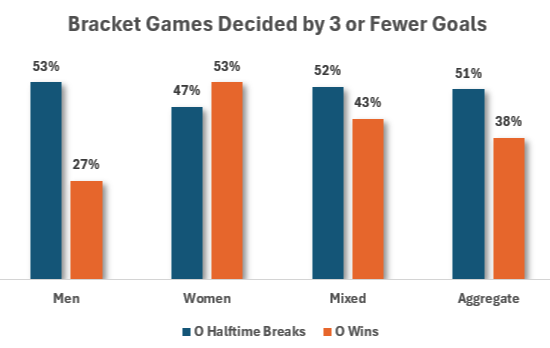
Finally, I thought to myself, what about do-or-die games where the losers go home? What do the data have to say about that? I filtered my results to eliminate all pool play games and give me just the games that would eliminate a team from championship contention and that were still close games. The data say that in those games teams that start on offense earn the halftime break 51% of the time yet lose the game 62% of the time.3
Alternative Advantages
Clearly, something is going on that makes the decision to start on offense or defense more complicated than simply increasing a team’s likelihood to earn the halftime break. Teams that are earning the halftime break are more likely to lose close and important games despite their one-break advantage. So what else is going on? Well at this point I am venturing out from the realm of logical reasoning and data analysis, but I have two hypotheses to put forth that might have some explanatory power in showing why this is.
The first reason is fatigue. The nature of close games is that the number of points played reaches or nearly reaches its maximal limit. Therefore, close games require O-lines to play more points. And with few exceptions, most elite teams today play with around 10 of their 26-person roster on the O-line. This means that in a game to 15 the O-line will enter Universe Point with an average of 9.8 points played:

Meanwhile, their D-line counterparts who make up the remaining 16 roster spots are on average playing nearly 4 fewer points per game going into the double game point:

Of course, teams may crossover for the literal double game point, but the point here is that O-line personnel, on average, put more mileage under their legs than the D-line personnel. The resulting fatigue tax that they pay may contribute to the reasons why teams that start the game on offense and earn the halftime break are more likely to lose games that are close, late.
The second reason I posit as a contribution to the explanation of this phenomenon is contextual pressure. When a close game is nearing the end, O-lines have intense levels of psychological pressure to execute cleanly. Moreover, since the games that I am hoping to explain are games where Team O earned the halftime break but went on to lose,4 we are talking about games where the losing team’s O-line fumbled their advantage and lost the lead. Unfortunately, the only vocabulary available to me to try and articulate this idea relies on cliché sports platitudes. These are situations where the pressure mounts even higher as not only the game nears the end, but also the momentum of the opposing team gains steam and challenges the O-line to execute under thin margins for error. This kind of contextual pressure for Team O as the game begins to slip from their fingertips poses a real, though unquantifiable, obstacle to the performance of the O-line. Yes, of course, the D-line experiences pressure too, but I believe that the pressure experienced is correlated to the responsibility held in the matter. That means that an injured teammate on the sideline experiences the pressure differently than the rookie who only played two points this game, who experiences the pressure differently than the D-line stalwart, the O-line center handler, or the coach. The greater responsibility one has in bringing about the Universe Point game, and particularly, the greater the blame placed on an O-line who once held a lead in the game, the more heightened the experience of pressure is felt.
*****
In 2021 when Charlie criticized PoNY for electing to start the game on defense, he was not wrong. PoNY did in fact choose to forfeit a higher likelihood of earning the halftime break and in the end it happened to cost them the game. However, what Charlie, as well as I prior to this study, failed to understand is that starting a game on offense is not the only advantage available. Something else is clearly going on that gives defenses a greater chance of scoring goals in tight games, in high pressure games, and particularly in the second half of games. It’s my belief, after having completed this study, that there are real, demonstrable advantages to starting the game on defense and that those advantages outweigh the advantages of starting a game on offense. Teams that start the game on defense not only win 50% of games outright, but they also tend to win close games, including close, elimination games. Yes, starting the game on offense yields a higher likelihood of earning the halftime break. But that is just one card in the deck. Team O may have an Ace to start the game, but Team D has a few face cards of their own.
I’m ignoring the wind factor here. In perfect conditions, you choose offense. ↩
What a shame to have an odd number of games sampled. I wanted so badly to pull another women’s game to make it a true 50/50 split, but that would have been manipulating the data, and I couldn’t do that. I suspect that if I were to double the sample size that each division would round out at 50/50. ↩
This is bolstered by the fact that in the men’s division where nearly half of all such games appeared the team that starts on offense wins just 27% of games. ↩
See charts In Games Decided by 3 or Fewer Goals or Bracket Games Decided by 3 or Fewer Goals. ↩
