Colorado, Carleton, and Oregon delivered universe point classics to cap off the 2026 regular season.
April 3, 2026 by Edward Stephens in Recap
Ultiworld’s 2026 college coverage is presented by Spin Ultimate; all opinions are those of the author(s). Find out how Spin can get you, and your team, looking your best this season.
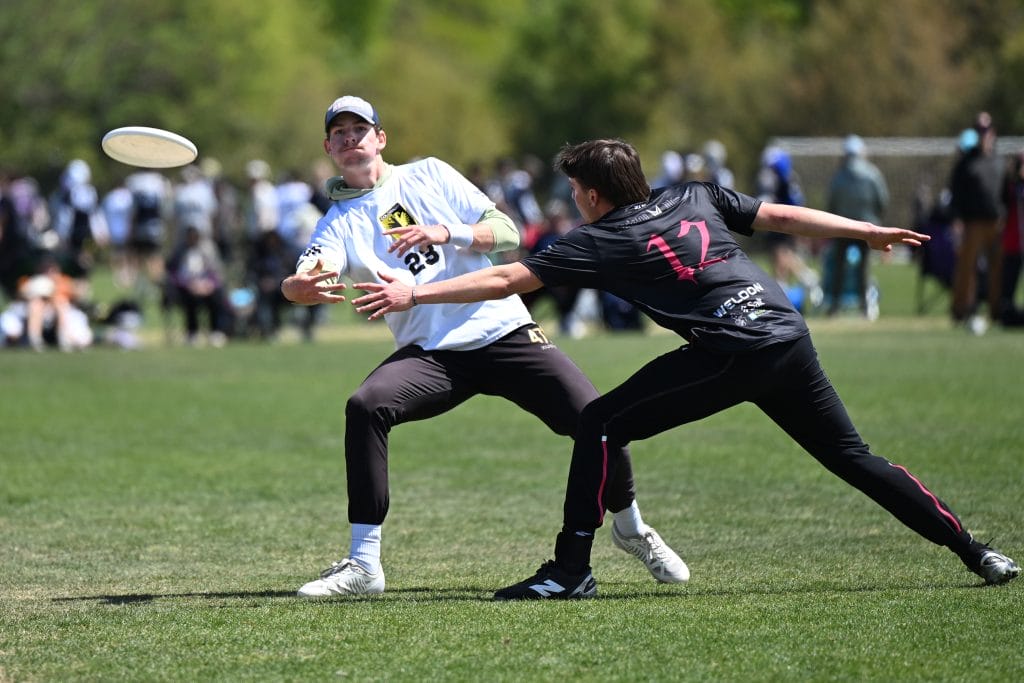
WILMINGTON — #1 Colorado Mamabird continued their quest for a 2026 championship with a second consecutive undefeated tournament, holding on in the final for a 15-14 win against #2 Carleton CUT despite a torrid CUT run late in the game. Mamabird’s win in the final mirrored Carleton’s universe point win in semis, where #3 Oregon Ego nearly put together a multi-break comeback. While Colorado leave Wilmington with a slight edge, the major takeaway from the top end of the tournament is how close the three major championship hopefuls are to one another — and how breathtaking it is when they come up against one another in high-stakes competition.
The Berm-Universe Triangle: Mamabird, CUT, and Ego
The Copy
Colorado’s Easterns win seemed all but assured as they cruised through the first half of the tournament final. Resolute and full of swagger, they exhibited every feature that has made them a great team in 2026: bold offensive play, defensive depth, a can’t-touch-this attitude.
Second-year Elliot Hawkins, who had the hot hand during the team’s semis win over #4 UNC Darkside, was often at the center of the O-line’s dazzling play in the first half. He is the quintessential downfield hybrid, the kind of player who excels at knowing which of two equally dangerous choices to make: going deep for one of his sharpshooting teammates, or grabbing the free under and tossing a casual 40-yd dime from motion. It helped, of course, to have a few other Hobson’s choice all-stars — Ryan Shigley, Tobias Brooks, Zeke Thoreson — to keep the defense from keying in too tightly on him. Between those four all-arounders and high-skill specialists Will Barnouw, Dan Bauman, and Finn McKenzie, the Mamabird O-line were essentially oceanic, which is to say they were both liquid and overwhelming.
CUT, meanwhile, struggled to find their footing. Perhaps there was an element of fatigue: they were playing their seventh game of the weekend only minutes after Oregon stretched their semifinal to the full 29 points. Perhaps the wind, picking up to difficult levels for the last round, caught them off-guard. Or perhaps they found it hard to adjust to Colorado’s opening scheme of planting a full-time poach (often Rami Rifaat, who had a breakout weekend) underneath the force side cutting lane.
“Using smart, heads-up defenders in places like that where they can still take away [a cutter] and not give free outlets but still get pressure D’s or squeeze the lane,” said Thoreson.
Whatever it was, they couldn’t stitch together possessions nearly as well as they had done previously in the weekend. Combined with an effective Mamabird counterattack engineered by second-year Finn Dougherty or rookie Simon Logan, CUT’s offensive faltering resulted in breaks and deficits. First they trailed 3-0, and then 6-2 before trading out the final four points of the half. Colorado’s final score of the first half, to take an 8-4 lead, ended with a ferocious one-on-one sky battle between Brooks and CUT star Declan Miller. Last year at Nationals, Miller won similar moments; this time around, Brooks high-pointed the disc.
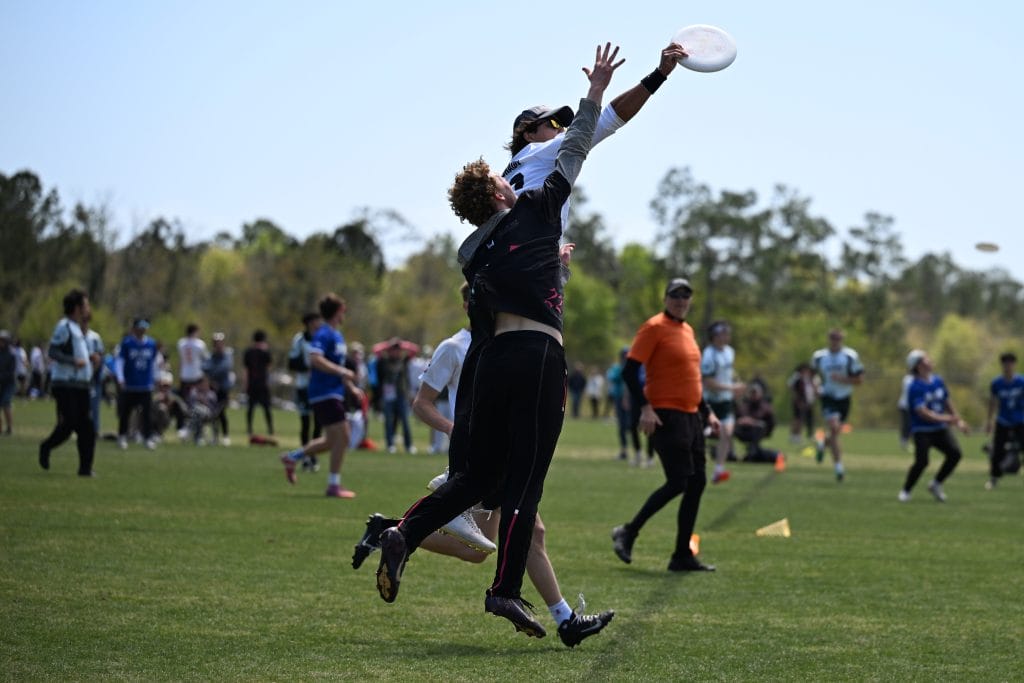
“First half kind of felt like a breeze for us,” said Thoreson. “And they were dropping the disc, having little mental lapses. We were able to compress [on defense] and do what we wanted to do.”
The second half threatened to be a retread of the first. When Mamabird come out of half with a lead, they tend to stack the line to start the second half. Accordingly, Hawkins and Brooks were on the field. (Shigley would also join on an injury substitution.) Hawkins and Shigley both picked off carelessly weighted passes, and Colorado’s second possession gained traction from a long inside backhand by Brooks before Sam Kilgore earned the goal. That score stretched the score line to its widest mark, 9-4 to Colorado.
Carleton cleaned up their act on offense after that. Part of the remedy was becoming more selective with their goal shots, waiting to get the Mamabird defense to commit to covering certain spaces (as opposed to trying quick strikes from motion that never quite seemed fast enough to beat them) before attacking the newly vulnerable ones.
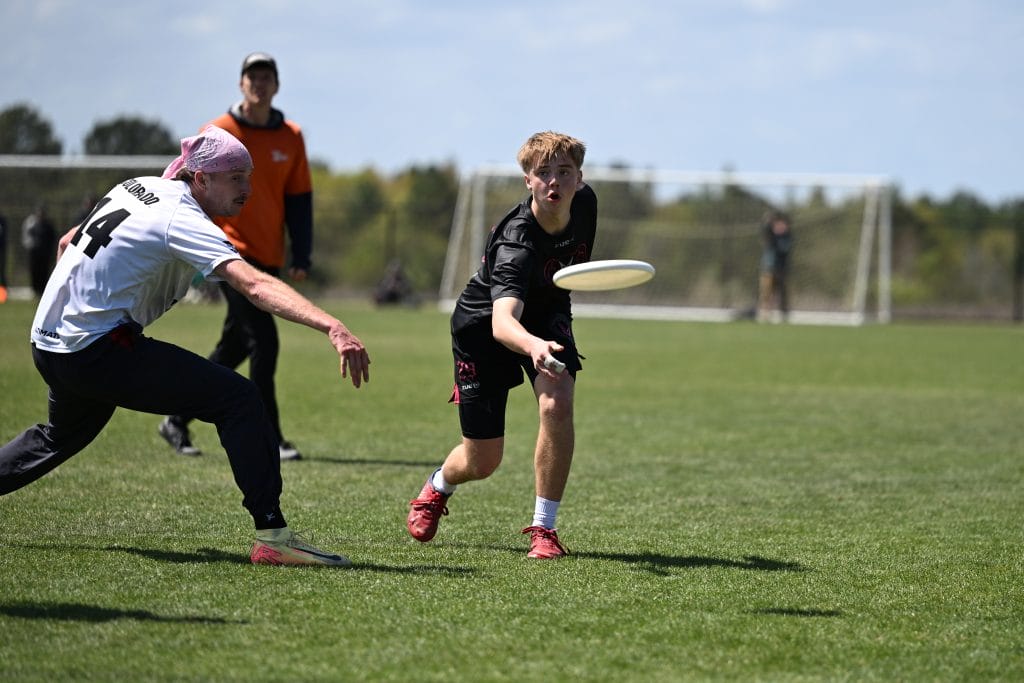
“We were just focused on clearing space and opening up big stages for our cutters downfield,” said sophomore Nate De Morgan. “The wind seemed to die down, which made it a little bit easier to move the ball side-to-side and open up lanes downfield instead of just having [to go through] that one poach.”
Another part was a generous dose of De Morgan. De Morgan, a fixture on CUT’s D-line for the second straight year, is also the first call to join the O-line when they are in a tough spot. He brings a different character to offense. He cuts in different patterns, he looks for unconventional lanes as a thrower, he refuses in every way to meet the defense’s expectations. His entire offensive personality is shaped not by the standard of play around him but by his peculiar devotion to scoring. It’s as if he is formed anew every single possession from the particular conditions that will lead to the goal box in that moment. He threw or caught CUT’s next four holds.
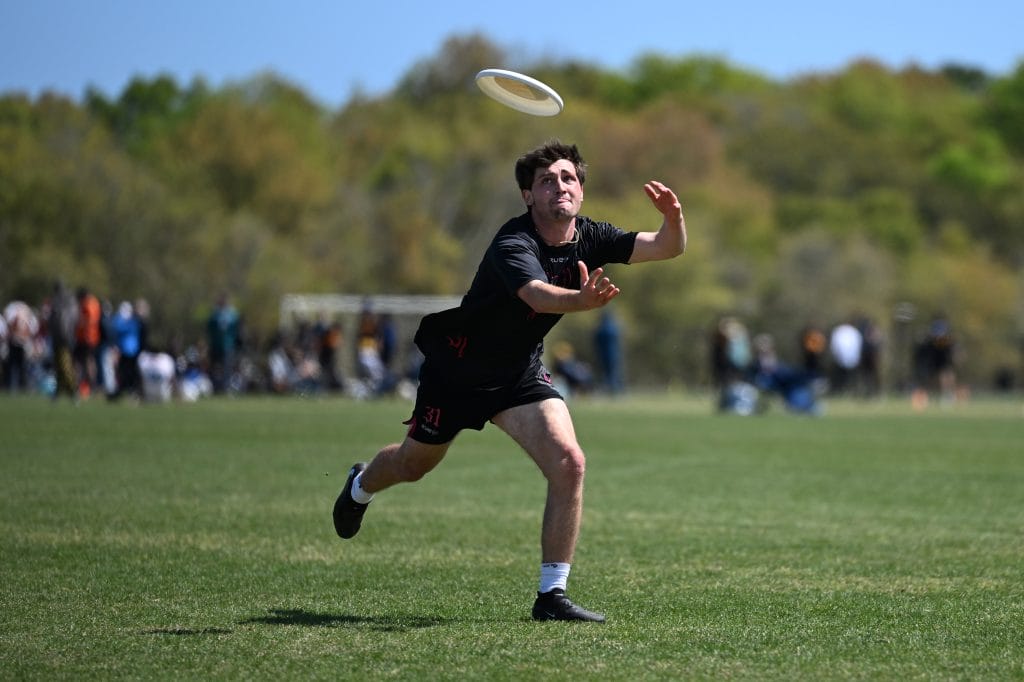
The CUT O-line were back on track; the game was not. Mamabird cashed in holds at the same rate, and the lead stood at 13-8. Credit Thoreson, who has blossomed into a fine thrower this year, adding another sharp arrow to the Colorado quiver. Two tournaments in a row now, CUT sidelines have been calling ‘Rondo’1 when he gets the disc. He didn’t do much to disprove the label in their SMI bout, but he threw a couple of excellent away shots in the Easterns final. (Maybe CUT will reconsider some of their priors.)
“I’ve been working on throwing a lot,” said Thoreson. “So the ‘Rondo’ call feels good. And then when I hit one it feels even better.”
13-8 means the game is over, right? Wrong. CUT started to key in on some of Colorado’s offensive tics — and that allowed them to be aggressive. They pushed closer to cuts to pressure them and became adept at jumping lanes at or near passes. You could see it in the way Declan Miller dogged Brooks’s footsteps and spooked him into a drop. Combined with a some Colorado execution errors of the same sort that plagued Carleton in the first half, the defensive pressure began to create opportunities. And the opportunities begat breaks. CUT clawed back first one, then another to bring Colorado within shouting distance.
“We had to turn our minds on and figure [Carleton’s sets] out,” said Thoreson. “They were sitting a lot of people in the lane, setting people on poaches.”
“Something we’re going to try to work on at Nationals is if we run into something like that and we’re feeling the pressure, or they’re taking away our 1 or 1-A options, then we need to do a better job of adjusting,” Thoreson added. “We need to work with our legs to try to open things up instead of trying to break things with our throws.”
The score stood at 13-11 before Colorado “ended” the game again. They did so by bringing out one of their most potent tools: Thoreson’s speed. On a designed play, Elliot Hawkins accepted an under and transferred his momentum into a long backhand. It stayed low, and it gathered speed as the wind pushed it closer and closer to the back line. Thoreson, having already left De Morgan in his wake, found some extra miles per hour he had been saving and went half-horizontal for the tricky grab just inside the box.
“I thought it was going to be a clap-catch,” said Thoreson in stubborn opposition to basic science, which insists that he could not possibly have been running any faster.
Colorado’s 14th goal should have made a formality of the rest of the game. It didn’t. Instead, Colorado botched the first game-winner on a drop, setting up a 70-yd Carleton drive to close the gap to a single goal. On the next point, the CUT defense was stouter than a circle of wagons.
“We know they like to keep it wide and shallow… big swings to open up the field,” said De Morgan. “When they’re keeping it wide, we want to push them super-wide, so that we’re poaching them from the inside lane on the long swings.”
Mamabird had no way to so much as approach the red zone and were reduced to impotent swinging. Sarek Mallareddy, having read the clearing patterns, eventually jumped ahead of a fill cut for a block to set up an easy goal to force universe point.
“When you’re down all game, you eventually come around to that motivation to find what you need,” said De Morgan. “We did that against Colorado. Stuck around, made some plays, and found ourselves in a good spot at the end of the game.”
Very little separated CUT from a chance for victory on the last point. De Morgan left his match early in the Colorado’s final possession and nearly beat Brooks to the disc on a poach. A few throws later, both De Morgan and Olson lurked near the stack while they sized up a long Brooks swing. Both of them lunged for the block, and Olson, bidding, came within millimeters. The opportunity came at a cost: they were out of position for the next throw, and Shigley skipped in safely to give Colorado the win.
The Original
One wonders how the final might have gone had Colorado not enjoyed the scheduling advantage of not having to go through one of the other Big Three in semis. Darkside are hardly pushovers in 2026, but they have yet to show that they are in the same class as the three major title contenders. Mamabird skated away from them in the second half of their semifinal for a comfortable 15-10 win and benefitted from a recovery period.
The same could not be said of CUT, who had their hands full with an Ego comeback that was as fun to watch as it was tiring and furious. A tightly contested first half tipped toward Carleton as it went into the break. Aaron Kaplan, Julian Saunt, Adam Wulkan, and Owen Sprague were exceptional for the Ego O-line. But CUT’s defensive line-up of Thomas Shope, Ryan duSaire, De Morgan, frequent appearances by Miller and Olson, and breakout performances from Aage Bonnell and Sam Elliott forced turns anyway. For every two spectacular cuts from Saunt or Wulkan, for every heat-seeking huck from Kaplan or Sprague, there was a moment of forced frustration.
Trailing 8-5 at half, Ego were poised enough to keep the game tight. Ego’s defense came close to narrowing the gap a few times: Owen Shaff, Nic Cao, Ben Horrisberger, Alex Hall-Witt, and Max Massey all got hand to disc, but either the ensuing offensive possession went to seed or the ricochet would go to CUT. When Ellis Newhouse — whose performance on the weekend, like that of fellow O-liner Nobi Lorenz, was crucial for CUT and should not pass unnoticed in this write-up — caught a goal to bring the score to 14-11, the end seemed near.
Newhouse directed a hard spike at Cao after the catch, though, and earned a yellow card. Did that gesture fire up the Ego D-line even more? Or did the tight coverage up until that point start to bear fruit? Either way, they finally found the breaks that had mostly eluded them up to that point. Saunt, crossing over, took advantage of a shaky Carleton swing to earn bookends for Ego’s 13th goal. That set the stage for the biggest play of the game.
“It’s a long weekend,” said De Morgan. “And Oregon are obviously a really good team. But we got a little relaxed, a little lackadaisical.”
Hall-Witt boomed a downwind pull that landed just inside the backline. Olson scrambled to pick it up as it rolled in bounds. When he did, he was facing a stiff wind, a set defense, and cutters unsure how to proceed. He spotted Miller near the front of the end zone and tried to squeeze a forehand to him, but Hall-Witt — who had pulled the disc — was finishing the end of his 70+ yd sprint to that exact assignment and fully sold out to stop the pass. The result was a layout Callahan of epic proportions and a raucous caterwauling from the crowd just behind the endzone (including many Mamabird players) perhaps louder than has ever been heard before during a regular season game.
The hubbub gave way to the tension of universe point. As CUT would imitate a game later, Ego came nailbitingly close to blocks twice. The first saw Shaff nearly earn the takeaway. On the second, Raekwon Adkins did take the disc away in a bang-bang layout catchblock that was called (and eventually upheld as) a strip. How many hundredths or thousandths of a second separated Oregon from a game-winning break chance? CUT took the final two yards on the next pass to end the game.
The Upshot
Two tournaments in a row have seen Colorado dodge both Carleton and Oregon in semis, leaving them in good position to open up a lead on an exhausted winner. Carleton’s UP wins have indeed been Pyrrhic in both instances. Not only are the players on the field tired, but major players from both did not take part in the final after having played semis: Newhouse (Smoky) and duSaire (Easterns). With Colorado poised to take the #1 seed again at Nationals, should CUT (or Ego) fear a repeat?
“From when pools come out, you can kind of see the path. Especially this year, when it seems like us, Ego, and ‘Bird are the top echelon, we know we’re gonna have a tough semi,” said De Morgan. “So it’s obviously a big adjustment [to play the final after a difficult semi]. They’re screaming, relaxing, having a good time at the end of our game, which is fun.”
“But that’s the good thing about Nationals: you get a day between the semi and the final. If things like this happen in the future, it’s nice for us to have that time between games where you’re not rushing across the field and have just 15 minutes until game time and moving all your stuff.”
The larger takeaway is how evenly matched the three teams are heading into the postseason. Carleton’s only losses on the season are to Colorado. Colorado’s only loss is to Oregon. Oregon did catch a stray defeat at the hands of #14 Pittsburgh En Sabah Nur in the opening round of Smoky Mountain Invite, but their only other two losses are to Carleton. All three teams have depth, effective strategies, star level play, smart coaching, and mental toughness in spades. There is no indication, even after Colorado’s two wins, which of them is most likely to come away with the 2026 crown.
Rondo, shorthand for ‘Not a thrower,’ is derived from the shooting-averse NBA star Rajon Rondo ↩
Easterns 2026: Tournament Recap, Part 1: Three’s Company is only available to Ultiworld Subscribers
Already have a subscription? Log in
Whether you visit Ultiworld for our reporting, our podcasts, or our video coverage, you can help us continue to provide high quality content with a subscription. By becoming a subscriber, not only do you receive benefits like exclusive articles and full article RSS feeds, you also help fund all of Ultiworld's coverage in general. We appreciate your support!