Ultimate is falling further behind other team sports.
April 22, 2026 by Charlie Eisenhood in Analysis
This article was originally published as a part of my In The Zone email newsletter, available to all Ultiworld subscribers. We are opening up the paywall on this piece.
Every year, the Sports and Fitness Industry Association releases a report about the state of sports participation in the United States. We are fortunate that they have included ultimate in this report for many years: I was writing about this report a decade ago.
For a long time, the SFIA showed ultimate as one of the fastest-growing sports in the country. The 2012 data was very encouraging, with core participants (those who play 13+ times a year) at nearly 1.5 million people. To be honest, I always felt like the SFIA data was a bit overstated and paid more attention to the trends. So keep that same caveat in mind below.
I don’t have great news.
The 2026 SFIA report (unfortunately, it is not available publicly; I was given a copy as a journalist) shows that ultimate has been in a long decline, even as other team sports are surging back to growth after seeing declines in the 2010s.
Core participation is down to 502,000, down over 40% since 2020 and almost 12% year-over-year. Total participation is down from 2.047 million in 2024 to 1.684 million in 2025. Perhaps unsurprisingly given the impact of the COVID-19 pandemic, participation is down every year since 2020. And the average number of times playing per year is also down. Fewer people are playing, and people are playing less often. Ultimate is by far the worst performing team sport in the survey, and one of the worst performing activities overall.
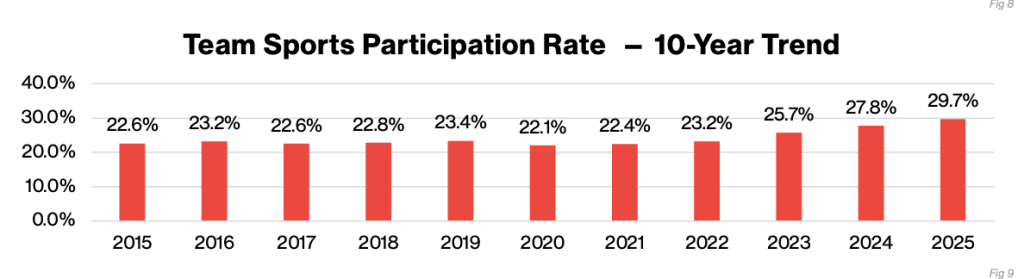
Meanwhile, team sports had their biggest year of growth ever, crossing 90 million participants for the first time SFIA has tracked. The category grew 6.9% YoY, and participation rose from 22.1% in 2020 to 29.7% in 2025. Basketball (+13.5%), outdoor soccer (+15.8%), cheerleading (+13.8%), fast-pitch softball (+13%), flag football (+9.3%), and track & field (+10.6%) all posted double-digit gains.
Gen Z team sports participation sits at 59.6% — the highest of any cohort — and grew 9.1% YoY. This is ultimate’s natural demographic, and they’re playing organized team sports at historic rates. Just not ultimate. Only two team sports declined meaningfully: rugby (-16.3%) and ultimate (-17.7%). Ultimate was the sharpest decliner.
With casual participation (<13 times/year) falling 20% YoY, a dramatic drop compared to past years, it seems that there are fundamental problems with getting people playing ultimate. Local youth scenes were hit hard by the pandemic, and many are still struggling to keep teams alive: even hubs like Seattle have seen contraction in the number of high school teams in recent years. With team sports writ large doing quite well, this is a major red flag.
One part of the problem may be that the top level of the sport — elite club, elite college, YCCs, HSNI — are doing fine or even growing. The absolute most committed players (call them Core+) are steady…for now. It means that USA Ultimate may not really be feeling the impact of what could be catastrophic decline if it’s not reversed, because memberships are stable and there is increasing demand for YCC.
But I’ve personally seen and heard anecdotes about the thinning of local leagues and high school programs. And I’ve watched key organizers and tournament directors walk away. Without this “top of the funnel” growth, eventually the elite side of the sport will feel the pinch too.
With traditional sports and even new entrants like flag football doing great, ultimate may need to reconsider its marketing pitch to youth players. As much as ultimate loves its countercultural roots, what we’re selling may not be clicking with young athletes and their families.
Meanwhile, disc golf just got added to the SFIA report for the first time: 6.3 million in total participation, 1.9 million in core participation. That’s about four times larger than ultimate. Comparing an individual sport to a team one is a bit apples to oranges, but given the common ancestry and how much disc golf has grown while ultimate has stagnated or shrunk over the last 20 years, it’s still worth mentioning.
It’s hard to overstate how dangerous this situation is for ultimate. Growth and decay are both exponential: we have negative compounding happening right now. New teams and players beget more new teams and players: we need to start finding a way to create positive network effects, especially in youth ultimate.