A pair of women qualified for Nationals on men's teams in 2026
May 21, 2026 by Edward Stephens in Interview, Other, Profile
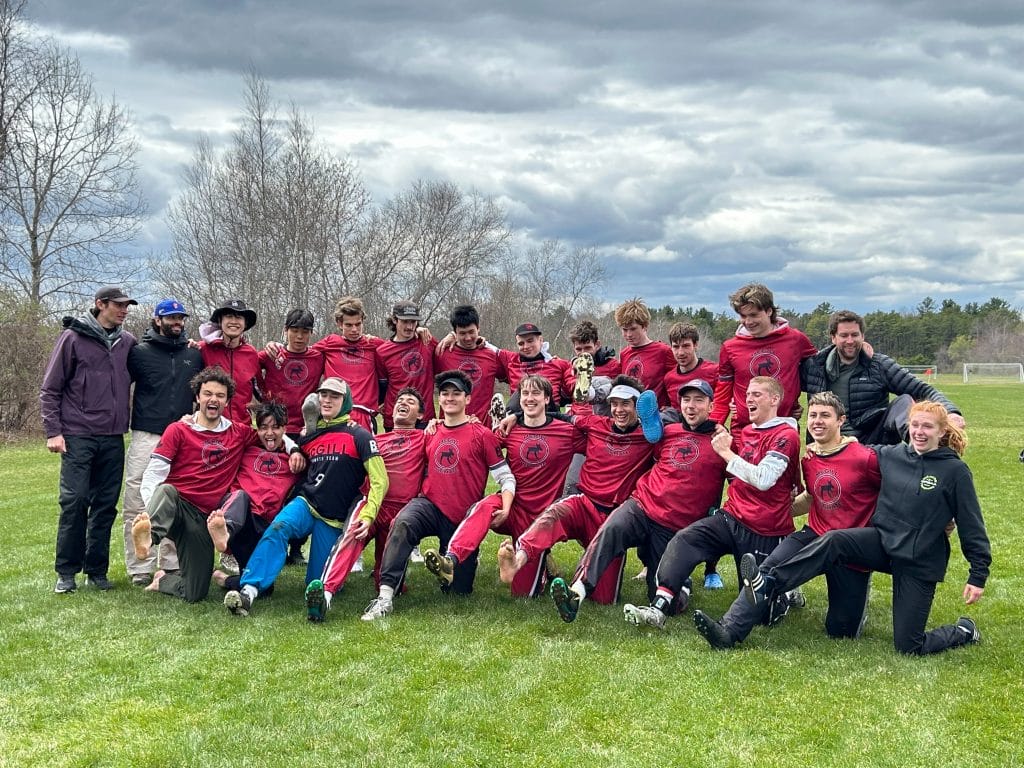
On April 26th, a culmination of years of work occurred in Des Moines, Iowa: Flat Earth, the Macalester College men’s ultimate frisbee team, rolled regional titans (and cross-state rivals) St. Olaf Berserkers in the North Central semifinals. With the victory, Macalester qualified for the Division III College Championships for the first time in program history.
A week after Flat Earth broke through to D-III Nationals, McGill University’s team, MUT, found themselves fighting for the final New England bid to the Division I College Championships. There, they executed in the wind to run past an exhausted Tufts E-Men side1, taking third place in the region and securing the program’s first trip to Nationals.
Watershed events for programs are always special. Macalester and McGill have some common ground in addition to the basic fact that they are both first-time qualifiers. Both programs have had to make significant cultural changes to reach this level of commitment. In Macalester’s case, the program re-started from scratch a few seasons ago after a multi-year hiatus related to an earlier iteration of the team’s misbehavior, and they have had to continually emphasize and commit themselves to a positive team culture that bears little resemblance to the team as it existed in the 2010s.
McGill, meanwhile, elected to undergo a multi-year process of steering the Montreal-based team toward spring competition in the USAU college structure, a very different time commitment and season from their typical place in the Canadian University Ultimate Championships. That tournament takes place every year in early October; it represents the end of the season for most Canadian schools, and until recently it was the end of the line for McGill. It’s a minor miracle to make a change like the ones McGill and Macalester made to reach this point.
These two schools have something else in common, though: each of them has a woman rostered on the team. Despite the division’s current “Men’s” moniker, it used to be called “Open,” with the idea that, regardless of gender, anyone who met the school enrollment requirements could play in it if they so choose, and it still operates on this principle.
That being said, it’s exceedingly rare for women to play in the men’s division, especially among the top teams. According to historical records2, from 1995 to 2025, there were 6,561 unique athletes rostered at D-I Nationals. Exactly one of them is a woman3: Tina McDowell, who played for the University of Georgia’s Jojah. McDowell, reduced to mathematical terms and rounded to the nearest one hundred thousandth, represents .00015% of the men’s D-I Nationals playing population in that time.4 The fact that there are multiple instances this season is remarkable.5
Rather than merely remark on it though, we reached out to 2026 players Stellah Marienthal-Legendre and Maia List, as well as 1995 player Tina McDowell, for interviews about their experiences playing in the men’s division. These were fascinating conversations. Below are excerpts from them, grouped by theme, in which the players describe how they came to join their respective teams, what it was like to be one woman playing on a field alongside 13 men, their best moments, the hardest challenges, and what they have learned about themselves and about ultimate because of it.
How It Started
Tina McDowell started playing frisbee at the University of Georgia because a former camp counselor invited her to a pick-up game, and like so many longtime players, she fell for the game quickly. Everyone played together in the fall – Jojah didn’t really break into their own thing until spring. When they started practicing, they needed numbers, and she was more than happy to join in to keep playing as often as possible. There was a simple reason that she didn’t play women’s.
“There wasn’t a women’s option,” recalled McDowell.
That might be shocking to read considering the robust Georgia women’s program (called Ho Dawgs, Dawgma, and now Athena) has 16 Nationals appearances (more than UC San Diego or UNC), including a seven-year active streak and the 2001 National Championship. They didn’t start, though, until after McDowell graduated. She kept practicing with them throughout the entire spring.
“I was definitely a part of the community at that point, pretty dedicated,” said McDowell. “And I was pretty good.”
Then, right before the postseason, the team’s coach made a surprising suggestion.
“Maybe a week or two before Regionals…[he said] ‘I think Tina should be on the team and go to Regionals with us… All in favor?’ And so we kind of put [the team] on the spot,” she said. “This wasn’t a blind vote. You could see what other people said. So I don’t know if they felt pressured, but they were all into it.”
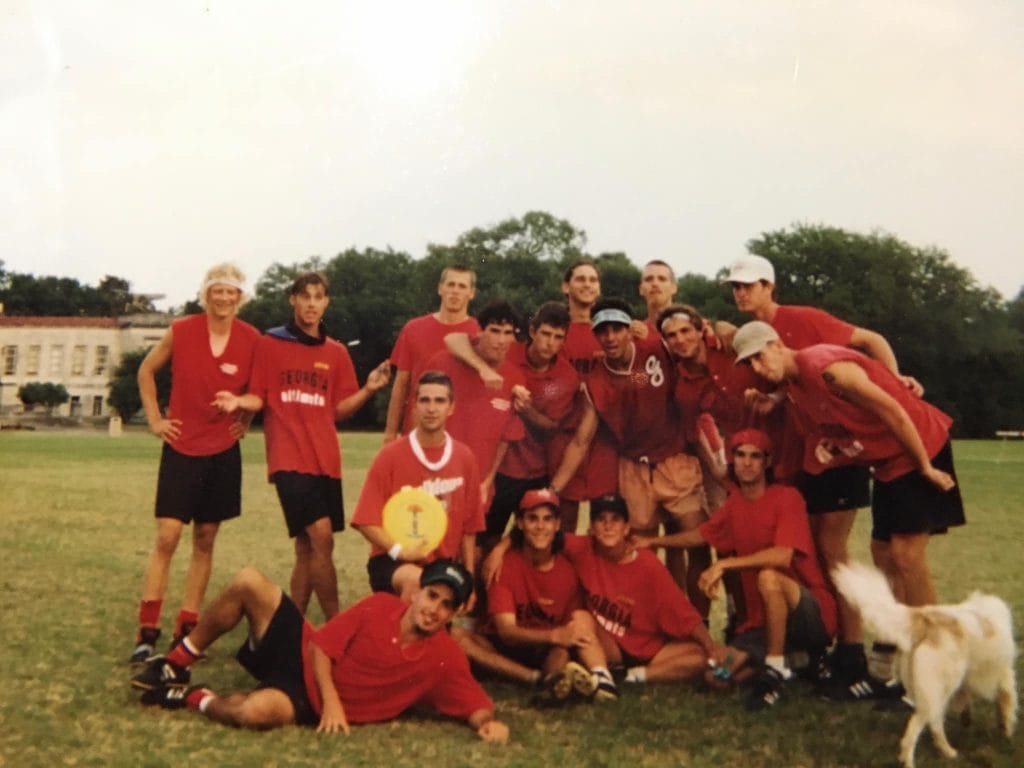
It didn’t make that much sense to McDowell from a competitive perspective. “Especially that being my first year, like there was only so much I could contribute on field with the gender difference,” she said. “It wasn’t like I was going to be an asset or anything. I’m guessing it was just maybe he saw potential and wanted to give me that opportunity, because that was way ahead of its time in terms of gender equity.
“That started my career.”
What a career it has been. Twenty-five years later, McDowell was inducted into the Ultimate Hall of Fame.6
List also faced reduced options when deciding where to compete. Having grown up in Toronto around the game – her dad played – she knew she wanted to play at the highest possible level and as often as possible. At a Canadian university, that means playing in the USAU College Series in addition to (or, sometimes, instead of) the Canadian University Ultimate Championships. While McGill fields both a men’s team and a women’s team, only the men’s team was committed to a USAU spring season in 2025 when she joined up.
“The decision was driven by a desire for ultimate,” said List. “I am hungry for more ultimate all the time. And since the women’s team wasn’t competing in the US Series…”
She tried out, she made the team, and she traveled with them throughout the 2025 season.
Marienthal-Legendre is the only one of the three who had legitimate options when she went to Macalester. She had played some pick-up ultimate in the Hudson Valley area of New York, but her major activity was competitive soccer. She knew she wasn’t going to continue with soccer in college, so she checked out the women’s ultimate club, Pursesnatchers. She liked the sport and the people, but she needed more of it.
“I wanted to get a little bit more physical energy out, get a couple extra touches,” she says. “So I was practicing with the men’s team just for the sake of it.”
She discovered over the course of the spring, however, that the athletic experience with Flat Earth suited her better.
“It felt like a level of play that I wanted to be at, and I could really push physically,” she said. “ I think a piece of it was just speed of play… I needed to be in a place where my physicality was appreciated and matched.”
More specifically, it was a better transition from her youth soccer career. “Ten years of six days a week, and hours of practice with really intense coaching was hard to let go of,” said Martienthal-Legendre.
She recalled that a couple of the Flat Earth seniors took her under their wing, and by the time it was time to create rosters for the Series, she felt very connected to the men’s club.
“I just kind of titrated onto the team,” said Marienthal-Legendre, who is a soil scientist when she isn’t on the field. “Everyone goes, ‘You’re in the team group chat, you come to everything.’ It wasn’t really a question.”
When the Going Gets Tough…
All three joined their respective schools’ men’s teams with relative ease. But that doesn’t mean it was easy for them to compete with the men on the field.
“I am 5’5″ on a good day. That means that everyone on the field playing open, like 99.99% of the time, is taller than me, is bigger than me, is faster than me,” said List. “And I pride myself on being pretty fast.”
There is an added mental aspect to the challenge. For a given individual play, an adverse moment can be processed as a learning opportunity.
“The first time on the field, I got run-through D’d. Somebody beat me from behind,” recalled McDowell. “It was like, ‘Oh, can’t slow down.’”
Other times, moments like that could be tossed aside with a smile.
“Doing a Randy Moss drill… I’m not feeling thrilled about my skying ability,” said Marienthal-Legendre. “But I take it on as a challenge. It’s a fun thing to, to push myself against the top players on our team.”
Over time, though, those small moments can add up to a great weight of self-doubt and exasperation.
“Fighting this kind of physical uphill battle, it’s like, ‘OK, I really can’t catch you deep,’” said Marienthal-Legendre. “Sometimes there is this real frustration where I’m like, ‘I’m working so much harder than you guys. I’m running all the time. I’m training all the time. I go to the gym more than all of you. How am I still slower?’”
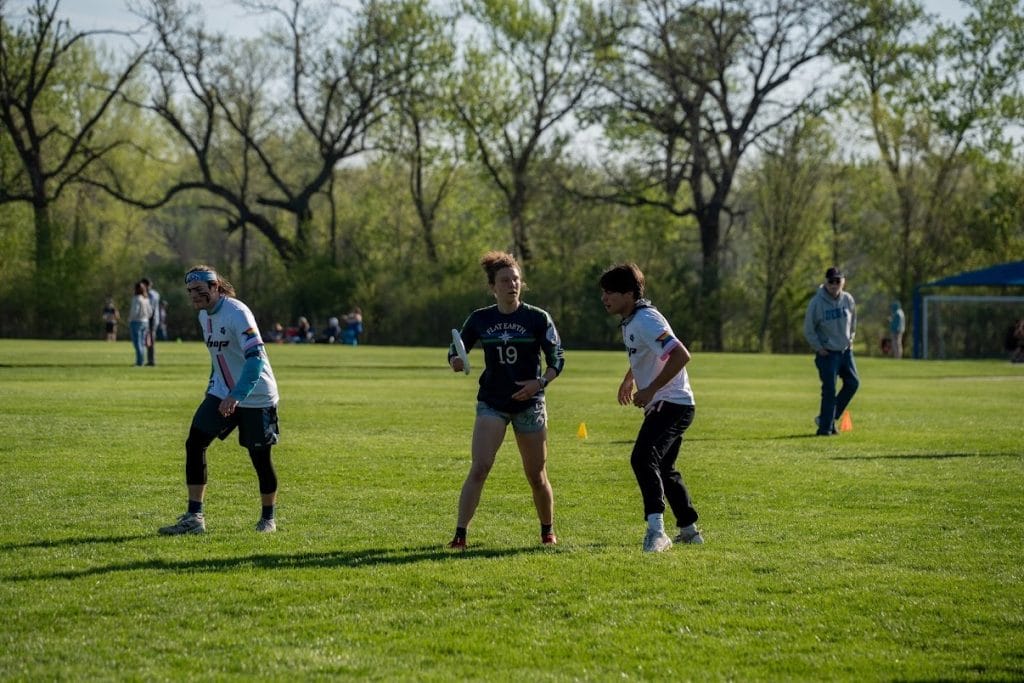
List explicitly drew a stark comparison between her state of mind in women’s division play – she has played two seasons with Toronto’s top club team, 6ixers – and men’s division play.
“In women’s, I’m almost always one of the most physically able players on the field… and I play with that confidence,” List explained. “But [then I] go to open practice. And to know that I can put in so much work, but I’ll never be quite as strong, quite as fast as these players that I’m playing against, can be really demoralizing.”
It isn’t just the individual stress of trying to keep up that can have an outsize effect, but the idea of loneliness or of having to carry the torch for a massive subsection of humanity.
“At tournaments, if I was not touching the disc very often, I would get really in my head. Or even at practice, if I felt like I played poorly, because I knew I was always an outsider, even though the team made me feel welcome,” said List. “It’s so obvious that I’m different. I felt like there wasn’t anyone who could relate to what I was going through. I wasn’t just playing bad, I was playing bad as the only girl on the team. And I felt the weight of that on my shoulders a lot.”
Finally, there is the social drip, drip, drip of microaggressions. Even if you choose to believe that the majority of these instances are unconscious, they have an undeniably alienating effect.
“‘I’ve got the girl.’ It’s like how people will mark up on me,” said Marienthal-Legendre. “Yeah, that is like my identifying feature, but it can get boring. Or, [if] we had some contact. You would never ask a guy on my team, ‘Are you OK?’ after a little bit of contact. Yeah, I’m fine. I’m not gonna break, you know.”
Whether intentional or not, these small moments are all different ways of saying something to the effect of: You look like you don’t really belong.
…The Tough Get Going
All of these players, however, have managed to overcome the physical hurdles and the grueling mental and social challenges to find success on the field. They highlight field sense, trust, determination, self-knowledge, and opportunism as qualities that have carried them to their best moments.
“There’s an element of… if I mess up, I definitely get worried that the other team doesn’t respect my play,” said Marienthal-Legendre. “I wouldn’t say that I’m super hurt by any of those things. I just see a moment to prove them wrong.”
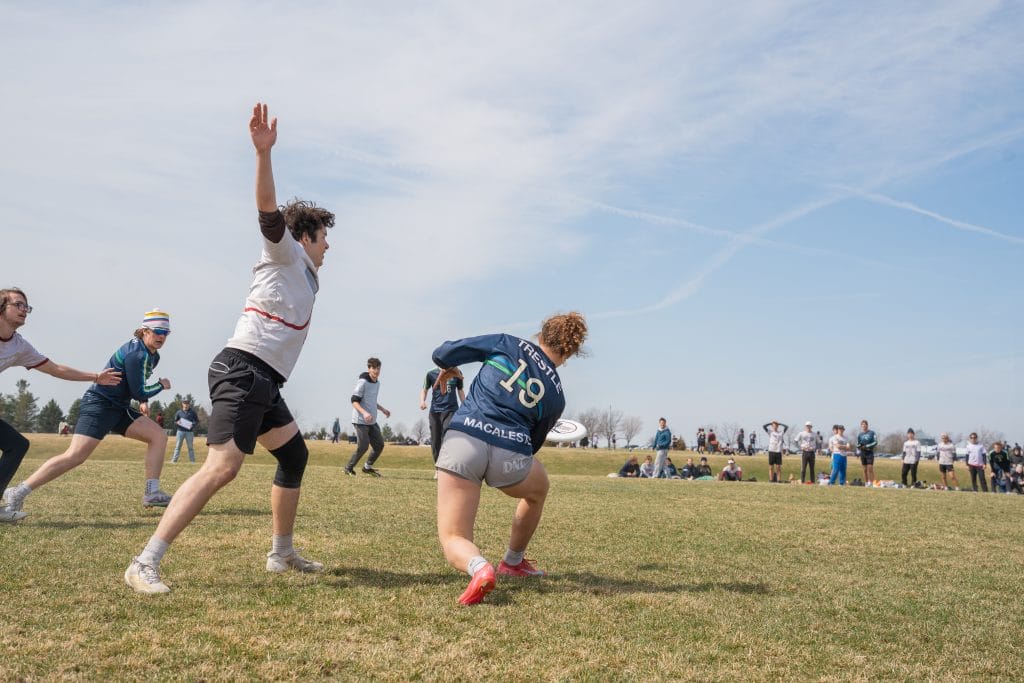
“When you’re not as good of an athlete you have to be smarter in terms of being able to read the field and read space and play angles and all that stuff,” said McDowell. “Even in the women’s division7 I was a very average athlete, but field sense is kind of my superpower.”
“In order to contribute on the field, you have to find an advantage elsewhere,” said List. “And for me, that’s playing smarter, both on offense and in defense. It means you have to pick your moments better. You have to cut with 100% conviction every single time.”
“There are ways that I can use my intelligence on the field, and spatial awareness that I often draw from soccer to mitigate a guy skying me deep,” said Marienthal-Legendre. “And I recognize the spaces where I have to utilize heads-up, anticipatory play on defense.”
They find other ways to exceed their male peers physically on the field, too.
“And, you know, I get on the ground a lot. I bid a lot. That’s a big part of my game,” said Marienthal-Legendre.
“Am I going to be the primary deep striker on the open team? Probably not. Am I going to be someone who can be super shifty, and like be a player in small spaces? Yes,” said List. “[I] prove consistently that I can perform in that space.”
With those fundamentals forming the recipe, the spectacular can happen.
Marienthal-Legendre remembers a game from Conferences against arch-rivals Carleton CHOP in 2025. “I scored four out of our eight goals, I had one bid in the end zone and then, like, two really nice ISO cuts.”
McDowell also dug into the past for some highlights. “I remember getting hand blocks,” she said. “And I got a layout D against Carleton on Hummer [at Nationals].” (“Hummer” is Sam Rosenthal, longtime Boston men’s club player and current coach of the UFA’s Glory.)
And when I was covering Florida Warm Up in 2025, I distinctly remember a massive layout score List caught against Texas A&M as I walked by their field.
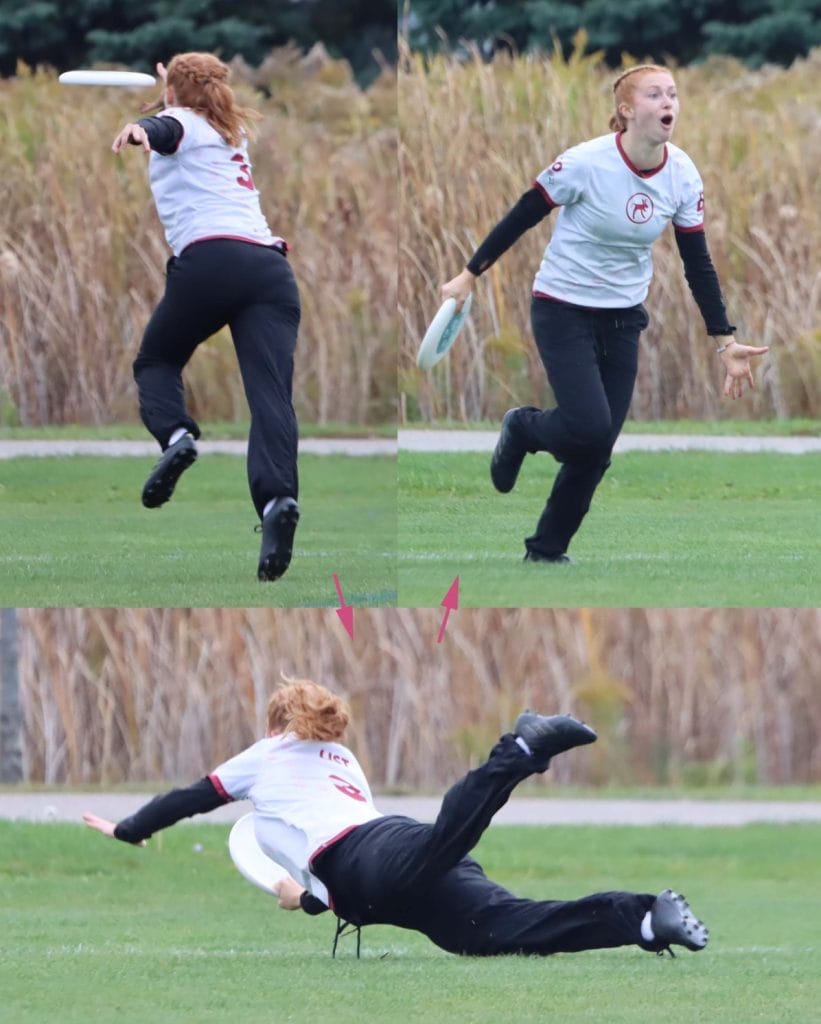
While much of the credit for why all three have been able to build successful careers playing in non-traditional divisions goes to their individual qualities and motivations as competitors, all are quick to point out the support, respect, and trust afforded them by their teammates.
“Once my teammates saw that I picked my moments and I was able to succeed in those moments, they trusted me to continue to do it. They throw to me when I’m open,” said List. “Or even sometimes when I’m not.”
Teammates don’t only provide active support in that way. Through creating a positive, welcoming culture, they also provide the balm during tough times that can help players push through. List noted that when she started to feel down, she looked to the people surrounding her.
“What I leaned on was the people on the team who are my close friends, people who I will continue to stay in touch with hopefully for many, many years until we’re crippled and old and we can’t play ultimate anymore,” she said.
“They include me in everything,” said List. “There’s no question about the trust that I receive on that team and credit where credit is due to the boys on the team. They have welcomed me without question, and it has been such an amazing environment to play in.”
“I feel really, really connected to these people,” said Marienthal-Legendre. “I wouldn’t say that they’re trying to bring me in as a girl. They really enjoy being around me. I’ve spent so much time with so many of them. It’s been a really sweet piece of my Macalester experience, a really, really central piece.”
According to McDowell’s recollection, her experience in the 1990s fitting in with Georgia was so natural she almost didn’t notice. “I always had lots of dude friends, so I was in my comfort zone there,” she said. “I honestly just took [my place on the team] for granted. Like that was all I knew. I had never played with women before. [The men] were just my teammates, you know?”
That team and community were so supportive. Being able to take it for granted that I would be treated as an equal was great… and that for sure was not the case in the 90s in most sectors. Overt sexism was a part of the culture in sports for sure. It’s funny, even now I get mansplained at league,” McDowell said. “So I really don’t understand how the team was so cool when I was at UGA.”
A Matter of Preference
List prefers women’s division ultimate. (“It’s where I’ve had the most fun. It’s where I thrive.”) Playing for McGill’s men’s team wasn’t a conflict for her when she started because the women’s team hadn’t committed to competing in the USAU Series. In 2026, though, they went for it, competing in conferences and regionals. It made for a choice that was, in List’s words, agonizing.
“I knew that by deciding to play with the open team this year, I was making the women’s ultimate scene worse by taking away a good player,” said List. “For me this year, it came down to what my goals with respect to ultimate are… And I wanted the physical and the mental challenge that playing on the open team offers because I want to be really, really good. And I felt like playing on the open team would get me there. Whereas playing with the women’s team, though still a great opportunity to play, still an amazing, amazing group of girls, wouldn’t have challenged me quite as much.”
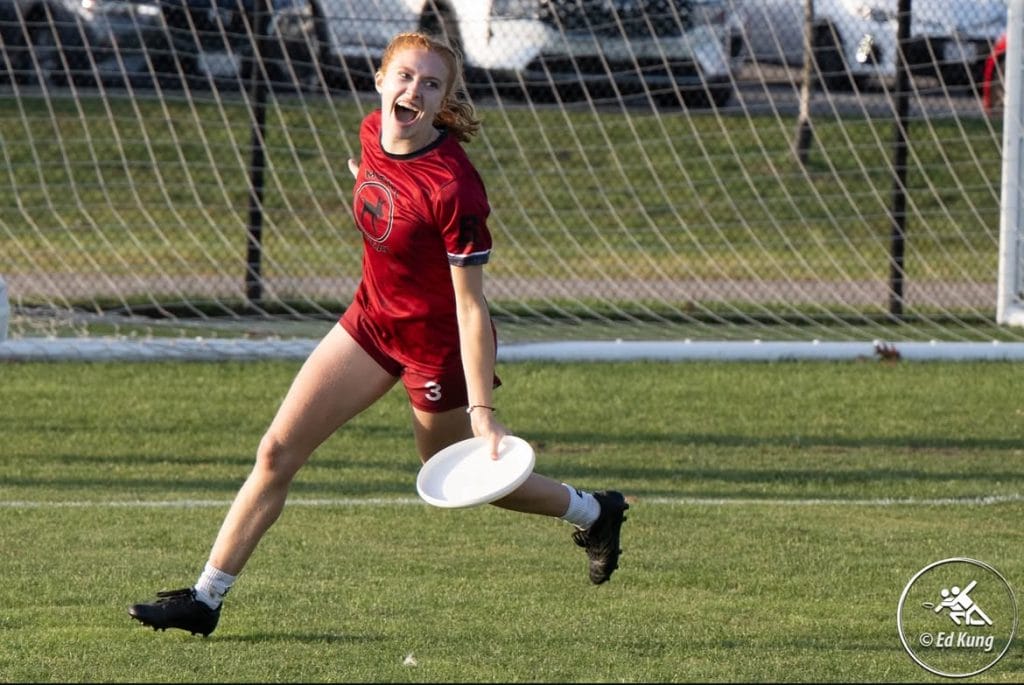
It’s a choice Marienthal-Legendre will confront again next season, her last. “It’s a discussion that has been up in the air,” she said. “It comes into my head and then it pretty quickly subsides [because] the team culture [on Pursesnatchers] is so different.”
The teammate bonds are at least as persuasive for her as the difference in culture. “Flat Earth is all of my best friends and I love the team,” she said. “The amount of time I would be spending with a team that’s not my current team whom I adore just makes it not really worth it for me.”
The takeaway from both of them is that they chose to play for their schools’ men’s teams for a suite of specific reasons that made sense for them.
I asked McDowell whether she would have chosen to play with the women’s team at Georgia if it had existed at the time.
“If I was talking to somebody who was in that situation now, I’d probably tell them to play women’s because you’re just gonna be able to contribute more on the field,” she said. “But that being said, I can’t imagine having any other college experience. I don’t envy the people that played on women’s teams at all. I got the complete experience with my team.”
So I think given the choice, I maybe would have played with the dudes, even though I value my later time with the women.”
While they made a different choice, all of them stress how important women’s division ultimate is. And they offered some advice for anyone in the future picking the same path.
“I think college frisbee is a place where you can mess around and try playing with men,” said Marienthal-Legendre. “They want to bring you in a lot of the time. I mean, I really hope my experience isn’t an outlier. Work hard, ball out.”
“Play confident,” said List. “Remember who you are, remember how talented you are, remember that you love ultimate.”
“It’s really freaking hard to play open,” she added. “No matter how kind and welcoming the team you play on is, it will always be more challenging for you than it will be for every other player on the field because people will see you as different. Your opponent will see a woman on the field and try to take advantage of you. Don’t let them. You are a really, really good player.”
McDowell was more succinct.
“Have fun. Yield no ground.”
Tufts had beaten Vermont the round before on universe point in cap ↩
Credit to William “Brody” Brotman for maintaining historical data and presenting it at the essential www.ultimate-reference.com ↩
This figure only includes cis-women. We recognize that there is a potential for a wider spectrum of trans or non-binary athletes, but this data is impossible to capture in practice and, in the opinion of the author, would cause more harm than celebration given today’s hostile political climate. ↩
It is not quite as rare in D-III, where multiple women have played for men’s teams in its 15-year official history, but they remain statistically miniscule occurrences. ↩
In addition to List and Marienthal-Legendre, there is a third player who fits the bill in 2026, playing for a D-I men’s division team. They did not respond to requests for an interview, however, so we feel it is prudent to respect their privacy and decline to identify them here. ↩
Author’s note: based on a few pickup goalty sessions, she still has the juice. ↩
McDowell played many years of elite women’s club after her college years with Georgia ↩