How Winona State used grit, coolness, and a whole lot of smiles to nearly make Nationals with a 10-person roster
June 25, 2026 by Zack Davis in Profile
Ultiworld’s coverage of the 2026 college ultimate season is presented by Spin Ultimate; all opinions are those of the author(s). Find out how Spin can get you, and your team, looking your best this season.
Ask anyone familiar with the Winona State University women’s ultimate to describe that team, and the two adjectives you will get are “gritty” and “scrappy.” Both are accurate in their own right but together speak to a larger truth about the Bad Monaz: they are all about the grind. Grind is an old word, even in the slang form that we still use today. The earliest use of “grinder” to describe someone as a hard worker extends back to the early 1700s. Grinding tools are some of the oldest in our history as humans, in fact they predate modern humanity, being used by Neanderthals thousands of years prior to the rise of homo sapiens.
Grinding, as a concept, is instinctual and deeply human. It combines two seemingly irreconcilable ideas into harmony through brute strength and force of will. To grind is to create through destruction. To whittle away at one thing, literally or metaphorically, in order to rip some other thing into existence from within. To take a lump of stone or hunk of metal and fashion a tool, to take a stalk of wheat and grind it to a fine powder of flour, to take one’s body or mind through a rough test of endurance in order to refashion oneself as better, more capable.
The proverbial grind can often be deeply painful, difficult, and isolating. The grind is often bereft of joy, it can be a complete forbearance of any immediate gratification that promises a revelatory satisfaction upon completion. It is also, like most things, only good in moderation. The sharpest sword can be ground to nothing, the sturdiest rock, ground to powder.
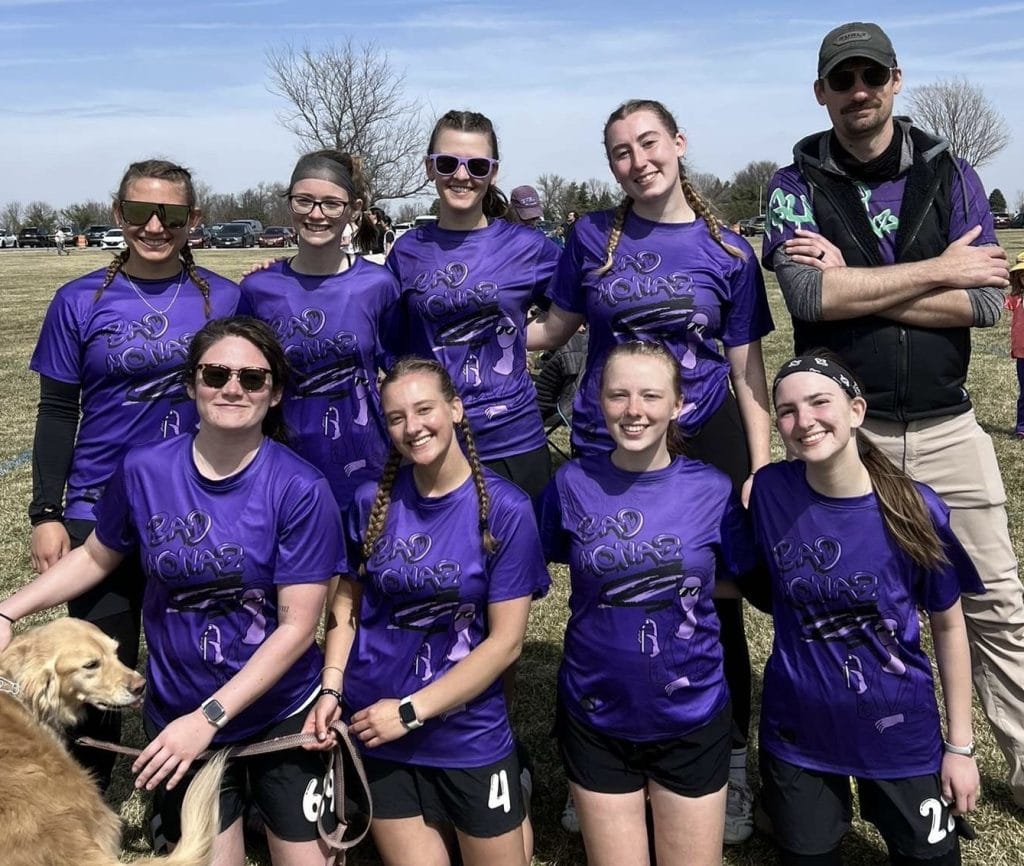
The Winona State Bad Monaz are in a constant grind state. As a team they are, like many D-III programs, on the edge of existence. This season, the Monaz rostered only 10 players, often traveling to tournaments with fewer, playing savage or nearly savage. That kind of play when done consistently can break teams, but the Monaz have been around in some form or fashion since the 80s.
The secret sauce to keeping the team together and running, both literally and figuratively, is the same as the actual Mona Lisa: a smile.
Smiling Through It
“We’re all in our best mindset for practices and for games,” said Juliah Hahm, one of the four players I spoke with. “But we’ve always been a super positive team, and I think that’s what keeps us all working really well together. We try to have fun with everything we do, because it does get tough.”
Part of that positivity manifests itself in celebrating small wins. “The Monas have done an excellent job of celebrating that growth and those steps together,” coach Craig Wotruba emphasized. “So, if Juliah [Hahm] wants to, you know, catch her Ds more than just knock them down, her teammates know that and are ready to celebrate and get excited when she does that.”
The foundation of that positivity has two major components. The first, as outlined by Kirstyn Sand, is “our personalities in a small team just click really well.” The second is music. “Practice or even tournaments, we start them off strong with hype music,” Sand continued. “We all just let loose, and get in that positive mindset.”
Though they start off in a good place, there’s that ever-present tension of the grind. Every player on for nearly every point can take its toll. However, some aspects of being a small team can help alleviate some of the issues caused by it.
“When you are such a small team, you know that everyone is struggling the same amount as you,” said Greta Baumgartner. “Everyone’s in the trenches, everyone’s sore, everyone’s tired. You know that if one person gets super down, you’re like, ‘okay, I’m gonna pick it up a little bit, because I need them to be up, and I don’t need anyone else getting really down.’ We all just do a good job of keeping each other balanced and checking in on each other and making sure that we’re all on a good, even playing field.”
A little ribbing and lighthearted sarcasm also helps. “We can tell when people are tired – we’re all tired,” said Hahm. “We are very sarcastic, too. We joke about everything. We will be so tired after a timeout or something, and then Craig would be like, ‘alright, D-line is on!’ and our whole team is D-line and O-line. So, we just make small jokes about that. Saying ‘I know you’re tired, but we’re just gonna put our O-line out’ and we all have to walk out back on the field.”
The Brushstrokes
They aren’t just running into a wall over and over though; Coach Wotruba spends a lot of his time thinking about ways to get his team as much rest as possible. Because of the limitations of the roster, he’s forced to find ways to maximize his players’ skillsets while accounting for the fact that he can’t ask them to specialize.
“I don’t have the depth or the versatility that other coaches have,” he said. He can’t afford to save legs in game three on Saturday if it’s a blowout. “That never comes in. So whether it’s at tournaments or practices, I try to focus a lot on skills. Every one of the players that we have is versatile. They have to be.”
At practices it’s fundamentals, but often his players have unique skillsets that manifest naturally and he takes advantage. “When Kirstyn [Sand] first showed up with the Monaz, she threw a couple inside breaks because no one told her it was hard,” Wotruba said. “Then that becomes a part of our game, that becomes a part of our offense.”
Each player has some talent similar to Sand’s that manifests itself in practices and tournaments, and Wotruba does his best to lean into them when setting the line up. “There’s seven positions, and we’re gonna try to find the best fit for each individual player,” he continued. “They can kind of blend that into what their teammates’ strengths are, as well.
Having a small team isn’t all bad as a coach either. “In some ways, having a small team lets me specialize more as a coach and say, ‘this is what we’re going to focus on’ with what I want to teach Greta [Baumgartner] this week, or ‘this is what I want your focus to be.’”
Strategy Guide
When it comes to tournament weekends, the team can get quite creative at finding ways to conserve energy.
“We make sure to use our timeouts very strategically,” said Baumgartner. “[We] kind of get a feel for everyone, like, ‘hey, do you really need a break after that point? Can we push for one more? We’re this far from halftime, like, when should we split it up?’”
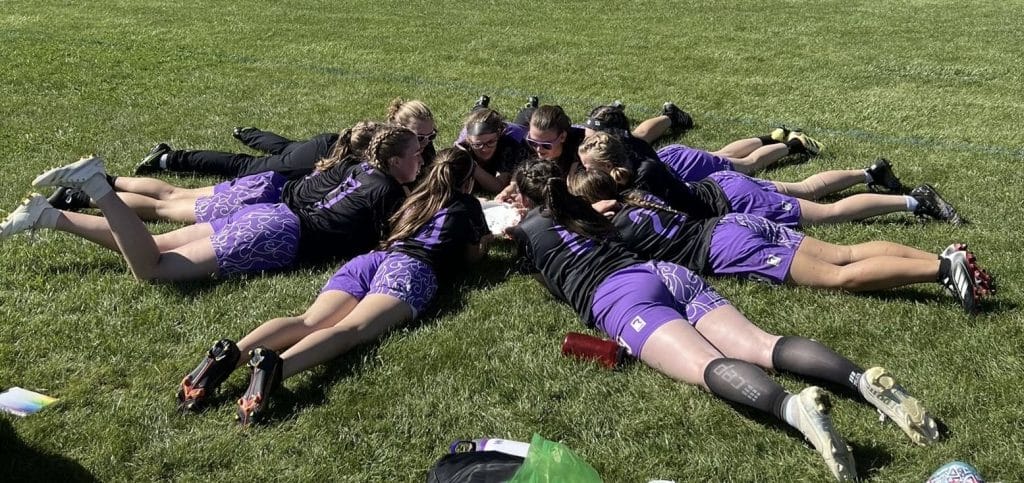
In addition to making the most of their timeouts, they make the most of their halftimes. “We always make jokes that some teams, to keep spirits up during halftime or in between games, they’re dancing, doing the fun things. And then usually you’ll look at our team, and we’re all laying on the ground,” said Baumgartner. “We’re all laying there, we’re trying to soak in the sun and the ground as long as we can, and getting our food.”
Baumgartner said that her team also makes the most of their time between points — “Honestly, even sometimes walking back to the line, I’ll sit down for a quick one if I’m like, ‘oh, my feet just need a breather.’”
There’s no grand strategy to their rest, they just make the most of what they have, taking nothing for granted.
Sometimes there’s just not enough gas in the tank for a player, and they need to sit someone without a sub. At Old Capital Open, the Monaz went down to six players. “We’re always going to prioritize safety,” said Hahm. “If you need to take a break, we’re not going to be lik,e ‘no you can’t do that.’”
Wotruba added that they scored a few points in those six-on-seven situations.
Off-Field Challenges
There are also off-field challenges that come from being a small program. Namely, keeping that program alive.
“My freshman year, we were a very senior-heavy class,” said Baumgartner. “When you lose half of your team, there’s that really hard recruitment year next year. We were able to scrape by in the fall, but then there are some injuries and issues, and we weren’t able to play a spring season.”
Even when they are able to play, there are challenges at practice. Coming up with drills for so few people can be difficult, so the Monaz will practice with the men’s team, the Winona State Experience. “When we play with the [men’s] team sometimes, we’re able to do a bunch of new things that we didn’t have numbers to do before,” Madelyn Brockberg said. “It’s about however many people show up to practice, that’s what we can do with just such small numbers, because very rarely it’s all ten of us.”
You would think that with fewer people it’d be more likely for everyone to show up, but even just getting space to practice is a massive hurdle for the Monaz.
“The fall is a little bit easier because we’re able to be outside,” said Baumgartner. “But when it’s the spring season, when we really should be conditioning and doing a lot of stuff, we, unfortunately, only get gym space one day a week, which is Tuesday nights, 10 to midnight. So, we always go into it being like, ‘we’re gonna condition, and we need to lock in and do that,’ but it gets to the point where most practices are so late you just need to make it fun.”
With a schedule like that, it’s a miracle the Monaz even have practice at all. “Combine that with just the geography of Winona. It’s basically an island in the Mississippi River,”’ said Wotruba. “Even if it is warm enough to go outside, the field space that we have access to in the fall is basically a swamp, you know, when all the snow melts. There’s just no place for the water to go, so everything is just a marsh, it’s a bog. It’s pretty rare to get any outside practice time post October.”
The team hasn’t always survived the hardships, even when they’ve had the numbers to field a team. “There’s been one year since I’ve been coaching the Monaz where the team decided, ‘We’re done being a frisbee team this year,'” said Wotruba, who has been a coach for fifteen years. “They had a rough spring break, they came back and said, ‘we don’t get along, and this is not a thing that we want to continue doing.’”
Despite all that, in 2026 the Monaz overcame and managed to have a full season, which ended with them nearly stealing a bid from St. Olaf Vortex in the game-to-go at North Central ConfRegionals.
The Upshot
There are silver linings to playing with such a small group. For every instance of a team not coalescing, there’s ten iterations of the Monaz that are as tight knit as the current one.
“Since we’re all on the field, we all have the opportunity to get so much better every single time that we play,” said Hahm.
“I feel like because we’re so small, we’re kind of forced to gain chemistry,” said Sand. “By playing one tournament, we had literally seven players, so we were the same seven on the line the whole time. I felt like as the day went on, we just grew in chemistry.”
“It gives everyone a chance to learn the different positions as well, if we need to,” Brockberg said, sharing that the Monaz often swapped on-field roles to try and save legs. “You really get new experiences and get to be better at everything all the time. And I think we just all have fun doing it, it’s always a fun time, we’re always in good spirits. We have fun out there.”
“Luckily we all like each other,” added Hahm. “We like playing frisbee. Yes, we’d love to win every game, we love to score when we can. Obviously everyone is involved, and if we see, like, ‘oh, Greta [Baumgartner] hasn’t scored a point,’ we’re going to get Greta this point, because it’s such a team sport, and we make it a team sport by getting everyone included.”
Part of that is knowing each other’s individual goals and celebrating those small wins. Hahm continued that if someone wanted to throw a hammer in a game, then they will try to set that up. Making these things happen helps, she said, “not to make it less serious, but to have fun with it, since it can be exhausting, you can get super down after a point.
“Let’s go out and do something that looks cool,” she continued. “Something that looks really cool.”
Self Reflections
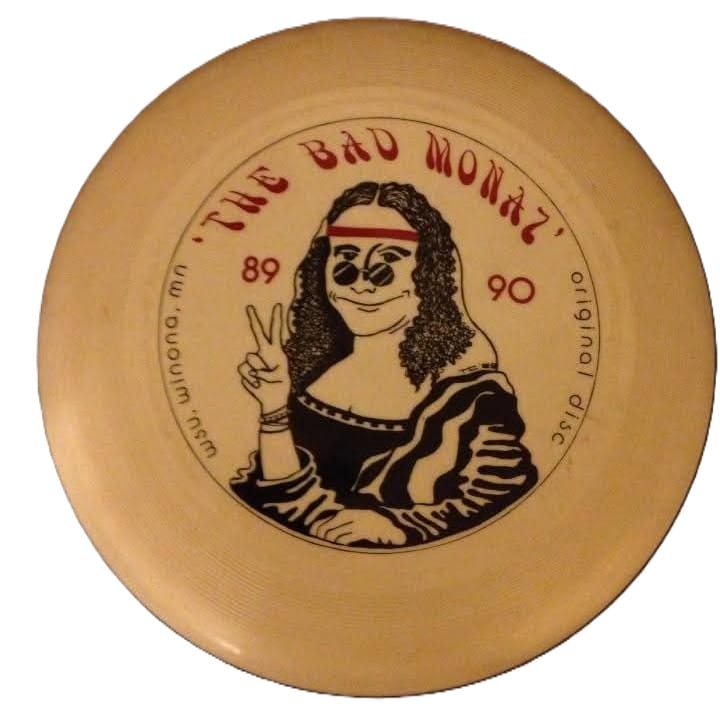
Coolness isn’t something that they’ve reserved for on the field, in fact it’s in the name. The origin of the Bad Monaz is simple, but iconic. There was a photo found by some early players for the women’s team in an art history textbook, and the descriptor of Bad Mona stuck. It wasn’t long before the team had an interpolation of Mona Lisa bedecked in stereotypical hippie garb on the top of an ultrastar.
Though everyone else describes the Monaz as “gritty” and “scrappy,” adjectives they themselves identify with, when asked to describe themselves, the first word they used was “determined.” Not just determined to get better or determined to make Nationals, but as Hahm put it, “Determined to get to half. We’ll be like, ‘what do we have to just score just to get to half?’ We are so determined, we’re like, ‘it’d be super cool if we could win against this team that has 25 players, that’d be crazy.’ But we’re also just determined to get to half, to take a break.”
Wotruba has a different word he uses to describe Winona State.
“They’re a very present team,” he said. “There’s very rarely a thought or a conversation of ‘Alright, so we have to do this, this, and this on this half, and two games from now, we’re gonna…’ No, two games from now is very far away. I think one of the strengths of this team is that they’re right in the moment, all the time.”
Wotruba understands why his team is described as “gritty,” and he sees it himself, but says that’s not necessarily a byproduct of the team’s nature, quite the contrary: “They’re all tough because they have to be, and they have to be because they’re all tough.”
Although the Monaz didn’t achieve their goal of making Nationals this year, it wasn’t for a lack of effort. However you want to describe them, gritty, scrappy, determined, or present, they didn’t let the grind wear them down. It’s hard to imagine that they won’t be back, nose down, back at it again in some new iteration, next season.