Spirit, perseverance, and support from her Oregon State teammates is helping Cami Potter continue to play the sport she loves
July 26, 2026 by Laura Osterlund in Profile
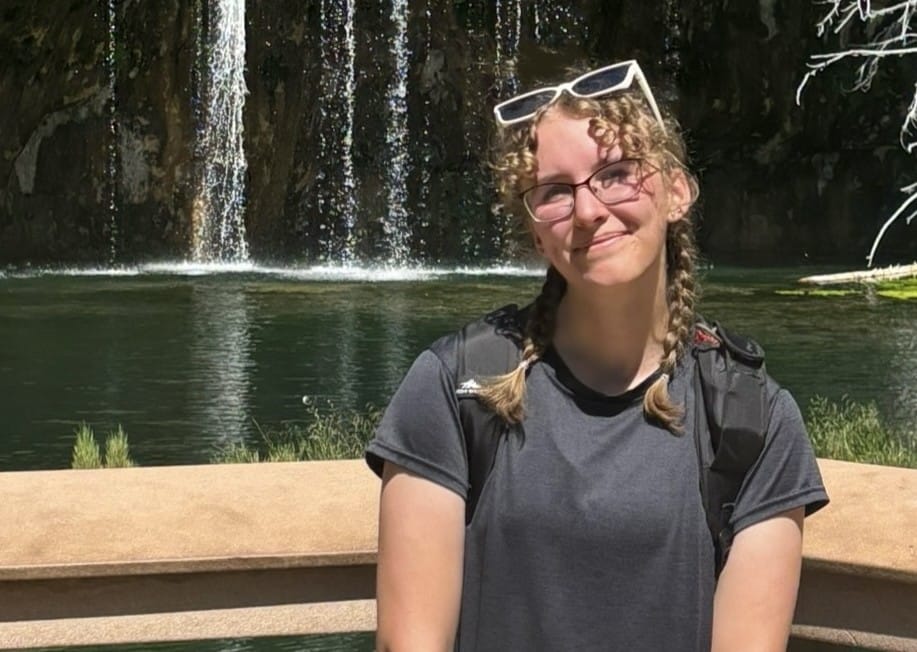
In her first season playing ultimate with Oregon State Dinos, then first-year student Cami Potter broke her foot just weeks into the school year. That November, she tagged along with the team to a rainy, windy OFUDG tournament to cheer her new teammates on. At the end of the day, as everyone sat down at a long table to enjoy a food truck dinner, Cami conked out, asleep.
Her teammate, Lena, turned to her and said, “Hey Cami, are you okay? Did you have a long day?”
Since Cami had sat on the sidelines all day and merely kept score, she knew her teammate was just being nice.
“Oh, yeah, I just have narcolepsy,” Potter explained.
The following day, in the worst tournament weather she’d seen, Potter had an extra sleepy day. As she sat on the sidelines, bundled in layers with her umbrella propped up and cones in front of her to keep score, she nodded off several times throughout the day.
That tournament was the catalyst, and within the next few months, everybody on the team knew she had narcolepsy.
Her First Test
Contrary to popular belief, narcolepsy is not simply falling asleep without warning at any given time. In fact, these “sleep attacks”1 are relatively rare in many people with narcolepsy who have learned how to manage their symptoms and/or take medication. They typically come on with an urge that lets the person prepare.
Narcolepsy has two types: type 1, which is caused by a lack of the chemical orexin (that helps control sleep and wake cycles) in the brain and includes cataplexy (a condition that causes sudden muscle weakness triggered by strong emotions), and type 2, which does not have a known cause. Potter has the latter. Her symptoms include excessive tiredness during the day, vivid nightmares, anxiety, differently-regulated sleep cycles, a lack of restorative sleep that impacts daily recovery and healing, quick REM sleep, and occasional sleep attacks. Some with type 2 narcolepsy take stimulant medication to help keep symptoms at bay; when Potter started medicating, she found herself able to make it through the day without needing a nap.
“You feel very cold towards sleep. Some people describe the level of tiredness that unmedicated people with narcolepsy feel as the same amount of tiredness that people without narcolepsy feel after staying awake for 48 to 72 hours,” Potter described.
Narcolepsy hasn’t always been a part of Potter’s life – in fact, she didn’t reach a diagnosis until several years ago. When Potter was 13, she experienced her first “sleep attack” while riding in a car. When she brought it up to her pediatrician, she was told that it was just a part of being a teenager with a poor sleep schedule. She tried to get a better night’s sleep and change up parts of her lifestyle, but still didn’t feel better. Potter struggled to get any doctors to listen to her, and it took years to get a formal diagnosis.
Coming to college was the first time Potter met new people with narcolepsy instead of the other way around. Balancing a double major in zoology and anthropology, two jobs, team responsibilities, and her narcolepsy, she learned to make it work. Fortunately, on a college campus, seeing a sleeping student is not out of the norm.
She started figuring out how to manage her symptoms with a nightly schedule: She goes to bed at 10 p.m. each night, and on the nights she has practice, she makes sure everything is ready for bed. And, now medicated after her first year, Potter’s school life once again started to resemble that of a typical hard-working, overachieving student.
Finding Frisbee
Very few people with narcolepsy play high-intensity sports like ultimate.2 As she did not play any sports in high school, Potter’s discovery of ultimate was something of an intervention by a higher power. She accompanied her roommate to OSU’s school sports fair (with the lure of bowling afterwards) and saw the Dinos’ table. She decided to put her name on the email list, with the thought that she would come to her senses and unsubscribe the next day. If that had happened, this story would likely end here.
“I woke up the next morning, and I was like, ‘You know what, I’m going to commit to this,’” said Potter. “And then I didn’t Google it. I showed up to the first try-it-out, and it was pouring rain. And you know what, I went back the next day. And the day after that.
“I look back at it, and I don’t think there’s this big driving moment to commit. Maybe it was just a gut feeling,” Potter continued. “I don’t know why, maybe it’s some sort of cosmic overbeam. Because being on this team has affected so many different aspects of my life, I don’t know what my life would be like if I didn’t do it. It’s such a driving part of who I am.”
In a word: serendipity.
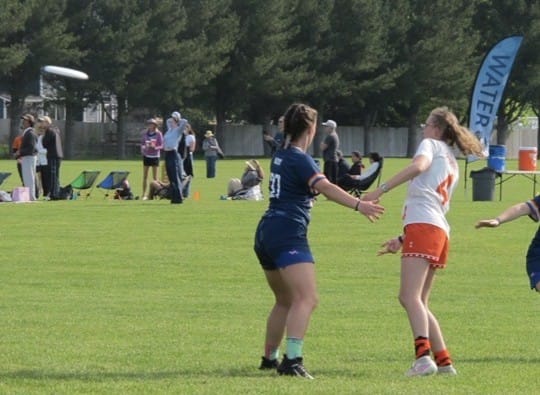
That first year, now-sophomore Potter decided not to tell many of her teammates about her narcolepsy; she wanted her team to get to know her as a person first, and not primarily for her condition.
“I didn’t tell my team for the first two months because I wanted them to know me as the person I was, as Cami, this teammate, and this person who also has narcolepsy instead of this narcolepsy that Cami comes with.
“I wanted people to know that I am hard-working and that I do care and that I have a lot to give and I can contribute. I just sometimes have a little extra struggle, instead of it turning into this ‘can’t’ kind of thing,” Potter said. “Looking back, that was the choice that I made at the time and it worked out in the end, which I’m happy for. I don’t necessarily regret it.”
After her teammates found out about her narcolepsy, their perceptions of her never changed. They treated her the same, which in turn helped Potter become more open about it.
As one can imagine, having a condition that causes extreme tiredness and makes it hard to recover and gain muscle comes with its own set of challenges when playing competitive ultimate. One of the main issues Potter ran into was the energy drain that accompanied long days of games at tournaments. She found herself needing to sleep for at least half of one game a day.
Not wanting to miss too much, Potter first tried to hold off her naps until her team played a game that would likely result in a tough loss. However, this option did not work as well as planned as she encountered sleep attacks, falling asleep in inopportune places and times. On the occasions that Cami would get sleep attacks in the middle of a game, she would want to be awoken as soon as possible, as she generally fell asleep in uncomfortable positions.
But Potter and her team ran into the speed bump of an inefficient communication system. If her naps were purposeful3, she could only efficiently tell a few designated teammates before lying down. In many cases, the teammate who would find her would have to ask around to see if anyone knew whether to wake her up.
Over the summer following her freshman year, she devised a new system to streamline communication. She started carrying a whiteboard that noted when she wanted to be woken up from her naps and situating herself near everyone’s stuff so they could keep an eye on her. If there was not writing on her whiteboard, that would mean she didn’t intend to fall asleep, and should be awoken. Potter also formally shared the details of her narcolepsy with the team and let them know the system, easing concerns if she was found conked out on the sidelines.
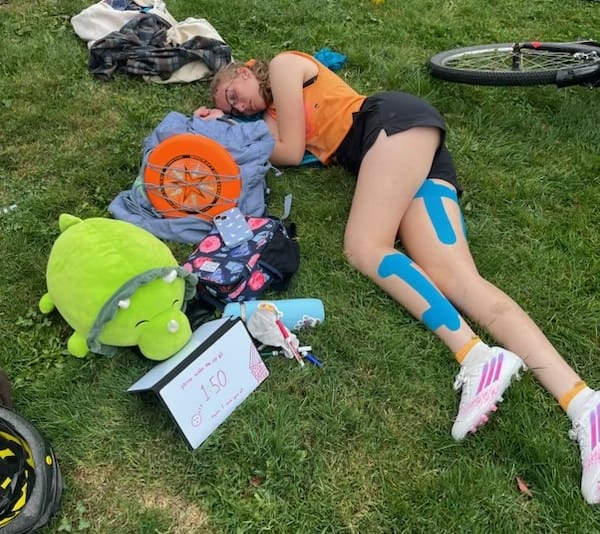
“Obviously nothing’s perfect, and sleeping on the sidelines of games is never ideal, but that’s what happens,” Potter said. “I go lie down for 30 minutes, I get up, I drink some water, I stay awake, I’m back on the field. And I’m back in it. I nap on the car ride home. And that’s just the way that it is.”
“It’s been a learning curve. This year has been a lot smoother since we came up with [the whiteboard],” said captain Charlotte Robinson. “I think last year started with only our leadership knowing, and so people would have been like, ‘Where’s Cami? Why’s Cami lying down?’ until everyone on the team knew what was happening. We didn’t really know when to wake her up, if she was sleeping, or how long to let her sleep. But with this whiteboard system, it’s a lot easier.”
Learning To Thrive
Despite the hardships that Potter’s disability presents her with, she has found ways that her narcolepsy has helped strengthen her team and its community, and helped her grow as a person.
While she did not her narcolepsy to become a major responsibility for her Dinos teammates, it was (and is) naturally something that required a team effort. Between making sure Potter stayed out of dangerous situations and did not sleep for too long, her teammates have been flexible and accommodating, and Potter knows they are looking out for her.
“We’ve kinda gotten into the groove of, if she doesn’t write it down, to wake her up at halftime or post game,” team officer Sylvi Barnes said. “Last year, she fell asleep in a soccer goal, so we’ve been trying to make sure that she’s in a spot that is not dangerous for both the players on the field and off the field.”
Potter’s Dinos teammates showed up for her in a myriad of ways, whether that was helping devise a system for her naps, asking questions so they could better understand what she was facing, being willing to check in on her, placing jackets on her when she looked cold, moving her from odd places, and generally keeping an eye on her.
“Having peoples’ help has made my life a whole lot easier. I’ll always accept it if they offer it, but I always, always, always make sure that people know that it is optional,” Potter said. “I feel like that will fundamentally change the relationship you have with someone, if that mindset shifts from being a friend to being a burden, but I’ve never been made to feel that way. I’ve never been made to feel ‘less than.’ All anybody wants is to be loved wholly and completely and accepted for all parts of you. And I feel like I’m very fortunate to have a community that loves all parts of me and accepts all of that. And is always willing to be there, always willing to learn.”
“It’s almost gotten me closer with some people on the team,” said spirit captain Mica Anderson. “We have something to check in about, and we’re all ready to be like ‘who has eyes on Cami and did anyone see her go down?’ Having a plan, it’s kinda nice to check in with each other and be like, ‘we’re all taking care of Cami, right?’”
In addition to strengthening her team, Potter’s narcolepsy in the context of the sport has made her grow as a person. She never let it stop her from doing what she wants and from trying new things. Through her narcolepsy, she learned to look challenges in the face and either overcome them or learn from them by testing her limits.
It gave Potter an extra chip on her shoulder, fighting to quiet the voice in her head telling her she can’t do things because of her condition, and she found herself working hard to see success. She realized that her struggles weren’t diminished or pushed down, but rather a part of her, and overcoming those obstacles did wonders for her confidence4.
“I feel like I have an extra motivation. I know that I have this extra thing that not many people have to deal with and that makes my life harder. I feel like if I have three things to juggle, my fourth thing is narcolepsy. It’s a part of who I am and it’s always a ball I am juggling in the air,” said Potter. “I feel like recognizing that has been really helpful. I know that it limiting me is not my fault, but there’s a part of me that doesn’t want me to be anything less than anybody else because of it. I see how that can be a damaging mindset, but for the most part, it helps me do things that I didn’t think that I could.
“I struggled and I had to make changes and I had to do really hard stuff and I overcame. I did it anyway,” Potter continued. “I don’t know what I can do, how far my barriers are until I nudge them a little bit. And if I nudge them and they don’t move, I’ll say ‘okay, I’ll leave you alone.’ But if I can nudge them and they’ll be like, ‘let me back up a little bit, you’re scaring me with how awesome you are,’ that’s okay. I always want to be the best version of myself, and that involves doing things that I don’t think I can.”
A sleep attack is a sudden, irresistible episode of sleep that occurs during waking hours. ↩
One of the more high-profile examples is retired NFL offensive lineman Josh Andrews, who also attended Oregon State ↩
i.e., not sleep attacks ↩
Although those who know Potter know that she’s a naturally prideful person ↩