The world's best teams meet in Chengdu for the sport's greatest tournament.
August 11, 2025 by Edward Stephens in News
The World Games 2025 coverage is presented by Spin Ultimate; all opinions are those of the author(s). Find out how Spin can get you, and your team, looking your best this season.
The World Games, held every four years1 and consisting of 14-player mixed rosters in a one-game-per-day format over the course of five days, is the pinnacle of international ultimate frisbee. Nowhere will you find better trained, more dedicated, or hungrier athletes in our sport. And it’s more than just the competition that makes for a compelling week: it’s the unique format. Games are short (to 13 points and with relatively quick round times), summer temperatures are blistering, and there is very little runway for teams to make mistakes. (In theory, a single pool play loss could be enough to knock a country out of the medal rounds.) It’s a tournament designed to push players to the limits of their physical and mental capacities.
So, how will it play out? Read on for a closer look of every team in the tournament.
Pool A
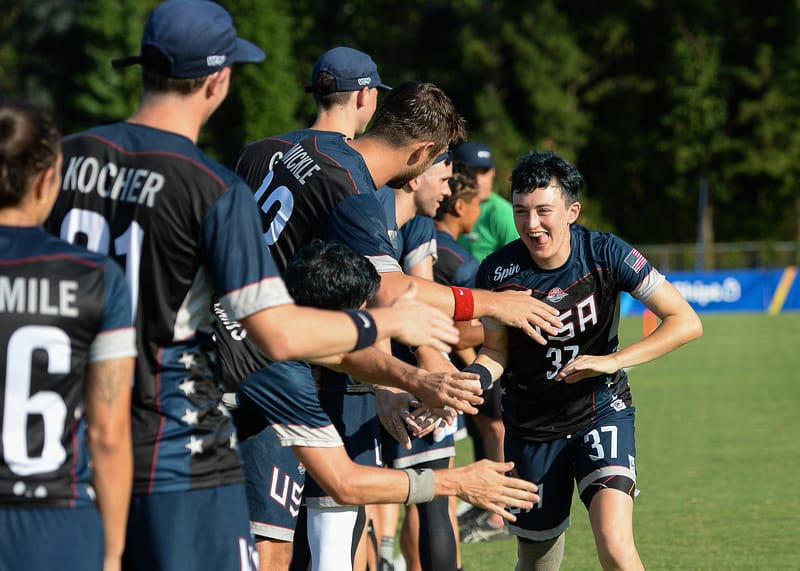
At first glance, Pool A seems straightforward. USA, the five-time defending World Games champions and universally acknowledged favorites, should skate through without too much difficulty. Host nation China, who did not have to earn a bid to compete (and would not have), do not at this point in time have the bona fides as an ultimate-playing nation to hang with the other seven teams in attendance. Germany and Japan, then, will have to fight it out for the second medal bracket slot. At least, that’s how we think the script goes. History has shown that reality could present a different picture than our expectations.
USA
Team USA have been utterly dominant across virtually every division in international play.2 The mature, multi-generational playing population, a robust competitive landscape, and a comparatively large pool of people from which to draw have all helped to entrench the sport’s birthplace and incubator at the world’s top level. It is said in tones too serious to dismiss that the tryouts for the 14 coveted World Games roster spots feature the most competitive game reps on the planet. They enter the 2025 World Games as the odds-on favorites to leave with another gold.
Under the leadership of Matty Tsang, as well as a whopping seven returners from the 2022 campaign in Birmingham (a number that includes five players — Claire Chastain, Carolyn Finney, Grant Lindsley, Dylan Freechild, and Chris Kocher — making a third World Games appearance), they’ll have the experience and knowhow to emerge victorious from the grueling week once again. The roster is a who’s who of American club greats, from veterans who seem to be aging in reverse (Lindsley, Finney, Kaela Helton) to bona fide warriors (Chastain, Freechild) to cream of the newest generation of stars (Henry Ing and Dawn Culton) to the most electric players you’ll ever see (Raphy Hayes, Anna Thompson, Claire Trop). The US have silky-smooth handles (Marques Brownlee), indefatigable cutters (Chris Kocher), and warning-label-grade potency defenders (Kami Groom, Michael Ing). Not winning the gold would send a shockwave around the ultimate frisbee world; failing to medal isn’t even conceivable.
And yet the top step on the podium is not at all a guarantee. The team may have weaknesses. Some have pointed out that Team USA are one of the older teams at the tournament — perhaps this is cause for concern, but (to insert my own editorial voice momentarily in this otherwise disembodied preview) I don’t buy that argument. The real trouble for them in 2025 could be the same trouble that has cropped up for them in the past: comparative lack of chemistry and the muted impact of depth. The chemistry issue has come into play in pool play each of the past two years, when the US plummeted to losses (Colombia 2017, Germany 2022) by playing shockingly poor games. Mulligans are not a luxury any team can afford, since a loss at the wrong time will bump them from the contention. The depth, meanwhile, plays out in the idea that while there is no single country in the world with as many elite-level players as the US, there are quite a few who can make a line-up of 5-12 players more than game to hang with the best Americans.
Germany
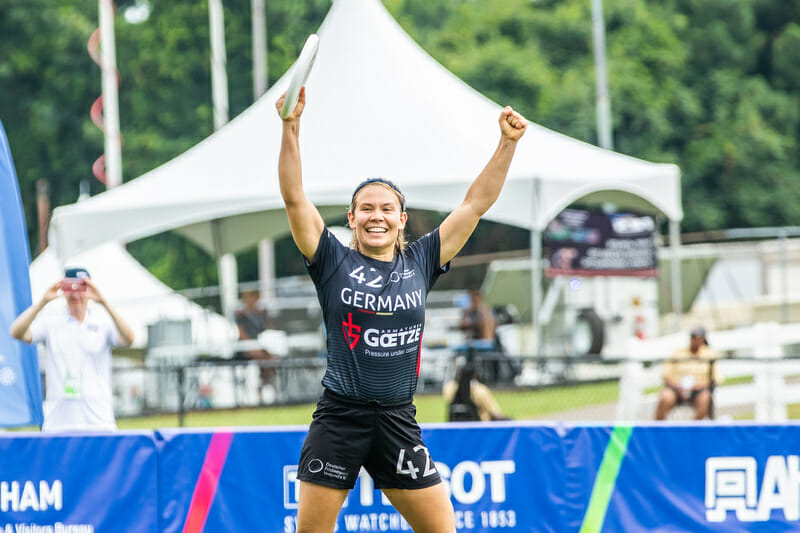
Germany are the last team to have beaten the United States in World Games play. And they didn’t just beat the US in 2022, they dogwalked them. The main feature players on that day were two tremendously consistent and incisive handlers (Nico Müller, Anna Gerner) and a pair of two-way downfield dynamos (Levke Walczak, Conrad Schlor). Three of that foursome — Muller, Walczak, Schlor — return for the Chengdu campaign. That’s a great start. If their warm up play at London Invite in June is any indication, Muller remains one of the most fearsome throwers on Earth. Schlor, a longtime member of New York PoNY in addition to his international exploits, will continue to patrol the deep space and open up counter attacks with massive hucks. Ever the agent of chaos, Walczak will most likely careen around the field like a pinball as the mood strikes her, pestering opposing cutters and blithely dismissing opposing defenders. The ceiling is a medal, possibly even the gold if the matchups break the right way.
To be perfectly honest, though, Gerner’s absence presents a major problem when it comes to evaluating Germany’s floor. They could count on her reset cuts and throws to be the pulse of their offense in Birmingham — not to mention freeing up Müller at times to be a bit more creative. How will they fill that role? They have a couple of interesting candidates in Ava Mueller and Charlotte Schall, both of whom impressed during their recent US Open play with the European club BFD Shout. Ava Mueller is the more traditional thrower of the two of them: her repertoire includes both well-measured OI forehands to beat tricky defense and rather massive hucks from both sides. Schall, meanwhile, is a bit more likely to start downfield, but when she gets the disc in the backfield her give-and-go game is nigh-unstoppable.
Will it be enough to power them again? They only have four returners from 2022 — Muller, Walczak, Schlor, and offensive rock Nici Prien — on the roster. (It isn’t just Gerner missing: one wonders what could have made standouts Lili Trautmann and Stefan Döscher sit out this round.) Someone else will need to step up if they plan to reach the same heights. Joanna Erdmann was one of the women’s team’s top scorers at WUC last year, and Hartley Greenwald packed the stats page for the mixed team at the same tournament. It’s possible. Perhaps another rousing upset is in the works?
Japan
Japan are regulars at the top of the international scene, and that means that they, like the United States (if not quite at the same height), have a wealth of invaluable experience from which to draw as they get set for a quest to earn the prize that has eluded them since 2021: a World Games medal. More generally, medals at international events have not been so rare. In fact, Japan has earned silver (behind the US) in both of the most recent prime age WUCs in the open division, as well as each of the last three U24 Worlds in the women’s division. Those two WUC open medals — the first of which included a final considered by many to be one of the greatest games of ultimate ever played — came largely on the strength of a golden generation of players, longtime Buzz Bullets stars Masahiro Matsuno, Taiyo Arakawa, and Masahi Kurono chief among them. That generation may well be cleating up — and, in the case of Matsuno, who is set to coach this week on top of his playing duties, clipboarding up — for the last time. They’ve aged gracefully enough that 2025 could represent a miraculous intersection of that group with the up and coming generation of female-matching players: Mayuka Takada, Riyu Shimizu, Kanari Imanishi (who spent two seasons playing US club with San Francisco Fury) that have seen so much success in the junior divisions.3
There are some key players (Aki Muraoka, Yuko Kashino, Miwa Tajima, Sho Okajima) who come from outside of those two bumper crop generations, of course, and all together Japan present a compelling case for a medal, or even the once-a-tournament upset-the-United-States tradition. So, what’s the argument against? Aside from a pair of strong teams in the pool who could simply box them out of contention, the advanced age of their male-matching stars is grounds for doubt. Can Matsuno and Arakawa continue to perform at the same peak as their opponents? Then again, the well-known Japanese style of play — lots of inside breaks, a certain throwing crispness, and defensive-scheme-defying crossfield OI throws — often reduces the need for raw feats of competitive athleticism. When they are on, they typically find windows that their opponents can’t touch. Finding those windows early and keeping them open for the duration of their games against the US and Germany will be the key to their potential for unolocking the medal round.
China
The tournament’s hosts come in as both relative unknowns to the larger global ultimate frisbee community and extreme underdogs in this tournament. The mixed team that China sent to last year’s WUC in Gold Coast, Australia (most likely in attendance mostly to fulfill a WFDF procedural requirement that allowed them to participate in the World Games) finished a lowly 17th — although, to their credit, they did win a round robin pool consisting of the bottom five teams to earn the 17th place finish. Did the roster they brought to Australia represent their best competitors? There is some crossover with the 2025 World Games roster: Bo Liu and Ying Zhang were two of the 2024 statistical leaders. Who knows whether the group of new players on this World Games team will be a step up from that baseline or not? However skilled and athletic they end up being, though, the lack of tournament experience at the elite international level is likely to prove too much for them to overcome. Respectable scorelines in an 0-3 tour of pool play is likely the best they’ll be able to muster.
The 2025 World Games is more than anything, then, a platform for the team to push along the development of an already rapidly growing sport. Ultimate frisbee fashion went viral recently for a spell, and such American luminaries as Miranda Knowles and Rowan McDonnell have spent time in the country to help spread knowledge of the game. If there are, as predicted, lots of eyes on the World Games, it could spread even further, setting up one of the giants of global sport for future frisbee success.
Pool B
Pool B — with apologies to Pool A — is what the World Games should be: four relative equals set for a three-day rumble of royal proportions. This pool features the 2022 silver medalists (Australia), the 2017 silver medalists (Colombia), the only team other than the US in the history of the tournament to capture gold (Canada), and the country that has seen biggest uptick in high-level international success since the pandemic (France). Strap in. It’s going to a be a thrilling ride.
Australia
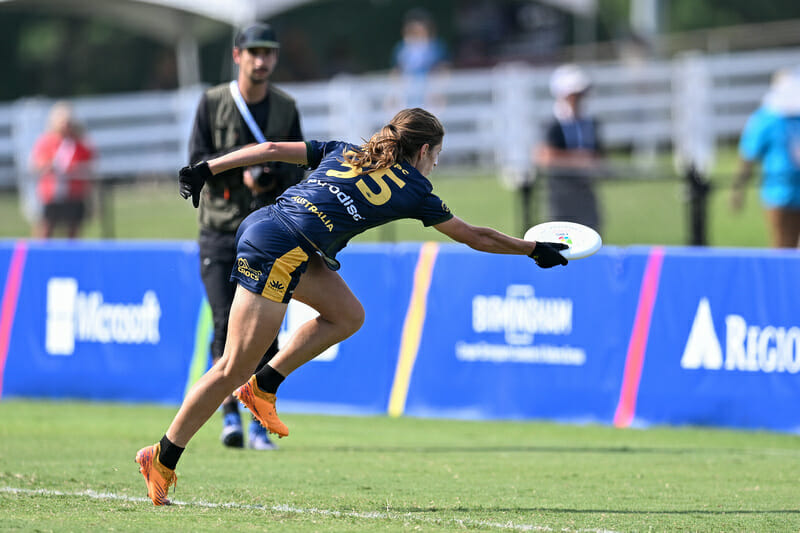
The 2022 silver medalists nearly stole gold from the clutches of the United States in Birmingham in a marvelous tournament final. They came from a 7-3 halftime deficit and had possession at 10-10 before the US put them away 13-11. It showed the enormous potential of a locked-in Aussie side. Can they meet that level again in 2025? Or even, dare I say, exceed it? Short answer: yes. The star power and experience of the Crocs4 this year is matched only by the US and Colombia. Any discussion of personnel begins with a legend of the sport, Cat Phillips. Phillips, a two-time silver medalist, will be playing in her fourth World Games tournament. Her relentless cutting and big throws have been one of the linchpins of the Crocs’ offense for multiple generations, and that will likely be the case again in Chengdu.
But Phillips is far from their only star. Rob Andrews and Sam McGuckin, both of whom play bigger than their already large frames and tend to use the entire expanse of the field with their cuts and throws, were electric in 2022. Liv Carr, then a youngster, had a breakout tournament in Birmingham and has only developed into a more complete player. Another returner who was on the younger end of the roster in 2022, meteor-quick handler Alex Gan, set London Invite on fire earlier this season. And then there is Kya Wiya, who, if the tape can be trusted, could end up being one of the least guardable players in the entire tournament. Even without longtime center handler Tom Tulett and defensive ace Sally Yu5, the Crocs appear to have the right mix of personnel once again to play for all the marbles at the end of the week.
The catch? A brutal pool schedule. Any of the other three teams could beat them. In fact, any combination of two of them could knock the Crocs out. It isn’t even out of the question that they go winless for the first three days of the tournament. It’ll be up to leaders like Phillips, Alex Prentice, and Alex Ladomatos to ensure they set the right tone each day.
Colombia
Two high-profile Worlds events — World Games 2022 and WUC 2024 — have seen the unbelievably talented cohort of Colombian women (Valeria Cárdenas, Manu Cárdenas, Yina Cartagena, Mangie Forero, Laura Ospina) come tantalizingly close to the gold medal that will validate the years of training and traveling they have put in to the sport. In 2022, they met the United States one round earlier than they had anticipated: Colombia narrowly lost the semifinal game to them and had to settle for a bronze medal. In 2024 they were even closer: the women’s final against the US was one of the more evenly (and excellently) played games you will ever see. The competitive window will close at some point, and this might be the last chance they have to win ultimate’s crowning achievement.
It’s one hell of a last chance, though. For starters, the Cárdenas twins (as they have since playing as teenagers in 2017) continue to shape the field. Valeria’s all-world throwing and Manu’s all-world athleticism are often enough to win points all alone. Toss in a few small ball ready teammates (fellow returners Forero, Cartagena, Simon Ramírez, and Jonathan Cantor; as well as newcomer Jorge Bulla). Add some reliable cutting experience (Andrés Ramirez, Ximena Montaña, Laura Ospina) and a couple of ace defenders (Maria Paula Santos, Ivan Alba) and you have a complete team. It’s a roster with a clear purpose.
Just as importantly, they have as much experience playing tight with (or, in the case of 2017, beating) the US as anyone. Their tough mental game has been building over the last decade — thanks in large part to coach and program architect Mauricio Moore (and no doubt augmented by co-coach Molica Anderson, who has instilled that quality in both San Francisco Revolver and Comunidad El Oso). They will not back down from a challenge. The only hang up, as with Australia, is the nature of Pool B, where the challenges won’t back down from them, either.
France
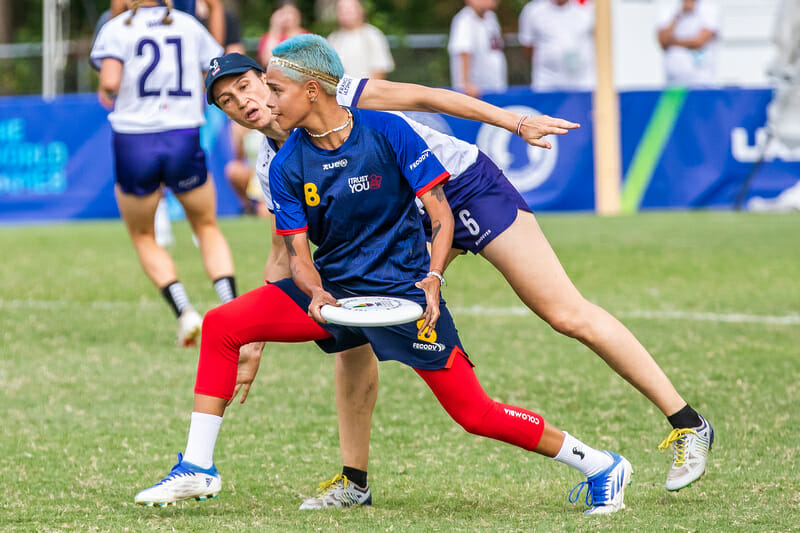
The reason Pool B is going to be a massive test for the top seeds is because of teams like France. France punched above their weight last cycle, solidly finishing sixth, leapfrogging usual world power Canada and coming a point away from wins over both Australia and Japan. It seems that performance was only the warning shot, because in the years since then their burgeoning youth scene has begun to pay off with brilliant performances at the U20 and U24 levels. They have earned silver medals in the boys division of each of the last two Junior Worlds events, and a bronze the cycle before that. In the girls division of Junior Worlds, they’ve done one better: silver in 2022 to match the boys, and then gold in 2024 with an emphatic 15-10 victory over the US. Earlier this year, they combined the groups for a mixed division side at U24. They were excellent once again: their only loss was in semis to a vaunted US group, and they came away with the hard-luck bronze.6
The first taste of that youth wave came in 2022 with star Eva Bornot, who has since become one of the best players in Europe. Bornot was set for a repeat appearance in Chengdu until she suffered an injury late this summer and had to be replaced on the roster. The ranks of young stars on France, though, remains strong: Zoë Forget, Léo Stanguennec, Camille Blanc, and Elliot Bonnet all were eligible to play in the U24 tournament earlier this summer.7 Stanguennec and Forget will be athletic matchup problems for any opponent. Blanc and Bonnet, meanwhile, could end up being the team’s top performers — both are proven playmakers in the prime age divisions at the highest levels already.
France aren’t only their young players, of course. Two-way star Gaël Ancelin is joined by Lison Bornot, Sullivan Roblet, and Sacha Poitte-Sokolsky to form a powerful quartet of returners. All of them know how to control a point from either side of the ball. And then there is the scoring potential of WUC star (and World Games debutante) Chloé Vallet, who a year ago dazzled the women’s division in Gold Coast to the tune of 19 goals and 21 assists. This is a talented roster. Do not be surprised to see them in one of the medal matches.
Canada
No team disappointed more during the last World Games cycle than Canada, who dropped from a 2017 bronze medal to a lowly seventh place, beating only Great Britain (twice) at the tournament. Worse than the end result was the way they achieved it: totally uncompetitive pool play games against the US and Germany.
Team Canada needed an overhaul, and they got one. The upshot is a team who look, both on paper and during their excellent weekend at warm up tournament London Invite, like genuine medal contenders again. They have retained their best performers from the previous cycle: world-beater Britt Dos Santos (the only player in Birmingham to finish with a double-double in goals and assists, no small feat given some of Canada’s paltry score totals), downfield threats Malik Auger-Semmar and Sarah Jacobsohn, and rock-solid veteran handler Lauren Kimura, who looked awfully spry at London Invite.8 The new players include super-veteran Mark Lloyd, who put up +20 offensive lines in both the 2013 and 2017 cycles; Molly Wedge, the dual citizen who was Great Britain’s best player at the World Games 20229; and two-way titans Quinn Snider, Anouchka Beaudry, and Thomas Edmonds. They’ll have plenty of firepower.
Will it be enough firepower to dispatch at least two of the three formidable opponents they’ll see in the tournament’s opening days? Maybe. The key to their success could be the play of their two youngest members, Mika Kurahashi and Marty Gallant. Kurahashi just won Player of the Year honors and a national championship for her college outfit University of British Columbia. Gallant hasn’t quite had the same big stages in his college play, but his star has been rising in Canadian ultimate at a similarly fast rate. Both of them have experience in prime age international play, and if that experience turns into true breakout performances this week, it could mean that Canada have vaulted themselves back into the medal conversation.
The Covid-19 pandemic delayed the 2021 World Games to 2022, making for five- and three-year intervals. ↩
Seriously. The US have won 25 of the 31 available gold medals in World events — counting all age groups and playing surfaces — over the last ten years. ↩
Japan would have also had Riko Yanahigara. However, she was scratched from the roster today due to illness. Here replacement is Sayako Nemoto. ↩
All of Australia’s national teams are nicknamed for one of their country’s native fauna. ↩
Yu was replaced on the 2025 roster after suffering an injury earlier this summer. ↩
Proper seeding would theoretically have placed them on the opposite side of the bracket as the US. ↩
France held them out of the U24 event as a precaution against injury and burnout. ↩
Mike Mackenzie was also supposed to don the maple leaf, but he suffered an injury and was replaced. ↩
Great Britain narrowly missed qualifying for the tournament this year. ↩