Coming full circle
October 18, 2025 by Patrick Stegemoeller in Opinion, Other

Ultiworld’s coverage of the 2025 club season is presented by Spin Ultimate; all opinions are those of the author(s). Find out how Spin can get you, and your team, looking your best this season.
Are Revolver… back?
We know that this season’s Revolver are a lot of things. The overall seed going into Nationals. 21-1 on the season. Winners of PEC West, US Open, and Pro Champs. On the verge of being only the fifth team ever to win the full Triple Crown (for all the import that has).

But are they back? Are they not merely Revolver, but the Revolver whose unparalleled domination of the men’s division in the modern era elevated them above the status of mere “team.” It’s an important question to ask – if the Roman Empire was potentially going to be “back,” the rest of Europe would probably take note and have a couple things they’d like clarified.
Revolver being “back” would be a big deal not just because of its implications for future titles, but because none of the other two generationally dominant men’s teams in the history of the sport, NYNY and DoG, ever got back on top after their run of titles. While those reigns ended with champions fading to dust, Revolver seem to be on the verge of returning to their former glory. If Revolver are establishing themselves as The Team in the men’s division again, it would do more than add some trophies to the mantle; it would probably make them the greatest program in all of men’s ultimate.
Is there something inherent to Revolver that has brought them back to contention when no other team with that level of success was able to avoid disbanding — let alone challenge for a title — just a few years after their title run ended? Or is this just a story about how USAU succeeded in preventing elite teams from breaking up in the TCT era? Put another way, is there something about Revolver that persists beyond the name?

Let’s start with the name, because there is a lot going on there.
“Revolver” is not just one of the most iconic team names in ultimate, it’s one of the best. There’s cyclical nature of a team rising each year and then starting anew the previous season. The nod to the spinning revolutions of a disc. The way it draws upon our cultural fascination with guns and their power while still having enough plausible deniability to gaslight anyone who says otherwise that “actually, it’s about the phases of the moon.”
But all that iconography of death and rebirth and rise and fall and rise again belie that during Revolver’s imperial era in the 2010s, Revolver’s cycle ended up looking a lot more like a straight line. Maybe the team had to reinvent itself in some way every season, but there were no rebuilding years, only reloading.1 For anyone who missed the era: Revolver felt eternal, omnipresent, looming over everything. Less a moon going through phases and more a sun that never set on an empire forged through the wholesale kicking of ass, game in and game out.
Some numbers: Revolver won Nationals five times from 2010-2017. They won Worlds three times. They failed to reach the final of Nationals once(!) from 2009-2018. (And what a once that was.) To put it another way, a hypothetical team could have played a maximum of 30 quarters/semis/finals games at Nationals from 2009-2018. Revolver played in 28 of them.
Here’s another one for ya: Across all of the USAU Club Nationals and Worlds tournaments from 2009-2018, Revolver went 126-5.That’s a staggering amount of winning, and maybe an even more impressive lack of losing. Teams that win tournaments occasionally cough up a game or two along the way.2 But Revolver just… basically didn’t lose anything other than a few National finals for a solid decade.
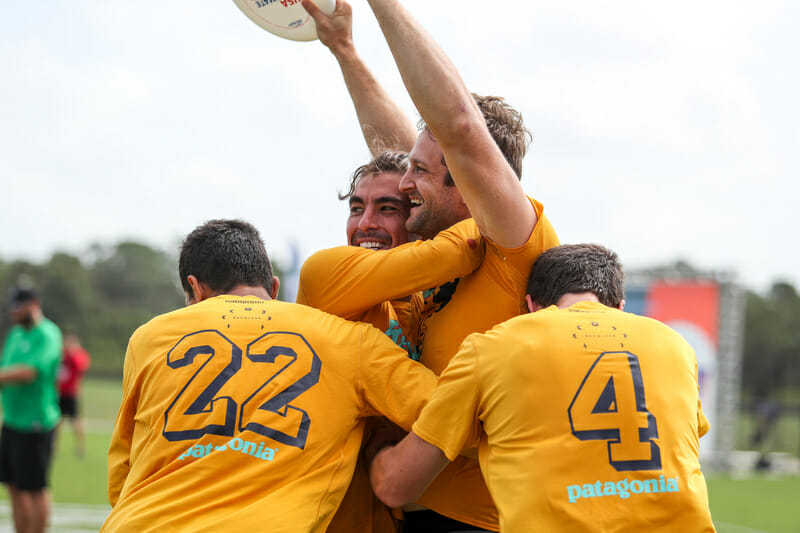
And this dominance was year round, not just at Natties. Some championship teams have mixed regular season results as they develop for the postseason. They maybe come into Nationals as a three or four seed, but are prepared to be the favorite. Revolver were the top of the USAU algorithm seven times from 2010-2018.
And beyond results, although undeniably tied to the results, there was a mystique.
For almost the entire decade of the 2010s there was no question about who the best program in the men’s division was, no question about who the championship would have to go through. No question that anything anyone else did was measured against the standard that Revolver set. Revolver were the kind of team that beat you before you started playing, before you put your cleats on, before you left your door on the way to the tournament because in your mind you were doing the bracket math of how far you could get before you ran into Revolver.
And then came the fall. There must be a fall. One cannot be “back” without it. It came in 2018. And it came hard, when PoNY’s team that was intentionally constructed to target the champs disassembled Revolver on a spiritual level in one of the most consequential results in the history of the sport.
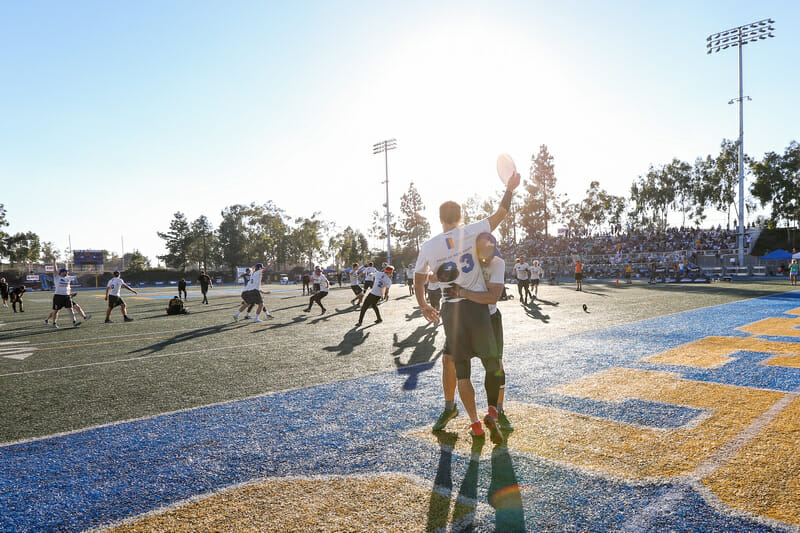
Most of Revolver’s biggest names left over the next two seasons, and perhaps more importantly, the mystique left too. Revolver were just some team again. A team that was definitely good, but ultimately just some team that made prequarters or quarters at Nationals and then called it a year.
But from that fallow period has arisen a 2025 Revolver that seems, on paper, to be a return to the standards of the teams that shook the earth a decade ago. A team whose results you could drop into 2015 and no one would bat an eye. A team that won all three TCT events they played and is the clear number one team in the country heading into Nationals.
And doing it with style.
Watching this year’s Revolver play offense is like witnessing an avalanche skateboard. The disc just surges towards its destination, towards a culmination, turning the defense into gawking bystanders. Like extras who wandered onto the field with incomplete instructions on things like “the mark” and “where to be standing.” Like the defense vaguely knows what it’s supposed to be doing, but got caught up watching the avalanche cruise by, doing heel flips and shit. It’s not the small ball of 2022 Truck Stop, which seemed like untangling a sentient knot. Revolver’s offense is moving at 1.75x speed while the defense is still buffering.
It was stylistically different, but that feeling of a fast-moving and all-encompassing expression of nature’s power was also at play, albeit with less flair, while watching 2013 Revolver’s wildebeest herd blast down the field with big, meaty cuts into open space. In both instances, it’s not so much about doing something tactically revolutionary, but making the most of uniquely talented personnel to push previously explored concepts to new heights.
And more than just the on-field results that tie the eras together, there is something compositional about the nature of the team that heralds back to the beginning of the championship era – an emphasis on elevating local youth and college players to roles with massive responsibility.
Most of the guys you think of as the Revolver lifers from that era like Ashlin Joye, Robbie Cahill, Joel Schlachet, Cassidy Rasmussen… all came into the team from local colleges. While Revolver ended up importing star players from elsewhere to help power the last few championships (George Stubbs, Nick Stuart, Eli Friedman, Tom Doi, Christian Johnson, Grant frickin’ Lindsley) the core of the dynasty came from a particularly fertile era for California schools and a few others who moved to the area and became superstars straight from college.
That pipeline kept producing even after the team went through its first championship cycle, ushering in local pieces who got a chance to earn key roles and become US National Team level players, like Eli Kerns, Simon Higgins, and Lucas Dallmann. Tellingly, it was after Revolver deprioritized opportunities for local call ups that the title drought began.
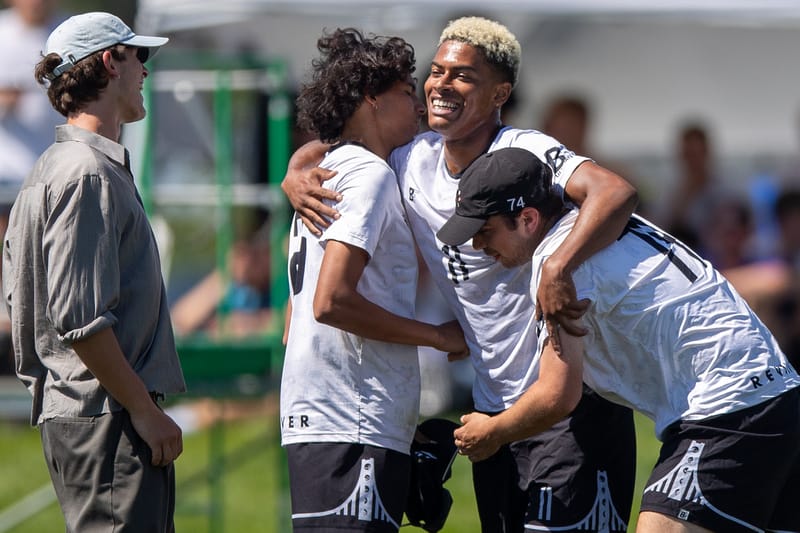
The youth development has indeed come around again (Revolver! Get it?) and is fueling the team’s dominance this season. The emergence of Cal Poly SLO has seeded Revolver with high caliber college talent, while an exploding youth scene in the Bay Area has reaped massive returns – especially as players come back to the area after college. Leo Gordon, Adam Rees, and Raekwon Adkins are the pulse of the O-line, all local high school products, and all coming home to roost on Revolver’s roster despite going elsewhere for undergrad.
If we are talking about individual player comparisons though, unavoidably, we have to talk about Beau Kittredge. Alaska bred, Colorado raised, globally revered… he was a notable exception to Revolver’s homegrown prowess. But Kittredge is always the exception. He could have emerged, fully formed, from a weird egg-shaped chair in Facebook’s SF office in 2007 and he’d still be from Mars.
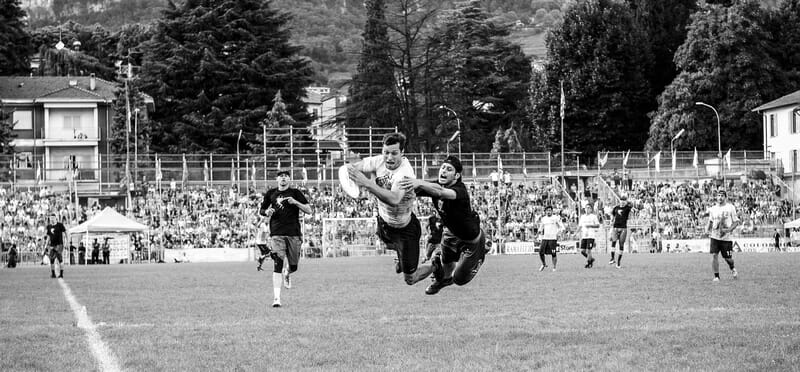
Does the current team have a Beau? A guy who inspires such fear and awe that it seems opponents only get to score when he decides he can’t be bothered?
Not really.
Michael Ing is the team’s best player, but he’s not Beau.3 Is there anyone on the team that even really seems like a potential one-name guy? Mayyybbee Mac or Leo? “Walker” could pop if Walker Frankenberg continues his trajectory for the rest of the decade.
That query is admittedly not the most rigorous form of analysis, but maybe it exemplifies what the current Revolver team is: the best team in the country, the favorite to win Nationals, a program built for now and the future. But not mythical. Not yet.
Can they get back to that status, that mystique?
No matter how good they are in one season, this year’s Revolver team cannot make it all “back” in one go. You probably can’t recapture everything those teams meant in three years of dominance, let alone one. More to the point, that Revolver may never be “back” – just like we will never get to live in 2013 again – because recapturing something is rarely a pathway to future success. But that doesn’t mean they (and maybe we) can’t dream of being something equally ferocious, perhaps even better.
It’s okay that this Revolver don’t have a Beau, don’t hold as much mental real estate over the sport as they used to. Sometimes we can get obsessed with a model of success, so much so that it impedes our ability to see and understand greatness. Think about how much LeBron discourse runs through comparing him to the specific type of success, the legacy of success, that Jordan had, rather than appreciating all the possible ways one can be great. We can envision a different kind of mystique.
And let’s be real – those peak Revolver teams were not exactly what you would describe as “fun.” Either in their perceived mode of being — Greek statutes largely beyond the need for human connection whose wildest idea for a night of blowing off steam was a six hour marathon session reorganizing their resistance bands — or in how they played on the field.
While watching them obliterate the division for years was impressive to the point of giving you some strange comfort in the feeling that at least there was an ordering principle to the world, it was less skateboarding avalanche and more voracious industrialists realizing portfolio gains. They felt like an embodiment of the late Obama-era Silicon Valley that seed-funded the area’s growth – omnipotent, seamless, pushing us towards something hopefully benign but distinctly less textured.
Whatever results Revolver have at Nationals, they are forging an identity that borrows from the success of the past without being constrained by it. Reinvesting in some of the same talent development and winning at a similar clip, but as something that thus far is more recognizably human. And say what you will about the content, but it demonstrates a different flavor of personality than the five minutes of unsettling eye contact and forceful conversation about the virtues of a Soylent diet you were likely to get from the 2015 team.
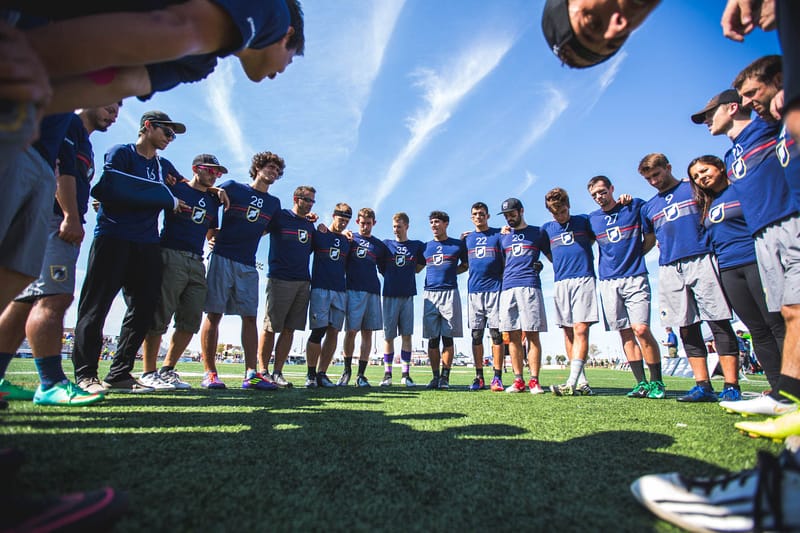
Just by dint of continuing to exist as an elite tier club, it seems likely that Revolver would once again contend for a title. And maybe that’s all this is – a carousel of elite teams taking turns winning, as Revolver’s number looks soon to come due. That the men’s division has had eight novel winners in the past eight seasons speaks to that. And frankly, if Revolver don’t win Nationals this year, or maybe this generation only adds a mere one championship to the total, that could be the takeaway.
But heading into a Nationals where suddenly so much is at stake there for the present and future of Revolver, there seems to be a vast horizon of potential outcomes for this young core that has already put together one of the best pre-Nationals seasons of all time. And if they can win a title, they will be the team that defied history and put Revolver into their own historic tier. There’s got to be some mystique in that, right?
So maybe the logo wasn’t a lie, we just weren’t thinking on an appropriate time scale. The moon is revealing itself again, on the verge of full illumination after years in the dark. But while we look at the same moon every month, the same side of the moon in fact, any generational dominance that flows from this new era Revolver will likely look different than the one that came before.
Embracing that idea may be the best move they can make. Rebuilding the old world won’t move them or us forward, we need to build something new.