Familiar teams and familiar matchups dot the men's semifinal slate, but will the outcomes be the same as 2024?
October 25, 2025 by Edward Stephens in Recap
Ultiworld’s coverage of the 2025 Club National Championships is presented by Spin Ultimate; all opinions are those of the author(s). Find out how Spin can get you, and your team, looking your best this season.
SAN DIEGO – It’s déjà vu all over again in the men’s division. For the second straight year, #1 San Francisco Revolver, #2 Chicago Machine, #4 New York PoNY, and #5 Portland Rhino Slam! have reached Semifinal Saturday in quest of a championship. The order is shuffled, but the overall effect – a quartet of hungry teams trading body blows and scrapping for every pass – should be the same.
There are storylines aplenty to add extra savor to each dish. From historical demons that need exorcising and rivalry scores to settle to legacy revivals, repeat bids, and the chance at a ninth consecutive unique champion, any of the potential outcomes will shape the narratives around the division’s major clubs for years to come. And on top of it all, the star power on these units is off the charts, with such luminaries as Michael Ing, Raphy Hayes, Chris Kocher, and Daan De Marrée all among the division’s most respected (or, depending on your perspective, feared) competitors.
Let’s dig in to each matchup to set expectations before the laser light show that is men’s semis begins.
San Francisco Revolver vs. Portland Rhino Slam!
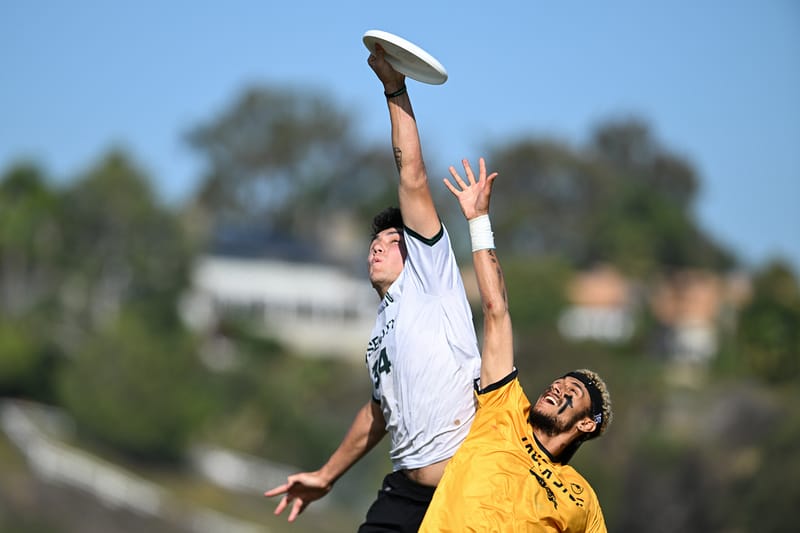
Choose. Your. Fighter. Do you take the #1 team in the country who haven’t stumbled since early July? Or do you take the defending champs putting together an eerily similar weekend to their 2024 title run? That’s the dilemma you face when trying to pick which of Revolver or Rhino Slam! have the advantage heading into Saturday’s midday clash.
Let’s start with the champs. Rhino famously brought big ball back in 2024, punctuating their championship effort with an interrobang of a final: the 15-6 dismantling of PoNY. Both the roster and play style are largely unchanged from a year ago. The O-line continues to use the threat of all-world downfield receivers like Matt Rehder, Raphy Hayes, and Henry Ing – and the deep-throwing threats presented by the likes of Ing, Mica Glass, and Jack Hatchett – to force opposing defenses into a demoralizing game of pick-your-poison. Glass’ Oregon Ego teammates Chander Boyd-Fliegel and Aaron Kaplan, as well as his in-state college rival Felix Moren, have been instrumental in making sure the smaller spaces on the field are criss-crossed with speedy, capable threats, as well. They all form a comprehensive set who have maddened defenses this weekend.
Rhino’s defensive unit, though, may be even stronger than their vaunted O-line. Peopled by such vicious playmakers as Lukas Ambrose, Daniel Lee, David Sealand, and Vinh Bui – and bolstered by regular crossovers from Ing and Glass – they have not found an offense capable of matching them yet at Nationals. Longtime superstar Dylan Freechild has reprised his role as the D-line quarterback this season to ensure the break conversion percentage remains high, and Lee has stepped up his offensive game in a huge way, to boot.
A slipshod regular season would be a bit of an alarm bell if it weren’t for what we already know. In the first place, they were missing Freechild, Ing, and Hayes (and others) for virtually the entire year. Furthermore, a slipshod regular season is exactly how they approached 2024 – and we all know how that ended. If Rhino manage to repeat, they will be the first men’s division team to claim back-to-back titles since 2010-2011, the beginning Revolver’s imperial era.
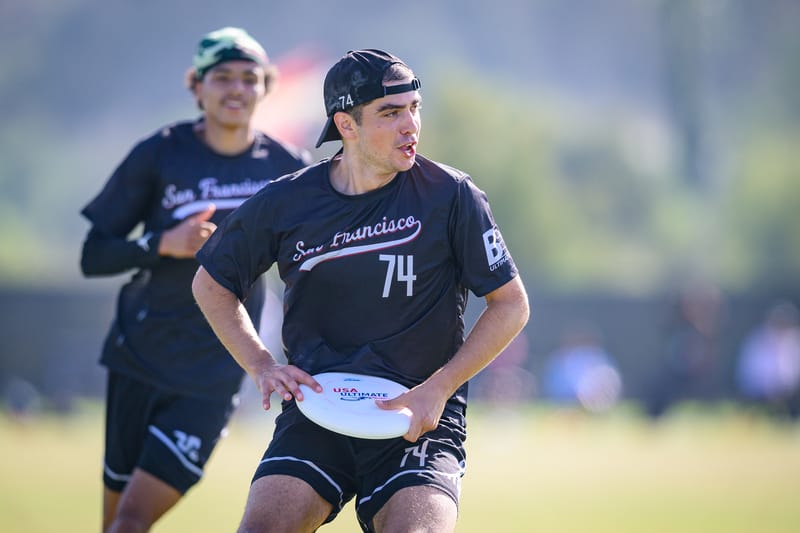
Standing in Rhino’s way, though, are the formidable Revolver of 2025. Is this the start of a new era of dominance for San Francisco? Their dizzying season to date – they’ve only lost a single game on the season, way back in the arguably meaningless crossover round at US Open – has some wondering if this could be the start of a new Revolver dynasty to match their supremacy of yore. This is the club, after all, who strung together five titles in in eight years.
Whether or not it begets another decade of plenty, the present ascendancy is unmistakable. Revolver’s 2024 finish – just two points shy of PoNY in semis – was largely forgotten in the shadow of the next day’s unforgettable final, but it has proved to be a window into their potential.
To say Revolver have had a great 2025 is an understatement: they’ve gone astral. With wins over every contending team – up to and including a relatively untroubled pool play victory over semifinalists Machine on Thursday – en route to 25-1 record, they have established themselves as the odds-on favorites for the championship. Their O-line is as balanced as they come, with throwers Mac Hecht, Nate Prior, and Walker Frankenberg; midfield terrors Leo Gordon, Raekwon Adkins, and Adam Rees; and one of the game’s pre-eminent deep targets, Simon Higgins firing on all cylinders. More than the mix of personnel, though, what stands out is the way they are able to switch between styles, including a pinball-paced open hands approach that no one else in the division has been able to replicate. Defenses can, sometimes, disrupt them once. They have always been ready to adjust and refocus to prevent big slides.
On the other side of the ball, they have a simply oceanic defense, heaving themselves at opposing O-lines in wave after wave. Their marking schemes – particularly when star Michael Ing, Jason Vallee, or Dexter Clyburn find themselves counting the stalls – are astoundingly devastating. Everything falls into place from there: teams just seem to make throws against Revolver that open up opportunities for blocks. Byron Liu, Dan Ritthaler, Kyle Lew, and Nick Tolfa have been only too happy to take advantage of the small margins and earn takeaways. Ritthaler and Ing have been close to automatic leading counters.
Revolver are likely the deeper team in the semi against Rhino. Will they have enough athleticism to match up with Rhino’s bigs on both sides of the ball, though? Or will the offense be able to regroup after the inevitable Freechild-led break? The answers to those questions should ultimately decide which of them push through to Sunday’s championship game.
New York PoNY vs. Chicago Machine
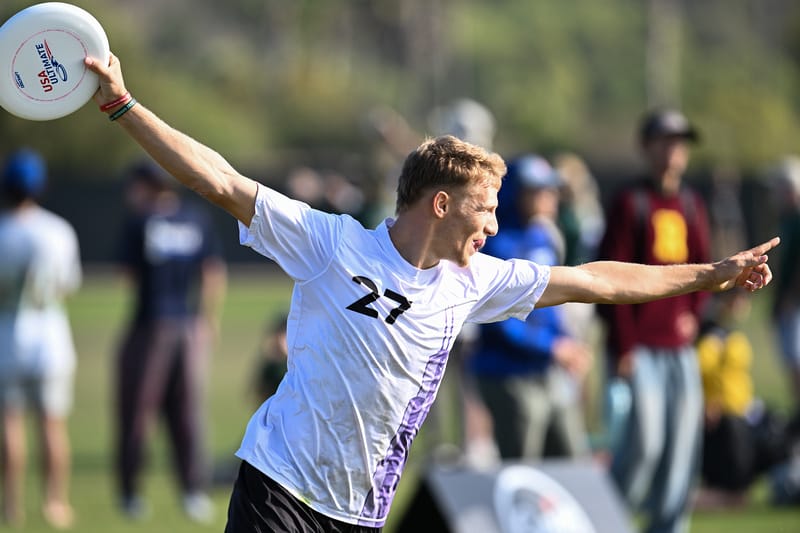
The other men’s semi features the only team capable of extending the run of unique men’s division champions to an unimaginable ninth year: Chicago Machine. Machine had the same chance at this time last season, but the one factor that hamstrung them in the semis – missing Daan De Marrée for the first half of semis thanks to a second half red card in their quarterfinal win – does not exist this time around.
You cannot discuss Machine 2025 without addressing De Marrée. The Belgian superstar has been nothing short of miraculous in his second USAU campaign. Already ranked the top player in the division by a panel of Ultiworld experts, De Marrée has been on one of the most dominant Nationals runs of all time. Through five games, he has 16 goals, 20 assists, three blocks, and only a single turnover – and, by the way, at press time he believes the turnover was misattributed to him. That level of production and efficiency, combined with the fact that he plays full-out every single point and has been Machine’s focal point, is incomprehensible. If Machine reach the final, you can bet that he will have turned in another stellar performance.
But don’t let the blazing sun that is Daan De Marrée blind you to the rest of Machine’s many virtues. The O-line find ways to put defenses in compromising positions thanks to balancing out his gravity with the field-extending play styles of Nate Goff and Paul Arters, two of the best big space attackers in the game, and both Australian import Sam McGuckin and former Ring of Fire standout Rutledge Smith have been putting up big scoring numbers.
The Machine D-line haven’t been shy about getting blocks: Johnny Bansfield, Jeff Gao, Jake Steslicki, and Adam Stautberg have all ranked among the best defensive players at the tournament. (It remains to be seen whether they will be joined by young defensive ace William Wettengel, who appeared to suffer an injury at the end of their quarterfinal win.) Some of the D-line possessions have been less assured than they would like, but when Pawel Janas, Jack Shanahan, and Xavier Payne are locked in, or when they take a moment to cross over one of their offensive players (usually De Marrée, Goff, or Smith) they have the necessary fangs to puncture any O-line’s stoutest resistance.
To believe in Machine to go all the way, though, you have to believe that their multi-goal losses to Revolver – in the Pro Champs final, and then again on Thursday in pool play – were learning experiences rather than red flags. You also have to convince yourselves that they can hang with a PoNY side who have been, in terms of score lines, the most dominant team at the tournament so far.
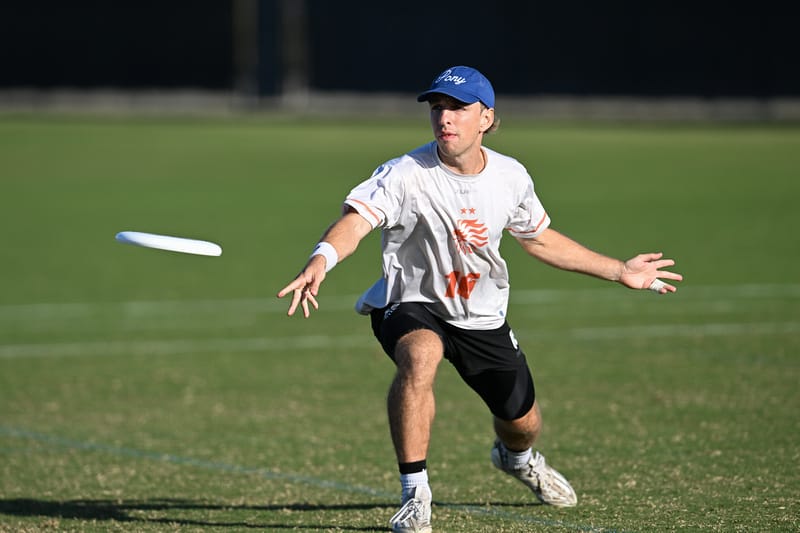
New York PoNY have been arguably the best program in the division since their 2018 championship, which ended in a memorable take down of the First1 Revolver Empire. From that time until now, they have made six out of the last seven semifinals, one of the best multi-year spans in history. What has eluded them in that time, though, is a second championship. Will this be the year they put the disappointing ends of 2019 through 2024 firmly in the past and once again capture glory?
Judging from their play so far this weekend, they have a tremendously good chance to do it. The scorelines from PoNY’s undefeated run through quarters – giving up ten, four, seven, and nine goals – brook no argument against their placement in the Final Four. But the most powerful indicator that they can win their last two games is the way that they put away the first four. Mixing offensive looks with a magician’s flair for distraction, PoNY have feasted on quick goals. The composition of their O-line does half the work: the season’s best deep connection pair in Harper Garvey and Ben Jagt, two of the most determined and daring downfield rainmakers in Ring of Fire transfers Ben Dameron and Anders Juengst, and a trio of longtime matchup puzzles Chris Kocher, Marques Brownlee, and Sam Little. There are simply too many elements for defenses to keep track of at once – and that’s before taking into account the way they use feints, pivots, and decoys to open up massive attacking spaces. Simply put, the offensive coordination2 has been flawless.
And the D-line, taking their tone from an invigorated, positively demonic effort from John Randolph, have been utterly brutal. Between Randolph’s hand-in-pocket handler coverage and the way Vinay Valsaraj and Cam Wariner have blown up in cuts with a series layout blocks, PoNY have found themselves with a boatload of break chances. With Randolph’s frenetic cutting putting O-line defenses on their heels (and he’s often joined by Wariner and the scorching Scott Heyman), they have been converting at a high clip.
The upshot of having rolled to four big, complete wins is that they are both confident and well-rested, two qualities that figure to give them a leg up against Machine.
Outside of the obvious – the fact that the teams standing in their way will certainly pose a challenge – there are two reasons to pump the brakes on a full endorsement of PoNY as championship favorites at this point. The first is that some of their offensive scores have been high-wire acts, as both Juengst and Dameron have a high tolerance for risk. It’s not inconceivable that some of the amazing plays they put together, say, in their quarterfinal win over #9 Seattle Sockeye could just as easily have been turnovers. The second is that they have been, in comparison to some of the other semifinalists, a little untested. When push comes to shove, will they be ready for the inevitable punch from one of the other title contenders?
and, so far, only ↩
Supposedly, it’s injured Calvin Brown calling a lot of the shots. ↩