The masterminds behind the division's best teams
November 21, 2025 by Josh Katz and Alex Rubin in Awards
Ultiworld is pleased to announce our annual Club Awards. While we consider both regular season and postseason performance, because of the nature of the Club division, we weight success in the Series and at Nationals above all else. The Club Awards are voted on by Ultiworld reporters, contributors, and editors.
The Coach(es) of the Year closes our annual awards. As so many teams have added more and more sideline-savvy consultants to their roster with less asked of a single head coach, this has essentially morphed into “Coaching Staff of the Year.” Coaches can impact the game in so many ways — tactics, motivation, communication, personnel management, program development, skill-building, etc. — and it can be hard to divine what exactly each has contributed to their team. But good coaching is something that we feel that “we know it when we see it.”
Player of the Year Award
All-Club First Team
All-Club Second Team
Offensive Player of the Year Award
Defensive Player of the Year Award
Breakout Player of the Year Award
Coach(es) of the Year Award
Club Awards Voting Breakdown
Snubs and Superlatives
2025 Mixed Division Coach(es) of the Year
Michael Dagher-Margosian (Ann Arbor Hybrid)
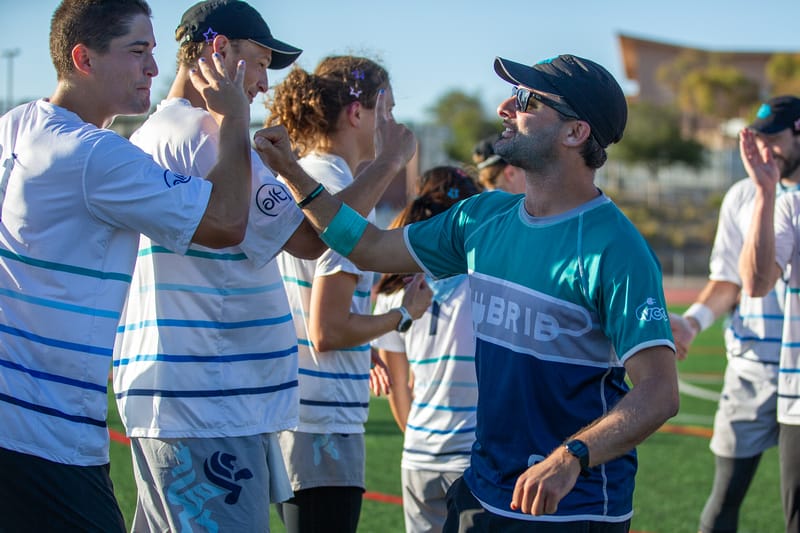
Ultimate is now a well-developed sport that does not rely solely on talent to win games. The most talented teams also rely on excellent coaching to best implement strategies and manage personnel so that they can become the best teams. Hybrid were clearly the most talented team in the division, and Michael Dagher-Margosian’s coaching only enhanced that talent.
First, the people-management to keep a team full of stars all happy playing their part takes a set of social skills often overlooked by coaches too focused on Xs and Os. Several players took on new roles this season, understanding that their shift strengthened the entire team. With team-specific game plans, sometimes those roles changed game-by-game. Rather than relying on stars to carry the team, Dagher-Margosian relied on skills, and leaned into his depth to highlight the specific skills each player brought to the team.
Strategically, Dagher-Margosian excelled as well. Hybrid waited until the National final to reveal a rolling-pull sideline trap defense that led to five breaks in the last game of the season.
It can be difficult to make the transition from player to coach, but over the last few years Dagher-Margosian turned from a great teammate, to a title-winning coach, and finally into a Coach of the Year.
– Alex Rubin
First Runner-up
Anne Worth, Isaiah Bryant, Kevin Lai (New York XIST)
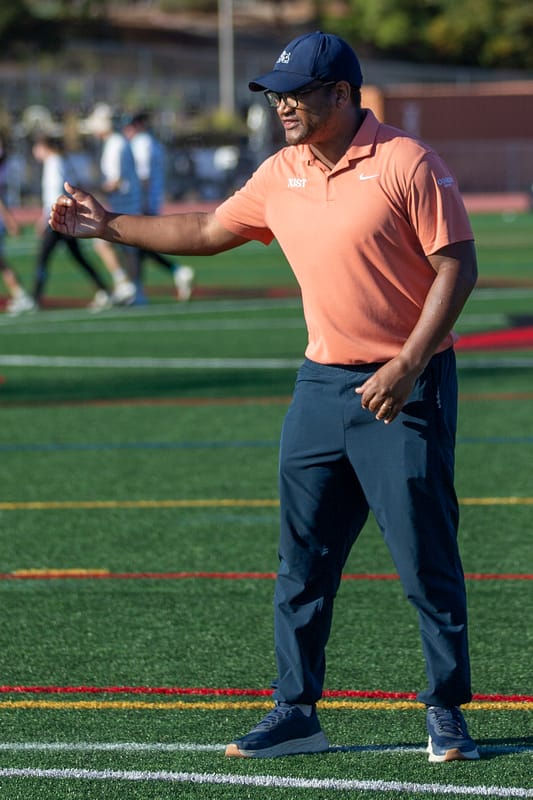
While Jolie Krebs’s consistency, Sadie Jezierski’s swagger, and Axel Agami Contreras’s doggedness will rightfully be remembered, the coaching job from Anne Worth, Izzy Bryant, and Kevin Lai was instrumental to XIST’s best season to date.
One sign of great coaching is a feeling among a team that each person is in their best position to succeed. XIST were able to play all season as a balanced unit because their coaching staff created line combinations that worked well together and worked well with the team strategies while empowering each individual player to highlight their strengths.
While much of the team has played together for a few years now, integrating Jezierski onto the offense is another feather in the cap of a strong coaching team. Other coaches may have been scared by her unique style, but XIST featured her as a centerpiece of their O-line, and that trust helped to bring them to the last game of the season.
While lots of teams say they like to play through their depth, XIST actually did roll out two distinct D-lines and rarely crossed players between O- and D-units. Taking advantage of a team with a very high level of disc-skills overall, the XIST coaching staff devised strategies and trained the team such that every single player could contribute to their success. With a strong foundation and positive momentum, XIST are well positioned to continue improving and searching for their first title thanks in large part to the excellent work of their leadership and coaching this season.
– Alex Rubin
Second Runner-up
Lena Goren, Lukas Nesheim (Denver Mile High Trash)
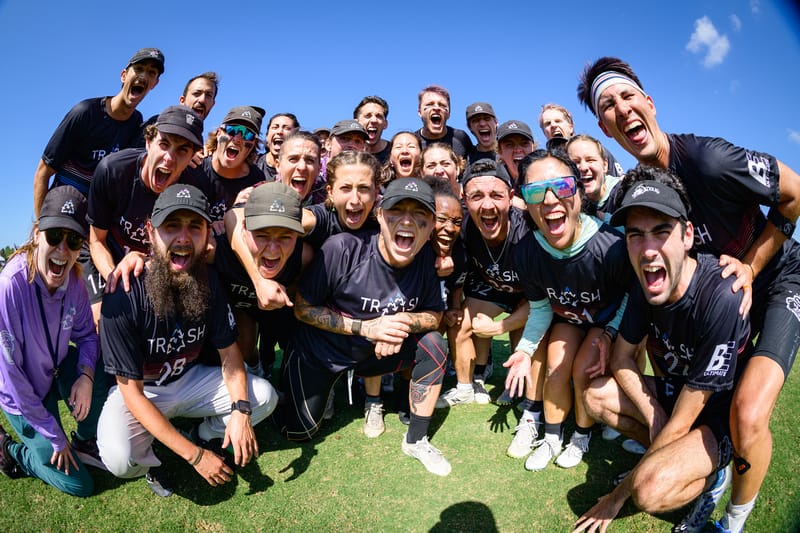
Sometimes, evaluating coaching can be a nebulous task, trying to figure out who gets what credit between the coaches and the players. Other times, it’s as simple as asking, “did this team accomplish their goals, and were their players put in the best positions to reach them?” For Mile High Trash in 2025, the answer to both of those questions was a resounding yes. They resoundingly earned a bid with statement wins over some of the top programs in the division at both PEC East and ESC, and defended it with ease at Regionals. Not content with just being at the big dance, they opened Nationals with an upset win over Austin Disco Club to earn a spot in the bracket. Along the way, Lena Goren and Lukas Nesheim put together a system that gave stars Abby Thorpe and Riley Kirkman-Davis the freedom to improvise as needed while keeping the rest of the offense in a coherent structure.
Their in-game adjustments were consistently on-point as well, with no better example than their furious second half comeback against Disco Club to open pool play. Mile High Trash spent that second half going back and forth between tight matchup defense and a standard cup zone, confounding Disco Club and forcing numerous simple execution errors, as they turned an 8-4 halftime deficit into a 15-13 victory.
Mile High Trash’s first Nationals appearance was a long time coming, but with a strong coaching staff and programmatic infrastructure squarely in place, the wait for their second appearance, and their first bracket win, should be much shorter.
– Josh Katz