Mamabird soared to the top of the Smokies
March 5, 2026 by Edward Stephens in Recap
Ultiworld’s 2026 college coverage is presented by Spin Ultimate; all opinions are those of the author(s). Find out how Spin can get you, and your team, looking your best this season.
KNOXVILLE – There’s a new title favorite in the men’s division.
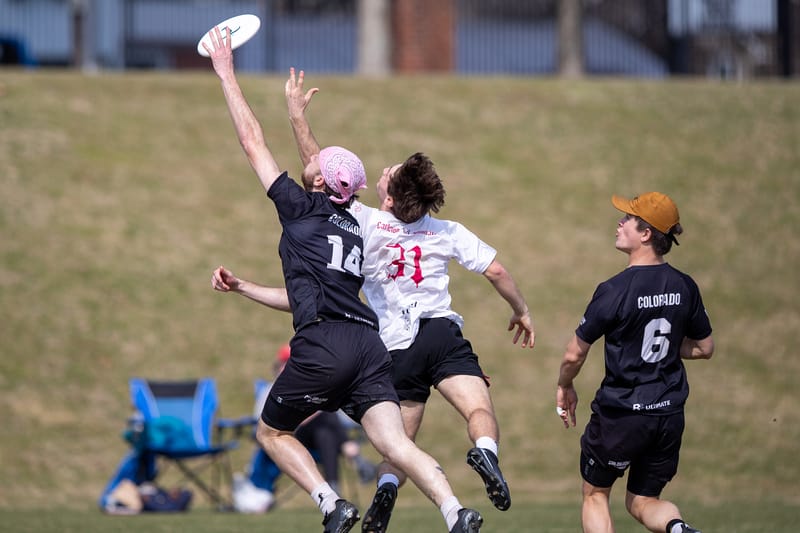
#4 Colorado Mamabird stitched together a perfect weekend at Smoky Mountain Invite, handling 2025 national champions #1 Carleton CUT to the tune of 15-12 in the final. Mamabird’s established stars and depth pieces alike rose to the occasion throughout the tournament. It was a comprehensive performance: no team they faced in seven games played them closer than three goals.
The 2025 Championship Rematch, Flipped
Colorado wasted no time exorcising the 15-12 loss they endured in last May’s national championship, beating CUT by the same score at the teams’ first meeting of 2026. They broke on their first defensive point to take a 2-0 lead — and never looked back.
Based on the path the two teams had taken through the tournament to reach the final, a multi-break Colorado win might even have been expected. Carleton had emptied the tank in semis, where a brilliant effort from Oregon — more on Ego below — pushed them to a hard-fought universe point victory. Colorado, on the other hand, had had plenty of time to rest, eat, and heckle-scout much of the Ego-CUT game after running a few warm-up laps around #6 UC Santa Cruz slugs in the other semi. (More on the Slugs weekend can be found below the fold, as well.) Three-goal wins, six-goal wins: big cushions were the norm for them on the weekend.
What had gone so well for Colorado? There’s an argument to be made that a lot of their success stemmed from usage. They bore the brunt of the playing load across no fewer than 17 regulars and sprinkled in the rest of the roster as often as possible, with a minimum of crossover between lines — although they would usually stack a defensive point to try to take half — and a maximum of trust. As a result, the seven players on the O-line didn’t wear out. Their key defenders — Sam Kilgore, Ezra Thoreson, Axel Hartzog — likewise stayed fresh.
“We were able to go really deep into our line this whole weekend,” said Tucker Kalmus. “And our ability to go deep means it’s different pressure on the [opposing] offenses.”
Some finagling of the lines since we saw them at Presidents’ Day Invite contributed to the cause. O-line fixtures Nanda Min-Fink and Tucker Kalmus joined the defense at Smoky Mountain Invite. Not only are both of them excellent stoppers, but they significantly raise the offensive profile of a unit that had sometimes struggled to gain traction on counterattacks earlier in the spring. And somehow it didn’t diminish the offense at all.
“The adjustment of [bringing] Nanda and myself over to the D-line makes every defense that we put out there really dangerous defensively, as well as offensively,” said Kalmus. “And that puts pressure on [our] offense at practice. It’s like that ‘iron sharpens iron’ thing. It builds competition.”
Dan Bauman and Will Barnouw skillfully filled Min-Fink’s and Kalumus’s spots alongside the feature players: Zeke Thoreson, Tobias Brooks, Ryan Shigley, Finn McKenzie, Elliot Hawkins. Those seven showed a talent for making quick work of 70 yards, manufacturing opportunities to isolate cutters for a long throw from Brooks, Shigley, Hawkins, or Thoreson. A good deep game is the best recipe for keeping an O-line well rested.
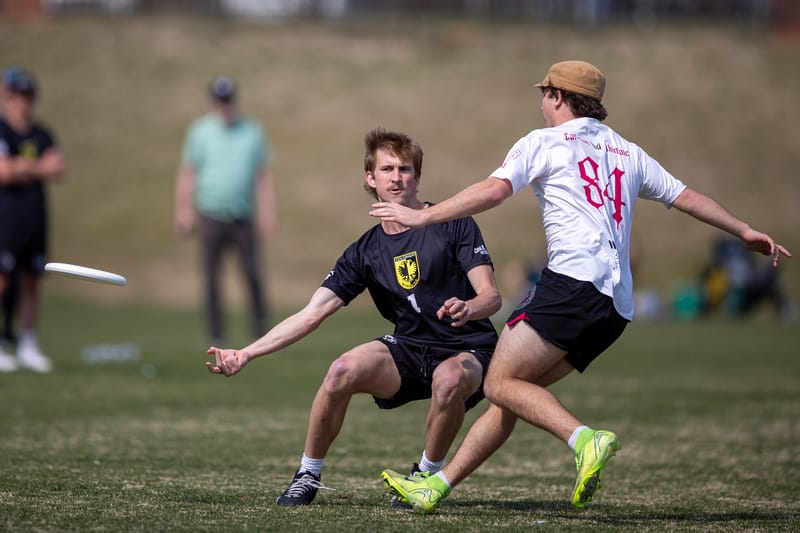
Thoreson was the revelation. His skill as a cutter and a defender are well-documented. This spring, though, he has come into his own as a thrower. No longer does he shy away from the big look and turn toward Shigley or Brooks for a reset: he’s slinging, and he’s slinging very well. The force middle CUT defense didn’t give him much of a chance to show it off in the final, but the rest of the weekend belonged to his right arm. Combined with his prowess in other areas, the new role as shooter par excellence made Thoreson the tournament’s best player, bar none.
Setting aside the mistake on their opening offensive point, Carleton were plenty good enough to match Colorado for the remainder of the first half. Declan Miller and Axel Olson absorbed a lion’s share of touches, keeping the disc (sometimes only barely) out of the reach of Mamabird’s switch-heavy defensive schemes, with Fin Fuhrmann and Nobi Lorenz lubricating possessions with their incessant movement from, respectively, the backfield and the shallow cutting space. It was a worthy attack, especially considering Miller’s ability to make catches under pressure, although sometimes Colorado pushed Olson right to the limit of his prodigious throwing skill and field vision.
What CUT lacked in the final in comparison to most of their weekend was a reliable deep attack. Rookie Sarek Mallareddy had been outstanding as a timed release and finisher in set plays, but he hardly featured at all in the final. Furhmann and Lorenz connected once for a gorgeous improvised look:
As clean as that shot was, though, it was the exception. CUT’s first half of offense was plenty capable, but the pressure and unpredictability of Mamabird’s defense made it dirty and strained in a way that was bound to wear down Miller and Olson.
“Every line is a hunting line,” said Kalmus.
Both teams opened the second half with extra firepower. Nate De Morgan and Thomas Shope, now in their second year of being as automatic a connection as possible for Carleton’s D-line offense, joined the CUT O-line. Colorado countered with Hawkins, Bauman, and Thoreson on defense. CUT appeared to have the point wrapped up when Olson’s huck put De Morgan two yards shy of the goal line, but Shope mishandled the flip reset as he followed the play. Kalmus bent an aerospace engineer’s dream of a forehand to Hawkins going the other way to add on a second Mamabird break.
CUT began to tighten their lines, crossing Miller and Olson over to the D-line and keeping Shope and De Morgan on hand for more offensive points. For much of the second half, though, it did not seem to matter who they had on the field against a Mamabird side that remained balanced on offense and disciplined on defense.
Perhaps the word ‘balanced’ should come with an asterisk. While Mamabird spread the disc around the seven on the O-line, finding highlight moments for everybody, one player undeniably rose to the occasion more than the others: Tobias Brooks. Brooks had not (at least when I was watching) asserted himself in a major way in the six games leading up to the final, electing to let his talented teammates shine. But the third-year star was in rare form in the final. He controlled the pace and the shape of the game beautifully, got the offense out of multiple tight jams with his backfield play, and made every difficult catch the moment asked of him. He was sensational.
With Brooks operating on an astral plane, CUT had their work cut out for them to catch back up. It got worse when they gave up another break. The 70-yard drive that Hartzog, Kalmus, and rookie Simon Logan — keep an eye on Logan, who is quickly emerging as a top two-way threat on the ‘Bird D-line — put together against a Miller-Olson-Shope-De Morgan CUT line was impressive. Mamabird’s commitment to sniffing out and double covering Carleton’s deep shots, though, was the key. Take a look at the way they pinch the receiver on both of these plays:
A 13-9 deficit is close to insurmountable, especially against a team that has been hot on both sides of the ball. Credit to CUT: they gave it a real run. De Morgan set the tone with an explosive catch-block to get the disc back for the offense, and completed the play with a goal for bookends. On the next point, Carleton finally earned their first break of the game, taking advantage of three increasingly sloppy Colorado possessions before first-year Joel Simon found the goal box.
Crucially, the break happened without Shope, De Morgan, and Olson on the field. (Miller, who did not start the point, played after matching a Colorado injury substitution.) They had played most of the second half, and CUT would need them the rest of the way if they were going to complete the comeback. Being able to rely on players like Simon, Jonah Berry, and Nathan Parker in that critical situation will surely be a lesson that the coaching staff can look toward in the future.
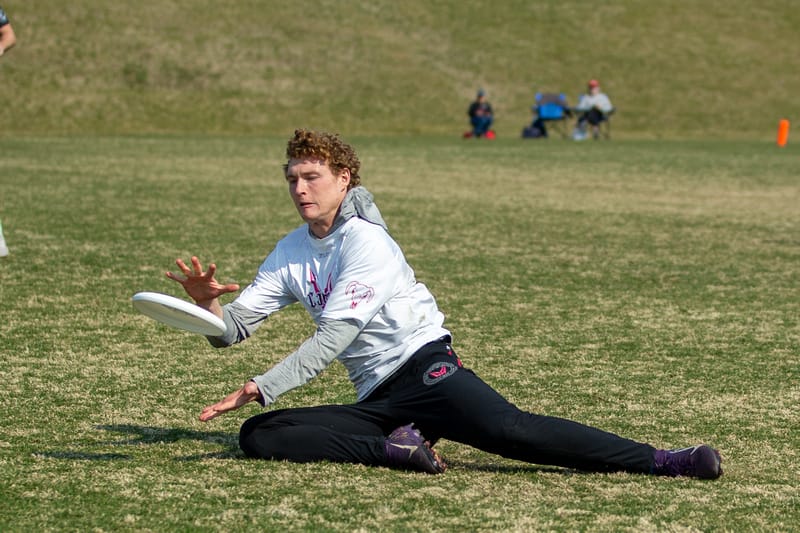
The call by Carleton to rest their top players appeared to pay off on the very next point when Olson dove into the lane to block Brooks’s backhand, but they couldn’t cash in the break. Then, on the last point, Shope gave them another chance with a deep block. Again, a throwing error cost them the break.
Mamabird had blinked. Clear-eyed again, they finished out the game. They worked to the red zone, where Min-Fink saw Barnouw at the back line and spotted an easy forehand to him.
Save for that late string of points against Carleton and a ho-hum first half on Saturday against #18 UNC Wilmington Seamen, Colorado were hands down the most complete-looking team at the tournament. Their line calling, play calling, playmaking, attitude, adjustments, defensive schemes, and fundamentals were all consistently operating at a championship level. They will take a healthy, earned dose of confidence from their effort into the rest of the season. Not that they’re all smiles about it.
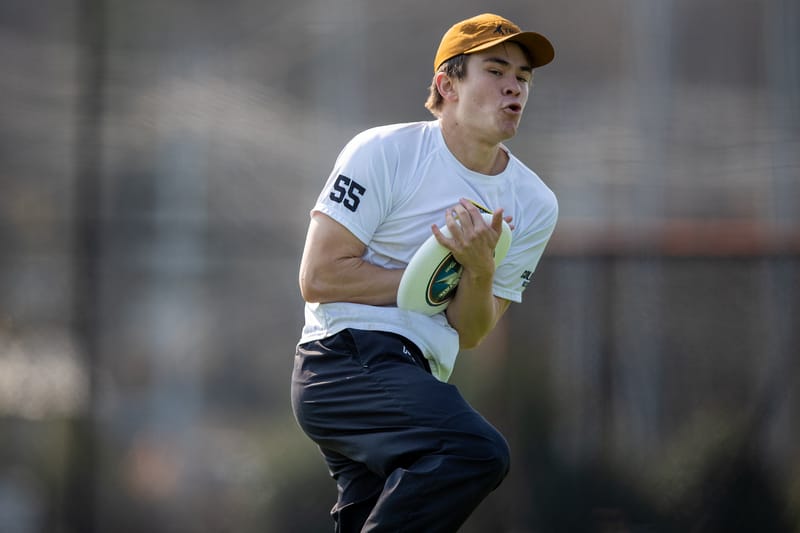
“For us this is data rather than a real weight off our shoulders,” said Kalmus. “If anything it makes the rest of the season harder for us. It comes with pressure and expectations that have gotten in our way in the past.”
Carleton did not quite measure up to Colorado’s mark, both leading up to and during the final. Nevertheless, they can take heart from the tournament for a number of reasons. The play of their second defensive line down the stretch, as noted above, was more than encouraging. The offense will have another field stretching option when second-year standout Ellis Newhouse returns: he played much of the weekend, but not the final.
And then there was the obvious bitterness they showed after the loss. Often at midseason tournaments, teams will shrug off the results and point to the process. Not CUT.
“We don’t like to lose,” said Shope. “This group of people is the most competitive group that I know. All of us just hate to lose.”
It appeared as though many of their players took the loss as badly as being knocked out of the bracket at Nationals. Their obvious passion for the game — and in particular for winning the game — will continue to drive them forward in pursuit of another title for one of the great programs in ultimate.
“We’re pretty disappointed with the result, but overall the team is happy with how we played. The main goal at these tournaments is to get ready, to get better, and to prepare for the postseason. And I think we did all those things,” Shope added. “So even though there’s some bitterness, we’re ready to step back on the gas.”
They’ll need that fuel if they mean to get back ahead of a dialed-in Colorado.
Subscribers, read on for more on Oregon, UC Santa Cruz, UNC, Texas, Vermont, Michigan, Georgia Tech, Pittsburgh, Penn State, Brown, UMass, UNC Wilmington, Tennessee, and Georgia! Plus: All-Tournament Lines and an All-Rookie Line.
Smoky Mountain Invite 2026: Mega-Recap is only available to Ultiworld Subscribers
Already have a subscription? Log in
Whether you visit Ultiworld for our reporting, our podcasts, or our video coverage, you can help us continue to provide high quality content with a subscription. By becoming a subscriber, not only do you receive benefits like exclusive articles and full article RSS feeds, you also help fund all of Ultiworld's coverage in general. We appreciate your support!