Mary encountered ultimate in a Cape Town high school and fell in love with the sport and its emphasis on integrity and pride
July 9, 2025 by Guest Author in Profile
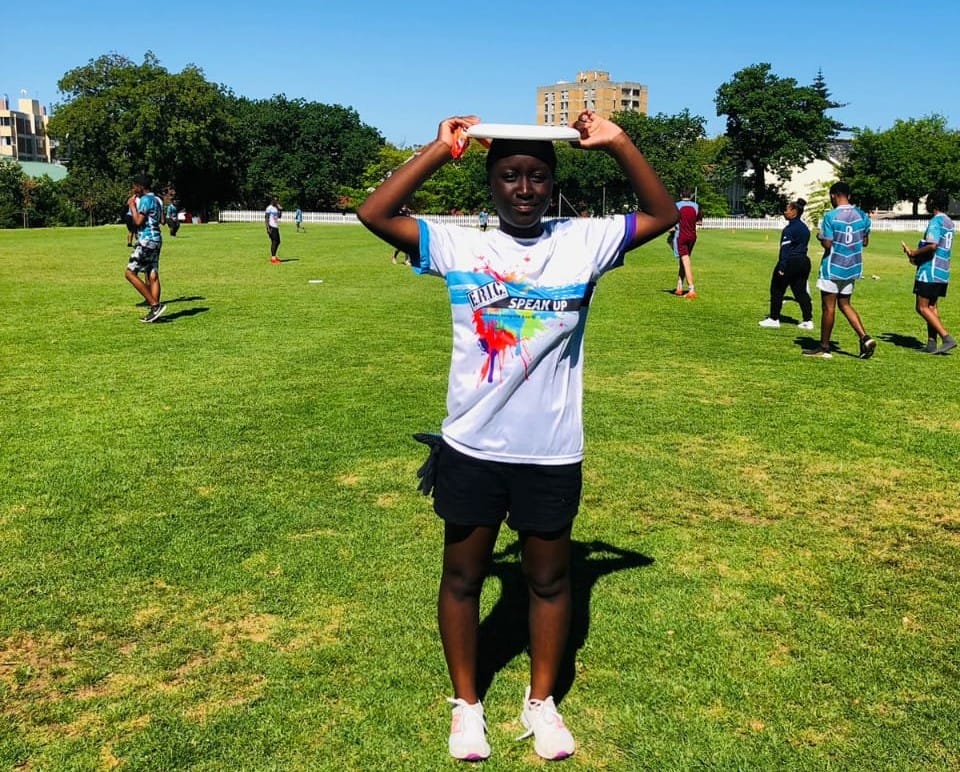
This article was written by guest author Doug Mattushek
Mary was born and raised in Uvira, eastern Democratic Republic of Congo, a region that became awash with uncertainty and violence in 2012. The brutality was sparked by the M23 rebels, who clashed with Congolese government forces. Amidst the M23 offensive and fearing for their lives, Rose Kiza Amissi grabbed her three daughters and fled. They would be four of some 140,000 people who left the region by the end of the year.
“It was a horrible experience,” recalled Mary, who was six years old at the time. “Even though I was still very young, I still remember how chaotic and traumatizing it was. Especially for Mom, who was travelling alone with three young kids.”
The perilous journey across four countries as refugees was desperate. Lacking documents, borders were crossed in the dead of night. This included crossing the Limpopo River from Zimbabwe into South Africa, where Mary nearly drowned in the torrent. Mary and her family eventually settled in Cape Town in 2014 and applied for asylum.
Enter former South African ultimate frisbee player Asanda Nanise. Development has always been close to his heart and his current project is operating out of Apex High School in Eersterivier, Cape Town, where Mary first came across the sport. Like in most countries, ultimate at the foot of Africa is largely played by a privileged few. Through his non-profit organization – Jula Isitya – Nanise is trying to change that.
“Ultimate shouldn’t just belong to the privileged – it’s a game for everyone,” said the passionate Nanise, who played on the South Africa Open team at WUGC in 2004.
“For the past seven years, I’ve been coaching in underserved communities, using the Spirit of the Game to teach more than just sport. Through my NPO, over 100 kids have learned teamwork, fairness, and leadership,” Nanise said. “This game isn’t just about scoring points; it’s about changing lives. And we’re just getting started.”
Ultimate has a decent foothold in Africa, with teams in Kenya, Uganda, Tanzania, Mozambique and Egypt. South Africa, however, has the biggest player base with over 500 players and several tournaments a year.
Given her size, Africa’s clubs rarely come across each other. The WFDF-sanctioned All-African Club Championships, held every two years since 2015, has endeavored to change this. Its 2017 edition, hosted in Nairobi, Kenya, was the first to feature mixed club teams from Cape to Cairo on the same patch of grass.
The South African Flying Disc Association has ambitious plans to host an international tournament in the next five years that aims to bring Africa’s talent down south.
But in order to fuel that competitive space, ultimate needs to start at grassroots level. South Africa – in Cape Town in particular – has a burgeoning school scene attracting brand new players such as Mary.
“I had rugby training, but it got cancelled,” recollected the rambunctious youth. “I saw Coach Asanda training the school team and wanted to try it out. After that, I just fell in love and decided to join the school team. Since that day, ultimate frisbee has been in my heart, it became my number one.”
Mary’s skills began to develop through inter-school fixtures. She then had the chance to link up with the Stellenbosch University women’s team for 2025 Open and Women’s Nationals. The team travelled to East London in May and after three challenging days, they claimed fifth place.
View this post on Instagram
Cape Town’s Hot Sauce dominated the women’s division, while the men from Mutiny upset perennial open division champions Long Donkeys in a blustery Sunday final.
“Playing with and against great players and being among excellent coaches was so wonderful,” said Mary. “I got to learn new skills and knowledge that I could use to uplift my community. It was beyond my expectations.”
But Mary is taking more than just the experience from Nationals; she is taking life lessons. Ultimate is self-officiated, meaning integrity is woven into the fabric of the sport.
“You should be able to keep calm and control yourself on the field, which is a very important factor in our lives,” continued the 17-year-old. “In ultimate, honesty is important, so you need to be able to call yourself or your team out and correct them. Those are things I would love to always implement in my life, living with integrity and pride.
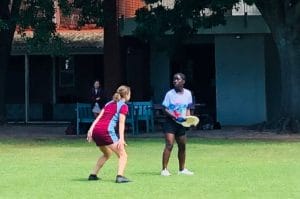
“Before I started playing ultimate, I always had one goal: winning and only winning,” said Mary. “But since I started playing ultimate, I saw my teammates and other teams encourage each other. They never let their hunger for victory ruin their relationships. Whether they won or lost, they were always happy for the other team.”
For Rose, she has seen her daughter blossom on the sports field. The future that looked near impossible for her child is playing out right before her glistening eyes.
“At first, I thought her academics would drop if she were to start another sport,” admitted Rose. “But instead, she just earned top achievements in class. Seeing her manage her academics and sport with honesty and grit makes me tear up. Sometimes I wonder where that girl is that I was so worried would never have a future. If it wasn’t for her will and determination, she wouldn’t be here.”
