Coach Dunte Hector reflects on the sport's changes in the last eight years since he last watched the Club Championships
January 21, 2026 by Guest Author in Opinion

This post was written by guest author Dunte Hector.
I’ve loved ultimate dearly since late 2015, yet still haven’t played a single point. Between traveling to Illinois for Club Nationals in 2016 out of curiosity and traveling to San Diego in 2025 to celebrate individuals I had supported, I realized something: the game has changed dramatically in nine years. Even though much of what I “knew” about the game as a strength and conditioning coach back then doesn’t apply anymore, a few principles from my coaching practice matter more than ever.
But first, rewind: one player brought me into the sport as her strength and conditioning coach, then over several months was patient enough to answer my thousands of questions and generous enough to connect me to her entire player community. Before her, I had never heard of ultimate.
Every player I met taught me something new about the game, about adult athletes, and about norms within the culture. League players taught me to throw a flick, then club players taught me to throw it in the wind. Individual athletes showed me how important training is away from practice, then teams showed me how important doing hard things together was for chemistry during tournaments. I kept extensive notes, wrote a few articles, and got deep into the Austin ultimate scene.
My approach to training dismissed track workouts, advocated for more rest days and longer offseasons, put low-volume training for speed and strength at the core of preparation, and avoided jogging of any kind. No sport had ever been so welcoming to a new face with such contrary opinions.
When I paced the sidelines of Nationals back in 2016, I came away with lots of ideas for supporting players better. Since that was the pinnacle of the sport, whatever made a difference for players there would surely make a difference for everyone. The common injuries players brought to the medical tent were reminiscent of developmental soccer players and the loss of playing speed across tournament days was similar to league rugby late in a long day. But the recovery methods players used were widely varied and fairly inconsistent. Those were areas I had the expertise to help with!
For several years, everything I did with semi-pro and club players was rooted in that one day of observations at the biggest tournament in the sport. I assigned players more crawling, tumbling, and mobility to make their shoulders more resilient to laying out. I doubled down on technical work for sprinting so players could still run fast later in the day. I prescribed less total running, fewer hours of training each week, and encouraged them to skip pickup and goaltimate outside of their main seasons.
My methods evolved in small ways over time as players gave me feedback: the game was getting faster; experienced players were sticking around longer; national teams had more structure to their tryouts and spots weren’t guaranteed for anyone. More speed, more emphasis on longevity, more emphasis on mental game. But everything was still secondhand because I didn’t play myself and I didn’t travel to big tournaments anymore. When my family moved out of Austin in 2019, I vanished from the scene.
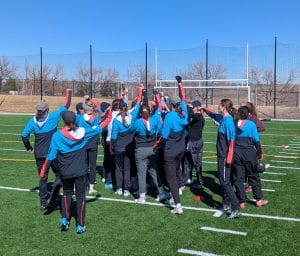
By the time individual players on the Colorado Alpenglow roster invited me to support their 2024 WUL season, I had lost the pulse of the sport. Still, players I coached back from injuries did well all year and kept that momentum through their 2025 club season, serving as big contributors to already strong teams like Fort Collins shame., Austin Disco Club, San Diego Flipside, Denver Mile High Trash, and others. When more than five of those teams earned bids to the Big Show this past October, I booked a ticket. Two days on the sidelines at Club Nationals shook me awake.
Ultimate is a different game now. I’m not a player so I can’t speak tactics, but I know what I see: players are faster, stronger and more muscular on average. They’re lighter on their feet, sharper with defense, more consistent across a long day of play. They’re clearly better fed and better hydrated on competition days and better trained coming into them, because there weren’t nearly as many cramps that led to personal injury calls. And they’re more deliberate about recovery activities, based on the massage sticks and foam rollers and electrolyte mixes and fruit snacks tumbling out of game bags.
In every way, individuals in ultimate are more athletic. This is a mark of a maturing sport: established players train harder and smarter, so they last longer and perform better. At the same time, the feeder system is pulling in better athletes.
I love witnessing the growth. I love witnessing the rising tide of performance. But as a coach, I have to pay close attention to the “bad” stuff, too.
Injury patterns in this new world of ultimate concern me. It was mostly turf toe, shin splints, cramps, and the occasional hamstring pull nine years ago. This year at the medical tent, there were a lot more shoulder dislocations, minor and massive ankle subluxations, and adductor or hip flexor strains. That means injuries have largely gone from moderate-intensity overuse issues to catastrophic contact and/or high-intensity load injuries.
Those kinds of injuries aren’t preventable, only manageable. As a performance coach, I help athletes minimize their risk of injury by building a foundation of strength and mobility that speeds up rehab when a bad thing inevitably happens. Players in this new world need tumbling and grass work like rugby players; ankle, knee, and hip prehab like football players; and far higher strength levels than already achieved. Players need all of this because they’re taking more and harder hits.
And that’s my other concern: you may need to play nice.
Nationals this year was interesting to observe after multiple years serving semi-pro ultimate teams. In semi-pro, there are fewer games in a weekend, the games are shorter, the field is longer, and the game clock adds a certain pressure absent in club. Because of this context, game play is faster and more aggressive. But with fewer total available touches in a game or in a day, players I worked with reported less soreness the day after games and often were ready to continue training without a day off. From a performance coaching perspective, I get the impression there’s less punishment on a body in semi-pro.
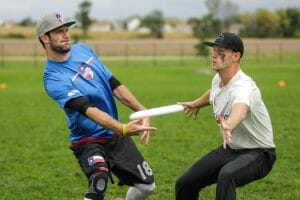
I saw a lot of players bring semi-pro energy to club games Friday morning at Nationals. The energy itself is awesome and fun, with sharper cuts in congested spaces, crisper throws down narrower lanes, intensity and intention about looking for the next disc movement after a big catch. But the aggregate load of a three-game day on the second day of play combined with that energy led to some issues. Angles to the disc went through people. Bids went into people. Moves on the mark stomped and smacked more than a few people. And tired people got upset.
Contested calls looked more contentious. I witnessed more work by observers to de-escalate conversations than I saw them arbitrating calls with evidence. Some scoring celebrations were more like professional football than like college volleyball – individual attention sometimes overshadowed team high-fives and hugs.
The game has gotten more aggressive at the same time it has gotten more athletic. It has gotten more showy at the same time it has gotten more exciting.
What I saw at Nationals this year awed me. Every player there and every player who narrowly missed a bid: you are strong and fast and incredibly skilled with the disc. Your game is fun to watch.
The game is also growing. Growth is hard. Growth means every element of the game is changing quickly. There may not be much time for reflection or debate. But twelve years as a professional coach have reinforced that reflection time is when I make the most impactful changes to my methods.
What I’ve loved dearly about ultimate since 2015 is how spirit is a core value of the sport. I’ve been in 37 sports across my athletic career and had never heard of that before. While I still haven’t played a single point, I’m back to pacing sidelines because I so deeply enjoy the sense of friendly rivalry baked into the sport.
It’s exciting (and a little validating, I’ll be honest) to see how much smarter people are training. My job used to be convincing players to do less conditioning and more speed development, fewer pushup burnouts and more deadlifts. Now I spend more time on injury mitigation and mental game, so athletes can play longer and harder without losing their cool or fading mentally. I had to evolve because the game has evolved.
After some years away, I’ve taken a second look at the highest level of ultimate. You, as athletes, and the game you play are bigger and better than ever. A few troubling things are emerging, maybe because there is more visibility and opportunity around the sport. I’ve never played your game. It’s possible the way I see things isn’t how players are experiencing them. As an outsider, I’m only asking that you folks who make the game what it is take a second look, too.
 Dunte Hector coaches adults in explosive sports as owner of SHIFT Speed Coaching. He is the author of Fast Kids Don’t Train Slow (a book for helping ultimate players sprint faster) and the biggest geek about movement skills you’ll likely ever meet on a sideline. You can find him training for Masters track & field by sprinting up hills and throwing stuff in public parks all over the Denver, CO metro.
