Recognizing the top seven performers of the 2026 season.
June 8, 2026 by Edward Stephens and Kiana Hu in Awards
Each year, Ultiworld presents our annual College Awards. Our staff evaluates the individual performances of players from throughout the season, talking to folks around college ultimate, watching film, and look at statistics, voting upon the awards to decide those to be honored. The regular season and the college Series are both considered, with extra emphasis for performances in the competitive and high-stakes environment at Nationals.
Our All-American teams recognize the top performers across the division. While in the past Player of the Year has been awarded first, this year we open our Awards with our First Team All-Americans, displaying the top seven players who had the best seasons. Listed in (reverse) alphabetical order, the First Team now serves as a finalist list for the Player of the Year Award, which will be announced live tomorrow on Deep Look.
- All-American First Team
- Player of the Year Coming Soon
- All-American Second Team Coming Soon
- Defensive Player of the Year Award Coming Soon
- Offensive Player of the Year Award Coming Soon
- Rookie of the Year Award Coming Soon
- Breakout Player of the Year Award Coming Soon
- Coaches of the Year Award Coming Soon
- Full Awards Voting Breakdown Coming Soon
D-I Women’s All-American First Team
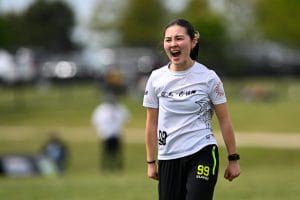
Lia Schwartz (Tufts)
Every aspiring elite frisbee player has studied (or should study) Schwartz’s play at some point, but few can emulate the power and precision that she generates on every single one of her throws. Her ability to hit cutters in places where most coaches would warn against even attempting truly shifts and redefines the possibilities on the field. Extremely wily with her upline cuts, it’s almost impossible to deny Schwartz the disc, and once she has the disc, it’s over. Her second-place 34 assists at the 2026 Nationals en route to nearly toppling the undefeated Syzygy is a performance for the ages.
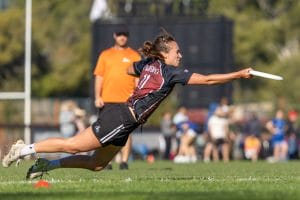
Sage McGinley-Smith (Stanford)
All season-long the question had been asked—is McGinley-Smith the best deep receiver in the division? Finding herself on this list seems to be a pretty good indicator towards the affirmative. Not only was McGinley-Smith nigh unstoppable when the disc went up in her direction, her 13 assists (to go along with the 22 goals that brought her to a career goal record) belies how she expanded her throws to make her just as dangerous outside of the end zone. A five-assist, one-goal stat line in the semifinal against UBC caps off an impressive run from McGinley-Smith, who only started playing frisbee in college.
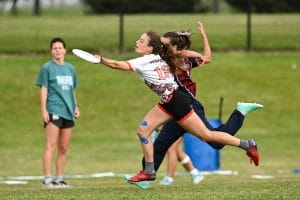
Grace Maroon (Pennsylvania)
This is a player who brought her team to national relevance only two years ago as a rookie, and now has propelled them to new heights, topping an incredibly competitive pool and playing a close quarterfinal game. Even amongst a field of generational talents, Maroon stands out with her excellence in practically every position on the field. Arguably most dangerous in the deep space with her speed and vertical, Maroon was more often than not in the backfield for Penn, wielding a variety of creative throws to maneuver the various zones they faced. On defense, she was simply everywhere.
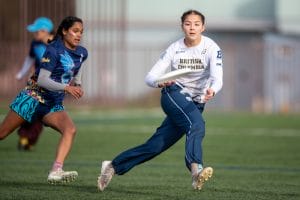
Mika Kurahashi (British Columbia)
Nevermind the injuries that limited her during the season’s long middle; let’s remember the player who bookended 2026 with the early favorite for Block of the Year against Carleton at Santa Barbara Invite and a performance at Nationals that bordered on sheer perfection. By the time UBC got to Rockford, Kurahashi, back in playing form, was once again the slippery cutter, the blindingly polished thrower, and the ferocious defender that defined her 2025 Player of the Year campaign. She posted a 13-goal, 14-assist line against only five turnovers to lead the Thunderbirds within two goals of a second straight title.
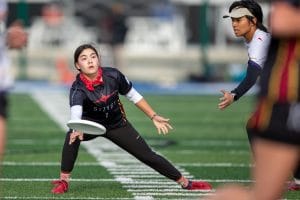
Chloe Hakimi (Carleton)
To explain Hakimi’s pure brilliance at Nationals, you don’t need to look past the staggering assist total. But those 42 throws alone don’t do justice to her game. One simply must see the way she controls the field: every pivot is an attack when she has the disc in her hand, every step she takes without it is a feint capable of capsizing a whole defense. And by the time Nationals rolled around, she was prowling the deep space against the zone as well as any of the division’s established bigs. What a season for the blue chip rookie, and what a career on the horizon.
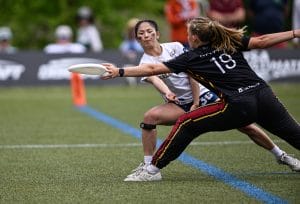
Chagall Gelfand (Carleton)
No team towered over the season like Syzygy, and, for most of that time, no one towered over Syzygy like Gelfand. Her game exuded pure power in a way that communicated itself every time she stepped up to the line. Her arcing, graceful hammers hit their marks with all the timidity of cartoon piano crashing into a sidewalk from a great height; her forehands were arrows from a longbow. The injury she sustained in quarters limited her somewhat late at Nationals, but even so she recovered enough to put up a two-goal, five-assist line in the championship game.
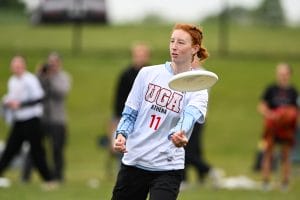
Quincy Booth (Georgia)
2026 will be remembered for many reasons, but one of them surely will be as the year it all came together for Quincy Booth’s Athena. For four years she led the team from the gunner’s chair, putting up a record run of assists (and playing sneaky-good defense). It never amounted to a spot in the bracket until now though. The crucial three wins that led Georgia to bracket play – against Florida in the Southeast final, and then UCLA and Victoria at Nationals – saw Booth put up 11, 8, and 12 assists, respectively. That’s legendary work from a player whose name has now become a byword for slinging the rock.