Whether layout blocks or shutdown defense, these players made life miserable for opposing offenses
November 16, 2026 by Edward Stephens and Aidan Thomas in Awards
Ultiworld is pleased to announce our annual Club Awards, starting with the First Team All-Club in each division. While we consider both regular season and postseason performance, because of the nature of the Club division, we weight success in the Series and at Nationals above all else. The Club Awards are voted on by Ultiworld reporters, contributors, and editors.
Our awards continue with the Defensive Player of the Year, recognizing the individual, and two runners-up, who we felt were the top defensive performers this club season. Whether through generating blocks, shutting down options, helping out teammates, or all of the above, these defenders stood out doing the tough work that too often go unrecognized.
All-Club First Team
Player of the Year Award
All-Club Second Team
Offensive Player of the Year Award
Defensive Player of the Year Award
Breakout Player of the Year Award
Coach(es) of the Year Award
Club Awards Voting Breakdown
Snubs and Superlatives
2026 Men’s Division Defensive Player of the Year
Cooper Williams (Raleigh Ring of Fire)
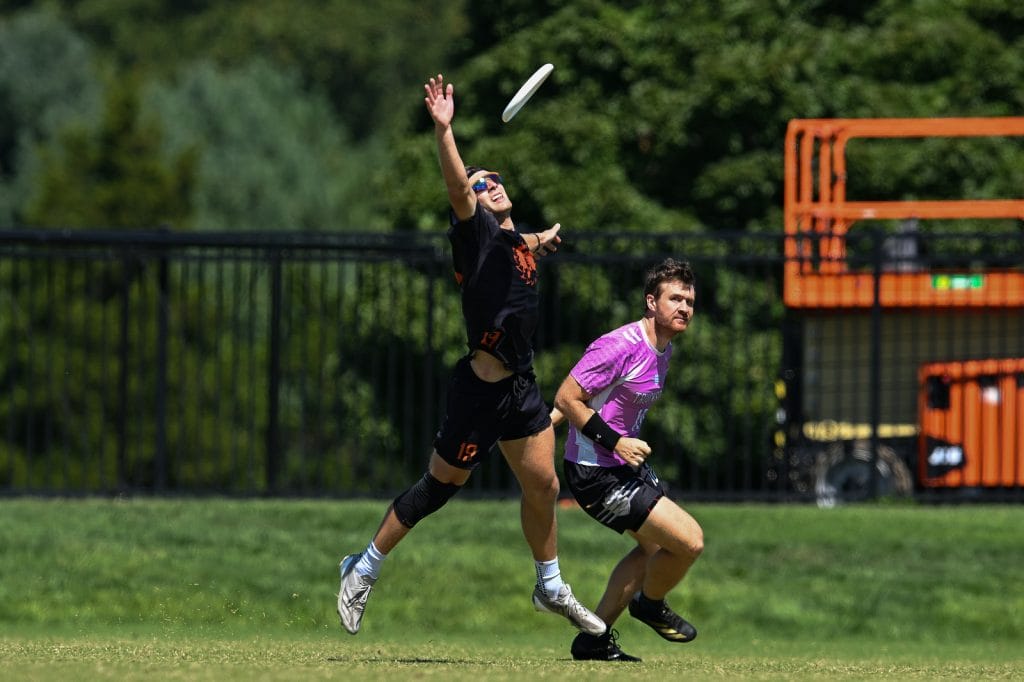
Cooper Williams earned an All-Club selection for his varied contributions to Ring of Fire’s title run, as he posted seven goals, one assist and six blocks at Nationals. Those six blocks tell part of the story, but Williams was inarguably the crux of the Ring D-line, taking on some of the toughest matchups throughout Raleigh’s surge in San Diego.
Williams’ standout moment came not in bracket play, but in the pool play comeback that paved Ring’s path to the final, a 14-13 universe point win over Machine in which the eventual champs rallied from 12-8 down to break on double game point. Williams notched three blocks in the game, half of his tournament total. The most crucial came with Ring trailing 12-11 – Williams stayed with Sam McGuckin on a deep cut and then tailed him all the way back to the reset space before exploding for a run-through block that led to Ring’s third straight break. That game set Ring up comfortably in bracket play where they drew a gassed Minneapolis Sub Zero team in quarterfinals, rather than New York PoNY.
Williams also earned blocks in both of Ring’s quarterfinal and semifinal victories. He took on Sub Zero’s elite hybrid initiator in Paul Krenik and drew 2025 All-Club selection Adam Rees in semifinals against Revolver. In that semifinal, Rees earned a few touches, but he notably struggled to get open on his initial looks against Williams and his yards were hard-earned and the gains minimal.
Against Machine, Williams did more of the same, limiting threats like Elliot Hawkins and Zeke Thoreson and denying some of Machine’s top contributors the disc. Williams’ shutdown presence didn’t notch him any blocks in the final, but it did contribute to Machine looking elsewhere for offense, helping Ring collect two breaks to start the game. Williams’ value was palpable and his engine was unmatched; he was the only Ring player to play all of the first three defensive points as Raleigh jumped out to a lead.
Williams produced like that all season long for Ring of Fire, earning multiple blocks in the Pro Champs final, including a layout effort and another block on double game point to set up a break chance. But at Nationals, with the lights shining brightest, Cooper Williams made sure every team’s O-line knew who he was, and his production and shutdown defense earned him the 2026 DPotY award in the men’s division.
“He’s dogging people all game,” Ring of Fire’s Dylan Hawkins said. “He’s such a rock, taking the toughest matchup on the other team. We call him Super Coop.”
– Aidan Thomas
First Runner-Up
David Sealand (Rhino Slam!)
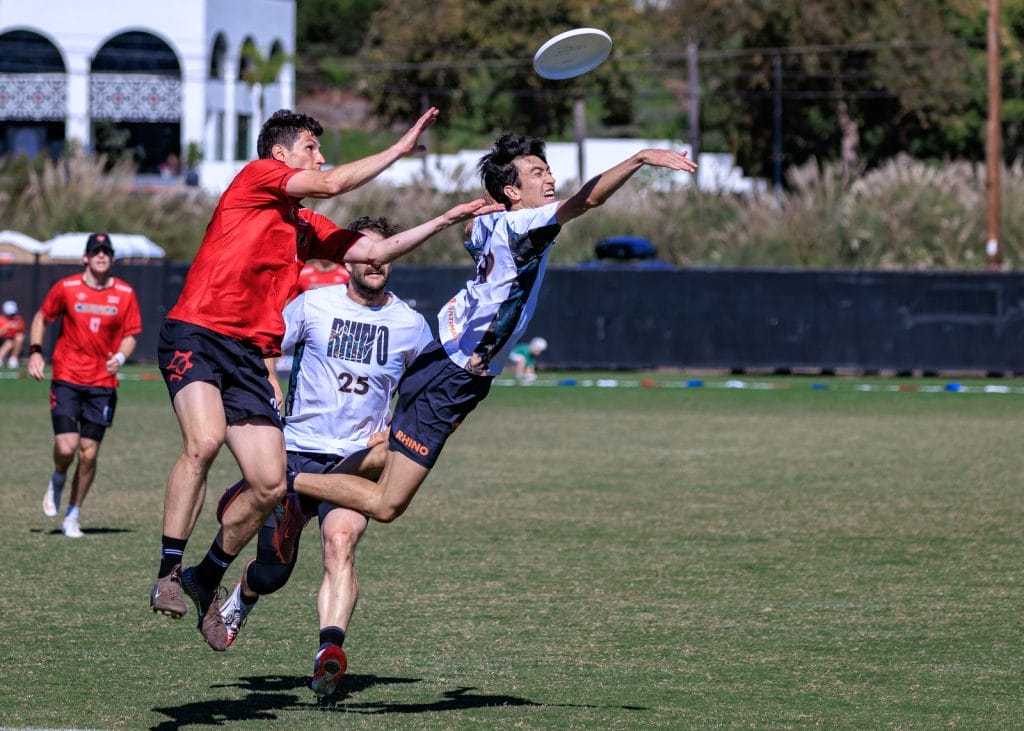
For the second time in three years, David Sealand is the DPotY runner-up after once again serving as part of the backbone of Portland Rhino Slam! defense.
The belief in Sealand as a leader of Rhino’s defensive unit can pretty much be summed up with one simple fact – head coach Leo Micklem trusted Sealand to stick with Daan De Marrée through most of their semifinal against Chicago Machine, including on an eight-turnover universe point in which Sealand dogged the POTY throughout, coming centimeters from a block on the game’s final possession.
In fact, Sealand had already notched a universe-point block when he alertly saw a Rhino defender slip and managed to pick up a streaking Elliot Hawkins in the deep space, denying Machine a potential game-winning look. He then hounded Hawkins into the force-side under space and nabbed one of his two semifinal blocks when Hawkins peeled off his cut.
Sealand displayed that level of heads-up defending while swallowing up top matchups throughout every game, as he battled with top opposing hybrid threats like Owen Erdmann and Justin Podnar throughout the tournament. His timely blocks and relentless defense earn him a spot on the DPotYium once more.
– Aidan Thomas
Second Runner-Up
Logan Piercy (Philadelphia Pacmen)
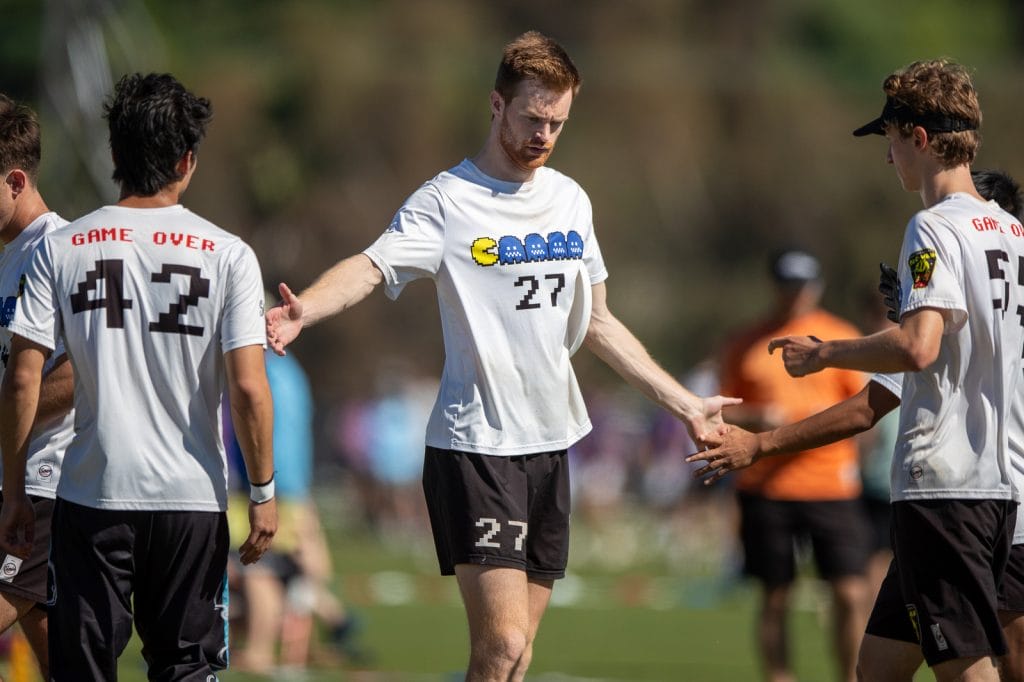
It isn’t a truism yet – but it should be – that the job of a D-line is to score. Same as an O-line. The trick, of course, is that for the D-line to score, they have to gain possession of the disc. That’s where a player like Logan Piercy comes in. Although sometimes you will see him practicing a denial-style of guarding in a crucial moment (say, blocking an upline in the red zone or peeling deep to discourage an otherwise open huck), his genius is for reading the play to intercept the disc. Most of Piercy’s blocks look almost casual, but they are the product of a field sense tuned up to an absurd sensitivity. The result of this talent is that for the second time in his brief career, he has posted the most blocks at a championship event.1 Which means he has created the most opportunities for his D-line to do their job, simple as that.
– Edward Stephens
2026 Club Nationals and 2024 College Nationals, both times tied with other players ↩