Ring of Fire’s offensive evolution powered the team to the 2026 title. Examining the film shows how they did it.
November 18, 2026 by Alex Rubin in Analysis
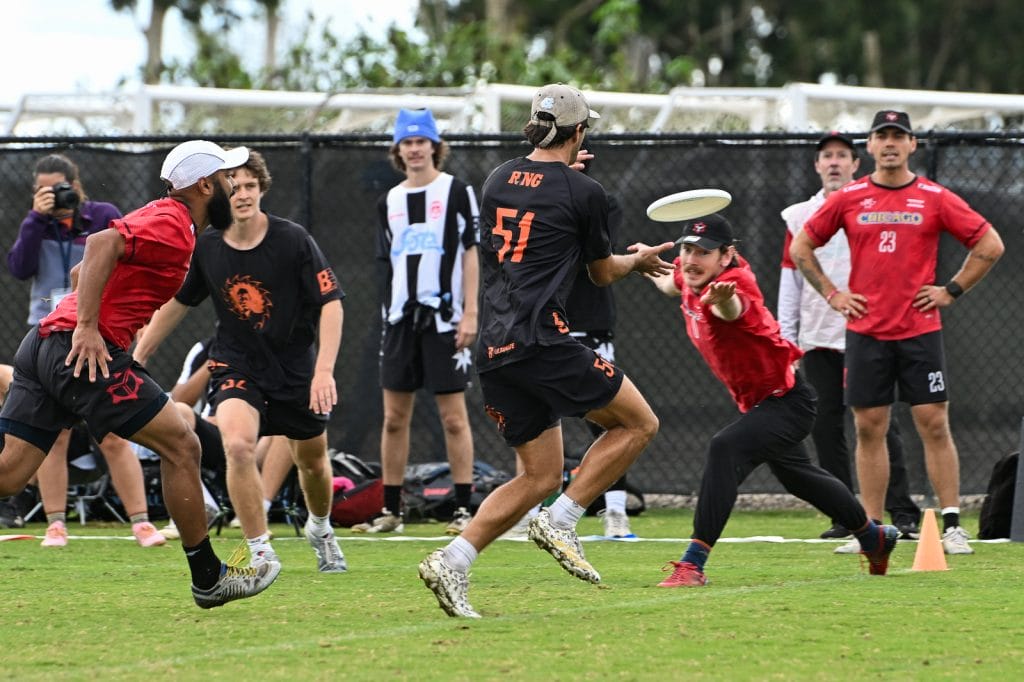
Nobody saw Raleigh Ring of Fire coming this season. Not when the team made it to the final of the Pro Championships; not even when they beat Chicago Machine during pool play at Nationals. Without many household names and without an Ultiworld-rated Top 25 player, who was Ring of Fire to break into the championship-contending core atop the men’s division? This team lost their own region!
And yet, behind an offense that no team had an answer for, Ring of Fire get to put their plaque on the USA Ultimate trophy. Their 2021 title was similarly won with a stellar offensive display, but the offense that worked so well just half a decade ago needed to be reimagined in order to succeed again.
Ring of Fire’s crisp offense was a redesign of horizontal stack, which coach David Allison said the team refers to as “Flo Stack,” built on two principles: keep the disc in the middle of the field and make every reset gain ground. Let’s look at how it delivered on the biggest stage.
The Rebuild
The personnel Ring had – and the gaps left by those they didn’t – were key to designing their offensive scheme and executing it to its full potential. “We lost essentially our entire O-line after 2024,” Sol Yanuck said on the Pod Practice podcast. “We lost Ben [Dameron], Ders [Anders Juengst], Allan [Laviolette], Henry Fisher, Eric Taylor, and Rutledge [Smith]. And then after last season we lost Ethan [Bloodworth] and [Jacob] Fairfax, both for family reasons, which we understood going into the year. Last year we built an offense around Ethan [Bloodworth] and Jacob [Fairfax] and Trevor [Lynch] and Dylan [Hawkins] trying to throw to each other in big space. This year without Blood[worth] and Fairfax, we had to completely sort of reinvent how we wanted to approach at least the O-line’s process.”
In particular, it was Fairfax’s departure that forced the matter. Previous iterations of Ring could structure their offense around Fairfax’s ability to get open in a cutting lane. While other cutters sat idle in a side stack, defenders could poach the lane and impact what looked open. Without a singular force like Fairfax, it was clear to Matt Gouchoe-Hanas that “playing that big space open side cutter continuation ball was not really gonna be our strength,” he said on that Pod Practice episode.
What Ring of Fire did have were “all these really interesting high-disc-skill mids who will be really challenging to match up with if we can give them a dynamic space to operate out of,” as Yanuck described them.
What Ring of Fire did this season was refocus to open up and attack the middle of the field against defenses built on help concepts out of a more traditional horizontal stack shape. “In December Dylan Hawkins sent me a bunch of texts and started bringing up the idea of playing ho stack,” Gouchoe-Hanas on the podcast. “When we first started talking about it, I didn’t really know what that meant. I obviously understand the structure of a ho stack, but I didn’t feel like any of us really knew what that was going to look like … What we ultimately did was take this staple offensive structure in our sport and try to make it our own and figure out how to play it in a way that played to our strengths.”
“North Carolina is known for running a spread offense, a sidestack offense,” Matt Barcellos said at Nationals. “We tried to do something different this year, to flip the script and create our own way. It was a process of building towards that, we had to unlearn a lot of tendencies.”
The System
While some set plays started as side stacks or 3-2 split stacks, the shape and structure of Ring’s Flo Stack were similar to what you’d see from a typical horizontal stack. Cutters spread out across the field, initiated cuts in front of the thrower, and attacked the deep space from continuation throws to cutters on the sideline. Two key principles powered this particular version: keeping the disc in the middle of the field and pushing for positive, forward-moving resets. With a healthy dose of hucking mixed in, the recipe was written. All Ring needed to do was execute.
One overall goal of Ring’s offense was to keep all seven players engaged and generate as many 1-on-1 matchups across the field as possible. “In our previous structure, there were a lot of guys who were sort of dead a lot of the time,” Yanuck explained. “In order for the cutters to be available to a handling core who was more and more proactively trying to get into positive space when you just have more than one cutter who could potentially be available at any given time. So a strength of ho stack is that if you operate from the middle then the disc could go to multiple spaces at any given time. All the sudden, every cutter defender is on the hook any given moment one throw from now.”
Through the Center of the Ring (Offensive Analysis) is only available to Ultiworld Subscribers
Already have a subscription? Log in
Whether you visit Ultiworld for our reporting, our podcasts, or our video coverage, you can help us continue to provide high quality content with a subscription. By becoming a subscriber, not only do you receive benefits like exclusive articles and full article RSS feeds, you also help fund all of Ultiworld's coverage in general. We appreciate your support!