The masterminds behind the division's best teams
November 19, 2026 by Laura Osterlund in Awards
Ultiworld is pleased to announce our annual Club Awards. While we consider both regular season and postseason performance, because of the nature of the Club division, we weight success in the Series and at Nationals above all else. The Club Awards are voted on by Ultiworld reporters, contributors, and editors.
The Coach(es) of the Year closes our annual awards. As so many teams have added more and more sideline-savvy consultants to their roster with less asked of a single head coach, this has essentially morphed into “Coaching Staff of the Year.” Coaches can impact the game in so many ways — tactics, motivation, communication, personnel management, program development, skill-building, etc. — and it can be hard to divine what exactly each has contributed to their team. But good coaching is something that we feel that “we know it when we see it.”
All-Club First Team
Player of the Year Award
All-Club Second Team
Offensive Player of the Year Award
Defensive Player of the Year Award
Breakout Player of the Year Award
Coach(es) of the Year Award
Club Awards Voting Breakdown
Snubs and Superlatives
2026 Mixed Division Coach(es) of the Year
Nathan Bussberg, Jon Mast, Tracey Lo (Ann Arbor Hybrid)
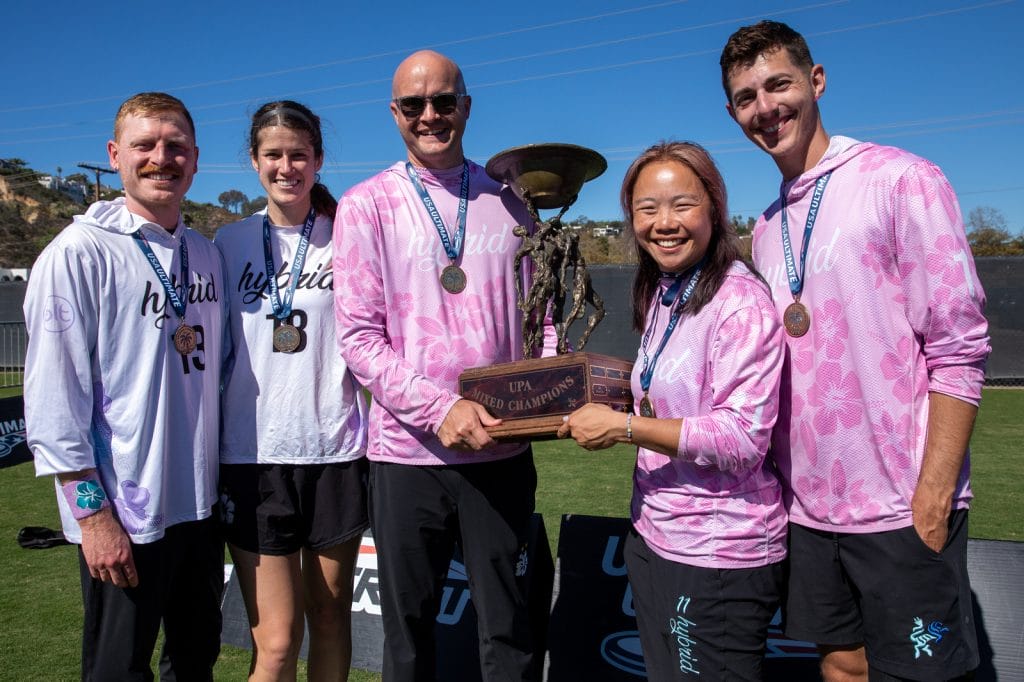
Hybrid made history in many ways this season: the only mixed team (and second team ever)1 to three-peat at US Open, the second mixed team to three-peat at USAU Club Nationals, and one of the very few to double peak at WUCC and Club Nationals.
They did all of this in spite of the high-usage personnel they lost this season — Kat McGuire and Aaron Bartlett in the preseason, Jon Mast, Tracey Lo, and Nathan Champoux for US Open, and Dalton Smith for the National final. For any other team, losing one player of this caliber would have been the difference between making a quarterfinal and a final, but for Hybrid, it meant their other players had those opportunities to shine. Bussberg ably filled in the holes and still put his team in a place where they could succeed. By Nationals, Bussberg, combined with Mast and Lo, had created systems strong enough to remain unfazed when they needed to make those adjustments.
Like any good coaching staff, Hybrid’s coaches spent countless hours the nights before their games doing research and strategically planning for the games and condensing the game-plan messages to the team.
“Our leadership team is very smart in making sure of what we can do and then also making sure the whole team can buy into what we’re doing,” said Hybrid captain/coach Jon Mast ahead of Nationals championship Sunday.
“I’m gonna back that our coaches are actually GOATed, dude, I’m not gonna lie,” added Kai Creed. “In my opinion, you got some of the best minds in the business.”
In most of their games this season, Hybrid played tighter with their opponents in the first half only to pull away in the second. Game after game, the coaching staff used halftime to make the right adjustments to force opponents into uncomfortable spaces and make them work hard for every point. Combined with utmost confidence that the team would keep their collective foot on the gas, and it was a winning game plan.
“They’re all phenomenally intelligent and good at being coaches. They have those skills that you need, that a team needs, to be a coach and leader,” said Rachel Mast. “The way they see the field, the experience they have, all shows up. They’re just great to learn from, and they spend so much time preparing and in their Zoom meetings weekly. So all of that prep that we don’t see, it shows just through the quality of our practices and tournaments. Even just all of the group huddles, the things that they repeat and things that keep us mentally strong and in the right space, that’s all them. They’re such a good group.”
– Laura Osterlund
First Runner-Up
Steve Sullivan, Daniel Naruo (San Francisco Polar Bears)
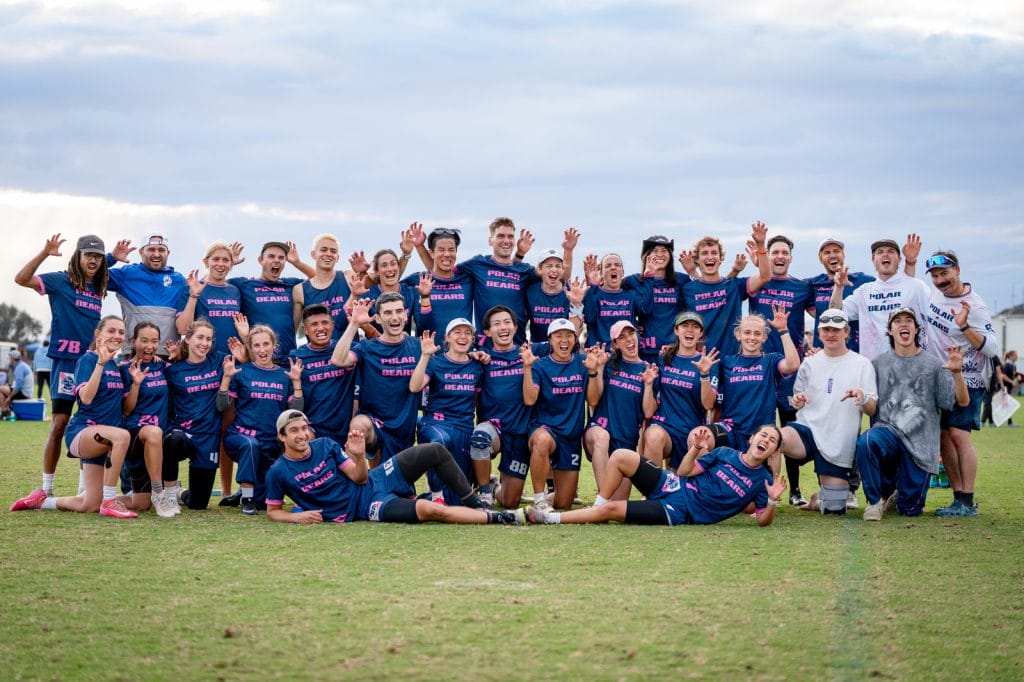
It’s quite possible that no team has seen such astronomical growth as San Francisco Polar Bears. To go from spending years on the precipice of qualifying for Nationals to making the final this season is an impressive feat. Credit where it’s due, their roster took a much-needed step up. But to foster the conditions for a national finalist-caliber team, we must look to the steady leadership of Steve Sullivan.
As the coach of Polar Bears, Sullivan made sure everyone on the team had a role to fill that helped propel them to victories. As a former editor for our humble site, Sullivan will be the first person to tell anyone to do their homework, and that’s exactly what he did as a coach. He did his scouting and leaned into what worked in-game so that the team could stick to the plan. Polar Bears played unafraid throughout the season, especially as they vanquished top teams in the bracket, led by the confidence Sullivan instilled in his team.
“Steve joined three years ago, and I was so impressed having him come through with his mixed experience. Being able to bring that from Slow previously, and see the team through different iterations of our O-line, our D-line. Steve’s been a steady presence through all of it,” said Polar Bears captain Courtney Greenley. “He’s very calming and just so good at meeting the moment. He knows what we need in huddles and what we need as a team for talking points. Steve’s been a calming presence and brings such a wealth and depth of experience. That is something that this team has been able to really rely on. It’s awesome.”
– Laura Osterlund
Second Runner-Up
Darren “Toast” McAuliffe, James Berry (Austin Disco Club)
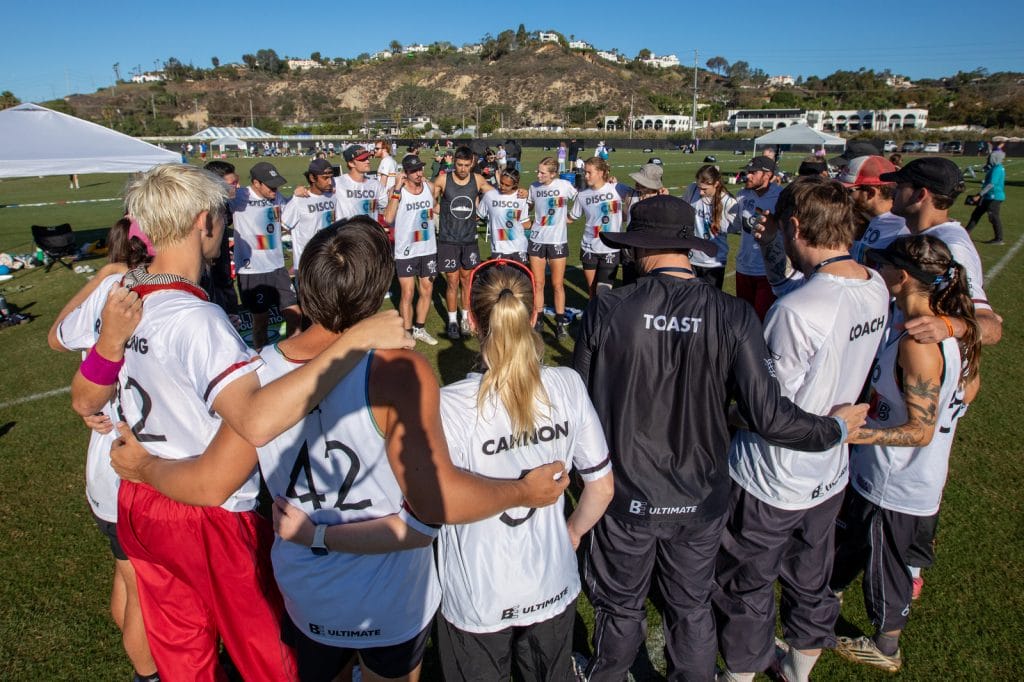
Previous iterations of Austin Disco Club have been hot and cold, succeeding in several points in their season but then flaming out at the end. This year has looked a lot different for the Texans. Not only did they win Pro Champs, taking down the then-recently crowned WUCC champions, Hybrid, but they also made it to the semifinals at Nationals without much difficulty. This might have something to do with the new systems they decided to run. Most teams run two lines, an O-line and a D-line, with potentially secondary lines for each.
Austin Disco Club ran three, expecting every player to fill in any role on the field. The Disco Club coaches spread out the roster’s depth of talent, presenting three lines that each appeared as one strong unit. It made it much more difficult for teams to plan matchups, never knowing if and when they would need to employ them. Every player was expected to fill in the handler set, be the reset, and throw the break, ensuring that one or two people did not try and default to playing “hero ball.” They trusted their systems and their players to make plays that got them all the way to a semifinals berth.
“We needed to bring someone in to call lines,” said Austin Disco Club captain Bennett Wachob. “I think it’s evident on every team if they’re trying to commit to a system, having a coach that’s willing to say ‘no’ and say why. That’s why we brought Jeb [Berry] on to call lines. He does an incredible job reading who’s hot, because we have so much depth this year.
“Jeb and Toast [Darren McAuliffe] have been incredible strategic minds,” Wachob continued. “The big ask this year was just someone who can hold us accountable. If someone’s not playing well, not continuing to throw them out there and try and work it out on the field. Having them work it out, being supportive, and trust that someone else can fill their shoes.”
– Laura Osterlund
See Revolver 2013-15 ↩