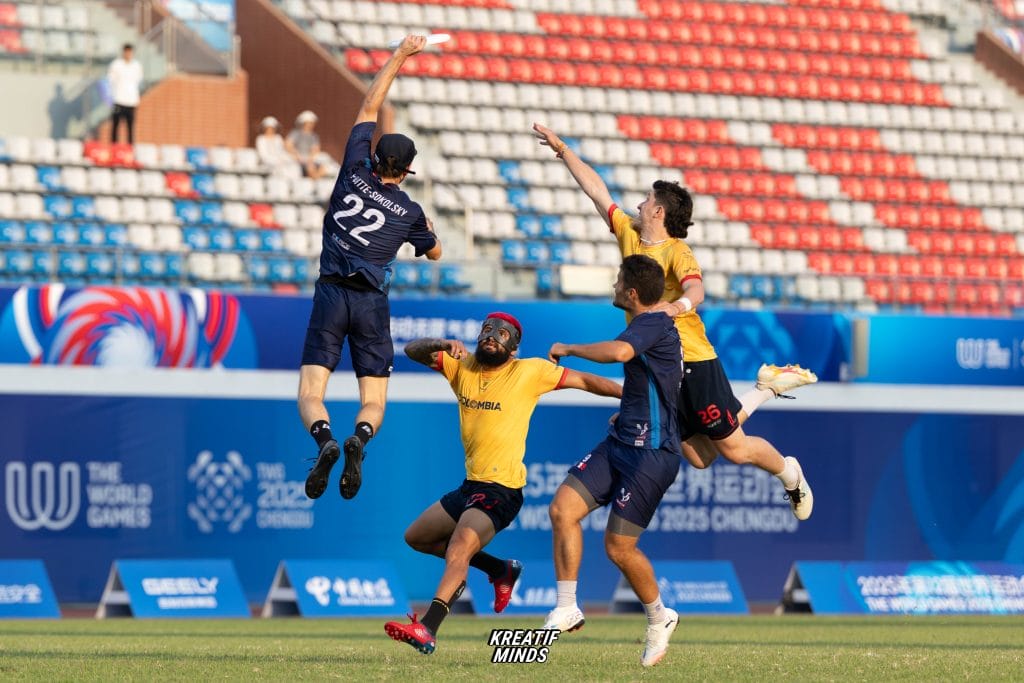
The two teams traded blows, sometimes literally, until France came out on top.
August 15, 2025 by Manny Eckert in Analysis, Recap
Ultiworld’s World Games 2025 coverage is presented by Spin Ultimate; all opinions are those of the author(s). Find out how Spin can get you, and your team, looking your best this season. The World Games is operated by the International World Games Association in collaboration with the World Flying Disc Federation.
In a must-win game for both sides, the much-anticipated matchup between France and Colombia was a clash of styles. Colombia’s breakneck pace couldn’t overcome the French long ball. It is impossible to watch this game without recognizing the sheer volume of stoppages, and while the responsibility for that falls squarely on both teams, it certainly impacted how the game played out.
Constant Calls Slow Down Pace
Not even ten seconds had elapsed in the game before we had our first foul call. As the Colombian handlers do on nearly every pull play, after throwing a centering pass, Yina Cartagena would immediately follow her throw for a short handoff from Manuela Cardenas. Quick dishies are a key aspect of the Colombian offense: they’re at their best when they can leverage their speed and quick releases to keep the defense off balance by constantly changing the point of attack. At many points throughout the game, the Colombians would complete long strings of continuous passes without a defender even getting the chance to say “stalling two.”
Rule number one for the Colombian offense is to never look off an open throw; rule number two is to stay in constant motion. On the third throw of the game, on the Cartagena upline, we saw immediate foreshadowing for the conflict that would be ongoing throughout the game, as Chloé Ollivier and Camille Blanc collide as they’re both trying to find their matchups. Watch for yourself one of the, but certainly not the only, example of defenders running into each other as France attempts to defend the Colombian small-ball.
I’m not here to assign blame, as both teams are simply trying to play their respective offensive and defensive styles. But frequent stoppages from both sides on pick and foul calls, as per the eye test, benefitted a French offense that was predicated on maintaining possession until a high-reward option could be found downfield, and hindered the breakneck pace of play that has always defined the Colombians’ style.
France Continues to Thrive in the Deep Space
Here are two hucks from France involving two different sets of players on the throwing and receiving ends – Gael Ancelin to Simon Ruelle, then Chloe Vallet to Lison Bornot. Additionally, Stanguennec also hit Benvegnen, and of course, there was the game-winning trust ball from Benvegnen to Bonnet which bailed them out of an ugly possession on universe point. Everyone was getting involved in the French long range attack.
France continues to showcase a wide variety of athletes who can throw and throwers that can be athletes. Their multidimensional players create matchup nightmares for their opponents. However, they’ll face their most athletic opponent yet in their semifinal against the US. If the Americans can apply pressure on France’s huck completions and large underneath gainers, France has also shown conservative tendencies that could hurt them if they’re not able to complete longer passes. In the clip below, we see three consecutive downfield cuts with separation that are all looked off: first Bornot, then Vallet, then Benvegnen. If France isn’t able to find longer throws against the US, they could struggle, as they haven’t shown a frequent propensity for grinding out 5-10 yard unders down the field.
Offensive Variance
When the Colombian offense was clicking, they rarely threw hucks and instead relied on a seemingly infinite well of energy to run their opponents into the ground, as we can see in these two possessions.
Manu and Valeria Cárdenas, as well as Yina Cartagena, showed supreme offensive talent, with Simón Ramírez also trickling into the handler set from downfield. When their give-goes and arsenal of creative break throws worked, Colombia looked unstoppable. But there are also times when Colombia’s organized chaos led to a high concentration of players around the disc, as in these two screenshots:
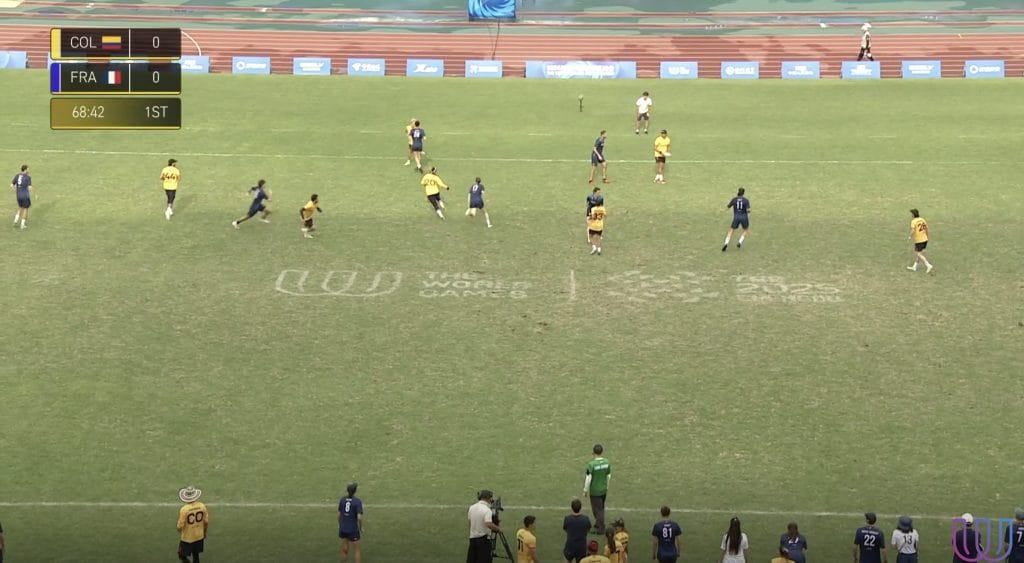
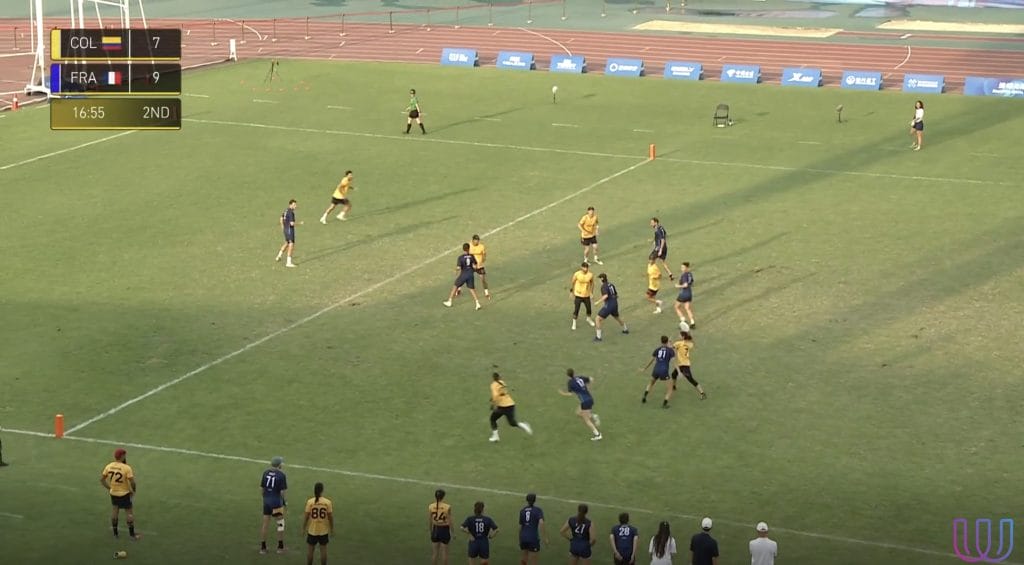
In longer possessions where Colombia wasn’t able to sustain immediate movement, they were plagued by a lack of efficiency, such as the possession below. After the disc was tapped in, their D-line offense spent almost a minute just outside of the endzone, unable to find the finishing pass, until they attempted yet another negative reset only for Sacha Poitte-Sokolsky to catch onto the pattern with a brilliant layout block.
Colombia’s Run Ends with Middling Results
With one blowout loss, one blowout victory, and one universe point game, Colombia’s pool play results at this tournament will be remembered as distinctly average – not what the perennial powerhouse was hoping for. They’ll be the favorites against China in their first matchup in consolation, but without a traditional big man defender, Colombia could struggle to contain the giant Yingyi Xu. Although not competing for a medal anymore, premier international competition is a rare opportunity that both teams will want to make the most of to be successful on the global stage in the future.