USA employed both an unusual defensive tactic and one of the most basic to foible France.
August 15, 2025 by Max Charles in Analysis, Recap
Ultiworld’s World Games 2025 coverage is presented by Spin Ultimate; all opinions are those of the author(s). Find out how Spin can get you, and your team, looking your best this season. The World Games is operated by the International World Games Association in collaboration with the World Flying Disc Federation.
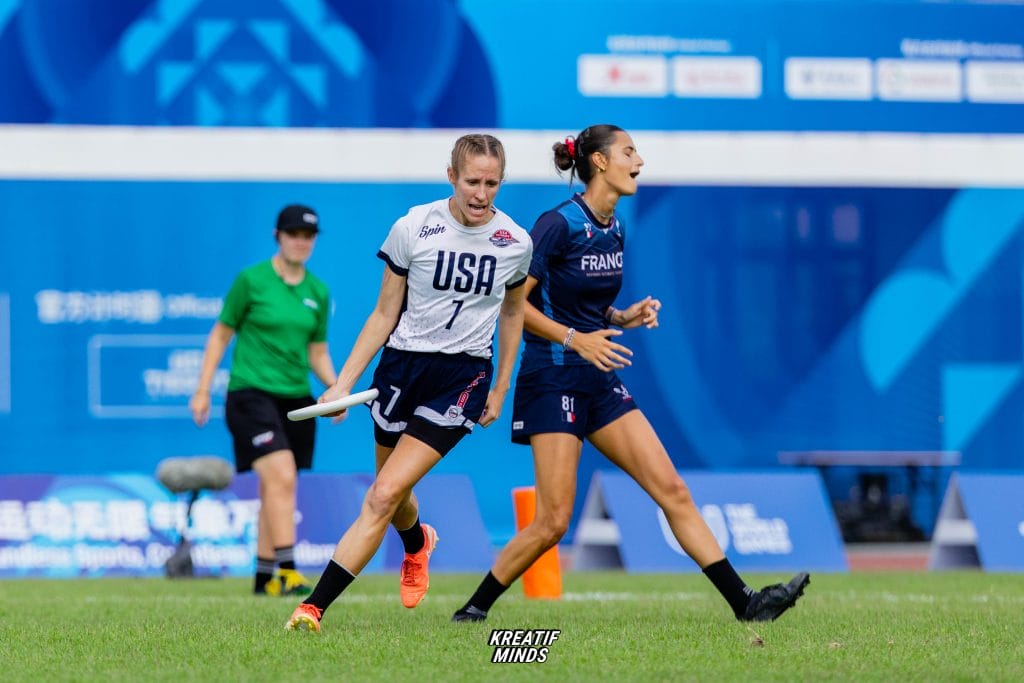
The United States took down France in their semifinal match at the World Games 2025, 13-9, in a game where their defense continued to carry the weight as the offense continues trying to gel. Defensively, the US implemented a unique mixed-based strategy to challenge the French composition and made a simple, but deadly halftime adjustment to punch their ticket to the championship game.
Mark-Less Zone
Throughout the game, the US defense would opt to not mark Chloe Vallet.
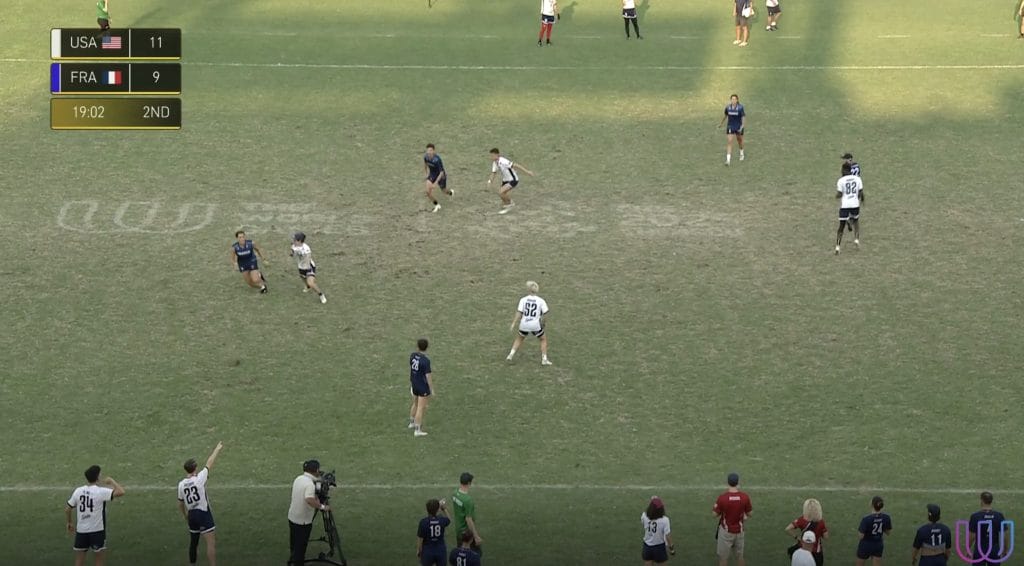
This is not a stoppage. This happened for about five seconds.
I can only hypothesize on the exact reasoning, but a few potential advantages of going mark-less in these specific scenarios stand out to me:
1. French cutter Vallet is very fast and one of France’s top goal-scoring threats. If she has the disc, she can’t do what she does best. Closing in hard on these sorts of players can actually be detrimental if you are concerned about their give-go deep threat, a route France showed in other matchups.
2. Especially on the four women-matching player (WMP) points, the French backfield was very man-matching dominant. In this scenario, the field is essentially split into an open division and a women’s division game off the stoppage. This gives the defense the ability to help and switch with a bit more certainty in both spaces, freed from worries about creating unintended matchups. See how Michael Ing flashes the reset space without conceding a blown coverage. The WMPs get to play 4 v 3 in the downfield space and help on uplines as well.
Does this huck need to go up with no stall? Absolutely not. Does it work? Somehow yes. Both answers suggest this was a defensive win despite the outcome.
3. The US may have identified a passiveness to how the French handlers cut. Here you can see Vallet motioning for someone to cut upline, only for two players to bail on the motion and settle for the negative reset. Someone finishing an upline cut, solely to force a reaction from the poaching Claire Chastain may have opened more lanes to the middle of the pitch and through the defensive shell.
Forcing Forehand
That’s right. The critical, world-caliber defensive adjustment was switching to the most common pick-up game force. Sometimes it’s that simple.
In the first half, the backhand force wasn’t too influential. On this possession, France marches down the field, with their primary handler only touching the disc in the end zone. Backhands felt like the comfortable option for the French offense to connect from cutter to cutter, even along the trap sideline.
Elliot Bonnet would also connect on a pair of backhand hucks: a cross-field dime and a perfectly weighted inside shot.
After the switch to forehand, the French offense felt more clunky, with less cutter to cutter motion and more frequent re-engagement with the handlers. In particular, around backhand breaks looked hesitant for the French against the seemingly tireless US handler defenders. On the first French offensive possession out of the half, the US immediately gets a contested stall. You can again see the double negative reset pattern from the French handlers that we saw above.
Mounting pressure in the end zone leads to a maybe impatient huck from Bonnet, and the forehand does not have the same touch as his first-half backhands.
And on what would end up being game point, the French would miss on a pair of fairly routine forehand windows.
The US defense is the clear strength of the team: coordinated, energetic, and agile. The hunt for gold is on and a US victory will certainly depend on their defense making their mark against a stingy Canadian attack.