How Team USA's strategy of "every-other" lines stacked up against the other World Games squads, by the numbers
September 9, 2025 by Paul Würtztack in Analysis

Ultiworld’s World Games 2025 coverage is presented by Spin Ultimate; all opinions are those of the author(s). Find out how Spin can get you, and your team, looking your best this season. The World Games is operated by the International World Games Association in collaboration with the World Flying Disc Federation.
The United States went 5-0 to take gold at the 2025 World Games, winning on universe point against Canada in the final after also defeating Germany on universe point to win their pool.
For some, this summary is an indictment of U.S. tactics and execution—no game should have been this close. For others, considering the variance jacked-up by short rosters and short games, it’s a vindication. Even if one assumed China had a zero percent chance of winning against Team USA, to assume the U.S. should go 4-0 against Canada, France, Germany, and Japan is to assume a per-game win probability of 84 percent (and higher still to win by at least two), which is pretty high given Team USA lost to half of those teams over the past three years (including beach).
As our contribution to the “indictment” or “vindication” debate, let’s look at the most prominent tactical decision of Team USA: to use “every other” lines rather than defined O-lines and D-lines. We’ll call it Matty’s Bet for Team USA head coach Matty Tsang, and the bet is that the benefits of limiting the number of times players have to play consecutive points outweigh the benefits of accentuating the offensive or defensive skills of certain players.1
To start, we’ll look at how many other teams took that bet, by looking at the distribution of line participation for each team (Figure 1).
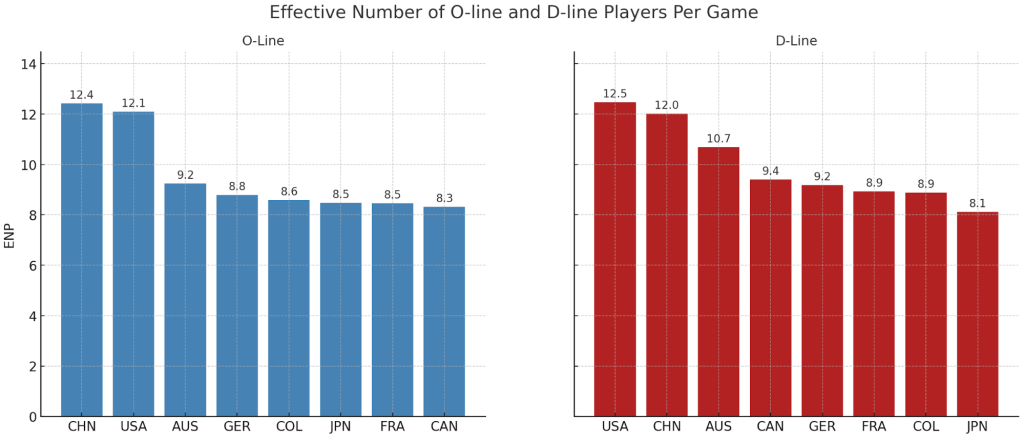
For a dynamic view of how strictly teams kept their O- and D-lines, we’re going to draw on the Herfindahl–Hirschman Index (HHI), a metric originally designed to assess market concentration (and used by anti-trust regulators to assess mergers), but which can be applied to sports to evaluate, for example, competitive balance within leagues or whether participation or production is dominated by a few players.2 While HHI values range from 0 (highly competitive, with many participants) to 1 (monopoly), we can translate HHI into a more recognizable “effective number of players” by dividing 1 by the HHI. We interpret ENP as the number of equally contributing players it would take to reach the same level of observed concentration.
From Figure 1, starting with the O-line, we can see that China was the only other team taking the Matty Bet. Indeed, because Team USA kept Raphy Hayes on O-line, China’s ENP value was actually higher. Every other team essentially kept strict O-lines, adjusting for majority WMP and MMP lines.
Resting between each point is likely to confer an aerobic and anaerobic advantage compared to playing successive points, particularly in the extreme heat of Chengdu; the question is always “how much” given that a majority of recovery in the first several minutes after intensive effort appears to occur in the first minute, before the next pull. In a team-sport setting, hockey is arguably the closest analogue to substitution patterns in ultimate, and research there shows that players typically skate 30–80 seconds per shift followed by 4–5 minutes of rest, and that double-shifting with shorter recovery reduces skating speed and power output (Vigh-Larsen et al., 2022). ↩
The HHI is calculated by squaring the share of a given metric for each player on the team and then summing the resulting numbers. ↩
World Games 2025: Team USA in Four Charts is only available to Ultiworld Subscribers
Already have a subscription? Log in
Whether you visit Ultiworld for our reporting, our podcasts, or our video coverage, you can help us continue to provide high quality content with a subscription. By becoming a subscriber, not only do you receive benefits like exclusive articles and full article RSS feeds, you also help fund all of Ultiworld's coverage in general. We appreciate your support!