These seven(-ish) men's division players impressed me at Nationals.
July 1, 2026 by Aidan Thomas in Opinion
Ultiworld’s coverage of the 2026 college ultimate season is presented by Spin Ultimate; all opinions are those of the author(s). Find out how Spin can get you, and your team, looking your best this season.
The Line brings together lists of sevens from our reporting staff.
I thought about the intro for this piece. I looked for a catchy line like “Breakout Stars at Nationals”, or longer forms of the same sentiment like “Non All-Americans who starred at Nationals”, or “Guys you didn’t know about who are worth watching”, and a million other iterations. But here’s the thing: none of the guys I wanted to really talk about fit cleanly into a category. Some are certainly beyond breakout status, but in my opinion, they did a lot more than I expected, frequently as a player that wasn’t the household name on the team, or even considered among the team’s top couple of players. Other players maybe didn’t really garner consideration in the BPOTY race, but they certainly made an impact in Rockford.
So here goes my official list of “Players I really enjoyed watching at Nationals that I didn’t get to write much about and who played really well that you may or may not have heard of and you should watch some of their games from Nationals because they’re fun to watch”. (*The title used here was chosen by the editors.)
There, nailed it. Now here’s the list.
Oh also, this is mainly going to focus on players that didn’t make semifinals (with one exception), because everyone got to see those standalone games. I want to call out athletes who weren’t on stream as much, or maybe were on the corner of your field pass screen and you just didn’t get to see as much.
Ok, now here’s the list.
Sam Anderson (Oregon State)
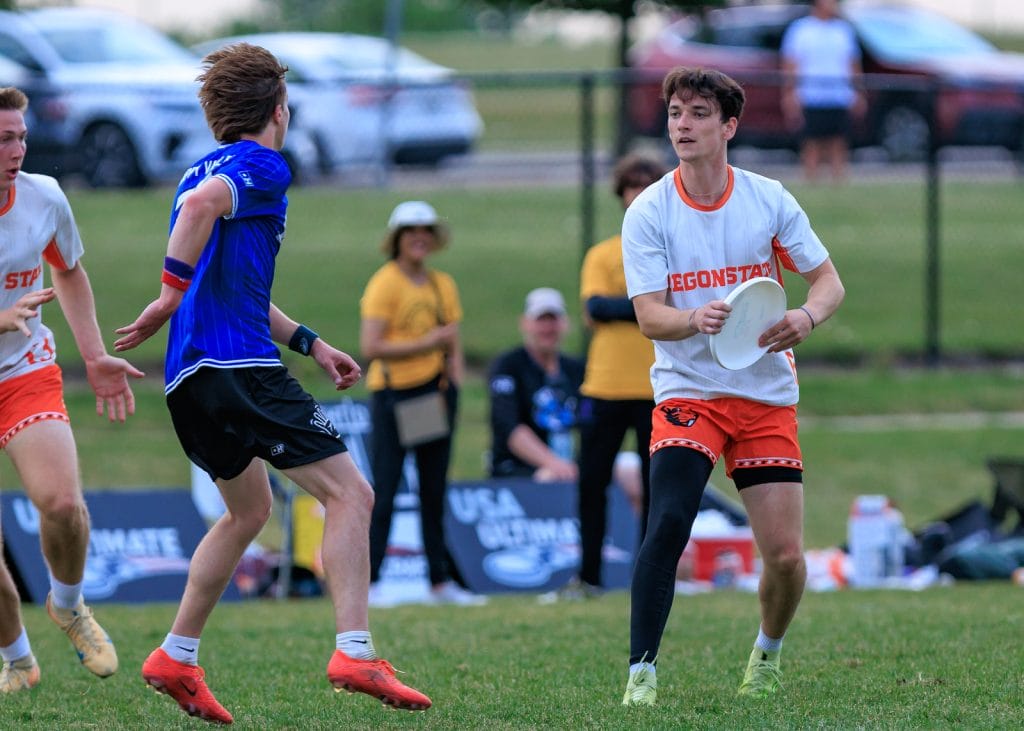
I thought about writing up a BPOTY Snub for Anderson, but decided to give him his flowers here. Everyone on the BPOTY podium certainly deserved their place, and Anderson was simply an excellent contender for an award that had several.
But Anderson’s role on an Oregon State squad that featured the more well-known starpower of Callahan Bosworth, Felix Moren, and Ben Thoennes, was impressive, and in particular, he starred in Oregon State’s bracket-clinching pool play win over Brown, as well as making some big players in their prequarterfinal against Penn State. Anderson nearly doubled up the next-best Beaver in goals, leading the squad with 12, while no one else had more than seven. He won deep and he beat defenders to the cone, bringing in key goals throughout the weekend, including the double-game-point winner against Brown in that aforementioned game that clinched the first bracket appearance in program history. His five blocks were also indicative of his constant defensive pressure, particularly in the deep space.
If you have to pick one game to watch, take a look at Anderson’s efforts against Penn State in prequarters, where he posted three goals, an assist, and two blocks, including a great box-out and sky on the game’s first point.
Ben Hanson (Western Washington)
The storyline for Western Washington, fair or not, was that in order to compete and get breaks against the best teams, they needed to cross over their three Seattle Sockeye stars (or some combination of them): Eli Diamond, Zoli Ishikawa-Szabo, and Cedar Hines. That was all well and good, but that’s only three of seven on the line, and Hanson was one of the key drivers for the DIRT D-line all weekend. He was a steady defensive workhorse for WWU, as he notched a block in each of their final five games, tying for the team lead with five blocks. In their prequarterfinal win against UC Santa Cruz, Hanson notched both a goal and a block.
His biggest moment came at 13-13 against UNC Darkside. Just watch this point and see Hanson go to work on first Grayson Trowbridge, denying him an upline and any positive yardage, and then, after a near poach block is caught, he works on Josh Singleton before collecting another poach block, which hits the turf. DIRT converted the opportunity to earn the break that ultimately pushed them through to knockouts. For a team that was all about their starpower, Hanson, among others, was a seemingly quieter secret weapon, helping Western Washington win on the margins and coming up with some critical plays in big moments.
Adithya Deepak (Georgia Tech)
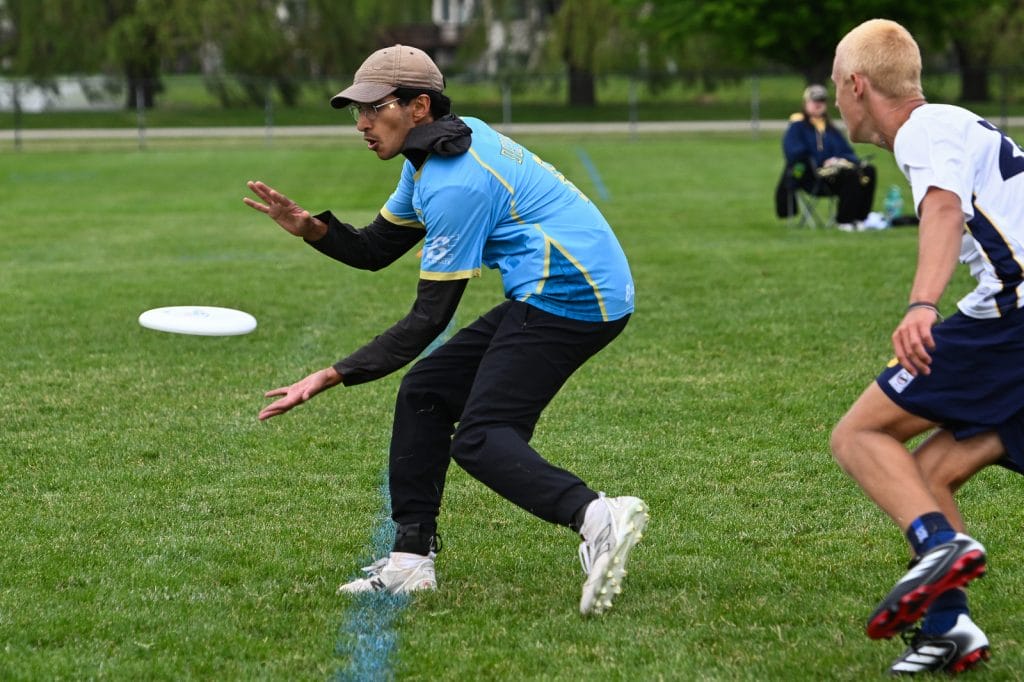
Sam and Adam Grossberg, Michael Poe, Stefan McCall: those were the names that were constantly floated around when discussing the resurgence of Georgia Tech Tribe at Nationals this year. But similar to Western Washington, Tribe also needed seven players on the line, and one of their steadiest contributors was Adithya Deepak. His backfield presence was a key stabilizer for Tribe, allowing the Grossbergs to activate in the cutting space, which unlocked new heights for the Georgia Tech defense. He was willing to take a few shots, but he also ran the offense extremely well and provided a critical steady hand that allowed Tribe to maximize their starpower en route to making the bracket. This well-timed breakside cut and immediate bending backhand continuation on to Sam Grossberg led to his receiver yelling “that’s tough Adi” as he collected the goal, and was one of many under-the-radar moments that Deepak had throughout the weekend.
Colin Jarvis (Michigan)
Jarvis, unfortunately, just faced absolutely devastating competition for the Rookie of the Year Podium, so if you haven’t seen some of what he did for Michigan Magnum, take this as a sign to go back and watch. With Michigan a near annual staple at Nationals, Jarvis is a player who should get 3-4 more years to showcase his talents at this stage, and if he posted five goals and 12 assists as a freshman operating as the center handler, Michigan should be very excited about the future. Jarvis made waves for his lowlight-turned-highlight moment on day one, when he dropped the pull and got it back with a layout D. However, that whole game is a great chance to see Jarvis make his first statement at college Nationals, as he debuted with a six-assist effort to help Magnum notch the upset win.
Hayden King (Cal Poly SLO)
King probably deserved a BPOTY snub write-up. After a one-goal, six-assist effort at 2025 Nationals, King took on a far bigger role in the SLOCORE offense this year and responded with three goals and 15 assists, as the junior provided a strong preview of what Cal Poly’s life will be after Anton Orme – which is to say, it will still be very good. Playing as the center handler without Orme against Carleton, King put together a strong four-assist performance in the loss. Although the game itself got out of hand quickly, King showed some strong moments, such as this sequence when he ejected deep out of the handler space, forced a switch, worked his way back to the disc, and unleashed a flick huck to get SLOCORE within three.
In the pool play finale against Penn State, King notched three assists and three blocks. And, in helping SLOCORE return to quarterfinals, King peaked with a two-goal, four-assist effort to topple the scrappy Maryland Space Bastards in prequarters. Regrettably, that game was not streamed, so refer to the Penn State and Carleton games for your chances to see King operate.
Cole Mires (UC Santa Cruz)
Mires wasn’t exactly an unknown commodity by any means, but it’s fair to say he wasn’t the headline star for UC Santa Cruz. Mires proved to have every bit of the takeover-quality you want in a star, showing out for the Banana Slugs in key moments to ensure UCSC made it into bracket play. I got to see Mires display his talents in person as the Slugs toppled Georgia Tech on Friday evening. Mires’ three-goal, five-assist performance was one of the more impressive individual efforts I saw, as he got open in the cutting space, beat defenders to the cones, went every-other in the backfield, and floated some beautiful hucks into space. Regrettably, that game isn’t on film, but Mires put on another impressive show in a win-or-go-home game versus Texas on Saturday afternoon, putting up a one-goal, four-assist performance. It is an excellent chance to see the Mires show, and he doesn’t make you wait long to see it, dropping a nicely weighted flick huck on the game’s second point to get UC Santa Cruz on the board. The sophomore more than doubled his assist total from 2025 Nationals while lowering his turnover count, making him, for my money, a breakout star.
Bodie Shargel (UC Santa Cruz) & Tomo Liou (UMass)
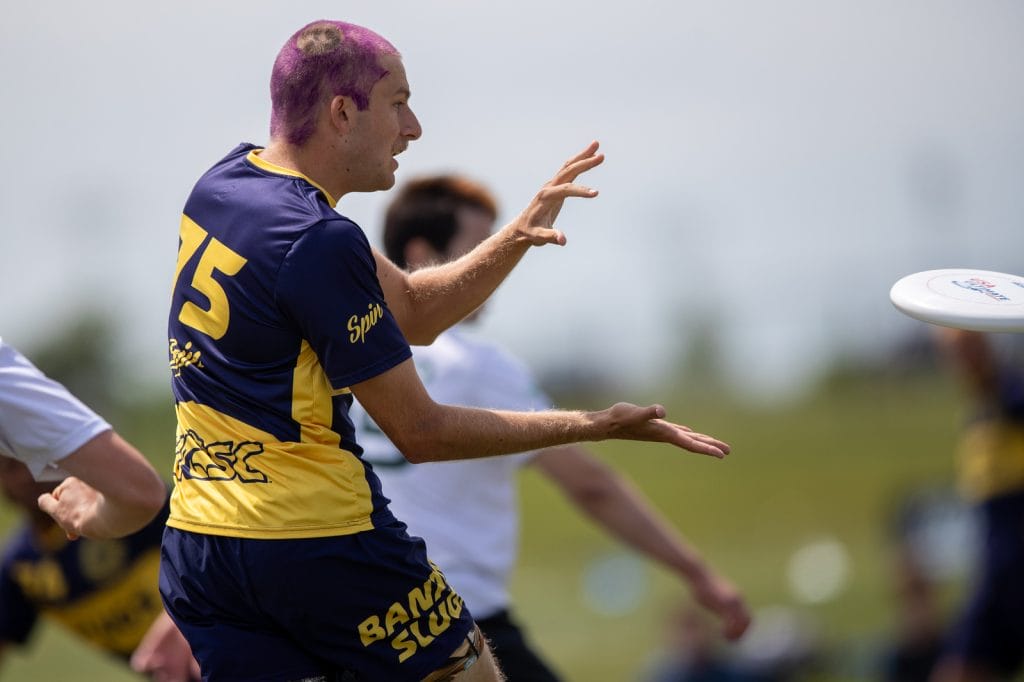
I’m cheating. In this edition of the Line, we somehow snuck eight players on the line. Blame the Observer for not catching it. While there’s more to this list, for sure, these were guys who I learned during the week spent a year or more on their program’s B-team and turned into strong contributors for high-level Nationals teams. In a year where Vermont Bruckus represented for B-teams everywhere, it felt right to end with a quick shoutout to Shargel and Limou. Shargel was the second-leading goal-scorer for the Slugs (8 goals), and Liou (7 Goals, 3 Assists) played almost every D-line point for a UMass defensive unit that broke down every team in their path to a national title.
You can see Shargel put up four goals in that win-or-go-home game versus Texas, starting with this point where he follows the disc on a huck gets a quick dump, dishes it off and then bursts through some traffic to beat his defender deep and toe taps for the goal. For Liou, he had a goal and an assist in UMass’s semifinal against Oregon, but you can watch him play superb defense in just about every Zoodisc game.
More and more, with the evolution of the youth game, we are seeing elite players join the folds of top programs as freshmen and immediately contribute. But at its core, Ultimate frisbee is more predominantly a sport picked up later in your teenage years for a lot of players, and it’s really cool to see guys that had to grind their way from minimal organized frisbee experience to B-team developmental players and into heavy contributory roles on bracket-level Nationals teams.