Hear from the teams themselves as they gear up to perform at the tournament they've spent years working toward -- Club Nationals!
October 22, 2026 by Rhea Patney and Aidan Thomas in Preview
Ultiworld’s coverage of the 2026 college ultimate season is presented by Spin Ultimate; all opinions are those of the author(s). Find out how Spin can get you, and your team, looking your best this season.
The USAU Club National Championships can become the annual stomping grounds for many of the premier programs, with competing in October representing not just the goal, but the bare minimum expectation. It’s easy to forget that building a team capable of achieving those heights can be a grind. It can take years of program building and development, the right offseason acquisitions, and finally, a strong season peaking at regionals to fulfill that dream.
In 2026, nine teams are realizing that program goal for the first time, punching their first tickets to Nationals. It’s a jaw dropping number; in 2025, only two teams made their debut, both in the Mixed Division. In 2024, there were four newbies, and in 2023, there were five. 2022, the most recent year there was a new qualifier in the women’s division, was almost comparable, with eight new teams making it across the divisions.
Now, the goal shifts to setting more history in San Diego, where these nine programs will compete for bracket play berths and set new bars for future years of their programs. It’s not a guarantee by any means; of the 19 teams over the past four seasons to make their Nationals debut, only nine teams have made a return trip. But while more goals lie ahead of them, it would be foolish to not celebrate the work and progress the nine programs put in to make it this far.
Montreal Mephisto
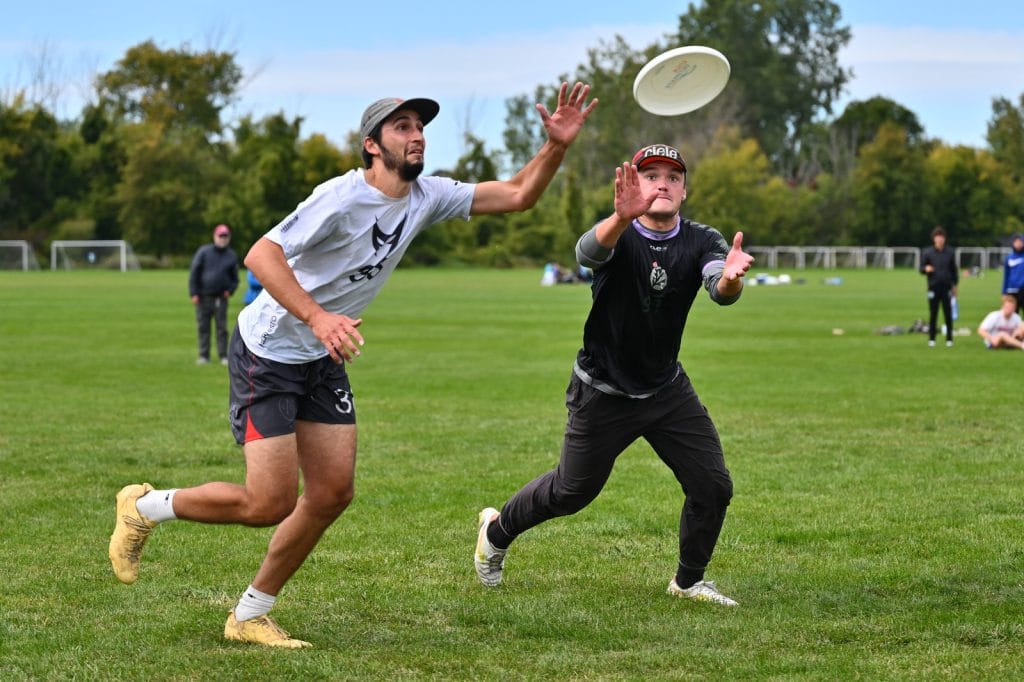
Montreal Mephisto player Vincent Lemieux echoed the learn-and-grow sentiment: “Our goal for the tournament is to experience it fully, and gain as much experience as possible as a team to hopefully repeat this achievement in future years as our program continues to evolve.”
Mephisto were the lone bid-stealer in the men’s division and are the only first-timer in the field. Their story was as unforeseeable as any, as Montreal lost their biggest star, Malik Auger-Semmar, to fellow Canadian squad and Nationals attendees Vancouver Furious George in the offseason.
But Mephisto weren’t built around just one star, and Montreal didn’t blink. Their leadership praised the larger Montreal Ultimate community for their role in the development of the Mephisto program. “For the past four years, we have worked to build a team culture and truly put Mephisto on the map,” they shared. “We have invested time and energy, made sacrifices, traveled, and experienced both victories and defeats. Yet, we kept working, improving, and believing in the project we built together.”
Mephisto announced their intentions early, pushing #13 Denver Johnny Bravo to universe point in the PEC West quarterfinals in June and showing they weren’t about to take a step back. Mephisto took some mid and late-season lumps, struggling first at WUCC and then at Pro Champs (to the tune of a 1-5 record). Regionals was anything but a smooth ride; Montreal was upended by Amherst Sprout in the championship bracket quarterfinals, knocking them into the backdoor bracket that required three straight wins to qualify. They did just that on Sunday, beating Hartford Colt (15-7), #25 Portland Red Tide (15-14, breaking twice to win on universe), and earning their revenge against Sprout in blowout fashion, 12-7, in the game-to-go.
“Founded in 1995, Mephisto has always strived to be the best Open team in Quebec, and countless players from our community have worn its colors. This qualification therefore belongs to everyone who came before us, too,” Lemieux said.
Los Angeles Lotus
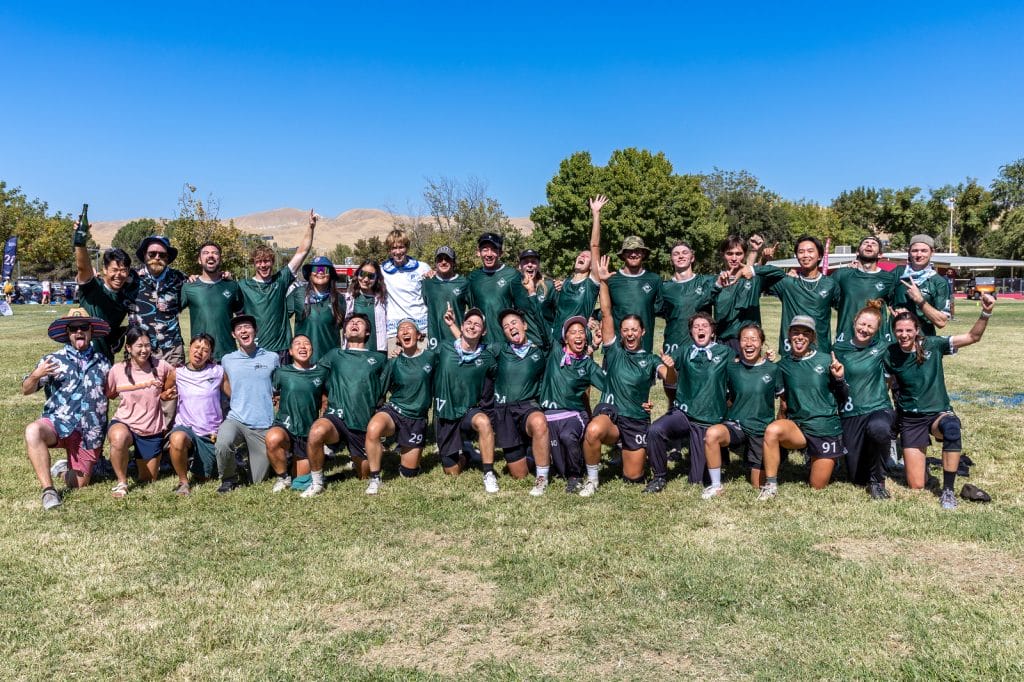
In the Mixed Division it’s a newcomer party, with five of 16 teams making their debut appearance at Club National Championships. 11th-seeded Los Angeles Lotus, 12th-seeded San Diego California Burrito, 13th-seeded Pittsburgh Port Authority, 15th-seeded Oregon Scorch, and 16th-seeded Toronto Union are all joining the field for the first time, a massive number even in the traditionally chaotic division. With so many new teams, it’s also guaranteed that at least one of them will be qualifying for bracket play, so history will be made in San Diego.
For Lotus, they’ve been knocking on the door, losing in their regional semifinal five times since 2019, and reaching one game-to-go. Their development culminated in 2026, when they earned and defended their bid to Nationals. The season was powered by a wonderful fusion of veteran talent, such as co-captains Stephanie Pritchard and Jesse Cohen, returners who had stepped away from Lotus in prior seasons, and new players, many of whom had played at Nationals with other programs.
“I believe we added 15 new rostered players from last season,” Cohen said. “Some of our new arrivals had played at the highest level of the sport, so in addition to their on-field skill and leadership, they brought a wealth of experience.”
Sean McDougall was one of those veterans, a previous Nationals qualifier in the Men’s Division with SoCal Condors. His bookends in the game-to-go at Regionals staked Lotus to a 2-0 lead and set the tone for a six-break first half that gave Los Angeles an 8-1 lead over San Francisco Mischief, who had beaten Lotus earlier in the tournament. Like Mephisto, Lotus had their backs against the wall on Sunday at Regionals, forced to win three straight games.
As Lotus developed this season, there were both early-season statements, such as a win over #3 Sacramento Tower at PEC West, and inconsistencies, such as a loss to #19 Mischief in late August. Through the wins and losses, a focus point remained to build a team culture and on- and off-field cohesiveness.
“Another important goal was to exemplify a culture of trust. This led to a more concerted effort to spend time together off the field,” Cohen said. “This was a season-long balancing act between experimenting with different line combinations to see how people fit together best and giving folks opportunities to build chemistry. I am elated that it all came together on Sunday at Regionals.”
Cohen noted that the team has set a variety of goals, but the most results-oriented goal is to qualify for quarterfinals. After emerging from the Southwest gauntlet, anything’s possible.
San Diego California Burrito
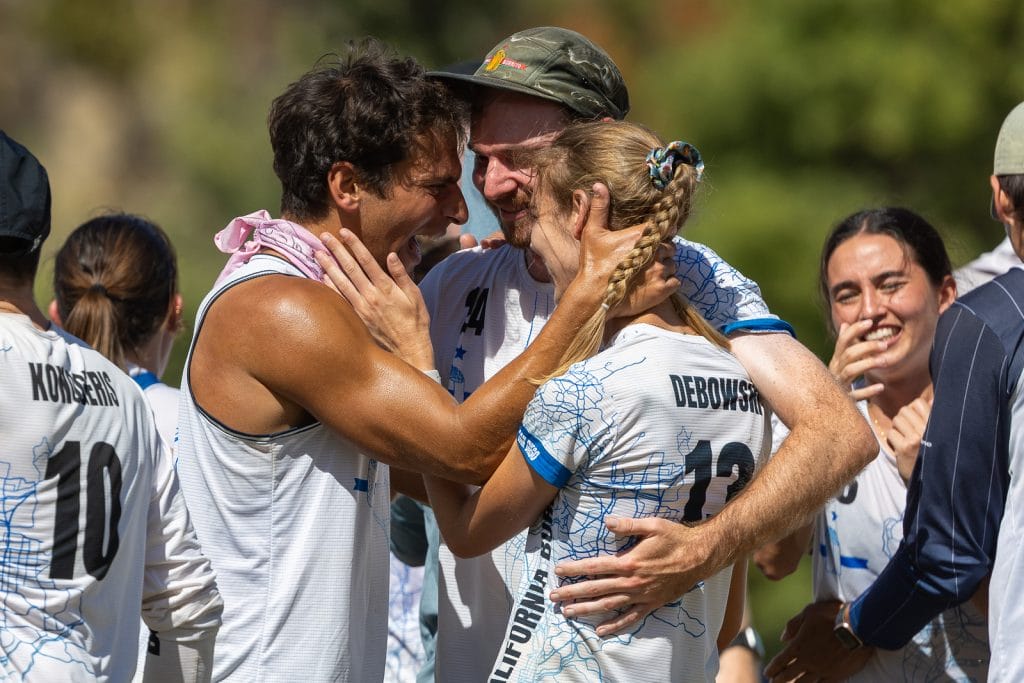
Also out of the Southwest, San Diego California Burrito join Lotus as a Nationals newcomer, finally getting to participate in the party hosted in their backyard. They clinched their berth on Saturday at Regionals with a 15-13 win over San Francisco Polar Bears.
Burrito have been building to this moment, with the team forming back in 2018. Their three founding members, Christina Debowski, Anders Ruden, and Abe Shklar, all still play and will take the field in San Digo. The team finished ninth out of 10 teams at sectionals their first year, made regionals in 2019, and earned Select Flight status in 2021. They regressed a bit with regional finishes of 10th (2022) and 8th (2023 and 2024) before Burrito took a jump last year and earned a bid but lost consecutive games-to-go and finished third.
“We were a team that, on our best days, could beat the top Select teams” Shklar said. “But, we were not ever coming close to beating [teams like] Polar Bear [and] now Tower. We were always…fiery and feisty, but never Nationals-competitive, really.”
Shklar credited Burrito’s jump to the arrival of Khalif El-Salaam. “It changed when Khalif came…He gets so much hate from people who’ve never met him…To be his teammate, it’s different,” Shklar said. “He came in and he wanted to build something…he just brought so much fire and so much passion.”
Burrito certainly attracted more talent in SoCal since the arrival of El-Salaam. Ava Hanna (San Diego Flipside), Naomi Guzman, Dena Slattery and Sharon Tseng (Los Angeles Lotus), and Thomas Konogeris and Peter Lenz (SoCal Condors) were among the 16 players new to Burrito in the past two seasons since El-Salaam joined the squad. It pushed the San Diego squad to new heights.
“A week later. I’m still crying. We’ve been doing this for nine years and so much sacrifice…Lifting an hour every morning, the sprint workouts, doing net throwing…everyone telling us that San Diego mixed is nothing,” Shklar said. “We were always the little brother, little sister team…And so the feeling — it was just unbelievable.”
And on what he was most excited for, Shklar highlighted veterans like Debowski, Guzman and Tim Klacik. “I’m stoked for players like them to get out there and show the world that they’re some of the top talent out there because they’re incredible. Y’all are gonna learn their names for sure.”
Pittsburgh Port Authority
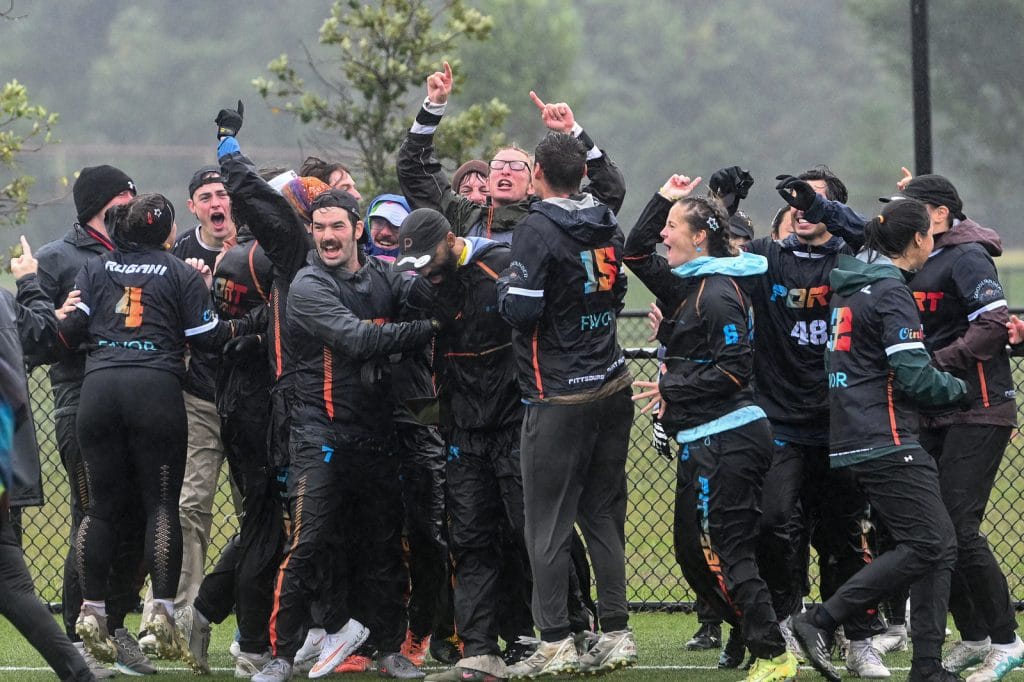
Joining Burrito in Pool A is a slightly newer program in Pittsburgh Port Authority, who stunned everyone by knocking off #18 Washington D.C. Rally and #8 Philadelphia AMP to claim the Mid-Atlantic Regional crown. Pittsburgh started with a higher floor, earning Select Flight status in their first year (2023). They reached the game-to-go last season for the first time, and Pittsburgh has continued to bring in new pieces.
One of their founders, Alexander Thomas, played on Pittsburgh Temper in 2022 (the last year Temper made Nationals) and brought in other core pieces from his Temper days. Max Sheppard, who led that 2022 team with a double-double at Nationals, joined this year along with Jimmy Towle, while Thomas and Dylan Best have been anchors on the squad since its inception.
“More than a notable difference between this year and prior years, we have just continued our upward trajectory by building upon another year of growth and chemistry,” Jake Murray said. “We’ve certainly added players to our roster who have been indispensable components of our success this year, but we’ve also lost key contributors from prior years who helped bring the program to where it is today.”
Port Authority grinded their way to Nationals by battling through extreme inclement weather at Mid-Atlantic Regionals, playing in steady 20-30 mph winds and rain. After upending Rally, Pittsburgh battled against AMP and clawed back from a two goal deficit. They delivered two upwind holds and an upwind break as part of the climb, ultimately winning on a multi-turn, 10-minute long universe point. Fittingly, Thomas secured the game-winner, laying out to get on the receiving end of pass from another Port Authority veteran, Kit Asterin.
“The winning point was a small moment within a larger display of resilience our team showed in the final,” Murray said. “We all have so much pride in our community, and we’re excited to represent Pittsburgh alongside Parcha in San Diego.”
Oregon Scorch
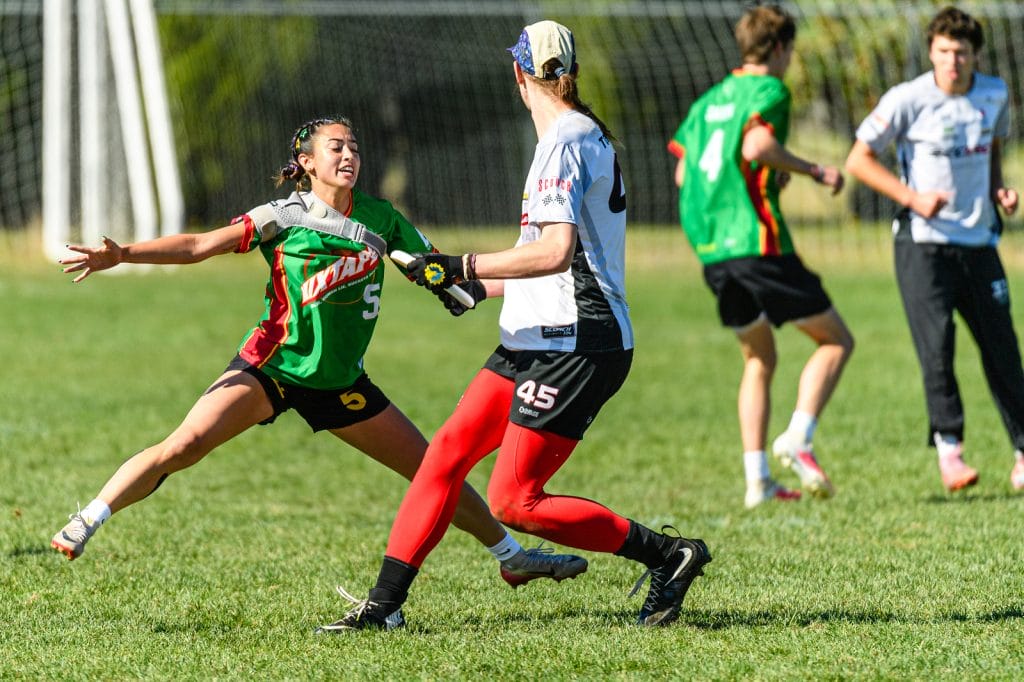
Another shocking regional winner was Oregon Scorch, who didn’t earn a bid in the Northwest and then went unbeaten at Regionals. They did not have to beat a higher-seeded team to do that, but they upended a red-hot Seattle Mixtape squad in the final. Scorch are a young team, with much of their talent coming from current and recently graduated Lewis & Clark players, including major contributors Topher Olson, Sam London, Amelie Steer, Levi Stahl, and Presten Berg.
Despite this, and despite rostering 21 players who had never made Club Nationals, they’re the first Oregon mixed team to reach this stage since Portland Administrators in 2014.
“We are overjoyed to bring Oregon back into the Nationals-caliber mixed scene and hope to continue this season’s success into the future,” said three-year vet Seb Williamson.
Scorch started their program in 2022 and orchestrated four straight finishes as a Select Flight team. They had never made a game-to-go until this season, and they took advantage of their first opportunity in dramatic fashion, coming back from a 9-6 deficit against Mixtape, who had eliminated Scorch the year prior. They ripped off four straight breaks, and Olson sent Scorch to San Diego by whipping a hammer over the stack in the end zone to Elliot Davis.
“The game-winning point felt like a poetic ending to our most anticipated tournament of the year…The winning throw came after a stoppage in play, with the disc on the front corner of the end zone in the hands of our most consistent, risk averse player, Topher Olson,” Williamson recalled. “Just before play resumed, Amir Kaghazwala, the five-year Scorch veteran, uttered ‘I trust you Topher.’ The disc tapped in and it was a hammer over the stack.
“The feeling did not feel real to most, as we rushed the field with jubilation,” Williamson continued. “We had always dreamed of going to Nationals, but winning the Northwest Region made it extra sweet.”
Toronto Union
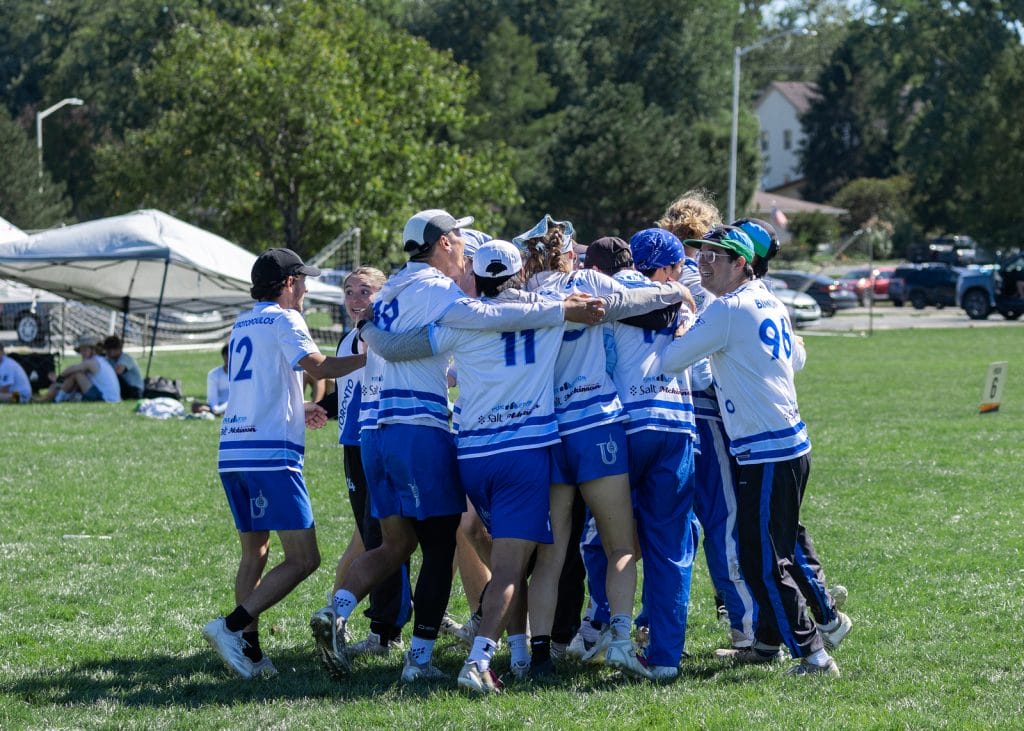
Rounding out the Mixed Division newcomers is Toronto Union. Union switched to the Great Lakes in 2025 with the regional redraw after years in the Northeast. They reached the game-to-go, their first since a 2014 appearance in the Northeast, but were thoroughly beaten by eventual national champions Ann Arbor Hybrid. The objective in 2026 was clear – earn a bid for themselves and defend it at Regionals.
Union lost their first two games of the season and then ripped off 10 straight wins to close their regular season, earning a bid. They ran the winning streak to 18 games before falling to Hybrid in the regional final. They rebounded to finish the season 19-3 by winning the game-to-go in a drama-free, 15-7 victory. Unlike other squads on this list, Union don’t have a massive influx of new contributors; just five players that played for Union this season were in their first year with the program.
The newcomers were hardly low-impact additions, however. Toronto University star and newcomer Aujin Li led the team in goal contributions at WUCC after playing with Ontario Houndd in 2025. Logan Keillor switched allegiances from Ottawa Phoenix and showcased her worth on the international stage, notching six assists and 13 goals at WUCC. Union also benefited from the return of Brianna Prentice, who played with Toronto in 2023-2024 but switched to the women’s division in 2025, playing for Ottawa Stella.
Coach Warren Tang credited the team’s multi-year commitment to Nationals as a turning point. Since setting that goal in 2024, Union have focused on building their core, improving their flight ranking and gaining access to more competitive tournaments. The addition of assistant coach Mandy Dunbar, who could provide on-site support this season, also proved instrumental in advancing the team strategically and individually.
“Our goals are about playing the game the way we want to, through preparation, winning moments and our mentality,” Tang said. “Be great with all aspects of our physical, nutritional, and mental preparation.”
For Tang, qualifying for Nationals brought different emotions for players who had spent years building the program and those newer to the team.
“The depth of emotion was incredible,” Tang said. “A blur. A big layout. A huge sense of relief, accomplishment, history.”
Philadelphia Flight
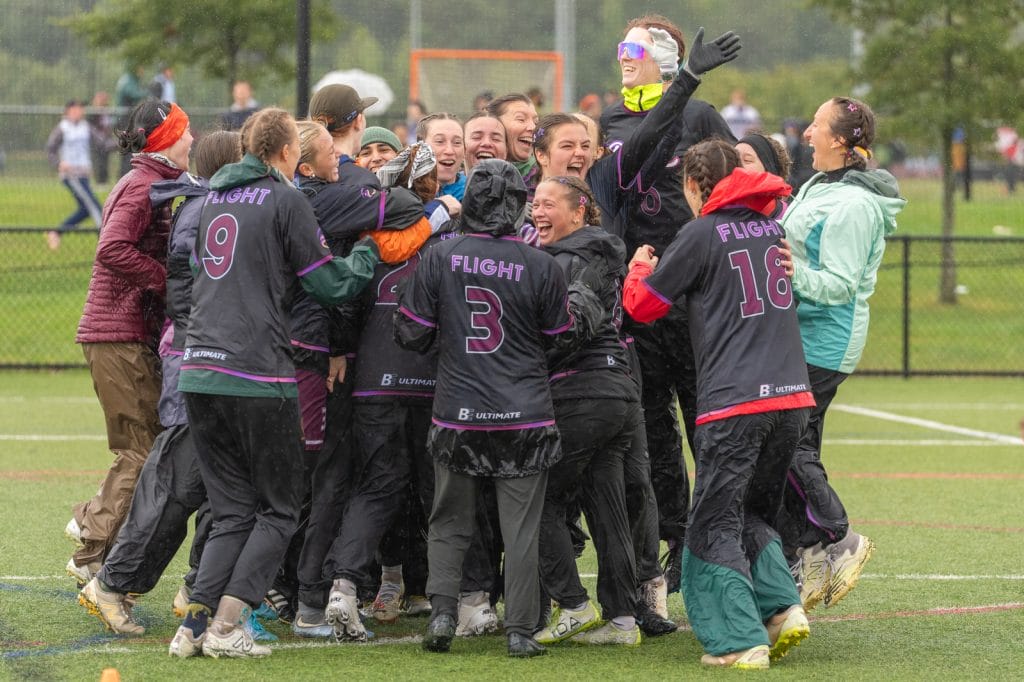
Over in the women’s division, we had new qualifiers for the first time since 2022, when Washington D.C. Grit made their first trip to Nationals and San Diego Flipside debuted as a program, earning their first berth as well. This year, the field welcomes three new faces in Philadelphia Flight, Dallas Dimes, and Northampton Starling.
After losing in the game-to-go for two straight seasons, Flight earned their bid in 2026, and they made their intentions known from the get-go, upending Pittsburgh Parcha at PEC East and pushing New York BENT to double game point. Quincy Booth, a record-holder at College Nationals, has been the straw that stirs the drink for Philadelphia. She debuted at Nationals as a 16-year-old with Atlanta Ozone, but hasn’t qualified since. In her first year on Flight, Booth is fittingly joined by another 16-year-old in Alice Rieger.
Zoe Lewis founded the team, which is in their sixth season; she is joined this season by Guinevere Rauch and Jocelyn Corey as the only players from the team’s original roster.
Like Port Authority, Flight had to earn their debut dance at Nationals in horrible conditions. “The weather at regionals was probably the most miserable conditions I have ever played or coached in,” Flight coach Jackson Dolan said. “The entire team came in focused though…I’m really proud of how the team was able to stay up, celebrate, and take care of each other throughout the weekend.”
Flight earned their berth in convincing fashion, taking down Parcha in the championship bracket semifinals, 15-10. That came after beating fourth-seeded Grit, 12-3.
“There were definitely some nerves going into our games against Grit and Parcha, but they settled down a bit as we earned upwind breaks early on in both games,” Dolan said.
Flight are the first Philadelphia women’s squad to make Nationals since Green Means Go in 2016. They are looking to be the first to make quarterfinals since Philly Peppers in 1999. “Getting a Philly women’s team back to Nationals has been the goal since Flight was started in 2021,” Dolan said. “We’ve had some bumps along the way, but the last three seasons in particular have really felt like we’re building a sustainable program that can have long-term success. But we’re not going into Nationals just happy to be there. Flight is filled with competitors, and we want to compete.”
Dallas Dimes
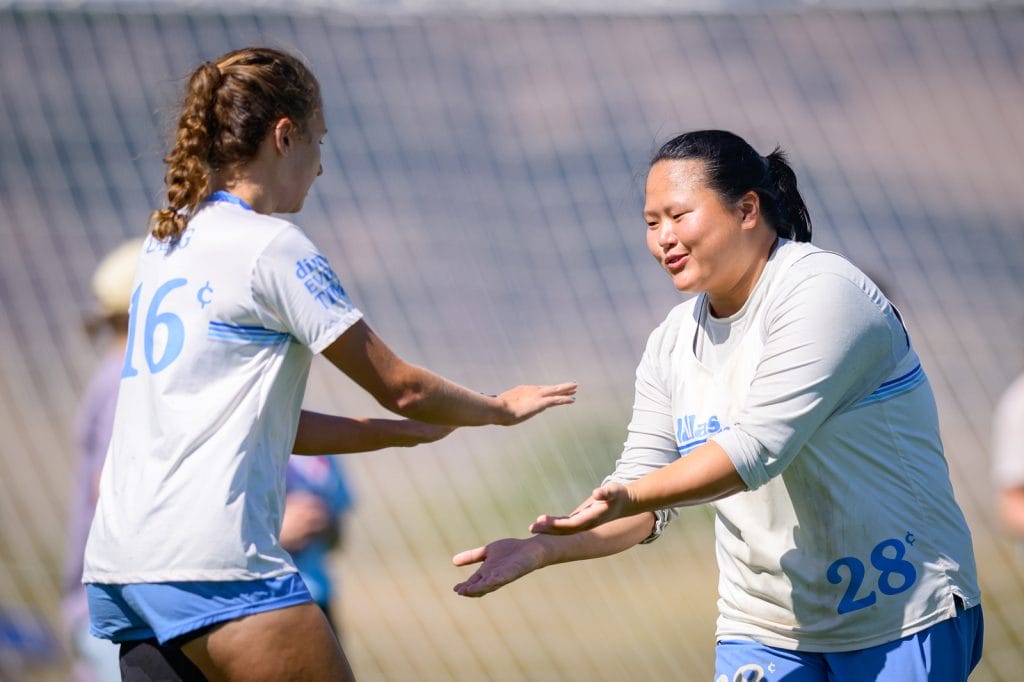
Dallas Dimes are the first ever women’s team from Dallas to make Nationals, and they earned their way all season. Stuck in the South Central with perennial title contender Denver Molly Brown, Dimes needed to earn a bid in the longtime one-bid region. They did that by going 8-4 at Select Flight Invite and Elite-Select Challenge, and then they avenged a regular season defeat to Colorado Kelp to defend their bid.
The program is in their second year; they lost the game to go 15-5 to Molly Brown in their debut season after an unbeaten regular season. Katie Metzler is the engine of the squad; she previously lost three games-to-go with Dallas Public Enemy, a now-defunct mixed squad that is the last team in any division from Dallas to make Nationals. Megan Tormey is one of a few players on the squad with Nationals experience, having made it with Public Enemy in 2019.
Dallas leadership, Bri Welkener, Katie Metzler, and Meredith Wooley, credited the team’s commitment to training the mental side of the game as a major reason for their qualification, noting they read the book “The Mind Gym” as a team. “This was the first time as a team that we actually trained our mental game,” leadership said. “We practiced being mentally tough in high pressure situations so that in an important game we weren’t scrambling when we got broken or when things didn’t go our way.”
That was critical for Dallas in their game-to go-against Kelp, which went to double game point. Despite the game being played in Denver, leadership noted the support they felt on the sideline. “We are forever grateful for the significant others, parents, siblings, friends, and fellow Texas teams that showed up for us,” they shared. “They were just as excited as we were to be there.”
Dimes didn’t wait around on universe point, scoring on a predesigned huck play to clinch a historic moment for Dallas women’s ultimate. “There were tears, rushing the field, hugs, and all sorts of excitement,” leadership said. “I think the reality that we really did it took a minute to sink in.”
Northampton Starling
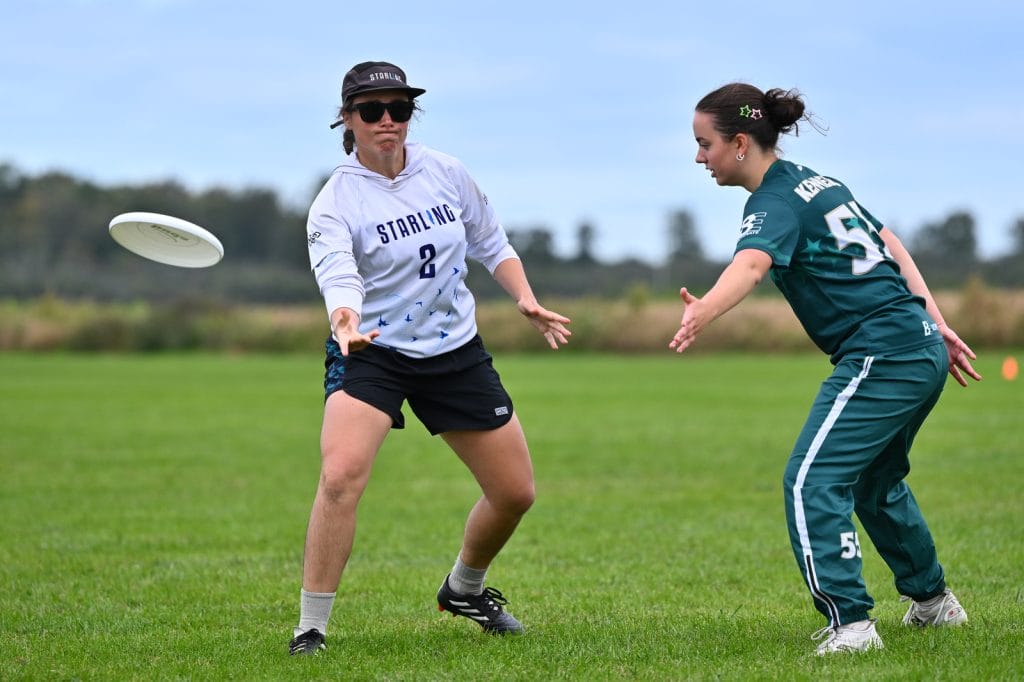
And finally, there was Northampton Starling. Like Mephisto, they were the lone bid-stealer in the division. After floating around the back-end of the power rankings all season, Starling took advantage of a favorable draw in the bracket to make their final push for a Nationals berth. After Ottawa Stella took down bid-earner Quebec Iris in the backdoor bracket semifinals, Starling capitalized with a blowout victory in the game-to-go, punching their ticket to San Diego.
“For the last few years running, one of our core values discussed at the beginning of the season was to be a ‘Nationals-caliber team.’ This means that we play competitively against top teams but do not define our season around making one tournament,” said Isla Cusick.
Starling lost to Iris in last year’s game-to-go, and this year they made no mistake with their opportunity. After getting broken first by Stella, Starling gutted out an upwind hold, which Cusick called the defining moment of the game. They punched in the ensuing downwind break and got things rolling from there, hardly looking back. “We pushed through the rest of the game even harder at that point, and we did not want to get distracted by the possibility of winning,” she said.
Christine Georgakakos, Paige Howell, Adrienne Wells, Maureen Dougherty, Joanie Cha, Maryann Platt, and Taylor Simpson lead the way for Starling as the seven players who have played all five seasons with the club. Third-year player Cusick is the linchpin of their offense as their center handler at just 20 years old.
“Many people on our team have never made it to Club Nationals before or, if they have, it was early on in their frisbee careers,” Cusick said. “It is a privilege to get to play at the tournament, and we are so excited to represent the MA/NY/CT/NJ community, as we have players spread all around the northeast.”