Raleigh Ring of Fire rode a new-look offense to shocking title run
October 28, 2026 by Aidan Thomas in Recap
Ultiworld’s coverage of the 2026 club ultimate season is presented by Spin Ultimate; all opinions are those of the author(s). Find out how Spin can get you, and your team, looking your best this season.
As the 2026 club season wore on, the major question facing the men’s division was whether any team could crash the Final Four at Club Nationals, which had been dominated by San Francisco Revolver, Chicago Machine, New York PoNY and Portland Rhino Slam! over the past two seasons. In the end, it proved to be the team willing to reinvent themselves, even if the process took a full season, that was able to not only usurp a spot in the semifinals, but also win the whole dang thing once they got there.
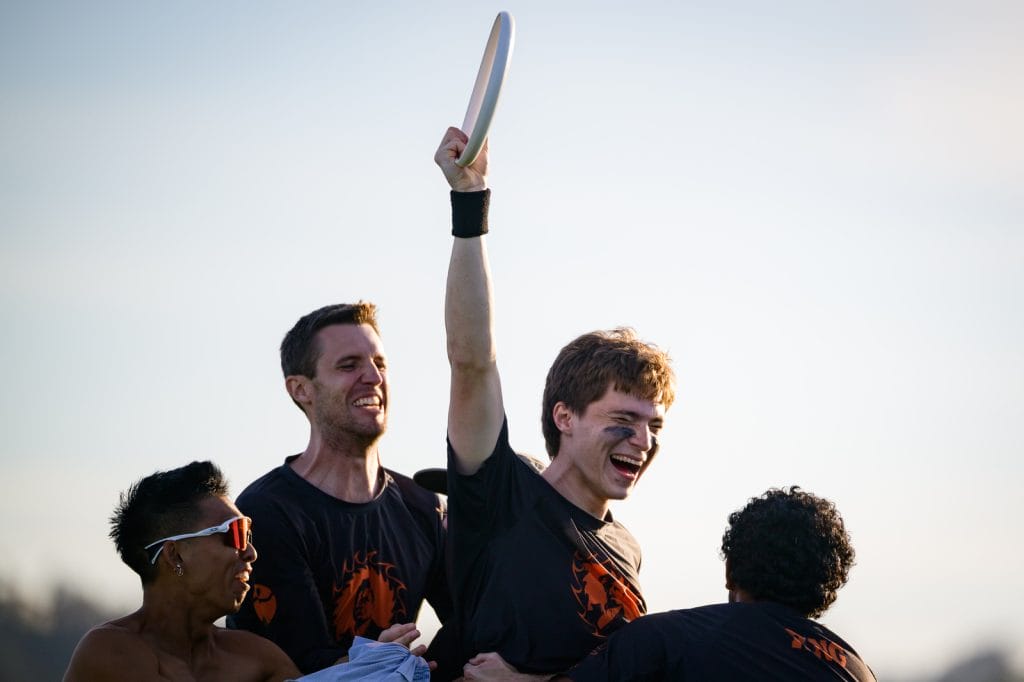
Raleigh Ring of Fire, a team discounted by most as a true contender due to inconsistent regular season results, showcased all the best parts of their new offensive mentality and rode that all the way to six straight wins and a national championship, punctuated with a 15-12 win in the final over Chicago Machine, a game that Raleigh led wire-to-wire.
“So special. Everyone wants to win. I think it’s way more important to win with the people you built with,” Ring of Fire’s Josh Singleton said after the game. “I’ve been to this tournament twice. Got smoked in quarters by PoNY [two years ago], lost in prequarters last year. It’s not just about winning, it’s about building to the win. Really happy to do it with these guys that have been here over and over again and to finally cross over the mountaintop.”
Ring of Fire followed a very similar script in all of their bracket games. Their O-line played impossibly clean ultimate, especially in the early going. After going unbroken in their quarterfinal, and one point away from being unbroken in their semifinal versus the defending national champions, Ring earned two early breaks against Machine and did not turn the disc in the first half en route to taking an 8-5 lead.
Chicago threw everything they had at Raleigh in the second half, clawing two breaks back, but Ring of Fire avoided any multi-break run and steadied the ship. Machine never got closer than two points. A highly pressured but ultimately clean hold was a fitting exclamation mark, and Ring of Fire left San Diego as champions for the first time since 2021.
“We had a great [first] half. We connected on a lot of our deep shots, and we played very free,” Ring of Fire handler Matt Barcellos said of the game flow. “[The key] in the second half, it was a little bit of continuing to be aggressive, not letting their second half punch deter us from playing our system.”
On Sunday afternoon, it was Raleigh’s defensive unit that provided the early cushion, breaking Chicago on their first two points. Henri Lessard didn’t give up after losing a step on a breakside cut, and he laid out for the early block. After easy flow, Sol Yanuck bent a flick to an unmarked Cooper Williams close to the back cone, and Ring had a lead they never relinquished.
The offense did their part to make sure the lead held up. While Chicago stabilized on offense, delivering five straight clean holds, Ring of Fire did exactly the same. They navigated some early trouble with hucks before truly finding their flow. Up 4-3, Josh Singleton ripped a second-throw flick huck to a former college teammate in Dylan Hawkins to go up 5-3.
Ring of Fire score in two throws off a huck from Josh Singleton to Dylan Hawkins
Then, a point later, Ring took every forceside under given to them and chipped up the field for a clean hold. When Chicago tightened those gaps, Ring went back to the deep game: Singleton fired for Christian Belus, giving Raleigh a 7-5 lead.
The D-line delivered one more break to close out the half, with pressure forcing two turnovers — first a drop on a tight upline, and then a forced inside backhand that stayed too low. Although they uncharacteristically missed on their first chance, Ring made no mistake with the second, moving to three-for-four on break opportunities. This time, it was Brayden Morrison firing deep for Williams, who beat Elliot Hawkins to the disc for the pivotal break. “I felt like they capitalized on their chances,” Machine veteran Timothy Schoch said. “They were applying pressure. I think it was unfortunately our own mistakes that led to the turnovers, but they capitalized.”
Brayden Morrison hucks to Cooper Williams for the break and 8-5 halftime lead
Chicago, who had broken Ring three straight times in their pool play game and come back from two breaks down in their semifinal against Rhino Slam!, was certainly not out of it, and they began stacking their lines. Daan De Marrée, Zeke Thoreson, and Rutledge Smith hardly left the field in the second half for Machine. Chicago threw wave after wave at Ring of Fire, sticking De Marrée on the seemingly unguardable Dylan Hawkins for much of the second half.
The pressure earned them three turnovers on Ring’s first four offensive possessions of the second half, but Machine converted just one of the opportunities into a break. On the first, Kevin Pignone stymied Johnny Bansfield in the reset space, Gouchoe-Hanas limited Zeke Thoreson, and Christian Belus bottled up De Marrée late in the break attempt, leaving Jeff Gao with limited options and causing a desperate reset attempt that was fell incomplete.
Machine did convert their next opportunity, again with De Marrée, Smith, and Thoreson crossing over, that finished with Raymond Lu finding Will Wettengel. But in a defining moment of the contest, Machine sought a second straight break and ran back out a crossover-heavy line, adding Kyle Rutledge to the mix, and pinned Ring deep with a huge pull. Raleigh calmly worked against heavy pressure, and then Christian Belus spied a window provided by a slightly poaching De Marrée and zipped a sharp forehand huck down the sideline to a waiting Cooper Williams, securing the bounce-back hold.
“We saw it with their O-line, they were really hard to get the ball off of,” Schoch said. “When we felt like we had a little bit of momentum and had a chance to string together breaks, they shut that down and continued to punch in those holds.”
Machine wasted their next break chance, again with all their preferred crossovers on the field. This time, Ring managed to force the disc to Wettengel and trapped a pure cutter with the disc on the sideline, leading to a late stall huck that was easily blocked. That turned into a dirty hold for Ring, and they followed with a gut-wrenching break, taking advantage of an unforced Machine error and countering with Brayden Morrison finding Williams for a 12-8 Ring lead.
That felt like the game. Machine clawed back one break courtesy of a De Marrée poach block and quick counter, but Ring didn’t turn the disc again. After Machine pulled within 13-11, Josh Singleton, who threw the turnover, rallied to throw an assist on the next point and push Ring to the brink of a title. “Shake it off and trust myself,” Singleton said of his thought process after the turnover. “Thought a lot this weekend about just being in the moment…I just need to trust myself. It’s not going to be perfect every time. Trust my read, trust my throws.”
Machine held to make it 14-12 and sent out the cavalry to try and pull a miracle, trotting out their crossovers along with Nate Astrom, Keegan North, Jeff Gao, and Wilson Matthews. It looked like they might extend the contest as they repeatedly forced Ring to take resets, with Raleigh at one point finding themselves about six yards deep in their own end zone. Operating in a dominator set with Gouchoe-Hanas and Barcellos, Ring patiently took the resets, until Barcellos spotted Hawkins streaking deep.
“They were playing good defense, but they weren’t trying to deny us the disc in the backfield,” Gouchoe-Hanas remembered. “I don’t really know how Dylan Hawkins got open deep, but it looked like they released him, and [Barcellos] let it rip, and he’s got plenty of power.”
View this post on Instagram
Barcellos’ flick huck evaded the scrambling Machine defenders to find his target in Hawkins. “We believed in ourselves the entire tournament, we believed in ourselves the entire game,” Barcellos said. “That huck that I threw was a manifestation of that belief, more than anything.”
Ring were off to the races. With Machine having committed so much to their high pressure assault on Ring’s dominator, most Chicago defenders trailed behind the play. A few quick passes later and Pignone found Hawkins for the winner. “Saw my open space, just threw my hand up, and [Barcellos] let it rip,” Hawkins said. “He’s been awesome all tournament.
“[I] kind of blacked out,” Hawkins continued. “Just kept running and KP hit me with his signature flick.”
Ring Reinvent Themselves In Gradual March To Title
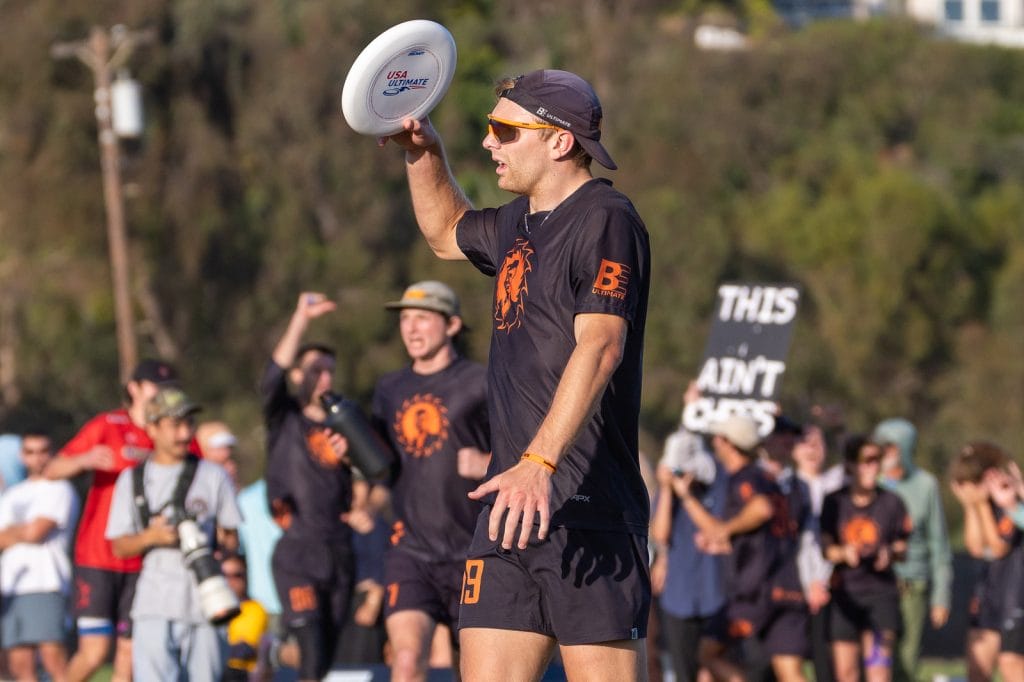
Ring of Fire’s stars were many of the same players that played major roles last year at Nationals, where Ring failed to make quarterfinals for the first time since 2013. In their 2026 triumph, Dylan Hawkins scored four times, Singleton threw five assists, and team captain Matt Gouchoe-Hanas scored twice and threw two assists. Cooper Williams continued his ascent with four goals of his own and was the only Ring player to play on both the O-line and D-line.
With many of the same contributors holding down the fort, what made the difference for Ring of Fire this year? After winning a title in 2021, Ring made the bracket four straight years, but only reached semifinals once as the game’s offensive meta rapidly evolved. First it was the small-ball possession-based style of Washington D.C. Truck Stop that dominated for two seasons, followed by Rhino declaring “small ball is dead” and introducing dynamic, hybrid-happy offenses that loved the deep ball. For Ring, ultimately, it was a willingness to go away from the offensive style that had driven the rise of North Carolina Ultimate and re-invent themselves in a way that they felt better fit the evolving offensive meta adopted by the most successful programs at both the club and collegiate level.
“For a long time, we’ve tried to play a spread, big-space version of the game. But the way we’ve approached it in the past led us to play on the sideline a lot,” Gouchoe-Hanas said. “We noticed that a lot of the elite teams, teams that were performing better than us, were finding more ways of attacking the middle of the field and generating leverage from the backfield.”
Indeed, when Raleigh Ring of Fire’s 2025 club season ended in demoralizing fashion, surrendering two late game breaks to Seattle Sockeye in a universe-point loss in prequarters, the frequency in which Ring of Fire found themselves on the sideline plagued them. When they got trapped on the sideline, up 13-12, Ring’s difficult swing reset was blocked, and Sockeye countered to even the score. The very next point, with the sideline operating as an extra defender, Sockeye blocked an under-cut that drove towards the boundary, limiting the range of space for the throw. Sockeye broke, and Ring’s season ended a couple points later.
When Ring returned in 2026, they knew change was necessary and were willing to embrace a grind of a process.
“We watched a film of a lot of teams, including a lot of college teams like Carleton and Colorado. And we just went out there and played and tried to figure it out, tried to figure out ways that it could work for us,” Gouchoe-Hanas noted. “Teams are getting really good at defense when the disc is on the sideline…so we just tried to find ways of playing from the middle more often.”
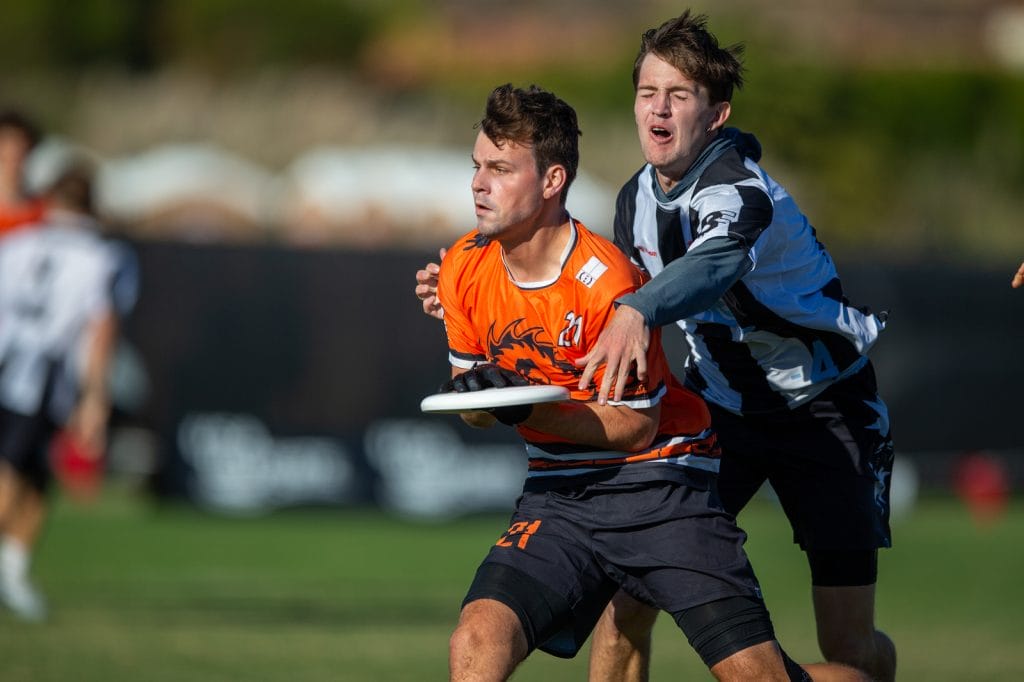
It wasn’t always pretty for Ring of Fire, who went 1-3 against American teams at U.S. Open, losing both pool play games and their prequarterfinal. At Pro Champs, things were better, as Ring of Fire got second place. Elements of what they were putting in place were visible, including the resurgent dynamacy of Gouchoe-Hanas, who put up three assists and six goals in the tournament final. But still there issues with the offense, as unforced errors plagued Raleigh and they coughed up a 12-10 lead in the final against Truck Stop.
“We were still trying to create our new offense, moving away from the spread where we were attacking the sideline and prioritizing the middle of the field and being dynamic. Guys like John McDonnell and Matt Gouchoe-Hanas had to change their games,” Barcellos commented. “Formerly they would stand in the backfield and operate as handlers. This year we asked them to be more dynamic, to go downfield, and it worked.”
Indeed, the process paid dividends. At Nationals, Ring of Fire were broken just nine times in six games. And while it was a different style, mostly new players and five years later, the cleanliness of the final was familiar to Raleigh – they committed just five turnovers in the final, the exact same number as their 13-12 championship win over PoNY in 2021. They trailed in just one game, their pool play clash with Machine. In that game, Ring was broken three straight times to go down 8-4. They trailed 12-8 in the worst conditions of the weekend before rallying to win 14-13 in a shocker.
“I think it was really that second half against Machine when it started raining, down 12-8…exorcised a lot of demons for a lot of Darkside folks on this team,” Hawkins said, referring to an infamous UNC Darkside collapse at College Nationals. “After that first Machine game, it just felt like we had the magic going.”
After that end to the first half against Machine, Ring’s offense was nearly untouchable. They were perfect in the second half. They were perfect in their quarterfinal against Minneapolis Sub Zero. They were perfect up until they held a 14-11 lead against Revolver, the tournament favorites. They were perfect in the first half of the final against Machine. A process that asked successful former North Carolina teammates and club veterans to “unlearn tendencies,” as Barcellos said, culminated in a national title that nobody saw coming.
“As much as it was chemistry, it was also love. We love each other and that’s what allowed us to do all the hard systematic things and trust that we were going to learn a new offense and trust that it was going to pan out, maybe this tournament, maybe next year,” Barcellos said. “But we love each other and we stuck through all the hard games, the hard moments, the losses. Just trust that love would carry us to the finish line, and this weekend is evidence of that.”
Machine Look Ahead to Transition as They Seek First Title
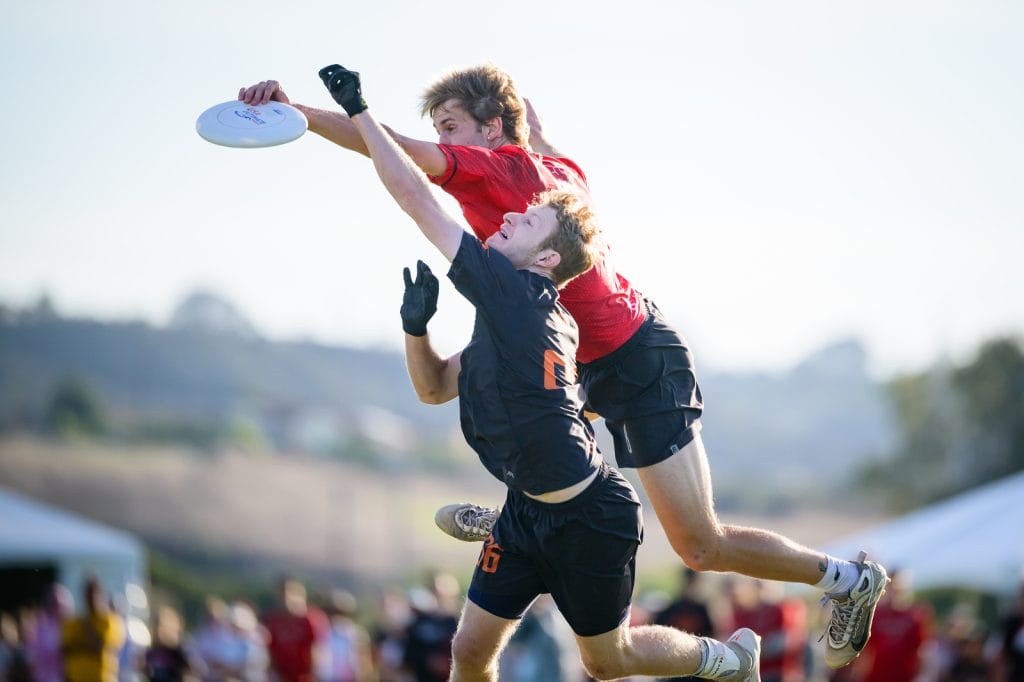
It’s been a brutal run for Machine, with three championship game losses in the past four years. They lost to the dominance of Truck Stop in 2023, of Revolver in 2025, and now to the Raleigh resurgence of 2026.
“Lots of tears. This could end up being a big transition year for Machine,” Schoch said. “We have a lot of veterans who may not be with the team this year.”
The team has a core of contributing veterans like Johnny Bansfield (33 years old), Jake Steslicki (30), Nate Goff (32), Schoch (29), Keegan North (31), Paul Arters (33), Xavier Payne (32), Sam McGuckin (31), Kyle Rutledge (29), and Adam Stautberg (29) all carving out roles of varying magnitude with Chicago this year. In particular, Rutledge, Goff, McGuckin and Arters were all core parts of the Machine O-line. The physical toll and overall commitment of club ultimate can certainly make it an unknown as to who elects to return.
Machine, however, can know that their young talent has the program in a good place. De Marrée, whom many consider the best player in the world, is just 25 years old. He posted a 1G/2A/2B stat line in the final after seven goal contributions in the semifinal. “Daan is a problem – understatement of the year,” Hawkins, who matched up with the international superstar for much of the second half, said.
Rutledge Smith is 24, and he threw three assists in the final, a game after securing the winning goal on universe point against Rhino. This title loss may feel especially painful for Smith, who won multiple college national championships with several players on the Ring of Fire roster while at UNC. Fittingly, on the final point, he guarded a former teammate in Singleton, with the two of them taking a moment to soak in that moment during a brief stoppage.
“Rutledge is one of my best friends. Incredible player, Incredible defender. Felt really honored to get that matchup,” Singleton shared. “It was just a special moment, realizing that as big as this moment is, our friendship is more important, and it was really cool to share that with him. I have no lack of confidence that he’ll back in this moment and he’s going to win plenty more.”
Zeke Thoreson, who is a first-year player on the team after winning the Callahan Award in college this past season, is 22. Thoreson’s emergence in particular was a major storyline for Machine, as the Colorado Mamabird star developed into one of the most critical pieces for Machine. His huge block with the score at 10-8 on Sunday gave Chicago a late chance to get within one point.
“He just got more comfortable in everything that we were doing, our certain flavor of defense, with a lot of switching. That kid can play,” said Schoch, who had to game plan against Thoreson while coaching Carleton College. “I’m really excited to see what his future is. I coached against him, and he was a problem in college and now he’s really becoming a problem in club. I wish there were two of them, I wish there were three of him, I wish we could have played him every point today.”
Chicago will also hope to continue getting major contributions from three-time club champion Aaron Bartlett (24 years old), 2025 DPOTY runner-up Will Wettengel (25), perennial DPOTY candidate Jeff Gao (26), D-line stalwart Nate Astrom (23) , and 20-year old handler and 2025 BPOTY winner Elliot Hawkins, who scored twice and threw two assists in the season finale, ending a strong debut season with Machine after breaking out with Denver Johnny Bravo.
The future is both bright and foggy for Machine, who will begin to build for another run at their first title in 2027. But Sunday was about reflecting on a long and special season, one that saw Machine compete at the World Ultimate Club Championships in Ireland, as well as advance to their third final in four years in San Diego.
“I’ve played on this team for a long time. This is my seventh year, and this was my favorite. We got to travel the world together, we spent so much time together,” Schoch said. “Sucks to lose, there were a lot of tears for that loss, but it hurts a lot more that it’s over.”