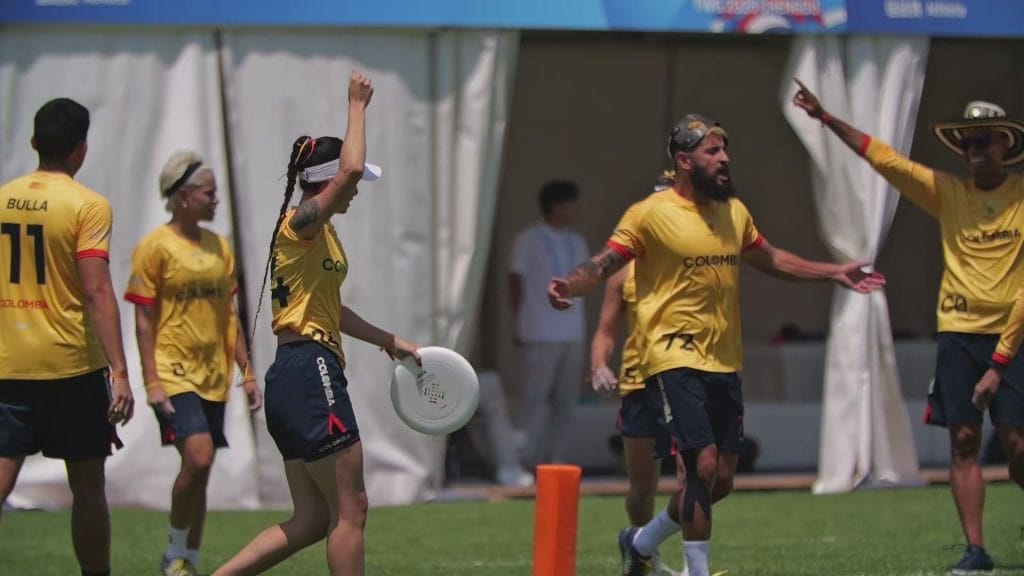
Team Colombia wielded their patented quick-pass style to exploit every defense Team Australia presented
August 13, 2025 by Graham Gerhart in Analysis, Recap
Ultiworld’s World Games 2025 coverage is presented by Spin Ultimate; all opinions are those of the author(s). Find out how Spin can get you, and your team, looking your best this season. The World Games is operated by the International World Games Association in collaboration with the World Flying Disc Federation.
There was a lot on the line in the head-to-head matchup between Australia and Colombia. Both teams dropped games on Day One and knew that another loss effectively disqualified them from medal contention. Considering the expectations for both teams coming into this tournament, there wasn’t a clear favorite between the two before the first pull. That all changed dramatically throughout the course of the game. Where Australia continued to falter in pivotal moments, Colombia played as close to perfect on offense as they could hope, proving themselves to be far more than the results of Day One by solving each new defensive wrinkle Australia threw at them.
Australia’s Backhand Force
The game didn’t start in Colombia’s favor at all. The South American squad came out on offense and immediately felt the pressure of Australia’s size and athleticism. The Aussies clearly had a gameplan in mind and stuck to it all throughout the first half: force backhand, don’t give Colombia’s power throwers a chance at a flick huck.
This worked well in the opening points. While Colombia held to start, their offense had to cycle through the backfield a lot, and it took them a little shy of twenty passes to make it to the end zone. In contrast, an athletic bid from Olivia Carr saved Australia’s first score, ending the point in a little less time.
Immediately after that, Australia’s defensive unit forced a low, wide backhand turnover from Colombia’s handlers that Jonathan Keyes took advantage of with a one-throw hammer goal. The hammer was a dime, but it was also emblematic of Australia’s offensive style. They played fast and loose on offense, even if the situation didn’t require it. Carr’s bid the point before might have earned them a goal, but she only had to make that bid because the backhand floated her way was headed out of bounds.
While there’s plenty more to be said about Australia’s offense, the star of this game truly was Colombia’s offensive unit. Australia’s break only served to sharpen Colombia’s edge. After dropping that point, they locked in for the rest of the game. Australia was still doing an excellent job of limiting the large, open field gains from the Colombian side with their backhand force, but they couldn’t find a way to stop the excellent throwing core of Yina Cartagena, Valeria Cárdenas, and Ivan Alba from getting easy resets and eventually finding enough inside backhands to generate downfield momentum.
Those quick throws both leveraged Colombia away from the open side and kept Australia’s defenders from clamping down. The moment Colombia got a true breakside attack going, Australia didn’t have much of a response with their normal backhand force.
Australia’s Junk Defense
After breaking to go up 3-2, Colombia got in the driver’s seat and never took their foot off the gas. While Australia’s offense allowed mistakes to pile up from rushed throws, Colombia never seemed hurried. Their primary option when trying to solve a defense was to pass back and forth between their handlers before finding the gaps in the defense and heading off to the races.
Australia tried to counter Colombia’s movements with a poachy junk defense that took away the downfield looks from Colombia’s woman-matching throwers and put the disc in the hands of their man-matching counterparts. Knowing how Colombia’s strength has historically been in their women-led backfield, Australia attempted to get the disc out of their hands and push it towards the players who were more likely to make throwing mistakes.
This did a fine job of limiting Colombia’s downfield flow, but once again, they were too content to move the disc around these poaches and take the small gains. In almost every instance, Colombia advanced too easily, as the poach allowed for easy yards without a plan to take the disc away. Before too long, Colombia would be in front of the end zone, and Australia would be forced to play more honestly.
Australia’s Switch-Mark Defense
Running out of options, Australia pivoted to their trump card: switching a woman-matching player onto a man-matching handler. The play was to take away Valeria Cárdenas as an option in an attempt to break up the Colombian’s backfield rhythm.
This proved equally ineffective. Valeria simply went downfield and allowed the man-matching players to go to work against the switch. Colombia has done more than their fair share of cross-gender switching, and so know how to exploit it. They’re more than willing to throw imperfect throws to the switch-marked player, even if those same throws might have led to a turn otherwise.
Manuel Candamil easily pulled down a less-than-optimal throw and then marshalled the offense in their attack against this defensive wrinkle from Australia. He then is passed off as Australia moves a man-matching player onto him, but that sets Andrés Ramirez with the switch-mark and they start to operate with impunity, forcing Australia to switch back to same-gender defense as it gets to the end zone.
In this defense, as with many others the Aussies threw at Colombia, the expectation was that Colombia would force a throw to a player that would allow their switched defender to make a play. Colombia never took the bait, though. Unlike their game against Canada, the Colombians were extremely disciplined at all times. They weren’t reliant on any one player and operated as a unit. Australia trying to deny any particular player or position from Colombia simply led to the South Americans finding the inefficiency and exploiting it.
By the end of the game, Colombia ended with an almost perfect offensive record. They had one turn in the opening points but otherwise both their offense and defensive lines closed out every scoring chance given to them. No matter what Australia sent their way, Colombia found the solution.
Considering the team’s semis aspirations, that’s the same energy they’ll need to bring to their upcoming matchup against France.