UBC advanced to their second-straight national final, holding off an early comeback attempt from Stanford for a complete wire-to-wire victory even against Superfly's vaunted zone looks
May 29, 2026 by Kiana Hu in Recap
Ultiworld’s coverage of the 2026 college ultimate season is presented by Spin Ultimate; all opinions are those of the author(s). Find out how Spin can get you, and your team, looking your best this season.
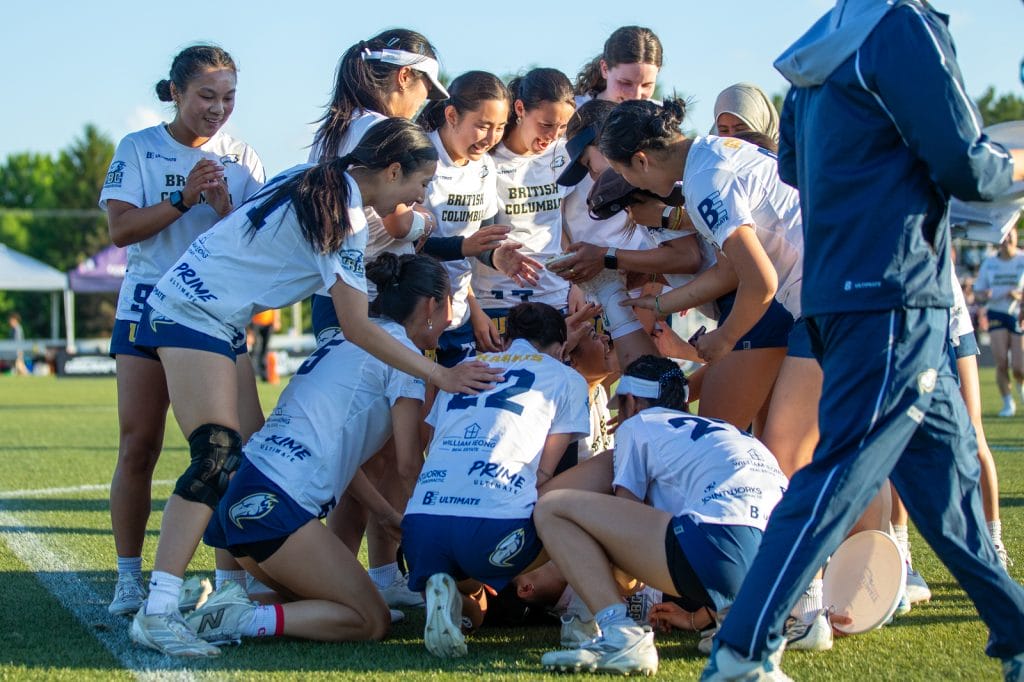
ROCKFORD, IL — Two legacy programs converged on the turf field at the gusty Mercyhealth Sportscore Complex for a riveting semifinal game. #3 UBC Thunderbirds continued their commanding run against the Nationals field, though #4 Stanford Superfly put up a convincing fight against the defending champions despite going down early in the round.
It was a game of momentum in the first half, peppered with execution errors from both sides. Perhaps inadvertently flustered by Superfly’s mistakes, UBC matched the frenzied energy that Stanford was playing, surpassing Fly’s 19-turnover half with their own 20 turns. The windy conditions—though certainly not at the level of fundamentally changing the game—were clearly affecting any throws that weren’t carefully handled, and contributed to the high-turnover rate.
A team known best for its zone defense, Stanford found the most success going with individual matchups against UBC. Coming down in person on the very first point, they pressured an early turnover, a huck look that was much too far for Thunderbirds standout Mika Kurahashi to chase down.
“We noticed that their pull play involved a lot of slash cuts coming under, and we thought that having a handler poach would be able to disrupt that initial motion,” said Shevaun Yip, a senior and veteran player for Superfly.
Anika Quon (2G/2A) drew the Kurahashi matchup in that person defense scheme. Having played on and off the past few seasons due to injury, Quon was a clear impact player for Superfly, quietly limiting Kurahashi’s impact on the field. While Kurahashi (3G/3A) was by no means taken out of the game, most of her contributions came when Stanford was playing zone.
The Thunderbirds looked their best when they reached their zone offense in flow state. Having perfected this particular strategy all of Friday in the windy conditions, they looked comfortable moving the disc with quick release points despite gusts in the stadium.
Playing in the Rockford wind was something captain Ella Bolan talked about going into the tournament, describing how the UBC coaches would simulate windy games by restricting the types of throws they could make.
Claire Weng echoed Bolan’s sentiments: “We don’t get much wind in the Northwest, so it definitely takes some time to get used to, but I think we got it in the end.”
Their third offensive point was a case in point. Ella Bolan (4G/1D) did a tremendous job of breaking through the cup and then immediately following the throw to the weak spot of the zone, allowing her poppers to continue the forward momentum to her without the stall count ever getting past three.
UBC has used this movement against a zone to great effect, able to score quickly and with few passes, despite the perception that playing against a zone requires patience, numerous passes, and long, “boring” points. Not so when watching the Thunderbirds, who are then able to get their offense off the field with minimal wear and run them fresh on defense.
Having jumped out to a 7-2 lead with a 5-0 run, the Thunderbirds looked firmly in control of the game. While many scoring opportunities came by way of careless Superfly errors, the UBC defense was particularly effective at shutting down the Stanford reset options, including the front-of-stack ace play, and forcing back-to-back punt looks.
Stanford was cooking up a run of their own, however. Able to disrupt UBC’s early flow with a handler poach that resembled their zone with a 1-2 wall in the backfield, a high throw to the sideline gave Superfly their first break chance to narrow the gap to 7-4. It ended up taking two more interceptions from Freya Spiekerkoetter (1G/1A/5D) that point to finally punch in the break.
“The goal of our cup is to force those deep shots, and I was able to make up the ground well despite initially being pulled into the wrong space,” reflected Spiekerkoetter.
Without any timeouts left, the Thunderbirds offense had to recover on their own. “We were saying that we just needed to go back to the basics, take a breath before we throw,” said Weng.
When they were able to mentally reset, UBC looked much more like their regular selves, closing out the first half 8-6 with a quick, clean offensive hold.
The mistakes continued in the second half for Stanford, but the Thunderbirds seemed to close the chapter on their previous jitters. The centering pass bounced out of Esther Filipek’s hands, and UBC immediately got on the board with a break with an upline from Kurahashi to Amelie Marshall for 9-6. Marshall (1G/3A) had been putting up big minutes for UBC on both sides of the disc, instrumental in both the earlier break run and recovering to maintain the lead.
When Superfly was able to hold more efficiently, it was because of their ability to hit their handlers in flow on the chisel pass or the seven cut. Sage McGinley-Smith (1G/5A/1D) was a force in the cutting lanes, especially capable of winning positioning close to the end zone and converting scoring opportunities.
Bolan—who made a phenomenal elevating grab upline to bring the score to 11-8—was hit hard from behind on a dangerous play from Stanford and went out for the rest of the match. The rest of the Thunderbirds rallied to go up one more break for 13-9, with a signature low step-out around flick to put the disc where only Bryelle Wong could get to it.
The Thunderbirds comfortably traded until game at 15-11 even without their center handler. Their final point was a straightforward sequence: forward movement all the way down the field, capped off by a high release backhand from Marshall to Kurahashi on the break side.
“The entire season we’ve just been working hard and we wanted to take it one step at a time,” said Weng. “We weren’t looking to the finals yet, we were just looking at the next game, and we did that and earned ourselves another game.”
Stanford’s commendable run in the bracket will provide valuable big-game experience for their younger players, carrying on the torch after Superfly graduate double-digit fifth years and seniors.
“There were so many games we played this season where we could have chosen to hang our heads and believe it was over, but we refused to, and we played every point like it was 0-0, game to one,” said Yip. “We played with love, trust, and confidence in ourselves and our teammates even when we’re down, and I’m so proud of my team.”
For UBC, this victory sends the Thunderbirds to a rematch of last year’s championship against Carleton Syzygy, where they’ll get a chance to go back-to-back and start a dynasty of their own.