Get to know the 20 teams competing for a D-I college title!
May 20, 2026 by Kiana Hu, Aidan Thomas and TJ Lee in Preview
Ultiworld’s coverage of the 2026 College Championships is presented by Spin Ultimate; all opinions are those of the author(s). Find out how Spin can get you, and your team, looking your best this season.
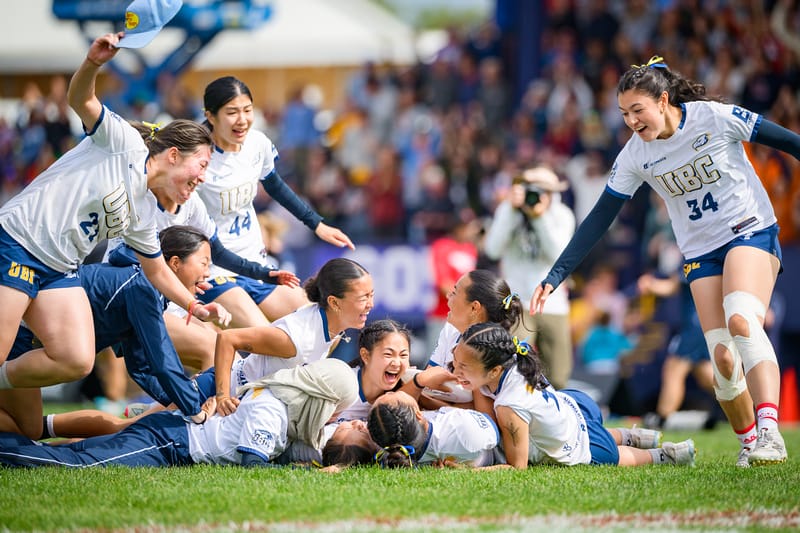
The D-I College Championships start on Friday! After a long regular season, only one team remains undefeated: #1 Carleton Syzygy. Will anyone, like last year’s champions UBC Thunderbirds, Southwest champions UC Santa Cruz, or last year’s semifinalists Washington Element, be able to topple the team from Northfield? With tournament newcomers, dark horses, pool play intrigue, and a few more championship contenders, the long weekend is sure to bring the thrills.
We’ve got you covered for all the exciting action this weekend, but before the first pull goes up, let’s get to know the teams who will be competing in Rockford. You can follow along on the D-I College Championships event page for updates and livestreams throughout the weekend!
Ultiworld Event Page — USAU Competition Schedule — Streaming Schedule
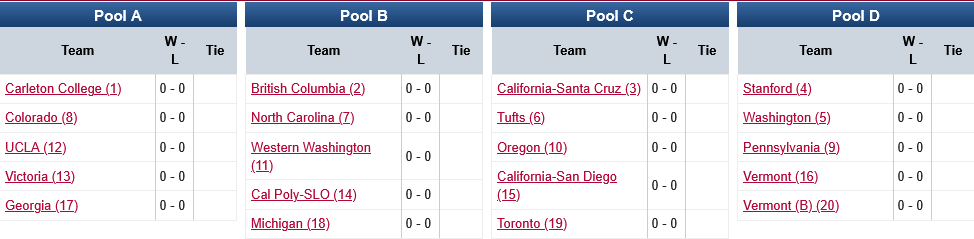
Pool A | Pool B | Pool C | Pool D
Pool A
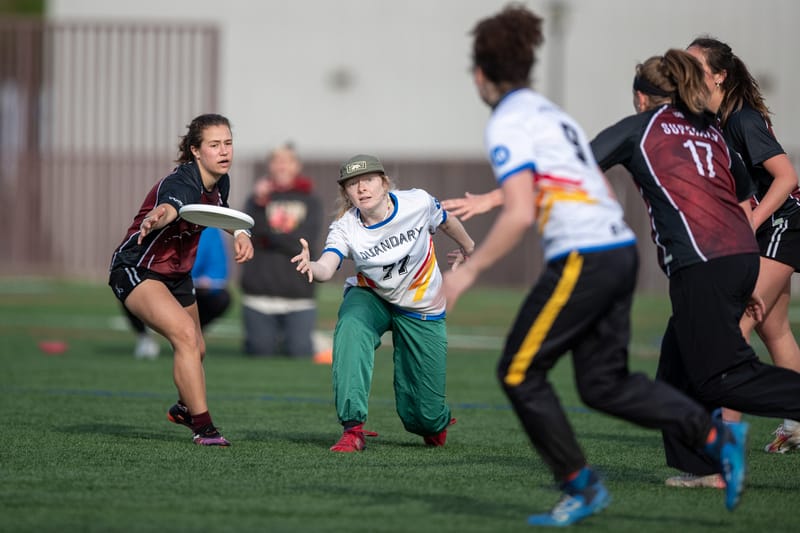
Teams: #1 Carleton Syzygy, #8 Colorado Quandary, #12 UCLA BLU, #13 Victoria Vikes, #20 Georgia Athena
Overall Strength: 💪💪💪
Star Power: ⭐⭐⭐⭐⭐
Upset Alert: 🚨🚨🚨

Carleton Eclipse
The undefeated no.1 seed Carleton Syzygy have had everyone on alert ever since they missed out on the title on universe last year and proceeded to load up their team with the most vaunted rookie class in recent memory. Reminiscent of the beginning of UNC’s dynasty, Syzygy have capitalized on their talent to go on a tear through the division, notching titles at all of the most competitive regular season tournaments.
“Going in as the one seed at Nationals is the best possible scenario. And yes, there comes some level of pressure of being expected to do well. That’s what we want. If we were to draw things up for ourselves, how could we be on a better track than we’re on currently?” said Logan Weiss, one of five coaches for Carleton.
Syzygy simply have too many angles of attack for opponents to contend with. Need a one-throw pull play? Chagall Gelfand will rip a stand-still flick to Kyliah McRoy, or maybe Chloe Hakimi will bend a throw around the stack to Mia Fischer. Want quick, slicing zone offense? Naomi Fina and Eliza Barton are some of the best small-ball movers out there. Patient endzone resets? Audrey Goedekke and Maddy Kallin are happy to play catch until the perfect window opens up.
Carleton has proven all season long that they can perform when the lights are brightest. Their closest results have come earlier in the bracket, 13-11 against Stanford at Pres Day and 15-14 over UBC in quarterfinals at Northwest Challenge. The key for Carleton will be consistency: every team will be on the hunt for their Achilles’ heel, but if they can continue to execute at the level they’ve shown all year, a championship will be the cherry on top for a historic season.

Colorado Quandary
Ever since COVID, Quandary have been a mainstay at the top of the division. Not only do they have the longest active Nationals qualifying streak at 11 years, they have been in contention for the final for several years in a row, including a 2024 showing where they started in a similar pool two-seed position and missed the championship game only because of a late five-point run from UNC.
The talent from the not-so-distant heydays is still there: Emma Williamson continues to hit all sorts of ridiculous throwing windows and Faye Burdick, when she’s been healthy, has been a two-way menace alongside Fiona Cashin. Losing Clil Phillips midway through the season may have hampered the trajectory of this Quandary team, but they’ve also had time to incorporate the rookie talents of Noah Fong, already a polished handler capable of heavy workloads, and grad student Chaily Derecskey, who has been a dominant force downfield.
Colorado has a convincing 4-0 track record against the teams in their pool, though their most recent encounter with Victoria at Northwest Challenge was a close 13-12 affair. What Quandary has their sights on the most, however, is an upset in their first pool play game against Carleton.
“We’re going in wanting to win, and we know that we have that capability. It’s really exciting that that is our first game of Nationals, and we’re hoping to set the tone,” explained captains Leyla Williams and Emma Smith.
The players, the systems, and the grit are all there for Quandary, who have had a quieter regular season than usual, but have a track record of making those pieces come together when it counts.
“Choosing challenge has been our overall theme…and being gritty and realizing that things aren’t always going to go to plan. Our preseason wasn’t what we were hoping, but we’re really locked in and set on this underdog mindset,” said Smith.
UCLA BLU

Virtually not on anyone’s radar at the beginning of the season, UCLA BLU have played their way into the top tier of an extremely crowded Southwest region and in the process proven their mettle as a legitimate Nationals contender.
Only four players return from their last Nationals appearance in 2023, where they just missed out on prequarters as the result of a three-way tie. By no means does that diminish their potential to go deep into the tournament, however. BLU has had plenty of experience matching up against top teams from the regular season, giving UCSC a run for their money in the Stanford Invite quarterfinals 12-10.
BLU captains Sabrina “Jedi” Belkin and Julia “Anarchy” Kamm talked about the excitement around going Nationals and looking forward to out-of-region competition: “We’ve played a lot of the Southwest teams a lot, but I think it’s fun, especially for rookies, to experience what it’s like to play a team you’ve never played before.”
Belkin, UCLA’s Callahan nominee and #13 in the Ultiworld Top 25 Player Rankings, has easily been the most impressive player at the heart of BLU’s success, but it would be a mistake to overlook the takeover ability of fellow handler Mya Mitchell and the cutting consistency of Kasey Parks and Zora Bael-Cyr. There’s a reason UCLA claimed a podium spot at Southwest Regionals, and the confidence they’ve built along the way will carry them far.
Victoria Vikes

Now in their fourth straight year of Nationals attendance — an impressive feat on its own coming out of a challenging Northwest field — the Vikes are looking to push their ceiling and play for the program’s second-ever bracket appearance.
Victoria boasts elite players that can go toe-to-toe with any other team in the division with the likes of Mari Nielsen and Ericka Edgell. But beyond the top, the Vikes have seen an influx of talented rookies and second-year players taking on bigger roles. Captains Bree Roussin and Lucy Robertson emphasized how this has contributed to the team’s confidence to play for more than in years past:
“This year, we’re especially excited because we have a really strong rookie class. So we’ve been able to use our depth a lot all season and win games with our whole team.”
Something the Vikes have had to balance with the team-wide playing approach is being able to tighten the screws in closer games, such as in their 13-12 universe loss against Colorado at Northwest Challenge. They’ll have a chance to avenge that loss in the second round of pool play, after first getting a chance to upset UCLA in the no.12 vs. 13 matchup.
“We have struggled a little bit with our first game of the day usually, so that’s something we’re thinking about for Nationals, adapting our warmup and trying to wake up earlier this week to adjust to the time change,” said Robertson.
The team has also emphasized their focus on spirited playing, which has been recognized by the spirit award in 2023 and 2025. If the Vikes can capitalize on their preparation and figure out the right balance of talent and depth, prequarters (and another spirit award) are more than attainable goal.
Georgia Athena

Another Nationals, another Georgia appearance, another danger lurking in the shadows at the bottom of the pool. Once again, Athena dispelled any questions about their being an elite college women’s team by going on a rampage through the Southeast division, including a talented Florida side, whom they took down 15-8 in the regional final.
Though the last time Athena made the bracket was back in the pre-COVID years, they have a penchant for making teams extremely uncomfortable in the late stages of pool play, either pulling off or coming extremely close to multiple upsets. Last year was no different: they took UCSB and Utah, the three and four seeds in their pool, to universe.
Athena captains Quincy Booth and Keely Baker talked about setting their sights high for a team that will be graduating a swath of seniors: “We’re hoping that this is the year that we break into the bracket and upset some teams.”
Georgia has a knack for extending the happy-to-be-here mentality to a happy-to-be-here-and-play-with-friends but-also-be-really-successful-in-the-process framing. There’s a distinct joy in watching the way they play with ease yet pace, executing on extremely impressive plays, thanks to the likes of Booth slinging to athletic receivers in Jemia Johnson and Sarah Lang.
Plus, we know they’ve all got that dog in them: “A lot of people might think that we’re a little annoying because we bark a lot, but really, we’re not barking at other people,” said Booth. “We’re just barking at ourselves. It’s a form of endearment.”
Pool B
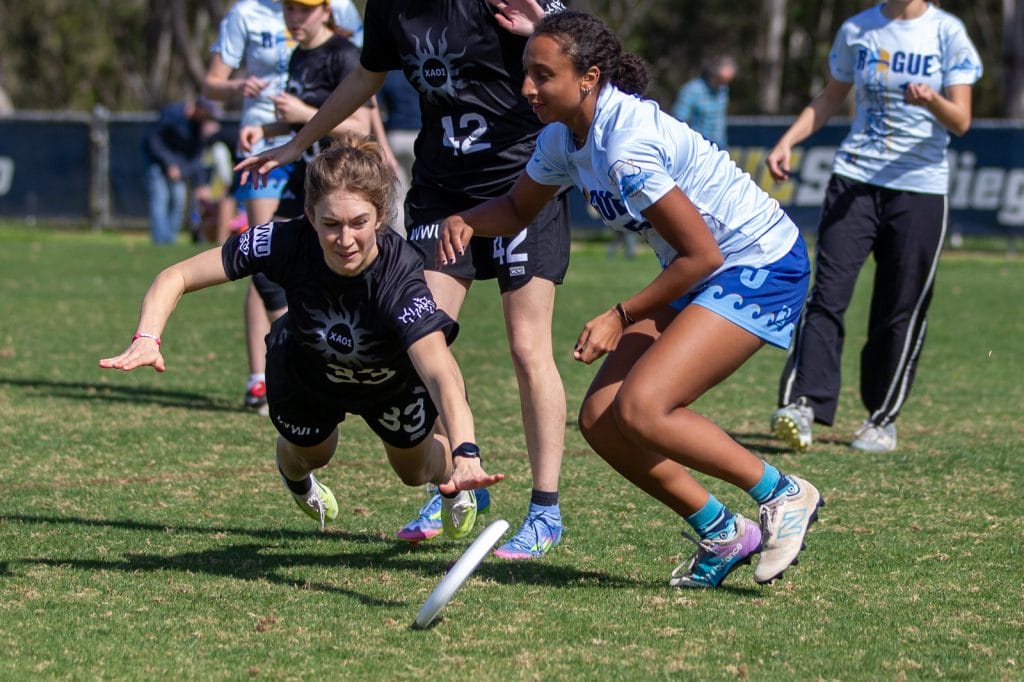
Teams: #3 UBC Thunderbirds, #6 North Carolina Pleiades, #11 Western Washington Chaos, #14 Cal Poly SLO, #17 Michigan Flywheel
Overall Strength: 💪💪💪
Star Power: ⭐⭐⭐⭐
Upset Alert: 🚨🚨🚨🚨
British Columbia Thunderbirds

The defending champions are on paper the team to beat, but Carleton’s undefeated record has certainly taken some of the attention off of this potent Thunderbirds squad. Nevertheless, UBC has been battle-tested this season, coming up just short in universe losses against UCSC, Stanford, Washington, and Carleton.
There is every reason to believe that the Thunderbirds can repeat, as they return much of their 2025 championship starters and once more gain a plethora of already proven rookies including Grace Liu, Arisa Gilbert, and Liza Ng. With such tight competition at the top, UBC have been intentional about their approach to the 2026 season.
“Last year, we relied a lot on open side, open side, open side, and winning our cuts with our speed and athleticism. Something we were trying to work on more this year was just having a little bit more of an ability to work the break side,” said captain Mika Kurahashi.
Facing a similar slate of teams in pool play from last year’s Nationals seems like a good omen for UBC, but their first game of the weekend will be a barn-burner of a rematch against UNC Pleiades. Instead of strategizing against specific matchups, however, Thunderbirds are focusing on the bigger tournament picture, anticipating the conditions in Rockford.
“Vancouver also doesn’t get that windy, so we’ve had a lot of practices where we simulate wind, which is hard to do when you don’t own a wind tunnel,” said captain Ella Bolan. “Our coach would tell us that ‘going upwind, you can’t throw passes more than 10 yards’.”
North Carolina Pleiades

For a team that missed the bracket by the thinnest possible margin in 2025, a year after a historic four-peat title run, Pleiades have the unenviable task of fulfilling a revenge tour and playing up to a behemoth legacy. On the flipside, they’ve more than proven that they can hang in the most intense games at Nationals, and a first-round pool play game against UBC might just be their best opportunity to come out firing.
Mostly untested until Northwest Challenge, UNC showed up against a strong field with universe point wins against Stanford and Tufts. This Pleiades team still has a lot of championship know-how, but perhaps more importantly, has brought in a wealth of rookies — including grad student Elle Christakos and U20 National Team player Caroleen Dewolf — enabling them to play to their own potential rather than chasing the shadows of victories past.
UNC captains Alli Reilly, Claudia Dare, and Martha Plaehn emphasized the magic of the Pleiades community: “We have a metaphor that being on Pleiades is like Christmas. Nationals is the most fun time of the entire year, and it feels exciting for the older players to be the parents on Christmas morning and see them have that joy and fall in love with the sport one more time.”
If Pleiades can flip the script on both universe point revenge matchups against UBC and SLO, they’ll put themselves in a prime position to make a deep run in the bracket. Otherwise, they’ll need to contend with a feisty Western Washington team late on Saturday.
Western Washington Chaos

It’s a triumphant return back to Nationals for Western Washington, who made their last appearance in 2024 and just missed out on a return trip in 2025. It’s tough sledding out in the Northwest region, but Chaos qualified comfortably without having to play the game-to-go.
Western Washington has had some variable results this season, with some of their best moments coming against regional rivals: back and forth results with Oregon, a 13-12 loss against Washington, and three separate wins against Victoria. Benefiting from the Seattle and Oregon youth scenes, they have found success around a talented core of Alexa Coca, Ollie Bunson, and Amaya Krutsinger.
Dealing with unexpected injuries all season has led to short-handed rosters for WWU, including ending Conferences with 11 players, but the upside was strengthened chemistry between those who were on the field and a sense that the team can take on challenges with aplomb.
Captains Lilli Werner and Amaya Shean-Jones talked about setting the bar high after a shortened 2025 season: “At the beginning of the season we had a team meeting to talk about what our main goals were, and the themes that came up were showing up for each other and putting in the work. Last year, we had a bit of a rougher season where we got really close. So this year, we really wanted to be able to finish out those games.”
A wildcard game for Chaos will be their pool play game against Cal Poly SLO, a team they have not played in recent memory despite being at a few of the same tournaments. Along with their first round against Michigan, these two out-of-region match-ups will be a litmus test for this Western Washington team looking to get back to the bracket.
Cal Poly SLO SLO Motion

The first-time-Nationals darlings have made it back to the big stage against somewhat difficult odds, thanks to the newly imposed USAU bid cap. Just looking at the postseason results, it isn’t much of a surprise that SLO Motion — despite not formally earning a bid due to the aforementioned cap — qualified in a comfortable fourth place out of the Southwest. Their shaky start to the season has been all but forgotten with a 15-6 Conferences title over a strong UCLA team.
Their 2025 roster that made a clutch prequarters appearance has turned over key contributors in Brooke Nishida, Poppy DeArmond-McLeod, and Margo Donahue, although they gain the latter of those as a coach. The Seattle youth pipeline has found its way down the West Coast to bolster this young team, most recently bringing ZsaZsa Gelfand into an immediate impact role as a do-it-all handler, as well as several other Seven Hills alumni.
SLO Motion have undoubtedly set a high ceiling for the team with their debut, but the knowledge that they have been able to exceed expectations in the past will be their greatest asset to make it out of pool play.
“Something that we said last year that we’ve brought into this year is ‘why not us?’ Coming from a team that had never been to Nationals before and having this mentality of needing to prove ourselves, we really want to keep that energy high,” said captain Nora Snyder.
Their return to Nationals is already a boon for the program, but everyone else should also be asking “why not SLO?” given their steady upwards trajectory across the season, with every indication that they will be a contender in Illinois.
Michigan Flywheel

Squeaking into Nationals out of a perennial one-bid Great Lakes region with yet another 12-10 victory over Notre Dame (how do they keep doing this?), Michigan find themselves in a very different position than in 2025.
Slotting in as a low seed in the pool this year, a prequarters reprise will be an uphill battle. Keep in mind, however, that this is a team that has found great success building around a cadre of elite players, as they did previously with Kat McGuire, Sophie Harvey, and Calliope Cutchins, pushing Oregon to the brink 13-11 and going blow-for-blow with a top-ranked Tufts team to 15-12 in the prequarters.
Flywheel return Cutchins, who remains a potent hybrid threat, as well as D-line stalwart Zaza Capriles. The not-so-secret to Michigan’s success is the strength of their large rookie class: handler duo Vivian Hakimi and Safya Biswal have immediately found their place with high touch, high playmaking capabilities, and grad student Caroline Bach has been a capable release valve downfield.
Knowing that Michigan has had to adapt to pretty significant new pieces, not much stock can be put into their regular season results, from which the best results were close games with teams like Oregon and Pennsylvania. But one thing is for sure — Flywheel know how to heat it up at Nationals and are one heck of a bottom seed team.
Pool C
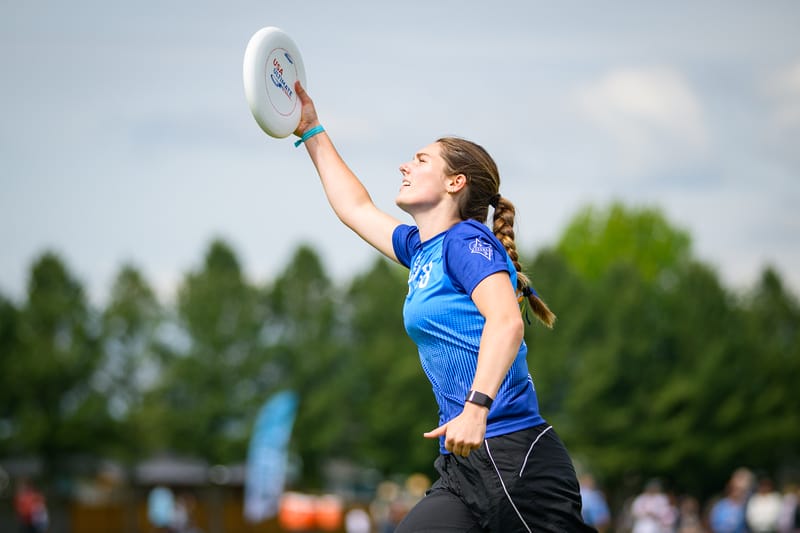
Teams: No.3 UC Santa Cruz Sol, #7 Tufts EWO, #10 Oregon Fugue, #15 UC San Diego Dragon Coalition, Toronto Torontula
Overall Strength: 💪💪💪
Star Power: ⭐⭐⭐⭐
Upset Alert: 🚨🚨🚨
UC Santa Cruz Sol

Santa Cruz enters Nationals on the heels of a dominant regular-season performance. Apart from a universe-point loss to Stanford at Conferences1, its only losses came against British Columbia at the Santa Barbara Invite2 and Carleton at Pres Day.
Rachel Chang was one of five players to receive a top-three vote or higher in this year’s Top 25 Players discussion, and rightfully so. Their throws open up the entire field and have propelled Sol into the elite tier of the division. On the other side of the disc, Kai Agueros will look to replicate their defensive prowess from last year, while Ruby Gholston has been making serious noise this season — particularly at the Stanford Invite, where the team cruised through pool and bracket play.
This regular season, Santa Cruz made at least the semifinals in every tournament attended. They started the campaign with a 13-3 rout over Oregon and have maintained that relentless level of competitiveness all year. Sol swept the early-season California tournaments, taking titles at both Stanford Open and Stanford Invite3, and have only given up double digits thrice so far in postseason play4.
Last year, Sol found themselves on the wrong side of some tight margins, knocking them out of bracket play before the weekend truly started. This year, if all goes to seed, Sol will face a powerhouse British Columbia team that has been saving its superstar, Mika Kurahashi, for this exact moment. Santa Cruz has already proven they can step up against a shorthanded Thunderbirds squad; now, they have to prove they can beat them at full strength.

Tufts EWO
Tufts EWO are entering Nationals with a dominant Queen City Tune Up performance and a respectable showing against the more competitive Northwest Challenge on their resume. Lia Schwartz finished just behind Rachel Chang in Top 25 Player voting this year to place 6th5, and will be the focal point of the EWO offense. While her flick is what stood out during QCTU, all of her throws are top tier. Annabel White, ranked 25th, has some of the surest hands in the nation. Kate Gearing and Mina Brown also earned votes this year, bolstering the top end of the roster.
Apart from a universe point win over Pennsylvania and an 11-9 over North Carolina, Tufts handled their first tournament with ease. A month later in California, they beat Colorado, Oregon, and Stanford — all on universe — before losing to Carleton in semifinals and North Carolina in consolation (also on universe). EWO have proven to be more than capable this year, but they will need to make sure they continue putting weaker teams away quickly so that they are fresh for their stronger opponents.
Perhaps the biggest advantage Tufts has is the schedule. They open up the weekend taking on bottom seed Toronto, before getting to watch Santa Cruz play San Diego and getting a third round to finish game planning for what is seeded to be the duel for the pool. Expect an incredible game this Friday at 3:00 PM CT.

Oregon Fugue
What an up and down season it has been for Fugue. A combination of illness and study abroad left Oregon at only partial strength for most of the year. The result? A top ten seed sitting below .500. While every loss has been at the hands of a fellow Nationals qualifier, the overall season has left much to be desired.
And yet, Oregon is in the dance, and has the full squad now. Trout Weybright may have just missed out on making the top 10 this year, but he is still one of the most explosive cutters in the nation. Syris Linkfield, Miko Magnant, and Acacia Hahn combine to give Weybright a very suitable support crew, and younger faces like Cece Seldera-Bahnson and U20 national teamer Lilly Hodges create a team with a lot of potential.
Still, even with the full roster, the postseason so far has shown their floor as much as their ceiling.. A 15-11 loss to Victoria at Conferences sent them to the third place bracket sooner than their seed had them scheduled, and while they were able to beat Western Washington on universe, Victoria once again got the better of them, 11-10. It would not be until Regionals where they started revealing their true potential, when they handled their pool with ease minus British Columbia, got back at Victoria with a 15-7 win in the second place bracket, and took down Western Washington again before losing to Washington 13-10. If Conferences Oregon wakes up in Rockford this Friday, expect an early elimination. Regionals Oregon, however? That is a team that could stun some favorites.

UC San Diego Dragon Coalition
Dragon Coalition may have to break seed if they want to make bracket play, but alongside a 13-9 win over Oregon at Santa Barbara, they have another similar flex to Fugue: each of their losses has been against someone who made Nationals. Sanam Rozycki-Shah and Mars Bau are the ones leading the charge for San Diego. The two combined for almost 30 goals last year, but more importantly both had single digit turnovers. That kind of possessiveness will be crucial in avoiding giving their opponents break opportunities. What really stands out for DCo is their incredible zone offense: Rozycki-Shah and Bau exploit gaps downfield, while Margot Nissen, Nicole Moran, and Sam Medina are all equally patient against the pressure.
As impressive as their regular season has been, it’s made even more so when looking at the Stanford Invite results. San Diego was keeping the game against Santa Cruz within one point until after halftime, when Sol pulled away to win 12-9. San Diego will have the chance to avenge that matchup this Friday morning, so expect a showdown to get the ball rolling.
After that and two bye rounds, San Diego will play Oregon. Once again, this opens the door for an upset, as legs should not be as big of an issue compared to regular tournaments. If San Diego can step up on Friday or early on Saturday, they get to take Toronto last, and potentially be in a position ready to qualify for the bracket.

Toronto Torontula
A team that came out of nowhere, Toronto TULA rolled through conference and regional tournaments, winning by at least three goals or more, save against NYU. NYU forced universe in pool play at Regionals, and while Columbia put up nine of their own, nobody was able to score double digits on them. The classic faux pas of “do nothing all regular season and wait until the postseason to play a USAU tournament” has once again sparked controversy amongst the Ultiworld Discord, but for now, Toronto is here and ready to go.
Starting with 11 players rostered for Conferences, they have since grown to 16 heading to Nationals. Vancouver Traffic’s Alicia Zhang and Zee He, alongside Jess Gao from Toronto 6ixers, all have elite club and international experience, and TULA are the defending Canadian University champions. The low numbers will be a question they have to answer, but with only two games on Friday and another pair of pool play games on Saturday, anything is possible6
Gearing up to play Tufts and Oregon on Friday, before having to take on Santa Cruz and San Diego, the real question for Toronto to answer is can this team actually compete or not. Their resume is solely against Metro East teams, so this pool will prove much more difficult than any American school they have faced all year. But with World Games player Brittney Dos Santos at the coaching helm, expect Toronto to stick it out as long as their short supply of legs allow.
Pool D
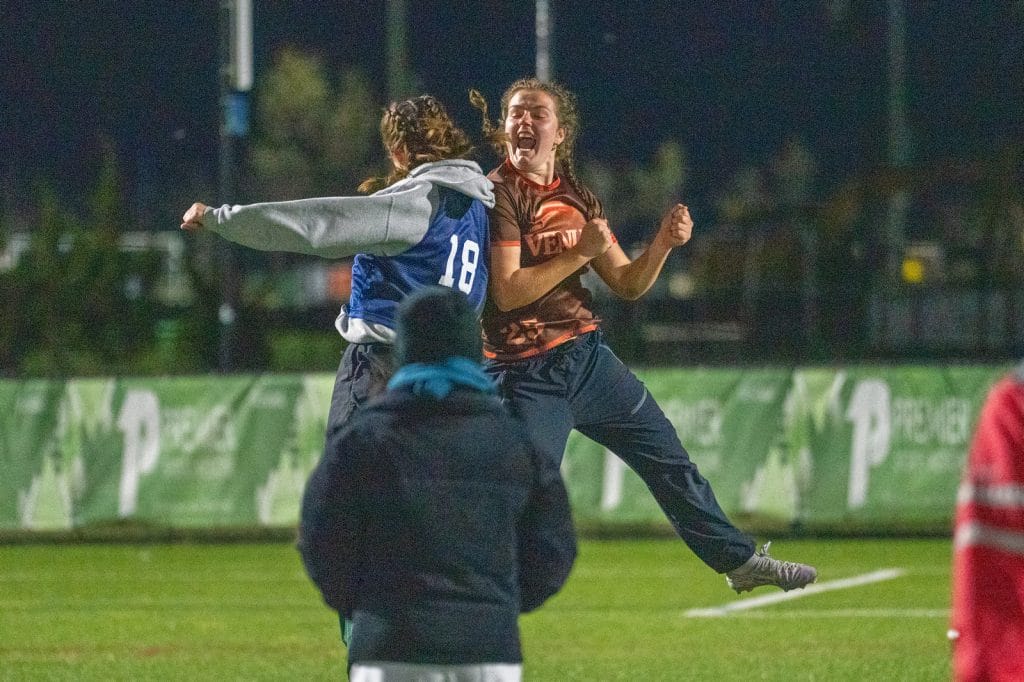
Teams: #4 Stanford Superfly, #5 Washington Element, #9 Pennsylvania Venus, #16 Vermont Ruckus, Vermont-B Bruckus
Overall Strength: 💪💪💪💪
Star Power: ⭐⭐⭐⭐
Upset Alert: 🚨🚨🚨🚨
Stanford Superfly

Stanford enters the tournament as one of the few teams who would probably be a big fan of a windier forecast. It would mean their zone defense could become an absolute force against the country’s best offenses. Additionally, if every offense is struggling, it may hide some of the inconsistencies that have plagued Superfly’s own offensive unit. Stanford has struggled a bit with careless turnovers throughout the season, but when Superfly’s O-line has clicked, it’s been fun to watch. Sage McGinley-Smith is a weapon in the cutting space for Stanford, and Superfly has a great handler in Callahan-nominee Esther Filipek to get her the disc, as well as second handler Harper Baer.
Filipek may be the biggest key for Stanford, as she will flash points of pure dominance, going every other and walking Superfly up the field. But she has also been quite prone to careless mistakes that largely just feel like bad decisions. If Filipek cleans up the mental miscues and can be a bit more of a consistent lynchpin, it will elevate Stanford to another level. McGinley-Smith will get plenty of defensive attention for good reason, but Stanford has a myriad of other players to get the disc to, including Amelia Hawkins, 2025 breakout player Shevaun Yip, and Anika Quon, a Nationals veteran that is just a year removed from a two-assist, three-goal performance in the 2024 semifinals.
Stanford has been improving over the season’s final two months with three double-game point losses at Northwest challenge and a couple defeats to #3 UC Santa Cruz as their primary blemishes. And Superfly love to peak at Nationals: they were quarterfinalists in 2025 as the no.10 seed and finalists in 2024 as the no.6 Seed seed, so they’ve certainly got their eyes on the semifinals and beyond in 2026.

Washington Element
At their best, Washington is absolutely electric to watch. While Carleton probably has the fastest cutting corps in the nation, Washington is up there, and these players will simply throw themselves any which way if it means coming down with a disc. Lauren Goddu, Rowan Lymp, and Savanna Tucker are an absolute nightmare to defend, and every defense will be stressed determining which of those players gets their third-best defender.
Washington’s struggle, at times, can be getting the disc to those playmakers. Lucy Tanner and Isabella Pharr can be dynamic in the backfield, and they marshal Element’s potent hucking attack, but struggles have arisen when zones and poachy sets force Element to grind possessions through their handlers. After pushing Carleton early in the NWC final, Washington faded as Szyzgzy forced Element to holster their deep looks and work the disc patiently in the backfield, and Washington struggled to do that consistently.
That being said, Element has been a team on the rise all season. Washington started their season with three losses at PDI and then took just one loss at each ensuing tournament, including Conferences and Regionals. With two of those remaining four losses to British Columbia – and the others to Carleton and Stanford – Element have established themselves as a top contender to reach semifinals. The progress can be seen in their rise from a 13-1 loss to Stanford’s zone early in the season to a much more respectable 11-7 defeat at Stanford Invite. If they’ve made similar strides in the past six weeks, this Element team could upset anyone on the right day.
Pennsylvania Venus
 Pennsylvania Venus
Venus will enter Pool D as an extremely dangerous no.9 seed with a lot of experience playing in the wind. In their final regular season tournament, Penn won the East Coast Invite with an undefeated performance. Their two bracket wins that Sunday were played in 30+ mile per hour wind.
Part of Penn’s proficiency in the wind is driven by their offensive starpower. Their engine is Grace Maroon, a do-it-all handler who finished third in the Ultiworld Top 25 player rankings this year. Maroon is joined by Callahan-nominee Poppy Wagner, Abigail Smith, and Duke transfer Sydney Neal to form a core four that can really power through windy conditions and dominate zone defense looks.
We know Maroon can be a star on this stage; she had 23 assists at Nationals last year. Wagner was another major contributor, Smith has continued to improve, and Neal’s arrival has been a huge bonus for Venus. Some questions that will arise is their lack of experience against Nationals teams – they’re just 3-2 against opponents that cracked the Memorial Day weekend field – and the depth beyond that quartet of top contributors. Certainly, more names will make themselves known in Rockford, but Penn will likely go as far as Maroon’s dynamic abilities take them. With extra rest between games at Nationals, Penn may be able to load up their lines quite frequently and challenge everyone in this pool, but Venus will become a lot more dangerous if they see some contributors break out, beyond Maroon, Wagner, Smith and Neal.

Vermont Ruckus
Ruckus have been ravaged by injuries all year and backed their way into a third bid for New England. There were legitimate questions about whether Vermont could defend their bid, but Ruckus put together a very strong weekend at New England Regionals, going 4-2 with two close losses to Tufts.
Their star Caroline Stone missed this season with injury, and Ruckus also suffered from the absences of their star junior trio in Annie Pozzy, Tatum Cubrilovic, and Ella Monaghan at different times. When playing, Monaghan has been far and away Vermont’s best player. Handlers Katie Stack, Rita Narbonne, and Meribel Collin have all developed into highly capable distributors in the space created by those absences. If they prove to be consistent, and Pozzy, Cubrilovic and Monaghan’s health holds up, Vermont is an absolutely devastating draw for the rest of Pool D. If Ruckus’ Regionals performance was indicative of their Nationals potential, they could absolutely be one of the tournament’s biggest spoilers.
They’re a 2025 semifinalist and the preseason #8 team, and they are getting healthy(-ish) with a host of talented contributors that have seen pivotal development this year. Not sure you’ll find many no.16 seeds as dangerous as Ruckus could be in 2026.
 Vermont B Bruckus
 Vermont B Bruckus
The best story in College Championships’ history, bar none. Vermont B Bruckus lurked as the No.5 seed at New England Regionals, but no one (including yours truly, who wrote the New England Regionals preview) really gave credence to Bruckus as a darkhorse to steal a bid.
Through a combination of outstanding play and a draw that required them to play just one of the region’s top three teams, Bruckus emerged with New England’s third spot at Nationals. While a win will be hard to come by against probably the deepest pool in the tournament, which includes a battle with their own A-team, Bruckus are playing with nothing but house money at this point, and every play, score, and break should be celebrated with title-winning energy.
Captains Allie Kingsley and Kalei Foley-Rutherfurd (who missed Regionals with an ankle injury) lead this squad, but keep an eye on contributions from plenty of other names on a roster that featured 14 rookies at the start of the season. Emma Buckley should get her moment to showcase her hucks and ability with the disc in Rockford. Lila Findlay had a ridiculous diving catch off of a deflection in the game-to-go versus Brown, and Ash Carreiro, Geneva Grube, Sadie Sarles, Aurelia Kornheisers, and Anaya Center were among a deep list of contributors who produced big moments for Bruckus in their history-making victory. Unlike what most might expect from a developmental program, there’s a surprising amount of youth experience across the roster. Bruckus’ appearance at Rockford will be about so much more than results, and fantastic storylines should abound from whichever fields Bruckus is playing on.
a team it is 5-1 against this year ↩
another team it has at least one win against ↩
Really need Stanford to hold a third tournament in the regular season so we can have a Stanford triple crown ↩
all to No.4-ranked Stanford ↩
3.01 points to be exact ↩
what? You thought the D-III kid was gonna hate on a team that was gonna regularly crossover their stars? ↩