There's always a lot to unravel from early season tournaments. We're digging past the topline stories to see what we can glean from the first TCT event of the year!
June 30, 2026 by Edward Stephens in Preview, Video
Ultiworld’s coverage of the 2026 club ultimate season is presented by Spin Ultimate; all opinions are those of the author(s). Find out how Spin can get you, and your team, looking your best this season.
Early season ultimate can be a grab bag. The games at Pro-Elite Challenge East counted, and the players on the field were pushing to win, but incomplete rosters, set experimentation, and line calling mindsets lodged somewhere between data gathering and chemistry building (and all of this uneven between the different teams) mean that a strict interpretation of results can only take us so far. So while we of course acknowledge the winners (and the entirely New York/Boston tilt of the PEC East championship axis):
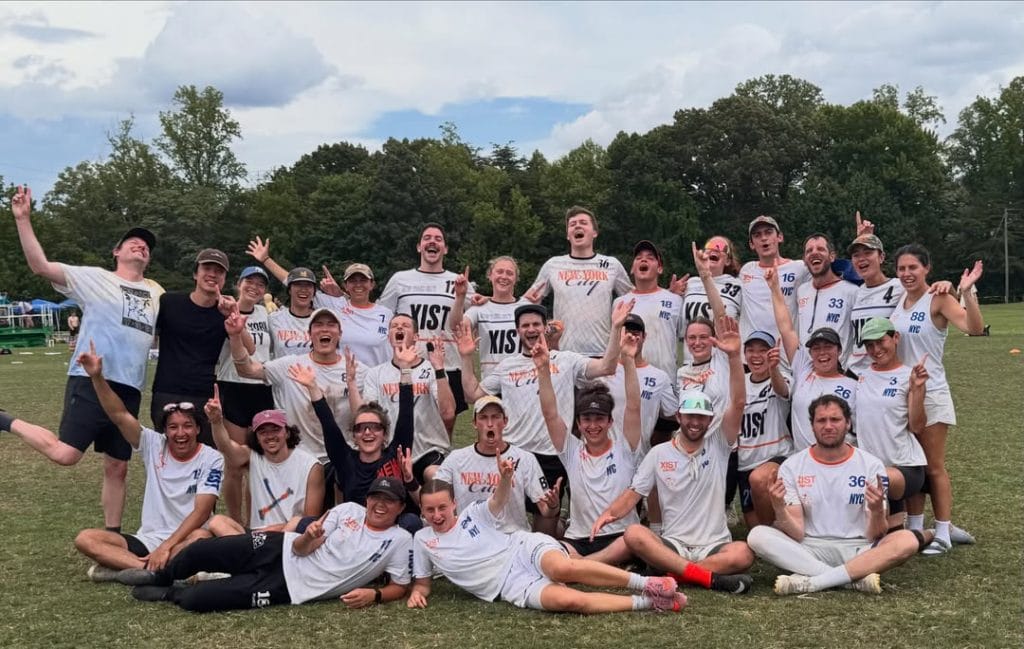
- New York XIST by a tidy 15-11 margin over Northeast rivals Boston Slow in mixed;
- Boston DiG with an equally decisive 14-10 takedown of New York PoNY in the men’s final; and
- Boston Brute Squad posting a clean sheet in match play, including a come-from-behind 12-10 win over New York BENT to stand as de facto champs of the women’s division;
it behooves us to dig a little deeper. Here are some of the key takeaways beyond the scorelines.
Mixed Division
The XIST Revenge Tour
Some readers may be old enough to remember Sadie Jezierski’s torrid Revenge Tour™ during the 2019 college season. A refresher: then part of Ohio State Fever and one of the consensus top players in college, Jezierski did not so much as get invited to the Team USA U24 tryouts heading into her senior season. So she went scorched earth, laying waste to the entire division for the entire season, driving Fever to semis at Nationals, and (eventually) getting the make-up call from the Team USA coaches as a late add to the roster. You see the pattern? Snub → Furor → Glory.
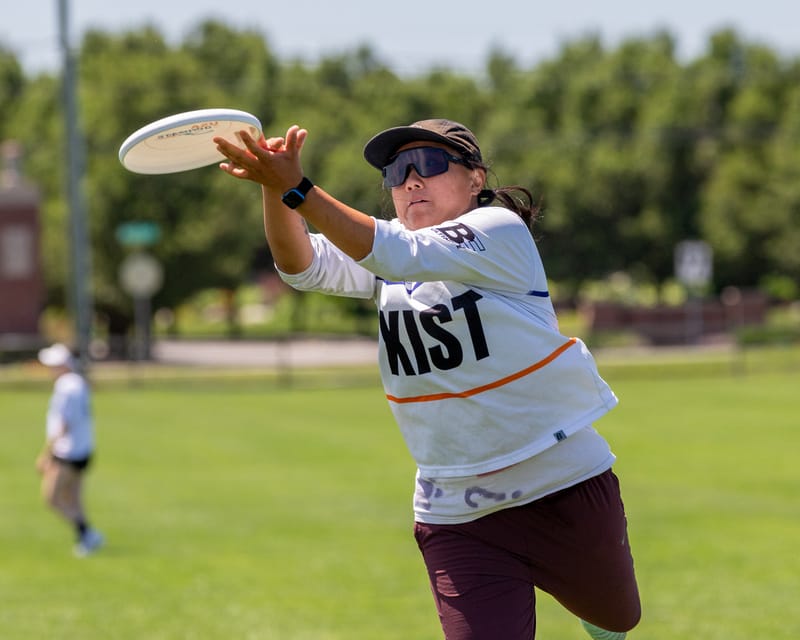
That may be what we’re seeing with the 2026 iteration of XIST. Losing a championship game isn’t the same as a “snub,” but you can bet they feel like they missed an opportunity, and based on PEC East it struck a match. Not only did XIST comfortably take down a more-than-solid Boston Slow in the final, they also soared past two-time reigning champs Ann Arbor Hybrid in quarters (and dispatched a very hungry Austin Disco Club in between). This is a team on a mission.
It’s no coincidence that their clear leader on the field this weekend was none other than the original Revenge Tourist (and 2025 Offensive Player of the Year) Jezierski. She was perhaps even more dangerous this weekend than during her incandescent run at 2025 Nationals, tossing off boutique throws from her endless quiver and sprinkling in two-handed back line layout goals to boot. Imports Theresa Yu and Ben Katz were stellar in their XIST debuts; so were Axel Agami Contreras, Abby Cheng, Jolie Krebs, and Oliver Chartock.
It’s true that nothing gets decided at PEC East, but XIST may have just established themselves as the divisional favorites.
Mixed Royals and Usurpers
Even counting XIST, there was a bit of a flattening in the mixed division as a few different squads made cases to creep into the “could-they-take-down-Hybrid-in-October-?” conversation. Tournament finalists Slow are first in the conversation after XIST. Their defense was outstanding, only reliably beat by the aforementioned Jezierski heroics. And Yuge Xiao, Peter Prial, and Liv Hampton moved the disc with ease. As with so many teams across all divisions, execution errors stood in the way of real progress, but the talent and system fundamentals for a semis team at Nationals (which they haven’t been since the year after their 2016 championship) are in place.
Falling a little behind preseason hype and well out of reach in terms of historical track record, Disco Club may nevertheless have the better argument as the second-best team at PEC East. Reese Bowman and Madi Cannon were their usual electric selves at the head of a team that came out roaring from top to bottom. Dare we say they can run with XIST, Slow, Hybrid, Fort Collins shame., Minneapolis Drag’n Thrust, and anyone else with championship ambitions? Maybe… but this wouldn’t be the first year that Disco Club have proved themselves dragons of June, July, and August. In that past, that fierce posturing has withered in October. The question we ask of them (and that they likely ask of themselves) is whether they can continue to build deep into the autumn.
And what of our two-time defending champions, Hybrid? The late fade against XIST in quarters was lamentable more than worrying given that the video evidence suggested they are in plenty good shape. Handlers Jonathan Mast and (transfer) Jack Shanahan anchored the backfield with poise; 2025 Player of the Year Rachel Mast continues to play at a world-beating level; Dalton Smith is every opponent’s post-turnover nightmare; the rest of the roster looked sharp as well. They’ll take a knock in the power rankings, but power rankings are made up. Hybrid are still the odds-on favorites (although perhaps no longer overwhelmingly so) for WUCC and Club Nationals.
Men’s Division

The Men’s Title Field Is Deep
While one hesitates to draw conclusions in mixed out of prudence, at least there are conclusions to draw. We have no such luxury in the men’s division: the lacunae in teams’ rosters were bigger and less defined, and the results approached incomprehensibility. However, DiG’s win does appear to be proof of concept for a potential championship run. In the first place, they played the cleanest ultimate on Sunday. Minimizing mistakes is one of the key qualities of title-level ultimate – and considering we emphatically did not see DiG excel in that area as they exited last season in prequarters, it’s encouraging to see them in form now, right at the start. Second, the performances from Tobe Decraene, Simon Carapella, Peter Boerth, Albert Yuan, Calvin Stoughton, and newcomer Quentin Bonnaud indicate that all of them are poised to have a season at (or at minimum very nearly at) their potential. Lastly, there’s a strong argument to be made that without bigs Orion Cable, Jeff Babbitt, and Turner Allen, handler Ned Dick, or rumored 2026 star transfer Thomas Edmonds with them in North Carolina, they were the second-least complete team in the field.
So we hereby formally add DiG to the list of legitimate 2026 contenders. The trouble for them is that we aren’t subtracting anyone from the list. Setting aside 2025 champs San Francisco Revolver and 2024 champs Portland Rhino Slam! since they haven’t taken the field yet this season, there remain the twin problems of New York PoNY and Chicago Machine, both of whom are on track despite losses to DiG. PoNY’s sets were solid, their personnel were often exceptional, and their roster looks like it will rival Revolver’s for deepest in the division. Calvin Brown (injured most of 2025) and Jimmy Mickle (not great in 2025) both played well, no doubt a welcome signal for a team who saw their handler core decimated a year ago. That allowed plenty of movement downfield through John Randolph, Chris Kocher, and Anders Juengst to set up a heap of tidy finishes from the likes of Ben Jagt, Marques Brownlee, and Jacob Cowan. The D-line as a unit did not impress quite as much, but Vinay Valsaraj’s matchup coverage and Sam Little’s offense after the turn were both brilliant. The only question hanging over the team heading forward is how they will manage rotations once Ben Dameron, Cam Wariner, and Declan Miller join the fray: all of them will have to get minutes, but at whose expense?
Machine finished the weekend fourth after giving away the semifinal to DiG near the end of the game, but that result hardly tarnishes their bona fides. Just as with the last two seasons, they play the big lane cutting game as well as, or better than, anyone in the division. Paul Arters, Nate Goff, and Daan De Marrée remain essential pieces in this regard. Elliot Hawkins and Nate Astrom, playing in place of departed 2025 standout Sofiène Bontemps and not-yet-arrived Sam McGuckin, only exacerbated the problem for the opposing defenses. The Machine O-line seems like they will be limited more by their own errors (which came into play in the lost semi) than they will by anyone’s attempts to slow them down. The defense, which adds a pair of influential block-getters in Zeke Thoreson and James Hill alongside Will Wettengel, also seems like it will take a (small) step forward in 2026.
Which is to say: Game on.
Ring and Sub: Poised for an Upset
If you are looking for teams who can crack the fearsome foursome who have bogarted the semis spots in the men’s division the last four years, PEC East offered some intriguing options in the form of Raleigh Ring of Fire and Minneapolis Sub Zero. Ring benefit from a deep defense (Tanner Roberts, Jake Thorne, and Cooper Williams were some of the weekend’s standouts) and a pair of transformative O-line additions: returner Liam Searles-Bohs (2022 D-I Player of the Year) and debuting Tobias Brooks (2026 D-I Player of the Year). Their play smoothed the game for Matt Gouchoe-Hanas, Josh Singleton, Dylan Hawkins, and Matt Barcellos. More importantly, Ring still have some dry powder, as 2025 All-Club selection Jacob Fairfax, as well as Christian Belus and Trevor Lynch, have yet to take the field for them in 2026.
Sub are not so much transformed as improved in the same direction. They continue to play well against the top teams – although late giveaways in a universe point loss to Machine in pool play must be frustrating, reminiscent of their games against both Machine and Rhino at 2025 Nationals. It’s notable that they adjusted some of their lines, possibly as an experiment, possibly in order to give more touches to new players: a pair of 2025 O-line stars either played out of position (Will Brandt) or on the D-line (Paul Krenik). This allowed for a lot of movement through Ellis Newhouse (who played well but will not be with the team for the Series), Micah Davis, and Nate De Morgan. It’s an excellent attack, and it will be even better if (when?) Brandt and Krenik retake their places. The D-line, anchored again by Noah Hanson and Ryan duSaire, will get takeaways on every team in the country. Like with BENT, the only question is whether they can get over the mental hump necessary to play better than the division’s beasts in the biggest moments. So far in the last couple of years, they’ve come up just short of that mark.
Women’s Division
BENT Narrow the Gap
Across all three divisions at PEC East, only one team posted a clean sheet: Boston Brute Squad. Going 6-0 in match play while playing each of the second- through seventh-place finishing teams is an achievement. Doing it without star playmakers Liv Player, Kelly Hyland, Levke Walczak, and Mangie Forero is amazing. The new influx of Tufts players looked like championship pieces, and veterans from Angela Zhu on down to Grace Conerly are picking up right where they left off. Brute are a title threat once again.
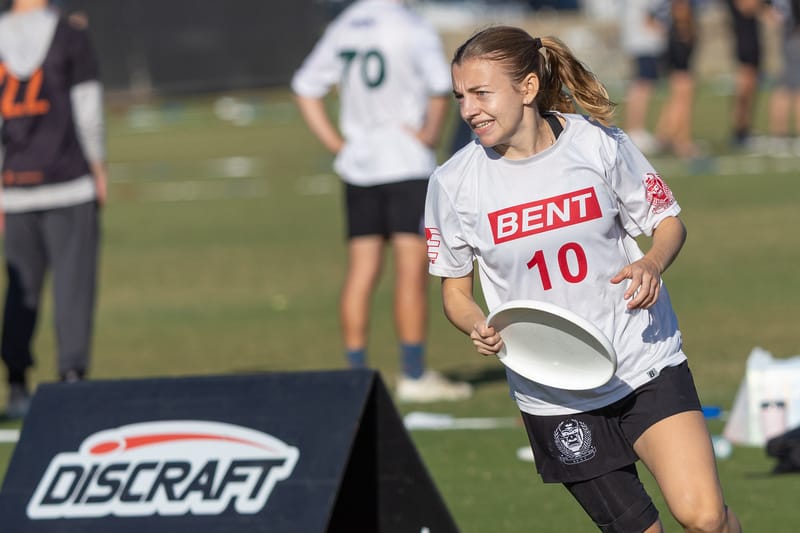
But that isn’t much of a story, is it? The more important development from the tournament is that New York BENT are inching closer and closer to that level. The last three years have been tremendous for New York as they ascended the division’s ranks. Could this be the season where they crack through to the semis level and give themselves a real (if slim) chance to compete for a championship?
The evidence on the field suggests that they can do it. Yina Cartagena is probably the division’s best pure handler, and she has one of the division’s best hybrids (Abby Hecko), one of the division’s best general purpose two-way stars (Amy Zhou), and two of the division’s best pure cutters (Ella Juengst and Sage McGinley-Smith) to work with on the O-line. BENT’s defense played tight coverage on all of their Brute Squad matchups, which means they will force turnovers against the elite teams. D-line offensive efficiency is still an open question, but it’s not a problem.
The biggest hurdle BENT face in their quest for greatness is one they couldn’t quite leap at PEC East: the mental challenge of digging in for wins against the top teams. They’ve been close before – see: their UP loss against Molly Brown in quarters at Nationals last year – but actually getting wins has been near impossible. Including the PEC East final, since 2023, the start of their big bloom, they are 1-15 against Scandal, Brute Squad, Molly Brown, and Fury. (The lone win was a 10-9 squeaker over Scandal at 2024 Pro Champs when both teams were missing players thanks to the concurrent World Ultimate Championships in Australia.) As great as they are, it will take a win or two against the established heavyweights before they can approach Nationals with true title confidence.
Philadelphia
Trivia question: When is the last time that Philly teams from all three divisions made Nationals in the same season? Check out the footnote here for an answer.1 Regardless of how well you did on the particulars of that question, you can imagine that it has been a while. But Philly ultimate has been on the upswing for the since the middle part of the decade. AMP managed a quick reset in 2025 after unthinkably missing Nationals the year before. The men’s club scene has been undergoing a renaissance after a much longer fallow period. It took ages for it to finally regroup after the slide of Patrol and the Nationals-irrelevant Phantom project. A youth-inflected club that first appeared under the name Ghostbusters before rebranding as Pacmen, though, has rekindled the city’s hopes with a quarterfinal appearance in 2016. Both AMP and Pacmen took steps forward at PEC East, leaving both in good shape not only to reach San Diego for the second consecutive season, but to perform closer to the top teams there than the bottom ones. Case in point: both of them took down the eventual tournament winners in pool play in their respective divisions.
The real change from 2025, though, is the performance of Flight, the women’s division team that has spent the last five years building a sustainable club structure in place to develop woman-matching talent in the area. It paid off with a trip to the Mid-Atlantic game-to-go last year, and 2026 feels like a Nationals year. Flight have plenty of homegrown young talent, and part of their rise is attributable to their continued development. But they’ve done some savvy recruiting: Emily Heyman from Parcha, Erica Collin from AMP, Gwen Evans from not playing club. And then there is new O-line center handler Quincy Booth, surprise addition formerly of various Georgia-based clubs. She has fallen into a dream situation at the helm of the Flight offense. Their only two losses on the weekend were to Brute Squad and BENT – and BENT only by a point – and they handed rivals Pittsburgh Parcha a three-goal loss to announce their intentions in the Mid-Atlantic. All told, it looks like San Diego will be getting a triple dose of Brotherly Love in October.
Checking in on the Phoenix Rebuild
Roster turnover from season to season is a fact of life. But Raleigh Phoenix are in the midst of a near-Ship of Theseus-level change in a miniscule timespan. Only five of the rostered players in 2026 have played more than one full season for the Triangle’s premier women’s club. Everyone else either is a rookie this season or was a rookie last season. A full Iliad of departees in that same period would be in poor taste here, so we’ll just content ourselves with musing that if you grouped them all together they could probably make semis.
We won’t say the same about the remainers and hatchling firebirds – no, this is definitely a down year by Phoenix standards. That said, they performed admirably well, proving once again the depth of the local area and the strength of their youth development. The 5-1 record on the weekend is somewhat misleading considering they didn’t face either BENT or Flight, but comfortable wins over Washington DC Grit, Atlanta Ozone, and the surprisingly competitive Knoxville Dolly For President indicate that they’re easily a Nationals team. More importantly, they gritted out a universe point victory over a strong Pittsburgh Parcha side at the end of the weekend. The kids are getting good in a hurry. Is it that far-fetched to think that “rebuild” mode might only last for a season?
Philadelphia AMP, Philadelphia Patrol, and Philadelphia Green Means Go all made Nationals in 2016. ↩